
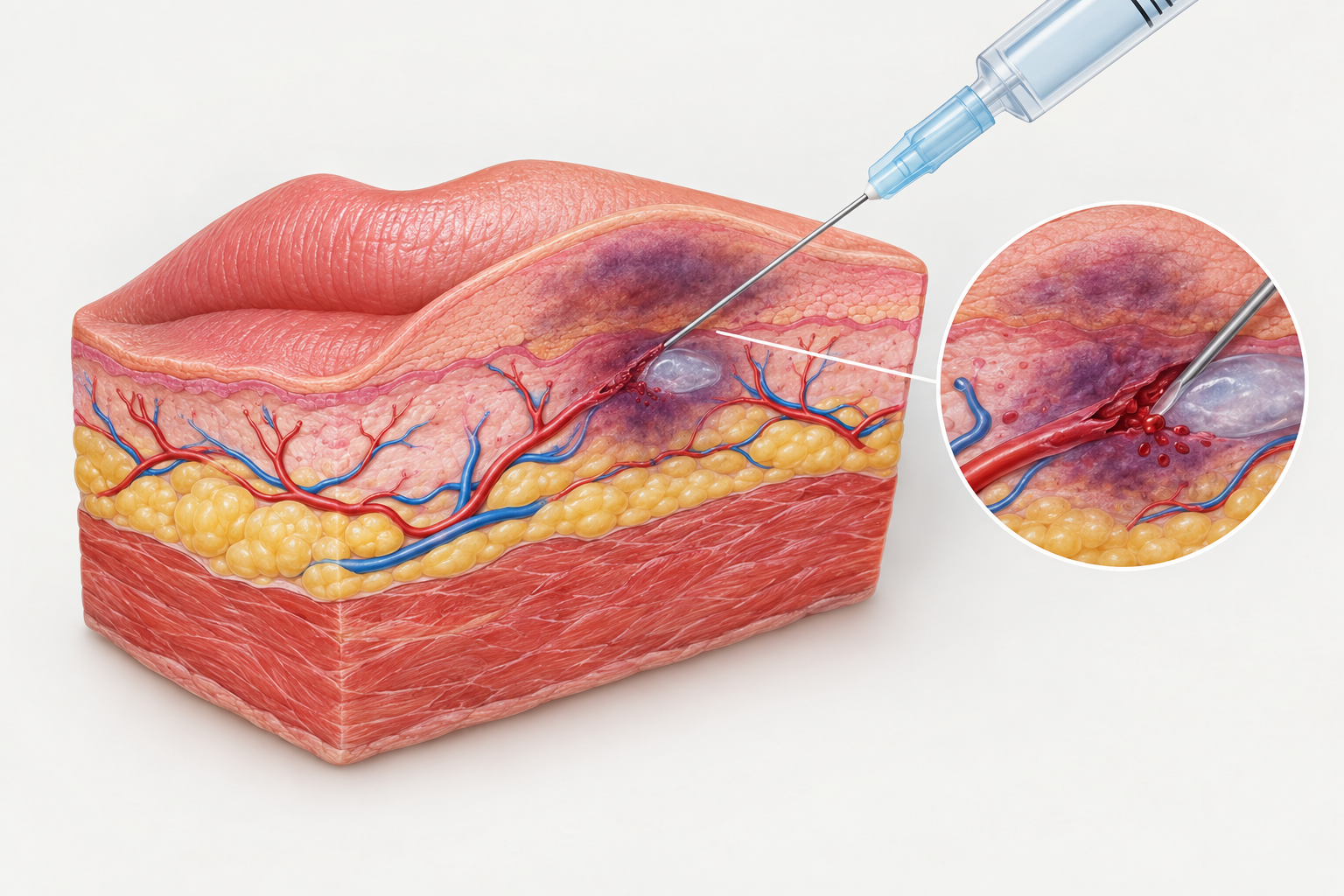

Bruising after lip filler is one of the most common concerns patients raise before booking a treatment. While it is a recognised side effect of any injection into the lip area, the severity varies considerably between individuals, and there are practical steps that can meaningfully reduce both the likelihood and the duration of bruising. Understanding why bruising happens, what influences your personal risk, and how to support recovery can help you plan your treatment with realistic expectations.
Key Takeaways
- Bruising after lip filler injections is common and usually resolves within five to ten days, though individual variation is significant.
- Certain medications, supplements, and lifestyle factors increase bruising risk and can often be adjusted before treatment with appropriate guidance.
- Injector technique, needle versus cannula choice, and the specific filler product used all influence how much bruising occurs.
- Post-treatment measures such as cold compresses, arnica, and avoiding heat and alcohol can support faster recovery.
- Persistent, worsening, or unusually painful bruising after lip filler should be assessed by a qualified practitioner promptly.
Why Lip Filler Injections Cause Bruising
Bruising occurs when small blood vessels beneath the skin are disrupted during an injection, allowing blood to leak into the surrounding tissue. The lips are a particularly vascular area, meaning they contain a dense network of blood vessels, which is one reason lip filler bruising tends to be more noticeable than bruising from injections in other facial areas. The discolouration that appears on the skin surface reflects blood that has tracked through the tissue and oxidised, producing the familiar purple, blue, or yellow tones seen during healing.
Not every injection disrupts a blood vessel, and many patients experience little or no visible bruising. However, because the exact position of small vessels varies between individuals and cannot always be predicted from the surface, some degree of bruising is considered a normal and expected outcome rather than a sign that something has gone wrong. The key distinction is between minor bruising that resolves predictably and bruising that is accompanied by significant pain, hardness, or skin colour changes that suggest a more serious vascular concern.
Factors That Influence Your Bruising Risk
Several factors affect how likely you are to bruise after lip filler treatment, and understanding them helps you make informed decisions about timing and preparation.
Blood-Thinning Medications and Supplements
Medications that reduce the blood's ability to clot increase bruising risk significantly. Prescribed anticoagulants such as warfarin, apixaban, and rivaroxaban, as well as antiplatelet drugs including aspirin and clopidogrel, fall into this category. If you take any of these for a medical condition, you should not stop them without consulting the prescribing doctor. Your aesthetic practitioner needs to know about all prescribed medications before treatment so that the risk can be assessed appropriately.
A number of over-the-counter supplements and herbal products also have blood-thinning properties. Fish oil, high-dose vitamin E, ginkgo biloba, garlic supplements, and St John's Wort are among those most commonly associated with increased bruising. Where these are taken for general wellness rather than a medical condition, many practitioners recommend pausing them for approximately seven to ten days before treatment, though you should confirm this with your practitioner based on your individual circumstances.
Non-Steroidal Anti-Inflammatory Drugs
Non-steroidal anti-inflammatory drugs (NSAIDs) such as ibuprofen and naproxen affect platelet function and can increase bruising when taken in the days before an injection. Paracetamol is generally considered a safer alternative for pain relief in the days leading up to lip filler treatment, though you should confirm this with your practitioner. Aspirin used for cardiovascular protection should not be stopped without medical advice.
Alcohol Consumption
Alcohol causes temporary vasodilation, meaning it widens blood vessels and reduces the blood's clotting efficiency. Drinking alcohol in the twenty-four to forty-eight hours before lip filler treatment is associated with increased bruising. Most practitioners advise avoiding alcohol for at least twenty-four hours before and after treatment.
Menstrual Cycle Timing
Some patients report that bruising is more pronounced when treatment coincides with menstruation, which is thought to relate to hormonal changes that affect vascular sensitivity and platelet function during this phase. While the evidence for this is largely observational rather than from controlled clinical studies, some practitioners and patients choose to schedule lip filler appointments in the first half of the menstrual cycle as a precautionary measure.
Individual Anatomy and Skin Characteristics
Patients with fair or thin skin tend to show bruising more visibly because the discolouration is less masked by melanin and the skin offers less optical diffusion. Older patients may bruise more readily due to changes in vessel wall integrity and reduced skin thickness. These factors cannot be changed, but they are useful to know when planning recovery time around social or professional commitments.
How Injector Technique Affects Bruising
The skill and approach of the practitioner performing the treatment has a direct influence on bruising outcomes. Experienced injectors develop an understanding of facial vascular anatomy and use techniques designed to minimise vessel disruption, though no technique eliminates the risk entirely.
Needle Versus Cannula
Lip filler can be delivered using a sharp needle or a blunt-tipped cannula. Sharp needles allow precise placement and are widely used for lip augmentation, but they carry a higher likelihood of puncturing small vessels. Blunt cannulas are designed to push vessels aside rather than pierce them, which can reduce bruising in some patients. However, cannulas are not universally preferred for lip work because they may offer less precision in certain areas of the lip, and the choice between the two approaches depends on the practitioner's assessment of the individual patient's anatomy and treatment goals. Neither method is risk-free.
Number of Injection Points
A greater number of injection points increases the statistical likelihood of encountering a blood vessel. Experienced practitioners aim to achieve the desired result with the fewest necessary entry points, which can help reduce bruising. The specific filler product chosen also plays a role, as products with different viscosities and cohesivity may require different injection techniques and volumes per point.
Aspiration and Vascular Awareness
Awareness of the lip's vascular anatomy, including the superior and inferior labial arteries and their branches, is an important component of safe lip filler technique. Practitioners trained in facial anatomy are better positioned to identify higher-risk injection zones and adjust their approach accordingly. This is one reason why choosing a qualified and experienced practitioner is relevant not only to the aesthetic result but also to minimising complications including bruising.
Preparing for Treatment to Reduce Bruising
There are several practical steps you can take in the days before your lip filler appointment that may help reduce bruising risk. These should always be discussed with your practitioner at consultation, as individual medical circumstances vary.
- Pause non-essential blood-thinning supplements such as fish oil, vitamin E, ginkgo biloba, and garlic supplements approximately seven to ten days before treatment, if your practitioner agrees this is appropriate for you.
- Avoid NSAIDs such as ibuprofen for several days before treatment unless they are prescribed for a medical condition.
- Avoid alcohol for at least twenty-four hours before your appointment.
- Stay well hydrated in the days leading up to treatment, as good hydration supports tissue health and may support recovery.
- Discuss your full medication list with your practitioner at consultation so that any relevant interactions or risks can be identified.
- Consider timing your appointment away from your menstrual period if you have previously noticed increased bruising during this phase.
Some practitioners recommend taking oral arnica montana tablets in the days before treatment as a preventive measure. Arnica is a herbal remedy with a long history of use for bruising, and while clinical evidence for its effectiveness is limited and mixed, it is generally considered low-risk when used as directed. Discuss this with your practitioner before starting any supplement.
Managing Bruising After Lip Filler Treatment
If bruising does develop after lip filler injections, several measures may help reduce its visibility and support faster resolution. The healing process follows a predictable sequence as the body reabsorbs the leaked blood, with colours typically progressing from dark purple or red through blue and green to yellow before fading completely.
Cold Compresses
Applying a cold compress or ice pack wrapped in a clean cloth to the treated area in the first twenty-four hours after treatment can help constrict blood vessels and limit the spread of bruising. Cold should be applied gently and briefly, typically for ten to fifteen minutes at a time, and should never be placed directly on the skin. Avoid applying pressure to the lips, as the filler needs time to settle in the tissue.
Arnica Gel or Cream
Topical arnica preparations are widely used after cosmetic injections to help reduce bruising and swelling. The evidence base for topical arnica is modest, with some small studies suggesting a benefit in reducing bruise duration and intensity, though larger controlled trials are limited. Many practitioners recommend it as a low-risk supportive measure. Apply gently to the bruised area, avoiding open skin or the mucosal surface of the lips.
Avoiding Heat and Exercise
Heat causes vasodilation and can worsen bruising by increasing blood flow to the area. In the first forty-eight hours after lip filler treatment, it is advisable to avoid hot baths, saunas, steam rooms, and vigorous exercise. Strenuous physical activity raises heart rate and blood pressure, which can exacerbate bruising and swelling in the treated area.
Avoiding Alcohol After Treatment
As with the pre-treatment period, alcohol should be avoided for at least twenty-four hours after lip filler injections. Alcohol's vasodilatory effect can increase swelling and prolong bruising during the early recovery phase.
Sleeping Position
Keeping the head slightly elevated during sleep in the first night or two after treatment may help reduce swelling and fluid accumulation around the lips. Sleeping face-down should be avoided as it can increase pressure on the treated area.
Camouflage Makeup
Once any open injection points have closed, which is usually within a few hours, colour-correcting concealer can be used to reduce the visible appearance of bruising. An orange or peach-toned corrector applied beneath a skin-toned concealer is effective at neutralising the purple and blue tones of a bruise. Most practitioners advise waiting at least four to six hours before applying makeup to the lip area, and some recommend waiting until the following day to reduce infection risk.
How Long Does Lip Filler Bruising Last?
Most lip filler bruising resolves within five to ten days. Minor bruising may fade within three to five days, while more significant bruising can take up to two weeks to clear completely. The timeline depends on the extent of the bruising, the individual's healing capacity, and whether supportive measures are used consistently. Swelling, which often accompanies bruising, typically peaks within the first twenty-four to forty-eight hours and then gradually subsides over the following week.
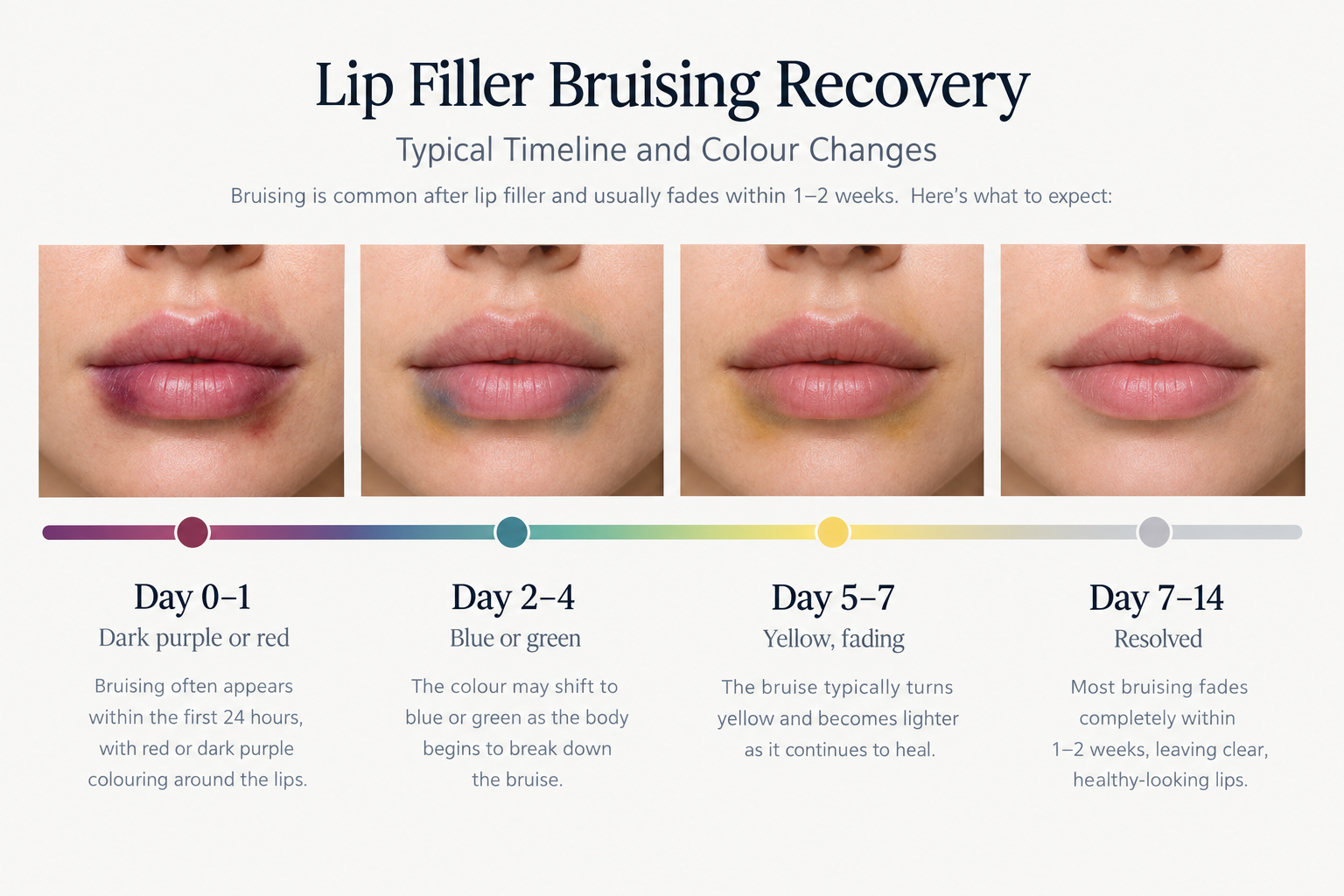
It is worth planning your lip filler appointment with this recovery window in mind. If you have a significant event such as a wedding, photoshoot, or important professional engagement, scheduling treatment at least two weeks beforehand provides a reasonable buffer for both bruising and swelling to resolve and for the filler to settle into its final position.
When to Seek Medical Advice After Lip Filler
Most bruising after lip filler is minor and resolves without intervention. However, certain signs warrant prompt assessment by a qualified practitioner. Vascular occlusion, which occurs when filler inadvertently compresses or enters a blood vessel and restricts blood flow, is a rare but serious complication that requires immediate treatment. The warning signs of vascular occlusion are distinct from ordinary bruising and include skin that turns white or pale immediately after injection, followed by a dusky blue or mottled discolouration, significant pain that is disproportionate to the procedure, and skin that feels cold or hard in the affected area.
Ordinary bruising does not cause these signs. It appears gradually over hours, is not associated with severe pain, and does not cause the skin to blanch or turn mottled. If you experience any of the warning signs described above after lip filler treatment, contact your practitioner or seek urgent medical attention without delay. Early intervention is critical for managing vascular complications effectively.
You should also seek advice if bruising is accompanied by signs of infection such as increasing redness, warmth, swelling beyond the first few days, pus, or fever, or if a firm lump develops in the treated area that does not resolve within a few weeks.
Alternatives and Complementary Approaches
For patients who are particularly concerned about bruising, it is worth discussing whether any modifications to the standard treatment approach might be appropriate. Some practitioners offer a staged approach, treating the lips in smaller volumes across two appointments rather than one, which may reduce the extent of tissue disruption at each session. This approach also allows the patient to assess their response to the filler before committing to a larger volume.
Patients who bruise very easily due to medical conditions or necessary medications may find that the recovery period is longer and more visible than average. In these cases, a thorough pre-treatment discussion about realistic expectations, timing, and camouflage options is particularly important. There is no lip augmentation technique that is entirely free from bruising risk, including non-injectable options such as lip flip treatments using botulinum toxin, which also carry a small bruising risk at injection sites though typically less than dermal filler.
Frequently Asked Questions
Is bruising after lip filler normal?
Yes, bruising is a recognised and common side effect of lip filler injections. The lips are a highly vascular area, and some disruption to small blood vessels during injection is expected. Not everyone bruises visibly, but it is considered a normal outcome rather than a sign of error when it occurs without other concerning symptoms.
How can I hide lip filler bruising?
Once injection points have closed, colour-correcting concealer with an orange or peach tone can neutralise the purple and blue discolouration of a bruise before applying a skin-toned concealer on top. Most practitioners advise waiting at least four to six hours after treatment before applying makeup to reduce infection risk.
Does arnica actually help with bruising after lip filler?
Arnica, both oral and topical, is widely used after cosmetic injections and is generally considered low-risk. The clinical evidence for its effectiveness is limited and the studies available are mostly small, but some patients and practitioners report a benefit. It is unlikely to cause harm when used as directed and may be worth discussing with your practitioner as a supportive measure.
Can I exercise after lip filler?
Vigorous exercise should be avoided for at least twenty-four to forty-eight hours after lip filler treatment. Increased heart rate and blood pressure from exercise can worsen bruising and swelling in the treated area. Light activity such as gentle walking is generally acceptable, but high-intensity workouts, hot yoga, and similar activities should be postponed.
Will a cannula reduce my bruising risk compared to a needle?
Blunt cannulas are designed to displace rather than pierce blood vessels and may reduce bruising in some patients. However, cannulas are not universally used for lip filler because they offer different handling characteristics compared to sharp needles, and the choice depends on the practitioner's assessment of your anatomy and treatment goals. Neither approach eliminates bruising risk entirely.
How long should I wait before a special event after lip filler?
A minimum of two weeks before a significant event is a commonly recommended guideline. This allows time for bruising and swelling to resolve and for the filler to settle into its final position. Some patients recover more quickly, but planning conservatively reduces the risk of visible bruising at an important occasion.
What is the difference between normal bruising and a vascular complication?
Normal bruising appears gradually over hours, produces purple, blue, or yellow discolouration, and resolves over five to ten days without severe pain. A vascular complication typically causes immediate skin blanching or a mottled, dusky discolouration, significant pain, and skin that may feel cold or hard. Vascular complications require urgent assessment and should not be managed at home. If you are uncertain, contact your practitioner promptly.
Planning Your Lip Filler Treatment with Bruising in Mind
Lip filler bruising is a manageable side effect rather than an unavoidable obstacle. By understanding the factors that influence your individual risk, preparing appropriately in the days before treatment, choosing a qualified and experienced practitioner, and following evidence-informed aftercare, most patients can minimise both the extent and the duration of bruising. The steps involved are straightforward: review your medications and supplements with your practitioner, avoid alcohol and NSAIDs in the days before and after treatment, use cold compresses and arnica as directed, and plan your appointment timing with a realistic recovery window in mind.
If you are concerned about bruising risk due to your medical history, medications, or previous experience with injections, raise this at your consultation. A practitioner who takes a thorough medical history and discusses your individual circumstances is better placed to tailor the treatment approach and set realistic expectations. Lip filler results, when achieved with appropriate technique and aftercare, can be well worth the short recovery period for most suitable patients.
