

Human noses come in a remarkable range of shapes, and most people find it surprisingly difficult to describe their own. Whether you are researching rhinoplasty, exploring makeup contouring techniques, or simply curious about facial anatomy, understanding the main nose types and how to identify your nose shape is a practical starting point. This guide covers the key structural features that define each type, a straightforward three-step identification method, the science behind nasal variation, and what different nose shapes may mean in a clinical or aesthetic context.
Key Takeaways
- Most nose shapes are defined by three structural features: the nasal bridge profile, the tip direction and projection, and the nostril width.
- There are roughly 12–14 named nose types, but many people have a combination nose that blends features from more than one category.
- Nose shape is primarily determined by genetics and ancestral climate adaptation, not by a single defining trait.
- Identifying your nose type accurately requires a side-profile photograph and a front-on photograph taken in neutral lighting — not a mirror selfie.
- A clinical consultation with a qualified practitioner is the appropriate next step if you are considering rhinoplasty or non-surgical nose reshaping.
The Anatomy Behind Nose Shape
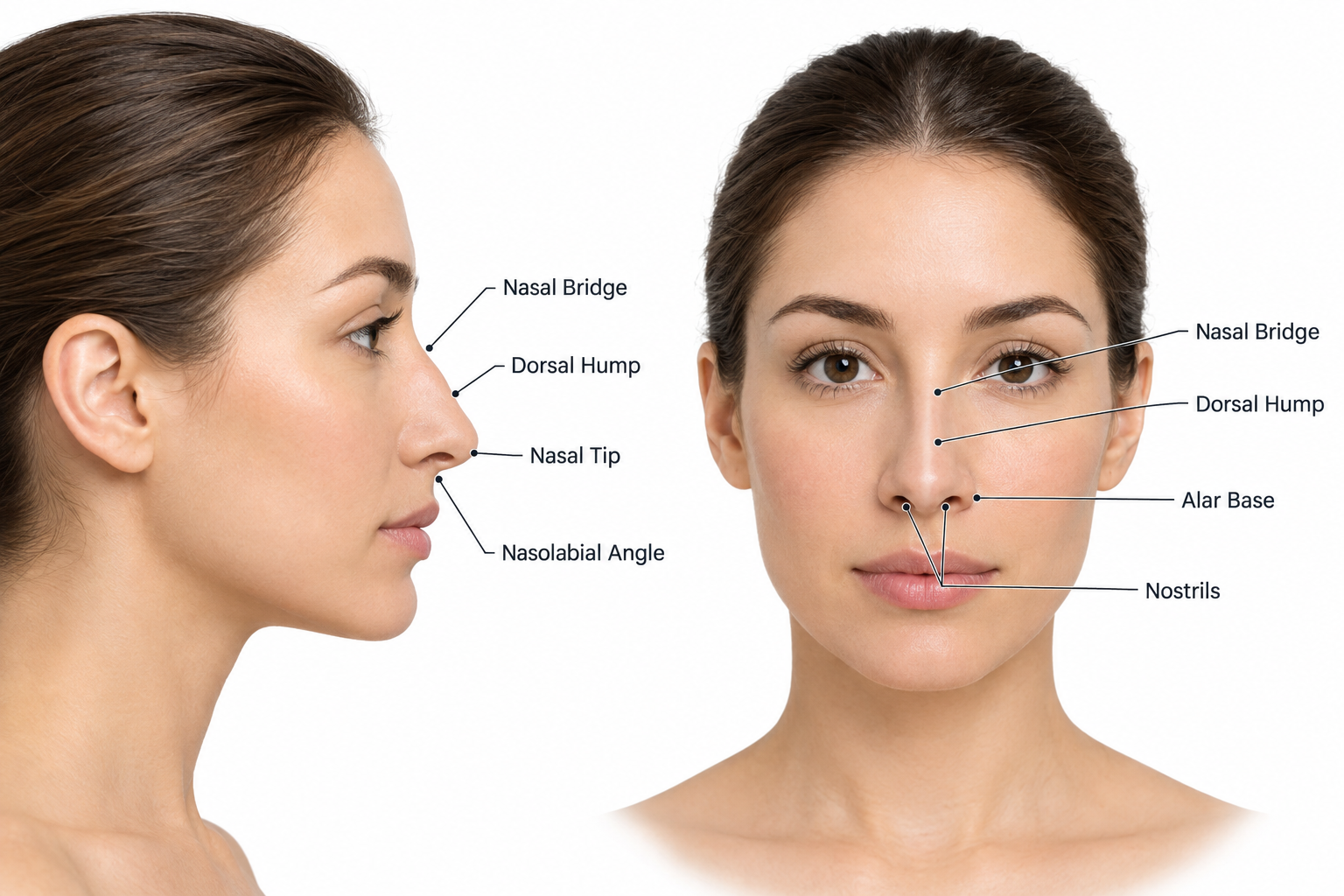
Before exploring individual nose types, it helps to understand the structural components that create nasal shape. The upper third of the nose is supported by nasal bones, while the middle and lower thirds are shaped by cartilage — specifically the upper lateral cartilage, lower lateral cartilage, and septal cartilage. The nasal bridge runs from the root (the area between the eyes, sometimes called the sellion) down to the tip. The tip itself, known anatomically as the pronasale, can point upward, downward, or project straight forward. The alar base — the width of the nostrils at their widest point — is another key measurement used to classify nose shapes.
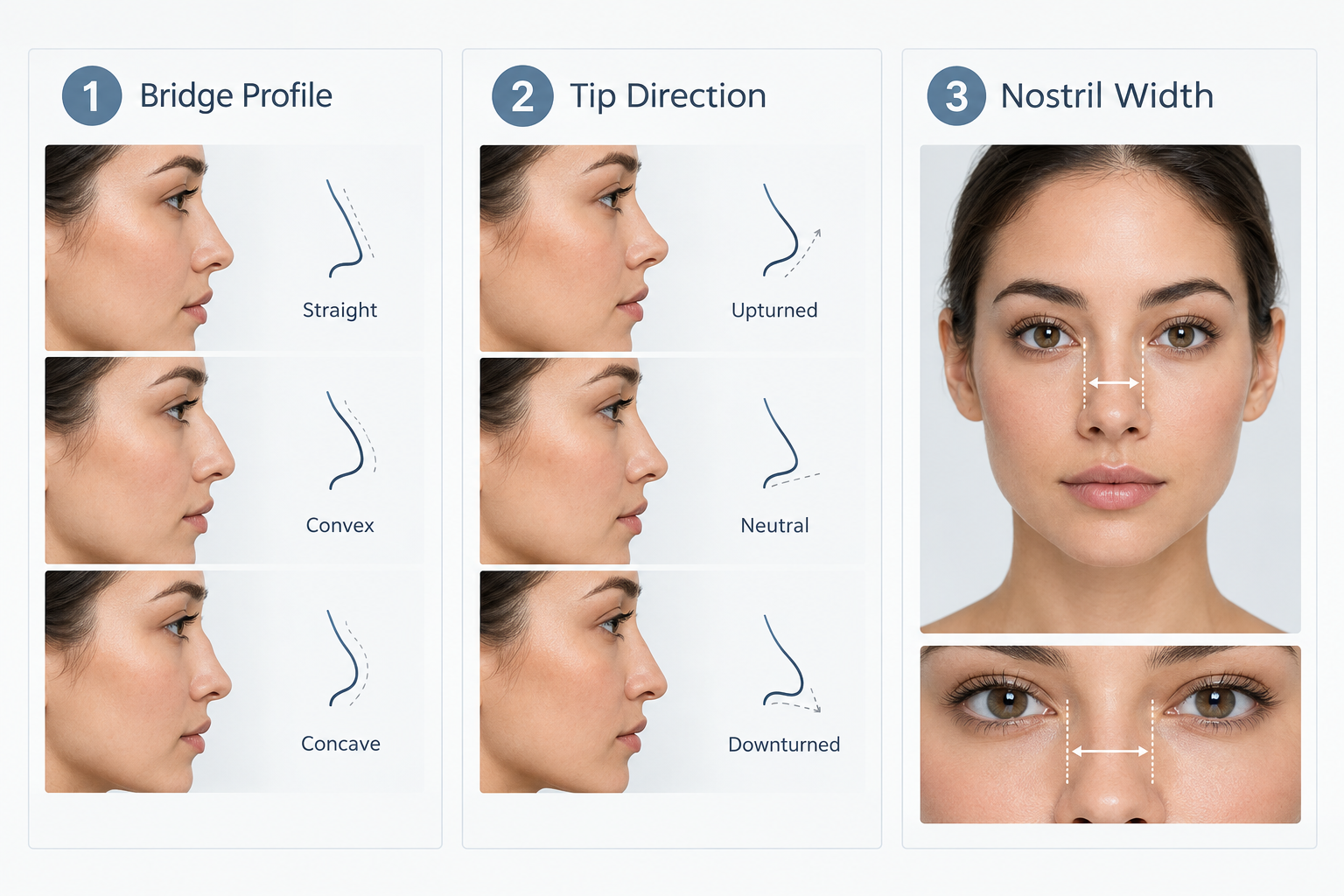
Three structural variables account for most of the variation between nose types: the bridge profile (straight, convex, or concave), tip rotation (upturned, downturned, or neutral), and alar base width relative to the inner corners of the eyes. Understanding these three axes makes self-identification much more reliable than trying to match a photograph to a named category.
How to Identify Your Nose Shape in Three Steps
Accurate self-assessment requires two photographs rather than a mirror, because mirror images reverse the face and can distort perception of asymmetry. Use a smartphone camera at eye level in natural, even lighting — avoid flash, which flattens contours, and avoid low angles, which exaggerate tip projection.
Step 1: Assess Your Bridge Profile
Take a side-profile photograph and look at the line running from the root of your nose down to the tip. A straight or nearly straight dorsal line suggests a Greek or straight nose. A convex profile — one that curves outward, creating a visible bump or dorsal hump — points toward a Roman, aquiline, or hawk nose. A concave profile, where the bridge dips inward, is characteristic of a snub, button, or upturned nose. A bridge that appears flattened with minimal projection from the face is associated with a flat or saddle nose.
Step 2: Assess Your Tip
Still using the side-profile image, observe the direction of your nasal tip. Tip rotation describes the angle of the tip relative to the upper lip — the nasolabial angle. A nasolabial angle above approximately 95–100 degrees in women or 90–95 degrees in men indicates an upturned tip. A downturned tip, where the tip droops toward the upper lip, produces a smaller nasolabial angle and is associated with a hooked or downturned nose. Tip projection — how far the tip extends from the face — also varies considerably and contributes to whether a nose appears prominent or subtle in profile. A rounded, poorly defined tip with significant soft tissue coverage is the hallmark of a bulbous or fleshy nose.
Step 3: Assess Your Nostril Width
Switch to your front-on photograph. A widely used proportional reference is the inner canthal distance — the gap between the inner corners of your eyes. In many facial harmony frameworks, the alar base width ideally approximates this measurement, though natural human variation means significant deviation from this ratio is common and normal. Nostrils that extend noticeably beyond the inner eye corners suggest a wide or Nubian nose. Nostrils that sit well within this reference width are associated with a narrow or Greek nose. Alar flare — where the nostrils flare outward at their base — is a separate characteristic that can appear alongside various bridge and tip types.
The Main Nose Types: A Structured Guide
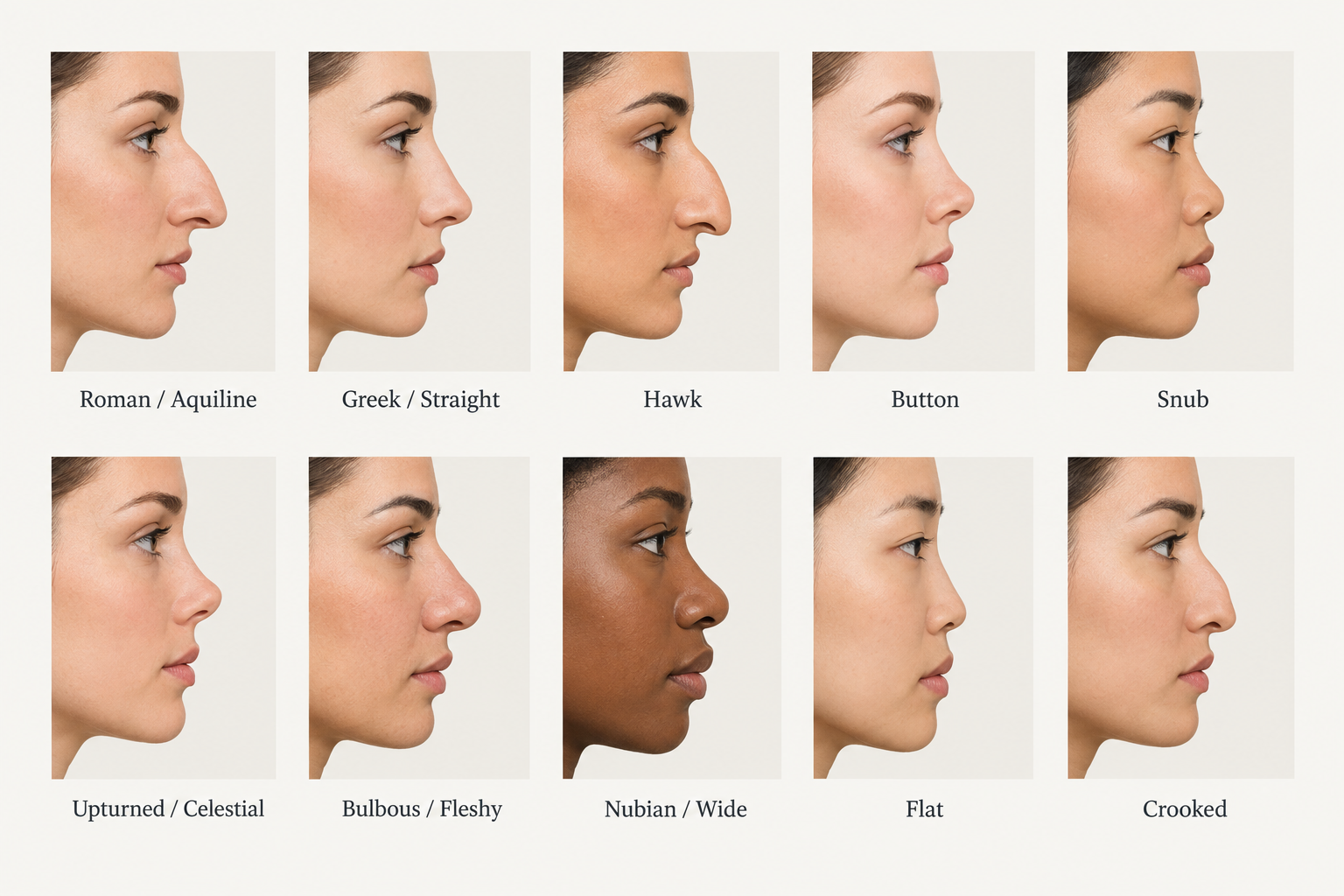
The following descriptions cover the most commonly named nose types. Because nasal anatomy is continuous rather than categorical, treat these as useful reference points rather than rigid boxes. A nose shape chart or visual guide used alongside these descriptions will improve accuracy.
Roman Nose (Aquiline Nose)
The Roman nose and aquiline nose are the same type described by different names. The defining feature is a convex bridge profile — a prominent dorsal hump that creates a curved, eagle-like silhouette in side view. The tip is typically straight or slightly downturned. This nose type is common across Mediterranean, Middle Eastern, and South Asian populations and is one of the most frequently searched types among rhinoplasty patients seeking dorsal hump reduction.
Greek Nose (Straight Nose)
The Greek nose is characterized by a straight, narrow bridge with no visible dorsal hump and a refined, forward-projecting tip. The dorsal line runs in an almost unbroken straight line from the root to the tip. This nose type is often cited in classical sculpture and is associated with Northern European and some East Asian facial profiles. In rhinoplasty planning, the Greek nose profile is frequently used as a reference for bridge straightening goals.
Hawk Nose (Hooked Nose)
The hawk nose shares the convex bridge of the Roman nose but is distinguished by a more sharply curved, downward-pointing tip that creates a pronounced hook shape in profile. The dorsal hump tends to be more angular than the smooth curve of the aquiline nose. This type is relatively uncommon and is sometimes confused with a severe Roman nose; the key distinction is the degree of tip downward rotation.
Button Nose
The button nose is small, short, and slightly upturned, with a concave or near-flat bridge profile and a rounded, well-defined tip. The overall nose is compact relative to the face. It is one of the most commonly cited nose types in popular culture and is associated with a youthful facial appearance. The button nose is closely related to the snub nose and the celestial nose, though subtle differences exist.
Snub Nose
The snub nose is similar to the button nose but tends to be slightly wider and softer in tip definition. The bridge is short and the tip is upturned, but the overall shape is less petite than a button nose. Some classification systems treat snub and button as synonyms; others distinguish them by tip definition and bridge length.
Upturned Nose (Celestial Nose)
The upturned nose — sometimes called the celestial nose — is defined primarily by a clearly elevated nasal tip with a noticeable upward rotation. The bridge may be concave or relatively straight. The nasolabial angle is wider than average, and the nostrils may be partially visible from the front. This type is distinct from the button nose in that the upward tip rotation is the dominant feature rather than overall nose size.
Bulbous Nose (Fleshy Nose)
The bulbous nose and fleshy nose are closely related types characterized by a rounded, poorly defined tip with significant soft tissue and sebaceous skin coverage. The bridge may be straight or slightly convex, but the tip lacks sharp definition and appears wide or ball-like. This is one of the most common nose types globally and is frequently a focus of tip refinement rhinoplasty. Skin thickness plays a major role — thicker skin limits the degree of tip definition achievable through surgery.
Nubian Nose (Wide Nose)
The Nubian nose is characterized by a long bridge with a wide alar base and broad, rounded nostrils. The bridge profile is typically straight or slightly concave, and the tip is well-projected. This nose type is common among people of African and Afro-Caribbean descent and reflects ancestral adaptation to warm, humid climates. The term wide nose is sometimes used interchangeably, though Nubian nose specifically refers to a combination of bridge length and alar width.
Flat Nose
The flat nose has a low bridge with minimal projection from the face and a wide alar base. The bridge profile appears nearly flat in side view, with little dorsal height. This type is common among East Asian and some Southeast Asian populations and is associated with ancestral adaptation to cold, dry climates. Bridge augmentation — either through rhinoplasty or non-surgical filler techniques — is a common aesthetic goal for this nose type.
Crooked Nose (Asymmetrical Nose)
The crooked nose deviates from the facial midline, creating visible asymmetry when viewed from the front. This may result from a deviated septum, previous trauma, or natural developmental variation. A crooked nose is not a shape category in the same sense as the others — it describes an alignment characteristic that can occur alongside any bridge or tip type. Functional concerns such as nasal obstruction are more commonly associated with this type than with others.
Saddle Nose
The saddle nose has a concave bridge that dips noticeably inward, creating a depression in the dorsal profile. This can be a natural variation or may result from trauma, previous surgery, or certain medical conditions affecting cartilage. The concave profile is the defining feature, and the degree of depression varies from subtle to pronounced.
Downturned Nose
The downturned nose is defined by a tip that droops toward the upper lip, reducing the nasolabial angle. The bridge may be straight or convex. This type can become more pronounced with age as the tip loses structural support. Tip rotation procedures — both surgical and, in some cases, non-surgical — are commonly sought for this nose type.
Synonym and Overlap Reference Table
Several nose type names are used interchangeably in different sources, which can cause confusion. The table below clarifies which names refer to the same type and which are genuinely distinct.
| Common Name | Synonym / Related Name | Key Distinguishing Feature |
|---|---|---|
| Roman nose | Aquiline nose | Convex bridge with smooth dorsal hump; tip neutral or slightly downturned |
| Greek nose | Straight nose | Straight dorsal line; narrow bridge; no hump |
| Hawk nose | Hooked nose | Convex bridge with sharply downturned tip |
| Button nose | Often confused with snub or celestial | Small, compact, slightly upturned; petite overall size |
| Snub nose | Similar to button nose | Short, upturned; wider and softer than button nose |
| Upturned nose | Celestial nose | Clearly elevated tip rotation; nostrils partially visible from front |
| Bulbous nose | Fleshy nose | Rounded, poorly defined tip; thick soft tissue coverage |
| Nubian nose | Wide nose (partial overlap) | Long bridge, wide alar base, broad nostrils |
| Flat nose | Low-bridge nose | Minimal dorsal projection; wide alar base |
| Crooked nose | Asymmetrical nose | Deviation from midline; may involve deviated septum |
Combination Nose Types
A combination nose is one that displays features from more than one named category — and this is, in fact, the most common situation. A person might have the convex bridge of a Roman nose combined with the wide alar base of a Nubian nose, or the upturned tip of a celestial nose alongside the rounded tip definition of a bulbous nose. Most classification systems acknowledge this reality but offer little practical guidance for identifying a combination nose.
The three-step method described earlier is particularly useful here: assess bridge, tip, and width independently, then note which named types each feature most closely resembles. A combination nose is simply a nose where the three features point toward different categories. This is not a flaw — it reflects the continuous nature of human facial anatomy. In a rhinoplasty consultation, identifying which specific features a patient wishes to address is more clinically useful than assigning a single nose type label.
What Determines Nose Shape?
Nose shape is primarily determined by genetics, with ancestral geographic origin playing a significant role. A landmark study published in PLOS Genetics by Zaidi and colleagues examined the genetic basis of nasal morphology across populations and found that alar base width and nostril width are significantly associated with climate adaptation. Populations from warm, humid climates tend to have wider nostrils — a feature that may facilitate efficient air conditioning and humidification of inhaled air. Populations from cold, dry climates tend toward narrower nasal passages, which warm and humidify air more effectively before it reaches the lungs. This climate adaptation hypothesis helps explain why certain nose types are more prevalent in specific geographic regions.
Beyond climate, individual genetic variation within populations accounts for the full range of nose shapes seen within any ethnic group. Nose shape is a polygenic trait — influenced by many genes simultaneously — which is why siblings can have noticeably different nose shapes despite sharing the same ancestry. Trauma, previous surgery, and certain medical conditions can also alter nasal structure over time.
How Nose Shape Changes with Age
Nasal anatomy is not static throughout life. With age, the tip of the nose tends to droop as the cartilage loses structural integrity and the soft tissue support weakens. This can convert a previously neutral or upturned tip into a downturned one, and may make a dorsal hump appear more prominent in profile. Skin thickening — particularly in individuals prone to sebaceous skin changes — can progressively obscure tip definition, making a nose appear more bulbous over time. These age-related changes are relevant both for self-identification (a nose type identified in youth may shift category by middle age) and for rhinoplasty planning, where a surgeon will consider likely future changes alongside current anatomy.
Nose Shape, Ethnicity, and Natural Human Variation
Nose shapes vary across populations, and this variation reflects natural human adaptation rather than a hierarchy of aesthetic value. Broad generalizations about ethnic nose types are useful as a starting point for understanding population-level trends, but they should not be applied rigidly to individuals. Within any population, the full spectrum of bridge profiles, tip rotations, and alar base widths exists. Framing all nose types as expressions of natural human variation — rather than deviations from a single aesthetic standard — is both scientifically accurate and clinically appropriate.
In aesthetic medicine, the goal of rhinoplasty or non-surgical nose reshaping is to achieve facial harmony relative to the individual's own facial proportions, not to impose a single idealized nose shape. A qualified practitioner will assess the nose in the context of the whole face, considering the relationship between the nasal bridge, tip projection, alar base width, and surrounding facial features before making any recommendations.
Practical Applications of Knowing Your Nose Type
Nose Contouring with Makeup
Nose contouring uses shadow and highlight to create the visual impression of a different bridge profile or tip shape. For a convex bridge, a narrow shadow applied along the sides of the dorsal hump can reduce its apparent prominence. For a flat nose, a highlighter stripe along the bridge can create the illusion of greater projection. For a wide alar base, shadow applied to the outer edges of the nostrils can visually narrow the base. Knowing your nose type makes it easier to select the appropriate technique rather than applying a generic contouring approach.
Glasses and Eyewear Fit
Nose shape directly affects how eyeglass frames sit on the face. A flat nose with a low bridge may cause standard frames to slide down or rest on the cheeks rather than the bridge. Low-bridge or adjustable nose-pad frames are designed for this anatomy. A prominent aquiline nose may require frames with a higher bridge clearance to avoid pressure on the dorsal hump. A wide alar base can affect how frame width relates to the overall facial width. Understanding your nose type can help when selecting frames, particularly when shopping online without the opportunity to try frames in person.
Rhinoplasty and Non-Surgical Nose Reshaping
Rhinoplasty — surgical nose reshaping — can address a wide range of structural concerns, including dorsal hump reduction, tip refinement, alar base reduction, bridge augmentation, and correction of a crooked nose. The specific techniques used depend on the nose type and the individual's goals. Non-surgical rhinoplasty using dermal filler can camouflage a dorsal hump, augment a flat bridge, or subtly adjust tip appearance, but it cannot reduce the size of the nose or narrow a wide alar base. Understanding which features of your nose type are amenable to non-surgical versus surgical approaches is an important part of pre-consultation preparation.
Frequently Asked Questions
How many nose types are there?
Most classification systems identify between 12 and 14 named nose types, though the boundaries between categories are not fixed. Many people have a combination nose that blends features from two or more types. The number of named types varies between sources depending on how finely distinctions are drawn.
What is the most common nose type?
The fleshy or bulbous nose — characterized by a rounded, soft tip with significant soft tissue coverage — is widely considered the most common nose type globally. The straight or Greek nose is also very common, particularly among Northern European populations.
What is the rarest nose type?
The hawk nose, with its sharply curved convex bridge and pronounced downward-pointing tip, is generally considered one of the rarer nose types. The saddle nose — with its concave bridge depression — is also uncommon as a natural variation, though it can result from trauma or previous surgery.
Can I identify my nose type from a selfie?
A standard front-facing selfie is not ideal for nose type identification because the camera angle and lens distortion can misrepresent tip projection and bridge profile. A side-profile photograph taken at eye level with a rear-facing camera in natural light gives a much more accurate representation of bridge shape and tip rotation. Both a front-on and a side-profile image are needed for a complete assessment.
Does nose shape affect breathing?
Nose shape can influence airflow and the nose's ability to warm and humidify inhaled air. A deviated septum — which may accompany a crooked nose — can cause nasal obstruction and affect breathing. Narrow nasal passages may be associated with certain breathing patterns. However, many people with unusual nose shapes have no functional breathing concerns, and many breathing issues are caused by internal anatomy rather than external shape. A medical assessment is appropriate if breathing difficulties are present.
Is a Roman nose the same as an aquiline nose?
Yes. Roman nose and aquiline nose are two names for the same nose type: a convex bridge profile with a smooth dorsal hump and a neutral or slightly downturned tip. The term aquiline comes from the Latin word for eagle, referring to the curved beak-like profile.
Can nose shape change without surgery?
Non-surgical rhinoplasty using hyaluronic acid filler can temporarily alter the appearance of the nose — for example, by camouflaging a dorsal hump or augmenting a flat bridge — but it cannot permanently change nasal structure or reduce nose size. Results typically last 9–18 months depending on the product used and individual metabolism. Surgical rhinoplasty produces permanent structural changes, though some degree of ongoing change occurs naturally with age regardless of whether surgery has been performed.
Understanding Your Nose Type as a Starting Point
Identifying your nose type is a useful first step — whether your interest is in makeup contouring, eyewear selection, or exploring aesthetic options. The three-step method of assessing bridge profile, tip rotation, and alar base width gives a more reliable result than trying to match a photograph to a named category, and recognizing that most noses are combination types removes the frustration of not fitting neatly into a single description.
If you are considering rhinoplasty or non-surgical nose reshaping, a self-identified nose type is a helpful starting point for a conversation with a qualified practitioner, but it is not a substitute for a clinical assessment. A surgeon or aesthetic practitioner will evaluate your nasal anatomy in the context of your full facial proportions, skin thickness, structural support, and individual goals before recommending any approach. Booking a consultation with a practitioner experienced in nasal aesthetics is the appropriate next step if you are moving beyond curiosity toward a treatment decision.
