
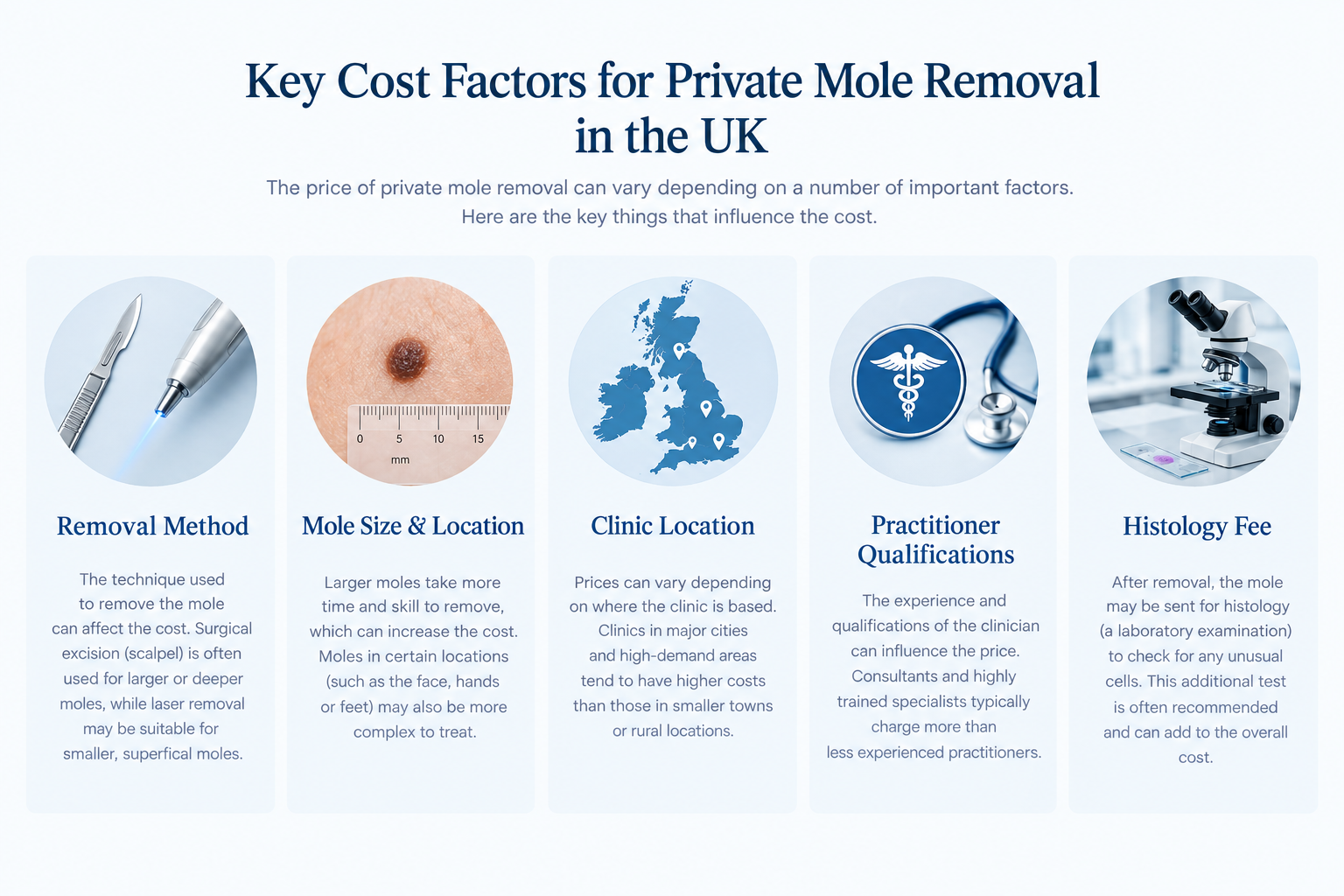

Private mole removal cost in the UK typically ranges from around £150 to over £1,000 depending on the removal method, the clinic, the practitioner's qualifications, and whether histology testing is included. Understanding what drives that variation helps you compare quotes accurately, avoid unexpected bills, and choose a provider who prioritises your safety as well as the cosmetic result.
Key Takeaways
- The total pathway cost — consultation, procedure, histology, and follow-up — is often higher than the headline price advertised by clinics.
- Removal method, mole size and depth, and mole location are the main clinical factors that affect price.
- Histology (laboratory analysis of the removed tissue) is an important safety step that not all clinics include in their quoted fee.
- NHS mole removal is available only when removal is considered medically necessary; purely cosmetic mole removal is not funded by the NHS.
- Practitioner qualifications significantly affect both price and safety — a consultant dermatologist on the GMC Specialist Register commands a higher fee for good clinical reasons.
Typical Private Mole Removal Costs in the UK
Prices vary considerably across providers and regions, but the figures below reflect ranges commonly quoted by UK private clinics in 2025. These are indicative ranges only; your actual cost will depend on the specific factors discussed throughout this article.
| Removal Method | Typical Cost Range | Histology Usually Included? |
|---|---|---|
| Shave excision | £200 – £500 | Sometimes (check before booking) |
| Elliptical (surgical) excision | £350 – £900 | Usually yes |
| Punch biopsy / punch excision | £250 – £600 | Usually yes |
| Laser removal | £100 – £400 per session | No (tissue is destroyed) |
| Radiofrequency ablation | £150 – £450 | Rarely |
| Cryotherapy | £100 – £300 | No |
These figures cover the procedure itself. A consultation fee of £100–£250 and a histology fee of £80–£150 may be charged separately depending on how the clinic structures its pricing. A follow-up appointment to check healing or remove sutures can add a further £50–£100. Understanding bundled versus itemised pricing is therefore essential before you compare quotes.
Bundled vs. Itemised Pricing: How to Compare Quotes Fairly
One of the most common sources of confusion when researching private mole removal cost in the UK is that clinics present their fees in very different ways. Some offer bundled pricing — a single fixed fee that covers the consultation, the procedure, histology, and at least one follow-up appointment. Others advertise a low headline procedure price that excludes some or all of these components.
To compare quotes on a like-for-like basis, ask each clinic to confirm in writing exactly what their quoted price includes. Specifically, ask whether the consultation fee is separate, whether histology is included, whether suture removal is covered, and whether a follow-up appointment is part of the package. A clinic quoting £250 for shave excision with histology and follow-up included may represent better value than one quoting £180 for the procedure alone.
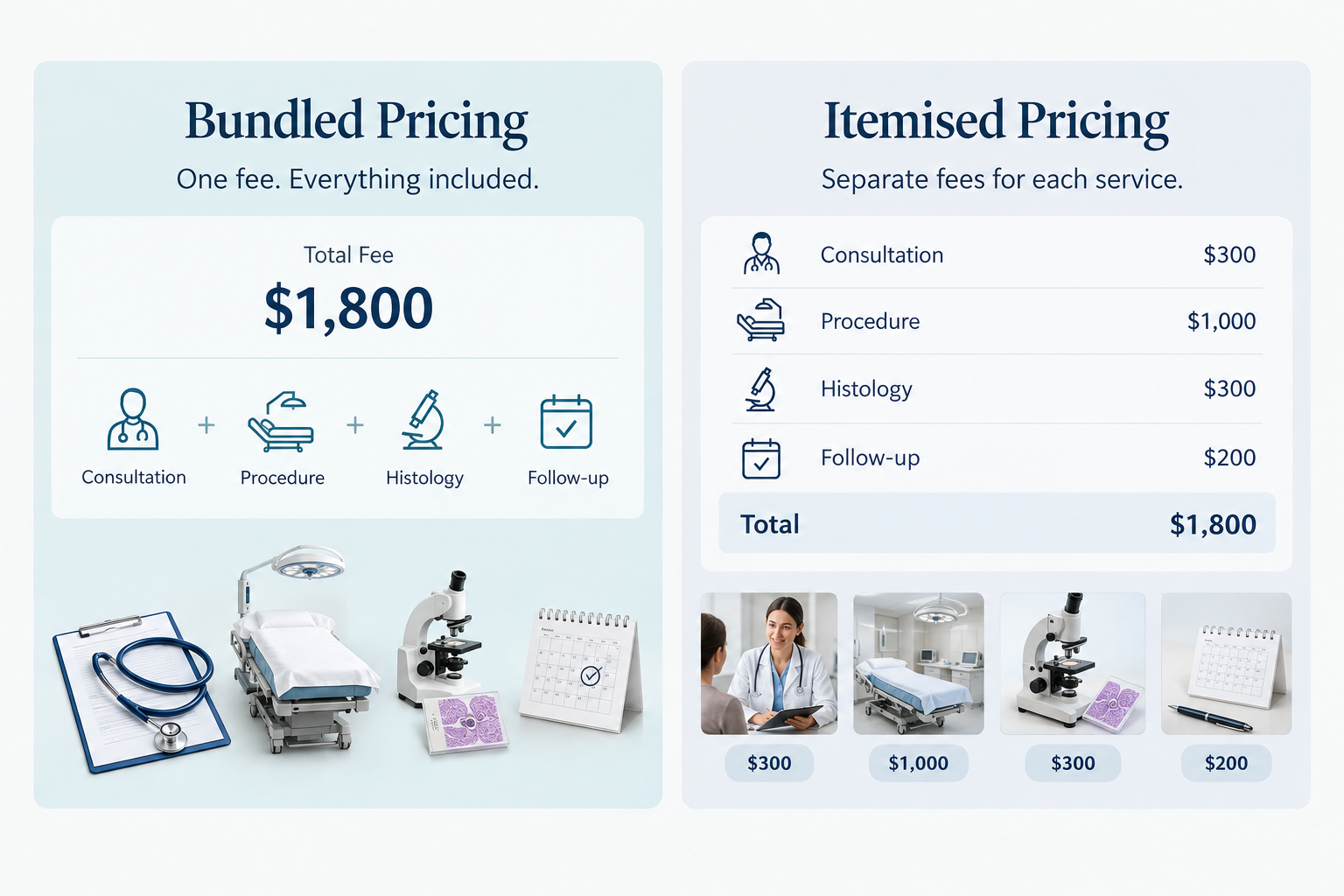
A realistic worked example of a total pathway cost for a single mole removed by elliptical excision at a reputable clinic might look like this: consultation £150, procedure £400, histology £100, follow-up £75 — a total of £725, even though the procedure fee alone appeared modest. Knowing this before you book prevents unwelcome surprises.
Removal Method and How It Affects Cost
The technique used to remove a mole is one of the strongest drivers of price, because different methods require different levels of surgical skill, equipment, and time.
Shave Excision
Shave excision uses a fine blade to remove a raised mole flush with the surrounding skin surface under local anaesthetic. It is generally quicker than surgical excision and does not usually require sutures, which keeps the procedure cost lower. It is best suited to benign raised moles and is not appropriate for flat or deeply rooted lesions. The removed tissue can be sent for histology, which is an important safety advantage over methods that destroy tissue.
Elliptical (Surgical) Excision
Elliptical excision involves cutting around and beneath the mole in an oval shape, removing it completely along with a small margin of surrounding tissue, and closing the wound with sutures. This method is more time-intensive and requires greater surgical skill, which is reflected in a higher procedure fee. It is the preferred approach for suspicious or atypical moles, for flat moles, and for any lesion where complete removal with clear margins is clinically important. The excised tissue is routinely sent for histopathology.
Laser Removal
Laser mole removal uses focused light energy to break down pigmented cells. It is typically less expensive per session than surgical methods and leaves no sutures, but it carries a significant limitation: because the laser destroys the tissue rather than removing it intact, histology is not possible. This means that if the mole contained any abnormal cells, those cells cannot be identified after treatment. For this reason, laser removal is generally only appropriate for moles that have already been assessed by a qualified practitioner and confirmed as benign. Patients should be cautious of any provider who offers laser removal without a prior dermoscopy assessment.
Cryotherapy
Cryotherapy uses liquid nitrogen to freeze and destroy superficial skin lesions. It is one of the lower-cost options, sometimes available from around £100, but shares the same limitation as laser in that no tissue is preserved for laboratory analysis. It is more commonly used for seborrhoeic keratoses and warts than for true melanocytic moles, and results can be less predictable in terms of cosmetic outcome.
Radiofrequency Ablation
Radiofrequency removal uses electrical energy to ablate the mole tissue. Like laser and cryotherapy, it does not preserve tissue for histology. It can produce a good cosmetic result for raised benign lesions but requires the same prior clinical assessment to confirm the mole is suitable for a destructive technique.
Mole Characteristics That Influence Price
Beyond the removal method, the physical characteristics of the mole itself affect how straightforward — and therefore how costly — the procedure will be.
Mole Size and Depth
Larger moles require more tissue to be removed and a larger wound to be closed, which takes more time and skill. Mole size and depth also influence the likelihood of scarring and the complexity of achieving a good cosmetic result. A small superficial mole on the forearm is a very different clinical challenge from a large, deeply rooted mole on the cheek, and pricing reflects this difference.
Mole Location
Location is an underappreciated cost driver. Moles on the face — particularly around the eyes, nose, or lips — require greater precision to minimise scarring and preserve the surrounding anatomy. Eyelid moles and scalp moles are technically more demanding still, and some clinics charge a premium for these sites or refer patients to a plastic surgeon or oculoplastic specialist. Body moles in low-risk cosmetic areas are generally at the lower end of the price range for a given method.
Raised vs. Flat Moles
Raised moles are generally more straightforward to remove by shave excision, which is a quicker and less invasive technique. Flat moles typically require elliptical excision, which is more involved and therefore more expensive. The distinction between a raised and flat mole is one of the first things a practitioner will assess at consultation.
Suspicious or Atypical Moles
If a mole has features that raise clinical concern — irregular borders, uneven colour, recent change in size or shape — the practitioner may recommend a more thorough excision with wider margins, and histology becomes essential rather than optional. This can increase both the procedure cost and the histology fee, but it is the clinically appropriate approach. A dermoscopy examination, in which a handheld magnifying device is used to examine the mole's internal structure, is often performed at the consultation stage and may be included in the consultation fee or charged separately at around £50–£100.
The Histology Fee: Why It Matters and What It Costs
Histology — the laboratory analysis of removed tissue — is the process by which a pathologist examines the mole's cells under a microscope to confirm whether they are benign or whether any abnormal cells are present. For any mole removed by a method that preserves the tissue (shave excision, elliptical excision, punch biopsy), sending the specimen for histopathology is considered best practice and is strongly recommended by dermatology professional bodies.
The histology fee typically ranges from £80 to £150 and is sometimes included in a bundled package price, sometimes charged separately. Clinics that do not routinely offer histology — or that actively discourage it to keep the headline price low — should be approached with caution. If a removed mole is later found to have contained abnormal cells, the absence of a histology result means there is no tissue left to analyse, and further investigation becomes significantly more complicated.
If a histology result returns showing abnormal cells after removal, the clinic should advise on next steps, which may include a wider re-excision or referral to a dermatologist or the NHS two-week-wait cancer pathway. Any additional procedures would carry further costs in a private setting, though an NHS referral may be appropriate at that stage depending on the findings.
Practitioner Qualifications and Their Effect on Price
The qualifications and experience of the person performing your mole removal have a direct bearing on both the price and the safety of the procedure. In the UK, mole removal can legally be performed by a range of practitioners, from consultant dermatologists and plastic surgeons to aesthetic practitioners with varying levels of training. Understanding the difference matters.
A consultant dermatologist on the GMC Specialist Register has completed full specialist training in skin conditions, is qualified to diagnose skin cancer, and can perform dermoscopy and interpret the results. Procedures performed by a consultant dermatologist at a hospital-grade or CQC-registered clinic will typically sit at the higher end of the price range — but this reflects genuine clinical expertise and the ability to manage any unexpected findings, including a suspicious result on histology.
Aesthetic practitioners may offer lower prices, and many are competent and experienced. However, it is important to verify that any practitioner performing mole removal has specific training in skin lesion assessment, not just cosmetic procedures. A practitioner who cannot perform or interpret dermoscopy, or who does not routinely send tissue for histology, may not be the appropriate choice for a mole that has not been previously assessed by a dermatologist.
Harley Street and central London clinics tend to charge more than regional clinics, partly due to overhead costs and partly due to the concentration of senior specialists in that area. Regional clinics in cities such as Manchester, Birmingham, Leeds, and Edinburgh can offer comparable clinical standards at lower prices, and it is worth researching CQC registration and practitioner credentials regardless of location.
Regional Price Variation Across the UK
Private mole removal costs are not uniform across the UK. London clinics, particularly those in central areas, typically charge more than clinics in other regions. The table below gives a broad indication of how prices may vary by location for a standard single mole removal by elliptical excision, including consultation but excluding histology unless stated.
| Region | Approximate Procedure Cost Range |
|---|---|
| Central London (Harley Street area) | £500 – £900+ |
| Greater London (outer boroughs) | £350 – £650 |
| South East England | £300 – £600 |
| North West (Manchester, Liverpool) | £250 – £500 |
| Midlands (Birmingham, Nottingham) | £250 – £500 |
| Yorkshire (Leeds, Sheffield) | £200 – £450 |
| Scotland (Edinburgh, Glasgow) | £200 – £450 |
| Wales and Northern Ireland | £200 – £400 |
These are approximate ranges based on publicly available clinic pricing. Prices at any individual clinic may fall outside these ranges depending on the practitioner's seniority, the clinic's facilities, and the complexity of the case.
Multiple Mole Removal: Discounts and Pricing Structures
If you have several moles you wish to have removed, many clinics offer a multiple mole discount or a reduced per-mole fee when several lesions are treated in the same appointment. This is because the consultation, preparation, and anaesthetic administration are shared costs across all the moles being treated, making it more efficient for the clinic to treat multiple lesions at once.
Typical structures include a fixed fee for the first mole and a reduced fee for each additional mole — for example, £350 for the first and £150–£200 for each subsequent mole in the same session. Some clinics offer fixed-price packages for up to three or five moles. Always confirm whether histology is included per mole or as a single fee, as multiple specimens sent to the laboratory will usually incur separate histology charges.
NHS vs. Private Mole Removal
NHS mole removal is available, but only when removal is considered medically necessary — that is, when a mole is suspected of being cancerous or pre-cancerous, or when it is causing a functional problem such as repeated trauma or bleeding. Purely cosmetic mole removal, where the mole is benign but the patient dislikes its appearance, is not funded by the NHS.
| Factor | NHS Pathway | Private Pathway |
|---|---|---|
| Eligibility | Medically necessary only | Cosmetic or medical |
| Cost to patient | Free at point of care | £150 – £1,000+ depending on factors |
| Waiting time | 12–26 weeks (routine); 2 weeks (urgent/cancer pathway) | Days to weeks |
| Access route | GP referral required | Self-refer directly |
| Histology | Routine for excised lesions | Varies by clinic and method |
| Cosmetic outcome focus | Secondary to clinical need | Can be a primary consideration |
If your GP believes a mole is suspicious, they can refer you via the NHS two-week-wait pathway, which aims to see patients with suspected skin cancer within two weeks. This is the appropriate route for any mole that has changed in size, shape, or colour, or that bleeds without injury. For moles that are clearly benign but cosmetically unwanted, private treatment is the realistic option.
Insurance and Financing Options
Private medical insurance (PMI) from providers such as Bupa, AXA Health, Aviva, and Vitality may cover mole removal if it is deemed medically necessary, but cosmetic mole removal is almost universally excluded. If you believe your mole warrants medical removal, contact your insurer before booking and obtain Bupa pre-authorisation or equivalent written confirmation from your provider. Without pre-authorisation, you are unlikely to be reimbursed even if the mole is later found to be abnormal.
Health cash plans — offered by providers such as Simplyhealth and Health Shield — work differently from PMI. They allow you to claim back a proportion of the cost of eligible private treatments up to an annual limit. Some plans include skin lesion removal as a claimable treatment, making them a practical way to offset part of the cost for self-pay patients. Check your plan's terms carefully, as coverage varies.
Many private clinics offer an interest-free payment plan or medical finance loan to spread the cost of treatment over several months. An interest-free credit arrangement can make a higher-quality provider more accessible without requiring the full payment upfront. Always confirm the total repayable amount and any conditions attached before agreeing to a finance arrangement.
Red Flags When Choosing a Clinic
Not all providers offering cosmetic mole removal operate to the same clinical standard. The following warning signs are worth being aware of when researching clinics.
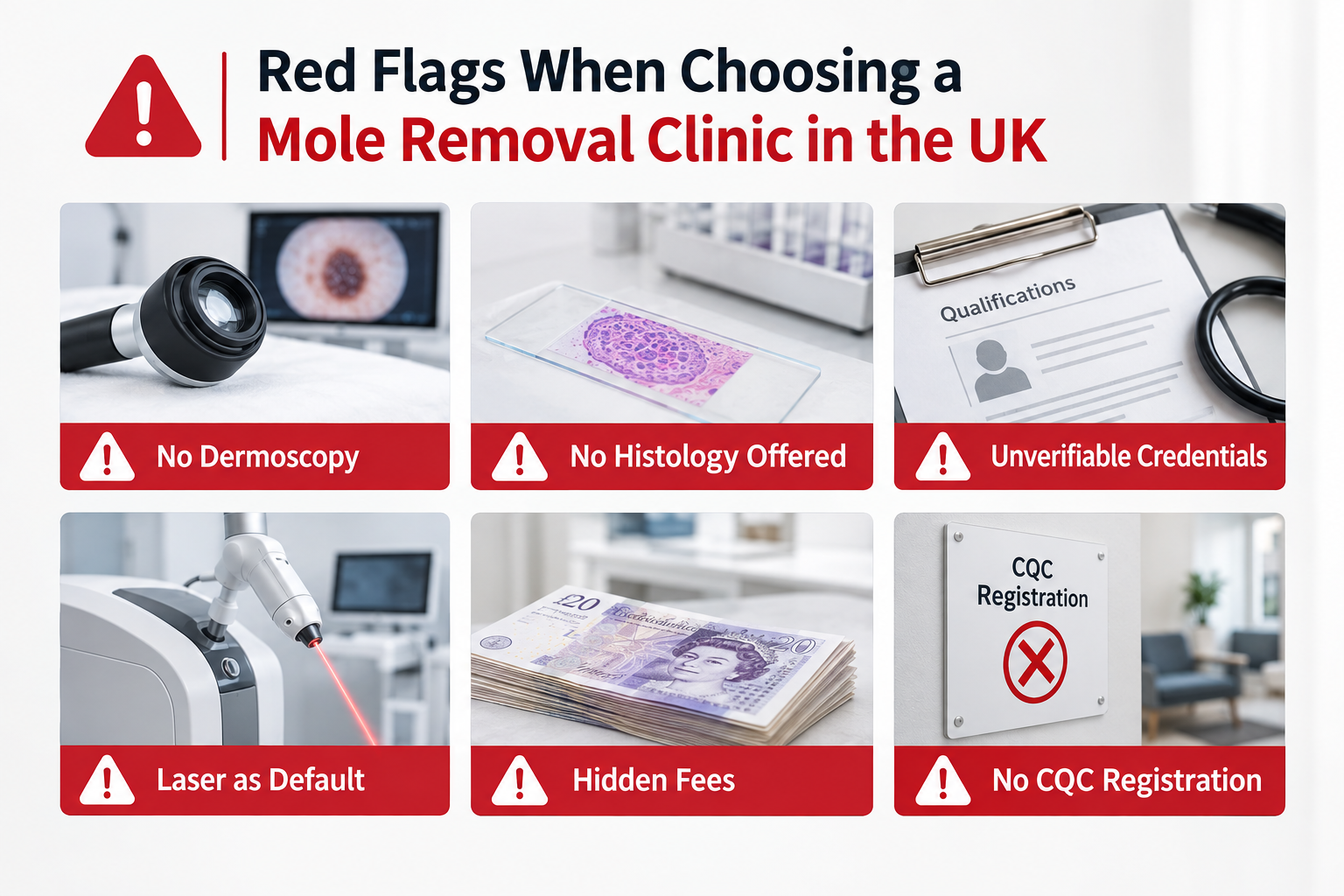
- No dermoscopy offered at consultation: Any reputable clinic should assess a mole with a dermoscope before removal, not simply agree to remove it on request.
- Histology actively discouraged or not offered: A clinic that removes moles without offering histology for tissue-preserving methods is not following best practice.
- No clear information on practitioner qualifications: You should be able to verify the practitioner's GMC registration and, ideally, their specialist registration, before booking.
- Laser offered as the default for all moles: Laser is appropriate only for confirmed benign lesions. A clinic that offers laser removal without prior clinical assessment is not prioritising your safety.
- Very low headline prices with no mention of additional fees: Unusually low prices often exclude histology, follow-up, or the consultation, making the true total pathway cost much higher than it first appears.
- No CQC registration for surgical procedures: Clinics performing surgical skin lesion removal in England should be registered with the Care Quality Commission.
Frequently Asked Questions
Does the NHS remove moles for free?
The NHS will remove a mole without charge if a GP or dermatologist considers it medically necessary — for example, if it appears suspicious for skin cancer or melanoma. Cosmetic mole removal, where the mole is benign but unwanted, is not available on the NHS and must be arranged and paid for privately.
Is histology always necessary after mole removal?
Histology is strongly recommended whenever the removal method preserves the tissue — such as shave excision, elliptical excision, or punch biopsy. It is the only way to confirm that the removed mole contained no abnormal cells. Methods that destroy tissue, such as laser or cryotherapy, make histology impossible, which is why these techniques should only be used on moles that have been clinically assessed and confirmed as benign beforehand.
How much does a consultation with a consultant dermatologist cost?
A private consultation with a consultant dermatologist in the UK typically costs between £150 and £300. This may include a dermoscopy examination of the mole. Some clinics offer a combined consultation and removal appointment, which can reduce the overall number of visits required.
Can I get a discount for having multiple moles removed?
Many clinics offer a multiple mole discount when several moles are treated in the same appointment. The reduction per additional mole varies by clinic, but it is common to see a lower per-mole fee from the second lesion onwards. Confirm whether histology is included per specimen, as this cost may apply separately for each mole removed.
What happens if my histology result shows abnormal cells?
If the laboratory analysis of your removed mole identifies abnormal or atypical cells, your clinic should contact you promptly and advise on next steps. Depending on the findings, this may involve a wider re-excision to ensure clear margins, or a referral to an NHS dermatologist or the two-week-wait cancer pathway. Any further private procedures would carry additional costs, though NHS referral may be appropriate and free at that stage.
Does mole removal leave a scar?
All surgical mole removal methods carry some risk of scarring. The extent depends on the removal technique, the mole's size and location, the practitioner's skill, and individual healing. Shave excision typically leaves a flat, pale mark. Elliptical excision leaves a linear scar. Facial moles require particular care to minimise visible scarring, which is one reason why location affects cost. Aftercare instructions and, in some cases, scar management treatments can help optimise the cosmetic result.
Is laser mole removal cheaper overall?
Laser mole removal often has a lower upfront cost than surgical excision, but the inability to perform histology means it is only appropriate for confirmed benign moles. If a mole has not been assessed by a qualified practitioner, choosing laser to save money could mean missing an abnormality. For moles that are clearly benign and have been assessed by dermoscopy, laser can be a reasonable option, but it should not be chosen on cost grounds alone.
Making an Informed Decision About Private Mole Removal
Private mole removal cost in the UK is genuinely variable, and the headline price you see advertised rarely tells the full story. The total pathway cost — covering consultation, the procedure itself, histology, and any follow-up — is the figure that matters for budgeting purposes, and it can differ substantially from the procedure fee alone.
Choosing a provider based on price alone carries real risks. A clinic that skips dermoscopy, discourages histology, or cannot clearly explain the practitioner's qualifications may save you money in the short term but leave important clinical questions unanswered. Conversely, the most expensive clinic is not automatically the best — regional clinics with appropriately qualified practitioners and CQC registration can offer excellent care at lower prices than central London providers.
The most useful approach is to request a written breakdown of all costs from any clinic you are considering, verify the practitioner's GMC registration and specialist credentials, confirm that histology will be performed for any tissue-preserving removal method, and ask what the process would be if your histology result required further action. A reputable clinic will answer all of these questions clearly and without hesitation. If you are unsure whether your mole warrants private removal or an NHS assessment, speaking to your GP first is always a reasonable starting point.
