

Sunken eyes — the hollow, shadowed appearance beneath or around the eye socket — are one of the most common aesthetic concerns seen in clinical practice, yet they are also one of the most misunderstood. The causes range from something as simple as a poor night's sleep to structural changes in bone, fat, and skin that develop gradually over decades. Understanding what is actually driving the appearance is the first step toward choosing the right response, whether that is a lifestyle adjustment, a medical investigation, or a clinical treatment.
Key Takeaways
- Sunken eyes can result from lifestyle factors such as dehydration and sleep deprivation, age-related structural changes, or underlying medical conditions — and the cause determines the appropriate response.
- There are three meaningfully different types: cosmetic periorbital hollowing, true enophthalmos (physical displacement of the eyeball), and naturally deep-set eyes — each with different implications.
- Sudden or one-sided sunken eyes can indicate a medical emergency such as an orbital fracture or silent sinus syndrome and warrant prompt professional assessment.
- Most lifestyle-related causes are rapidly reversible, while age-related volume loss and structural changes typically require clinical intervention to address.
- A qualified practitioner should assess the underlying cause before any treatment is considered, as the same appearance can have very different origins.
What Are Sunken Eyes?
Sunken eyes describe a visual appearance in which the area beneath or around the eye looks hollow, shadowed, or recessed. The skin may appear thin and translucent, dark circles or dark shadows under the eyes may be prominent, and the overall effect is often described as tired, gaunt, or aged. The medical term for the physical displacement of the eyeball deeper into the orbital cavity is enophthalmos, though many people use the term sunken eyes loosely to describe any degree of under-eye hollowness, including purely cosmetic concerns where the eyeball itself has not moved.
Distinguishing between the three main types is clinically important. Cosmetic periorbital hollowing refers to the loss of soft tissue volume — fat, collagen, and skin thickness — around the eye without any change in the position of the eyeball. True enophthalmos involves the eyeball sitting further back within the orbital cavity than normal, which can result from trauma, disease, or structural collapse. Naturally deep-set eyes are an inherited anatomical feature where the brow bone is prominent and the eyes sit further back in the socket by default — this is not a pathological finding and does not require treatment. Conflating these three types leads to confusion about causes and, more importantly, about appropriate management.
The Most Common Causes of Sunken Eyes
Ageing and Age-Related Structural Changes
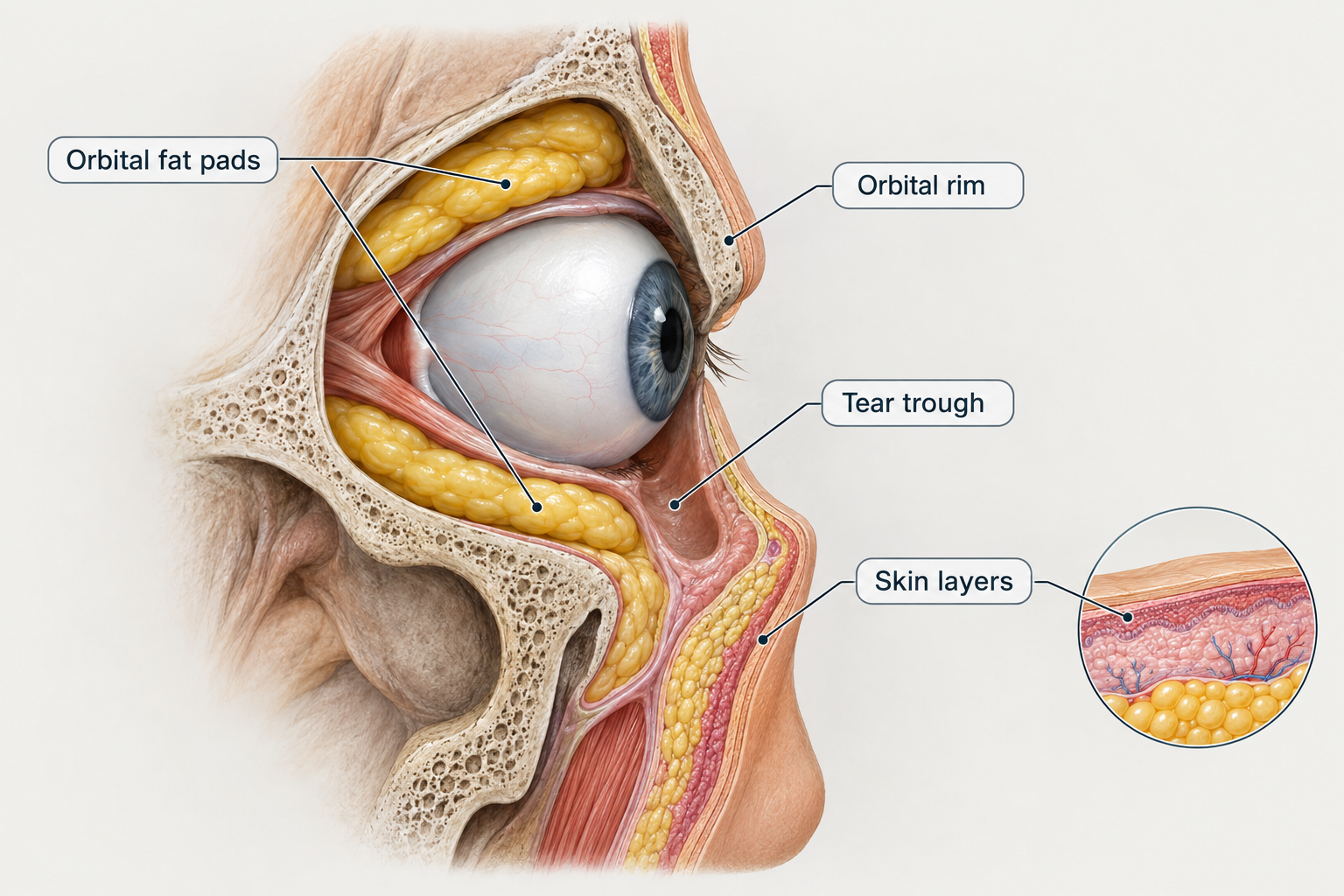
Ageing is the single most frequent cause of progressive under-eye hollowness in adults. The process involves simultaneous changes across multiple tissue layers. The skin loses collagen and elastin, becoming thinner and less able to conceal the structures beneath it. The orbital fat pads — compartments of fat that cushion the eye and fill the periorbital space — gradually diminish through a process called periorbital fat loss. At the same time, the ligaments that support these fat pads weaken, allowing remaining fat to shift downward and create an uneven contour.
Less widely appreciated is the role of bone resorption. The orbital rim — the bony frame surrounding the eye socket — recedes measurably with age, enlarging the orbital cavity and reducing the skeletal support for the overlying soft tissues. This means that even if fat and skin volume were preserved, the underlying scaffold would still change shape. The combination of skin thinning, orbital fat loss, and orbital rim recession explains why age-related tear trough hollows tend to deepen progressively and why topical products alone rarely produce significant improvement once structural changes are established.
Dehydration
Dehydration is one of the most rapidly reversible causes of sunken eyes. When the body is insufficiently hydrated, the skin loses turgor — its ability to spring back when pressed — and the soft tissues around the eye appear deflated and shadowed. Adequate fluid intake typically restores a more normal appearance within hours. In adults, mild to moderate dehydration is a common and overlooked contributor to a persistently tired appearance, particularly in people who consume significant amounts of caffeine or alcohol, both of which have diuretic effects.
In children and infants, dehydration is a more urgent concern. Sunken eyes in a child, particularly when accompanied by a sunken fontanelle (the soft spot on an infant's head), dry mouth, reduced urine output, or lethargy, can indicate significant dehydration requiring prompt medical attention. Causes in children include stomach viruses, vomiting, and diarrhea. Parents who notice these signs together should seek medical assessment rather than waiting to see whether the child improves with oral fluids alone.
Genetics and Inherited Anatomy
Some individuals are predisposed to tear trough hollows or a deep-set eye appearance from an early age due to inherited facial anatomy. Factors include the depth of the orbital cavity, the thickness of periorbital fat, the prominence of the orbital rim, and the natural distribution of facial fat. People with a family history of hollow eyes often notice the appearance in their twenties or earlier, well before age-related changes would be expected. Genetics also influences skin thickness and the rate at which collagen and elastin are lost over time, meaning that hereditary factors interact with ageing rather than acting independently of it.
Weight Loss and Facial Fat Loss
Significant or rapid weight loss frequently produces noticeable facial volume loss, including in the periorbital area. Fat is distributed throughout the face in discrete compartments, and the orbital and malar fat pads are among those affected by calorie restriction and overall fat reduction. The result is an increase in under-eye hollowness and a more gaunt facial appearance even when the rest of the body looks leaner.
This effect has become particularly relevant with the widespread use of GLP-1 receptor agonist medications — a class of weight-loss drugs that can produce rapid and substantial fat loss. The resulting facial deflation, sometimes informally called "Ozempic face", includes pronounced tear trough hollows and periorbital hollowing that can appear disproportionate to the degree of overall weight lost. Eating disorders and severe calorie restriction produce similar effects, sometimes compounded by nutritional deficiencies that further impair skin quality.
Sleep Deprivation and Chronic Fatigue
Lack of sleep causes fluid to shift within the body, and the periorbital tissues are particularly sensitive to these changes. Sleep deprivation reduces skin elasticity temporarily, increases the visibility of blood vessels beneath the thin under-eye skin, and can cause mild puffiness in some areas while creating shadows in others. The result is the classic tired appearance associated with dark circles and hollow-looking eyes. Chronic fatigue compounds these effects over time, and the appearance may become more persistent even after a single night of better sleep.
Nutritional Deficiencies
Several nutritional deficiencies can contribute to the appearance of sunken or shadowed eyes. Iron deficiency anaemia reduces the oxygen-carrying capacity of the blood, causing the skin to appear pale and the underlying vasculature to become more visible as dark shadows. Deficiencies in vitamins C, K, E, and B12 can impair collagen synthesis, skin repair, and circulation, all of which affect the appearance of the periorbital area. Poor diet and malnutrition — whether from restricted eating, illness, or inadequate food access — can accelerate the loss of facial fat and skin quality that contributes to under-eye hollowness.
Smoking and Sun Exposure
Smoking accelerates the breakdown of collagen and elastin in the skin through oxidative stress and reduced blood flow to the dermis. The periorbital skin, already among the thinnest on the body, is particularly vulnerable. UV exposure produces similar collagen degradation through photoageing, and cumulative sun damage over years contributes meaningfully to skin thinning and loss of skin elasticity around the eyes. Both factors tend to worsen age-related hollowing and can cause it to appear earlier than it otherwise would.
Allergies and Sinus Conditions
Chronic allergies cause repeated rubbing of the eyes, which damages the delicate periorbital skin over time and can contribute to darkening and thinning of the under-eye area. Antihistamine medications used to manage allergies have mild diuretic properties and may contribute to dehydration. Sinus infections and sinusitis cause congestion and inflammation that can affect the appearance of the under-eye area through swelling, discolouration, and pressure changes. These effects are generally temporary and improve with appropriate treatment of the underlying condition.
Medical Conditions That Can Cause Sunken Eyes
Thyroid Eye Disease
Thyroid eye disease — most commonly associated with Graves' disease, a form of hyperthyroidism — typically causes the eyes to appear prominent or bulging (proptosis). However, in some presentations, particularly after treatment or in certain disease phases, the orbital tissues can be affected in ways that alter the periorbital contour. Changes in orbital fat volume and muscle function can produce an asymmetric or hollowed appearance in some patients. Any suspected thyroid-related eye change warrants assessment by an ophthalmologist or endocrinologist.
Anaemia
Iron deficiency anaemia is a recognised contributor to dark shadows under the eyes and a pallid, hollowed appearance. When haemoglobin levels are low, the skin loses its healthy colour and the contrast between the thin periorbital skin and the underlying structures becomes more pronounced. Correcting the anaemia through dietary changes or supplementation typically improves the appearance, though it may not fully resolve hollowness that has a structural component.
Autoimmune and Connective Tissue Conditions
Conditions such as scleroderma and Parry-Romberg syndrome can cause progressive loss of fat and connective tissue on one or both sides of the face, including the periorbital area. Lipodystrophy — a group of conditions characterised by abnormal fat distribution — can similarly produce facial hollowing. These are uncommon causes but are important to recognise because the sunken appearance in these cases reflects an underlying systemic process that requires specialist management rather than cosmetic intervention alone.
HIV and Certain Medications
HIV infection and some antiretroviral medications used in its treatment can cause lipodystrophy, including facial fat loss that produces a gaunt, hollowed appearance around the eyes and cheeks. This is a well-documented side effect of certain older antiretroviral drug classes. Patients experiencing this change should discuss it with their HIV specialist, as medication adjustments or reconstructive options may be available.
Orbital and Structural Causes
Orbital Floor Fracture and Blowout Fracture
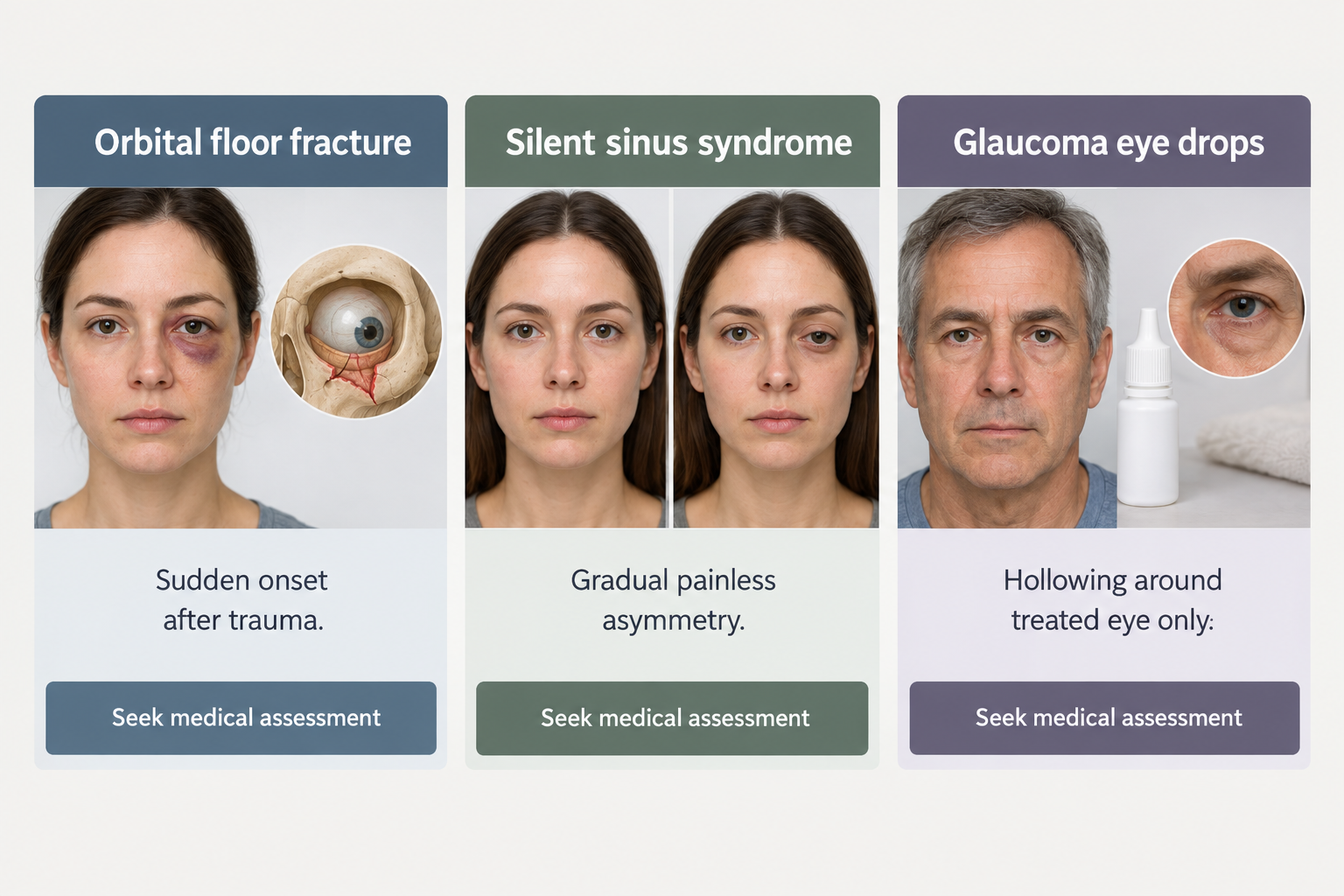
Trauma to the face can fracture the thin bone forming the floor of the orbital cavity — a blowout fracture. When this occurs, orbital fat and sometimes the inferior rectus muscle can herniate downward into the maxillary sinus, reducing the volume of tissue supporting the eye and causing it to sink backward and downward into the socket. This produces true enophthalmos and may also cause double vision and restricted eye movement. An orbital floor fracture is a medical emergency requiring prompt imaging and specialist assessment.
Silent Sinus Syndrome
Silent sinus syndrome is a less well-known but important cause of one-sided sunken eyes. In this condition, the maxillary sinus — the air-filled cavity beneath the orbital floor — gradually collapses inward due to chronic negative pressure, pulling the orbital floor downward with it. The result is progressive enophthalmos and a sunken appearance on the affected side, often without any pain or obvious sinus symptoms. Because it develops slowly and painlessly, it is frequently mistaken for a cosmetic concern before the structural cause is identified. Surgical repair of the sinus is required to correct it.
Glaucoma Eye Drops
Prostaglandin analogue eye drops — a commonly prescribed class of medication for glaucoma — are associated with a side effect called prostaglandin-associated periorbitopathy. This includes periorbital fat loss, deepening of the upper eyelid sulcus, and a sunken appearance around the treated eye. The effect is often unilateral (affecting only the eye being treated), which can make the asymmetry particularly noticeable. Patients who notice progressive hollowing around one eye while using glaucoma eye drops should raise this with their ophthalmologist, as alternative medications or formulations may be available.
Radiotherapy-Induced Changes
Radiotherapy to the head or face — used in the treatment of certain cancers — can cause atrophy of orbital fat and surrounding soft tissues over months to years following treatment. The resulting periorbital hollowing is a recognised late effect of radiation and can be significant. Management typically involves reconstructive approaches rather than standard cosmetic treatments, and specialist input is essential.
One-Sided Sunken Eyes: A Red Flag Worth Knowing
When sunken eyes develop asymmetrically — affecting one eye noticeably more than the other — or when the change appears suddenly rather than gradually, this warrants prompt medical evaluation. One-sided (unilateral) sunken eyes can indicate an orbital floor fracture following trauma, silent sinus syndrome, an orbital tumour, or other structural pathology. The sudden onset of enophthalmos in particular should be treated as a potential emergency. By contrast, mild natural asymmetry that has been present for years and is stable is generally not a cause for concern. The key distinction is change: a new or worsening asymmetry should always be assessed by a medical professional.
How Reversible Are Sunken Eyes?
The reversibility of sunken eyes depends almost entirely on the underlying cause. Dehydration-related hollowing is among the most rapidly reversible — adequate hydration can produce visible improvement within a day. Sleep deprivation effects similarly resolve with rest. Nutritional deficiencies improve as the deficiency is corrected, though this may take weeks to months. Allergy and sinus-related changes typically resolve with treatment of the underlying condition.
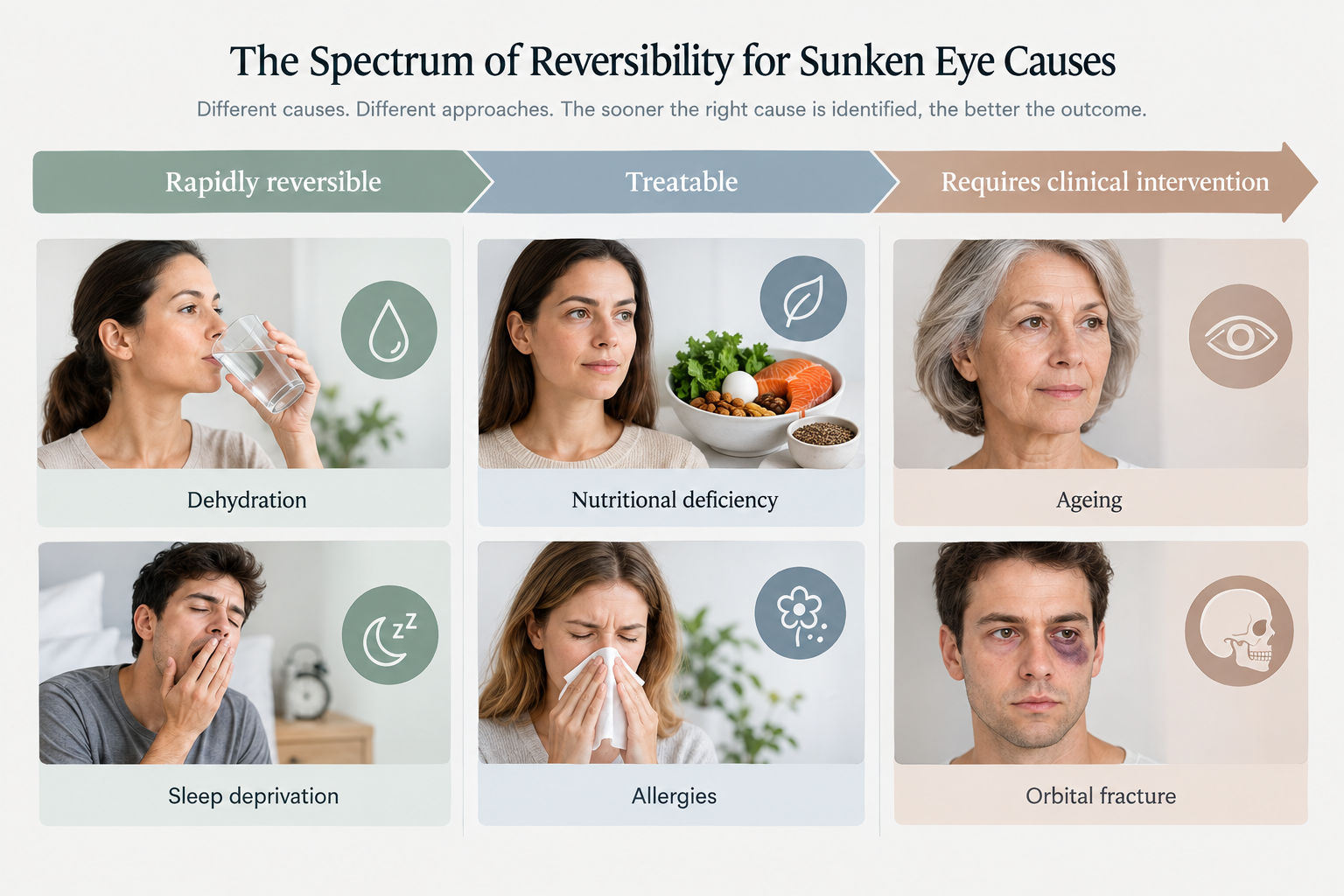
Age-related volume loss, periorbital fat loss, and bone resorption are not reversible through lifestyle changes alone. These structural changes generally require clinical intervention — such as dermal fillers to restore volume in the tear trough area, fat grafting, or in some cases surgical approaches — to produce meaningful improvement. Causes related to medical conditions such as thyroid eye disease, autoimmune conditions, or medication side effects require management of the underlying condition first, with reconstructive or aesthetic options considered afterward where appropriate. Trauma-related enophthalmos from an orbital floor fracture or silent sinus syndrome requires surgical correction.
Frequently Asked Questions
Can sunken eyes be a sign of something serious?
In most adults, sunken eyes reflect lifestyle factors or gradual age-related changes rather than a serious medical condition. However, sudden onset, one-sided hollowing, or hollowing accompanied by other symptoms such as pain, vision changes, or restricted eye movement should be assessed by a doctor promptly, as these can indicate orbital fracture, silent sinus syndrome, or other conditions requiring medical treatment.
Are sunken eyes the same as dark circles?
Not exactly. Dark circles and sunken eyes often appear together because the hollow created by volume loss casts a shadow that looks dark. However, dark circles can also result from pigmentation, visible blood vessels, or skin discolouration without any significant hollowing. Conversely, sunken eyes can be present without prominent dark circles. The distinction matters because the treatments for pigmentation-based dark circles differ from those for structural hollowness.
Why do sunken eyes look worse in the morning?
Fluid distribution shifts during sleep, and some people retain fluid in certain areas while others experience temporary deflation of the periorbital tissues. Dehydration from overnight fasting, reduced circulation, and the effects of sleep position can all make hollowing appear more pronounced first thing in the morning. The appearance often improves after hydration and movement.
Can children get sunken eyes for reasons other than dehydration?
Dehydration is the most common and most urgent cause in children, but genetics can also produce a naturally deep-set or hollow eye appearance from birth or early childhood. Nutritional deficiencies and illness-related weight loss can also contribute. If a child's sunken eye appearance is new, worsening, or accompanied by other symptoms, a paediatric assessment is appropriate.
Do glaucoma eye drops really cause sunken eyes?
Yes, this is a documented side effect of prostaglandin analogue eye drops, which are among the most commonly prescribed medications for glaucoma. The effect — known as prostaglandin-associated periorbitopathy — includes periorbital fat loss and deepening of the upper eyelid sulcus. It typically affects only the treated eye, creating a visible asymmetry. Patients concerned about this should speak with their ophthalmologist about alternatives.
Is there a difference between deep-set eyes and sunken eyes?
Yes. Deep-set eyes are an inherited anatomical feature where the eyes naturally sit further back in the orbital cavity, with a prominent brow bone. This is a normal variation and is not associated with any health concern. Sunken eyes, by contrast, describe a change — either gradual or sudden — in which the periorbital area appears more hollow than it previously did, usually due to volume loss, structural change, or an underlying condition.
When to See a Doctor About Sunken Eyes
Most cases of gradually developing under-eye hollowness in adults are cosmetic in nature and do not require urgent medical attention. However, a medical assessment is advisable if the hollowing is new and appeared suddenly, affects only one eye, is accompanied by pain, vision changes, or double vision, follows a facial injury, or occurs alongside other unexplained symptoms such as fatigue, weight loss, or systemic illness. In children, sunken eyes combined with signs of dehydration — dry mouth, reduced tears, decreased urination, or lethargy — require prompt medical evaluation. When in doubt, a GP or ophthalmologist is the appropriate first point of contact to rule out structural or systemic causes before any cosmetic assessment is considered.
