

A non-surgical Brazilian butt lift — sometimes called a liquid BBL — uses injectable fillers, energy-based devices, or a combination of both to add volume, improve shape, and enhance the contour of the buttocks without surgery, general anaesthesia, or significant downtime. It is not a replacement for a surgical BBL in terms of volume change, but for patients seeking modest, natural-looking enhancement or those who are not suitable candidates for fat transfer surgery, it represents a clinically meaningful alternative worth understanding in detail.
Key Takeaways
- A non-surgical BBL typically uses biostimulatory fillers such as Sculptra or Radiesse to add volume and stimulate collagen production in the gluteal region, with results developing gradually over two to four months.
- Results are temporary — most injectable treatments last between 12 months and two years depending on the product used — and maintenance sessions are required to sustain the effect.
- The procedure is best suited to patients wanting modest enhancement, improved shape, or hip dip correction rather than a dramatic increase in size.
- Risks are generally lower than surgical BBL, but the procedure is not risk-free; choosing a qualified medical professional with specific experience in gluteal augmentation is essential.
- Realistic expectations are critical: a non-surgical BBL cannot replicate the volume or permanence of surgical fat grafting, and patients with significant skin laxity or very large volume goals are unlikely to be satisfied with injectable results alone.
What Is a Non-Surgical BBL?
Gluteal augmentation has traditionally been achieved through surgical fat grafting — harvesting fat from the abdomen, flanks, or thighs and transferring it to the buttocks. While effective for significant volume change, surgical BBL carries meaningful risks including fat embolism, a rare but potentially fatal complication in which fat enters the bloodstream, as well as the full recovery burden of a major surgical procedure. The non-surgical BBL emerged as a response to demand for buttock enhancement with fewer risks and no surgical recovery.
In clinical practice, the term covers several distinct approaches. The most established involve injecting dermal fillers — particularly collagen biostimulators — directly into the gluteal tissue to add volume, improve projection, and refine contour. Device-based treatments such as Emsculpt NEO use electromagnetic energy to build gluteal muscle mass, offering a different mechanism that improves shape through muscle development rather than volume addition. Some clinics combine both approaches for a more comprehensive body contouring outcome.
Which Products and Treatments Are Used?
Understanding the differences between available options is important because the mechanism, onset, longevity, and suitability vary considerably between products.
Sculptra (Poly-L-Lactic Acid)
Sculptra is a biostimulatory filler containing poly-L-lactic acid (PLLA), a synthetic material that stimulates the body’s own collagen production rather than simply adding volume directly. When injected into the gluteal region, PLLA particles trigger a controlled inflammatory response that leads to collagen remodeling over the following weeks and months. Results are gradual — most patients begin to notice improvement at six to eight weeks, with full results typically visible at three to four months. Because the effect depends on collagen biostimulation rather than immediate volume, multiple sessions are usually required, commonly two to four treatments spaced four to eight weeks apart. Results from Sculptra in the gluteal area may last approximately two years, though individual variation is significant. Sculptra is widely considered the most established injectable option for non-invasive butt augmentation.
Radiesse and Hyperdilute Radiesse (Calcium Hydroxylapatite)
Radiesse contains calcium hydroxylapatite (CaHA) microspheres suspended in a gel carrier. It provides an immediate volumising effect from the gel component while simultaneously stimulating collagen production as the microspheres are gradually absorbed. A specific technique known as hyperdilute Radiesse involves diluting the product with saline and lidocaine before injection, which spreads the biostimulatory effect across a broader area and is particularly useful for improving skin quality, texture, and mild laxity in the gluteal region. Peer-reviewed research published in the medical literature supports the use of hyperdilute CaHA for gluteal augmentation, noting improvements in skin quality alongside modest volume enhancement. Results from Radiesse typically last 12 to 18 months.
Hyaluronic Acid Fillers
Hyaluronic acid (HA) fillers can be used for gluteal augmentation and offer the advantage of being reversible with hyaluronidase enzyme if needed. However, HA fillers are generally considered a third-tier option for this area because the volumes required for meaningful gluteal enhancement are large, the cost per vial is significant, and the results typically last only around 12 months. HA fillers may be more appropriate for targeted corrections such as hip dip filling rather than overall buttock volume.
AlloClae (Injectable Fat Transfer Filler)
AlloClae is an emerging injectable product designed to replicate some of the effects of surgical fat grafting without the need for liposuction. It represents a next-generation approach to non-surgical gluteal augmentation and is generating interest in the aesthetic medicine community, though clinical evidence is still developing and availability varies by country. Patients interested in this option should discuss its current regulatory status and evidence base with a qualified practitioner.
Emsculpt NEO
Emsculpt NEO combines high-intensity focused electromagnetic energy (HIFEM) with radiofrequency (RF) heating. The HIFEM component induces supramaximal muscle contractions — contractions far beyond what voluntary exercise can achieve — which stimulate muscle fibre remodelling and growth in the gluteus maximus. The RF component simultaneously reduces fat in the overlying tissue. Emsculpt NEO does not add volume in the same way as injectable fillers; instead, it improves gluteal shape and lift through muscle development. Results typically require a course of four sessions and may last six to twelve months with maintenance treatments. It is a useful option for patients who want improved tone and lift rather than volume addition, and it can be combined with injectable treatments for a more comprehensive outcome.
Combination Protocols
Some clinicians use combination approaches to optimise results. For example, pairing Sculptra injections with Emsculpt NEO can address both volume and muscle tone simultaneously. Alternatively, CoolSculpting or cryolipolysis applied to the flanks and lower back can reduce surrounding fat, making the buttocks appear more projected and shapely without adding volume to the gluteal region itself. These combination body contouring strategies are an area of genuine clinical interest, though individual treatment plans should always be based on a thorough assessment of the patient’s anatomy and goals.
| Treatment | Mechanism | Onset | Longevity | Best For |
|---|---|---|---|---|
| Sculptra (PLLA) | Collagen biostimulation | 2–4 months (gradual) | ~2 years | Overall volume, gradual natural results |
| Radiesse / Hyperdilute Radiesse (CaHA) | Immediate volume + collagen stimulation | Immediate + gradual | 12–18 months | Volume, skin quality, texture |
| Hyaluronic Acid Filler | Direct volume replacement | Immediate | ~12 months | Targeted corrections, hip dips |
| AlloClae | Injectable fat transfer filler | Gradual | Emerging data | Fat-like volume addition (evolving) |
| Emsculpt NEO | HIFEM muscle stimulation + RF | 2–4 weeks post-course | 6–12 months | Lift, tone, muscle definition |
Non-Surgical BBL vs. Surgical BBL
Understanding the genuine differences between these two approaches helps patients set realistic expectations before committing to either path.
| Factor | Non-Surgical BBL | Surgical BBL (Fat Transfer) |
|---|---|---|
| Invasiveness | Minimally invasive (injections) | Major surgical procedure |
| Anaesthesia | Topical numbing cream only | General or epidural anaesthesia |
| Downtime | Minimal (24–48 hours) | 2–6 weeks |
| Volume change | Modest (subtle to moderate) | Significant (large volume possible) |
| Results onset | Gradual (weeks to months) | Visible immediately (with swelling) |
| Longevity | 12 months to ~2 years | Long-lasting (fat that survives is permanent) |
| Key risks | Swelling, bruising, asymmetry, filler migration (rare) | Fat embolism, infection, asymmetry, necrosis |
| Requires donor fat | No | Yes — sufficient fat deposits needed |
| Suitable for lean patients | Yes | Often not — insufficient donor fat |
| Reversibility | Partial (HA fillers reversible; biostimulators are not) | Not reversible |
The most important distinction is volume capacity. Surgical fat grafting can add hundreds of millilitres of volume to the gluteal region, producing a dramatic change in size and shape. Injectable fillers, even when multiple vials are used across several sessions, produce a more modest enhancement. Patients whose primary goal is a significant increase in size are unlikely to achieve that outcome through non-surgical means alone.
What Happens During a Non-Surgical BBL Appointment?
A typical injectable non-surgical BBL appointment begins with a consultation and body mapping, during which the practitioner assesses the patient’s anatomy, discusses goals, and marks the areas to be treated. A topical numbing cream is applied to the treatment area and left for 20 to 40 minutes before the procedure begins. The injections themselves are performed using a cannula or needle depending on the product and technique, with the practitioner placing the filler at precise depths within the gluteal tissue. The entire treatment session usually takes between 30 and 60 minutes. Most patients describe the procedure as mildly uncomfortable rather than painful, though individual tolerance varies.
After the injections, the area may be gently massaged to distribute the product evenly. Patients are typically advised to avoid sitting directly on the buttocks for 24 to 48 hours following treatment, to sleep on their front or side during the initial recovery period, and to avoid strenuous exercise for approximately one week. Swelling, bruising, tenderness, and redness at the injection sites are common in the first few days and generally resolve within one to two weeks.
What Results Can You Realistically Expect and When?
The timeline of results depends significantly on which product is used. With Sculptra, patients should not expect to see meaningful change immediately after the first session. The collagen remodeling process takes time, and results build progressively over two to four months. Many practitioners describe the Sculptra approach as a gradual investment — each session adds to the cumulative effect, and the final result is typically assessed three to four months after the last treatment.
Radiesse provides more immediate visible volume from the gel carrier, with additional improvement developing over the following weeks as collagen stimulation takes effect. Hyaluronic acid fillers produce the most immediate result but also the shortest duration.
A realistic month-by-month expectation for a Sculptra-based non-surgical BBL might look like this: at two weeks, mild swelling has resolved and the area looks similar to baseline; at one to two months, early collagen formation begins to produce subtle improvement; at three months, results become more clearly visible; at four to six months, the full effect of the treatment course is apparent. Maintenance sessions are typically recommended every 12 to 24 months to sustain the outcome.
It is important to understand that natural-looking enhancement — rather than dramatic transformation — is the realistic goal. Patients who approach the procedure with this understanding tend to be more satisfied with their outcomes.
Who May Be a Suitable Candidate?
A non-surgical BBL may be worth discussing with a qualified practitioner if you are an adult in good general health who wants modest improvement in gluteal shape, projection, or symmetry. It is particularly well-suited to lean or athletic patients — sometimes referred to as candidates for a skinny BBL — who do not have sufficient donor fat for surgical fat grafting but still want meaningful enhancement. Patients who want to avoid surgery, general anaesthesia, and a prolonged recovery period are also reasonable candidates, as are those seeking hip dip correction or improvement in the overall contour of the lower body without a dramatic size increase.
Patients with mild skin laxity in the gluteal region may also benefit, particularly from hyperdilute Radiesse, which has demonstrated improvements in skin quality alongside volume effects in published clinical data.
Who Should Avoid a Non-Surgical BBL?
Non-surgical gluteal augmentation is not appropriate for everyone. Patients who want a significant increase in buttock size are unlikely to achieve their goals through injectable means and should discuss surgical options with a plastic surgeon instead. Those with significant skin laxity — loose, sagging skin — may not see satisfactory improvement from fillers alone, as injectables add volume but do not tighten skin in the way that a surgical lift would.
Contraindications include pregnancy and breastfeeding, active infection in or near the treatment area, autoimmune conditions that may affect healing or filler integration, bleeding disorders or use of anticoagulant medications, a history of keloid scarring, and known allergy to any component of the chosen filler. Patients with unrealistic expectations — for example, those expecting results equivalent to surgical BBL — are not suitable candidates regardless of their physical characteristics.
Risks and Side Effects
Common side effects of injectable non-surgical BBL include swelling, bruising, tenderness, and redness at the injection sites. These are generally temporary and resolve within one to two weeks. Asymmetry between the two sides is possible and may require a touch-up treatment to correct.
Rarer but more serious risks include filler migration — where product moves away from the intended area — and granuloma formation, an inflammatory reaction to the filler material. Infection is possible with any injectable procedure and underscores the importance of treatment in a clean clinical environment by a trained practitioner. Biostimulatory fillers such as Sculptra and Radiesse are not reversible with an enzyme, unlike hyaluronic acid fillers, which means that any adverse outcome from these products must resolve naturally over time.
A critical safety point is the importance of avoiding unregulated or non-medical injections. Reports of serious complications — including tissue necrosis, severe infection, and permanent disfigurement — have been associated with injections performed outside licensed medical settings, using unregulated substances, or by unqualified individuals. The gluteal region contains significant vascular structures, and injections performed without appropriate anatomical knowledge carry serious risks.
How Much Does a Non-Surgical BBL Cost?
Cost varies considerably depending on the product used, the number of vials required, the number of sessions, and the clinic’s location and pricing structure. Individual vials of Sculptra or Radiesse typically cost between £300 and £800 per vial in the UK, or approximately $400 to $1,000 in the US. Achieving noticeable results in the gluteal region generally requires eight to ten or more vials per session, making a single treatment session cost between £2,000 and £6,000 or more. When multiple sessions are factored in, the total investment for a full course of treatment commonly ranges from £4,000 to £12,000 or higher.
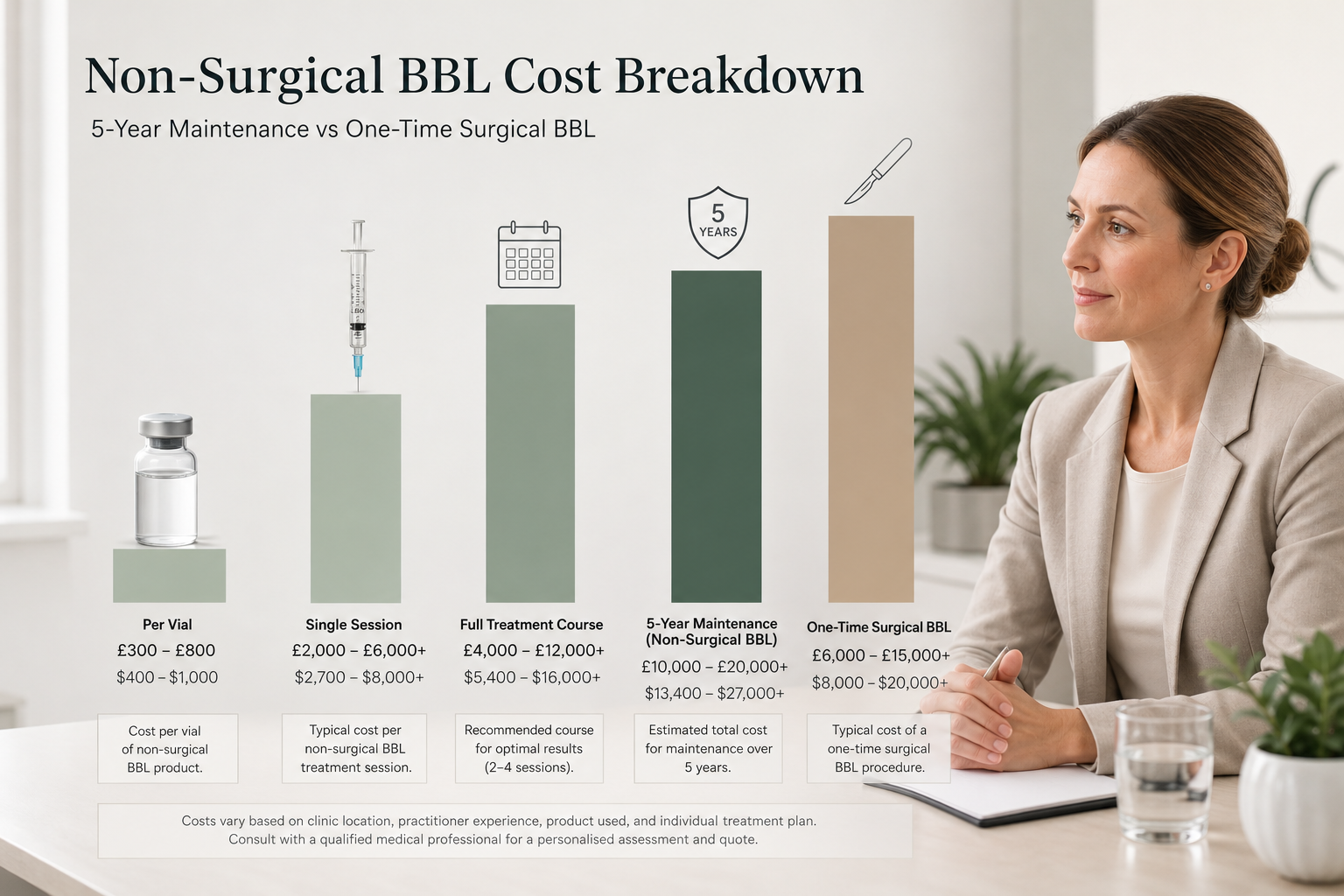
It is also worth considering the long-term cost of maintenance sessions. Unlike surgical fat grafting, where surviving transferred fat is permanent, injectable results require ongoing maintenance every one to two years. Over a five-year period, the cumulative cost of non-surgical maintenance may approach or exceed the one-time cost of a surgical BBL, depending on the clinic and the number of vials needed. This is a meaningful financial consideration that patients should discuss openly during their consultation.
How to Choose a Provider
Provider selection is one of the most important decisions in the non-surgical BBL process and is an area where many patients do not receive adequate guidance. A board-certified injector or qualified medical professional with specific training and documented experience in gluteal augmentation should be the minimum standard. In the UK, this means a practitioner registered with a recognised medical regulatory body such as the GMC, GDC, or NMC, working within a CQC-registered clinic. In the US, look for a board-certified dermatologist or plastic surgeon, or a nurse practitioner or physician assistant working under appropriate medical supervision.
Questions worth asking at consultation include: What product do you recommend for my goals and why? How many gluteal augmentation procedures have you performed? What is your protocol if I experience a complication? Can you show me before-and-after photographs of your own patients? Red flags include practitioners who cannot answer these questions clearly, clinics operating outside regulated medical settings, unusually low pricing that may indicate diluted or counterfeit products, and any provider who guarantees specific results.
The use of FDA-cleared or CE-marked products in their approved formulations is an important baseline. Some fillers used for gluteal augmentation are used off-label — meaning outside their originally licensed indication — which is a common and accepted practice in aesthetic medicine, but it should be disclosed and discussed transparently by the practitioner.
Frequently Asked Questions
How many sessions will I need?
Most patients require two to four sessions of injectable treatment to achieve their desired outcome, spaced four to eight weeks apart. The exact number depends on the product used, the degree of enhancement sought, and how the individual responds to treatment. Emsculpt NEO typically requires a course of four sessions over two to three weeks.
Is the procedure painful?
Most patients find the procedure tolerable. A topical numbing cream is applied before treatment, and many fillers contain lidocaine to reduce discomfort during injection. The gluteal area is generally less sensitive than facial injection sites. Some tenderness and soreness in the days following treatment is normal.
Can I sit down after a non-surgical BBL?
Most practitioners advise avoiding direct pressure on the treated area for 24 to 48 hours after injectable treatment. This means avoiding prolonged sitting and sleeping on the front or side during the initial recovery period. Specific aftercare instructions will vary by product and practitioner.
Will the results look natural?
When performed by an experienced practitioner using appropriate volumes, results are typically described as natural-looking enhancement — an improvement in shape and projection rather than an obviously augmented appearance. Overfilling or poor technique can produce unnatural results, which is another reason provider selection matters significantly.
Can a non-surgical BBL correct hip dips?
Hip dip correction is one of the more targeted applications of injectable gluteal augmentation. Hyaluronic acid fillers or biostimulatory fillers can be placed specifically in the lateral hip depression to soften the indentation and create a smoother contour from the waist to the thigh. Results are typically modest and temporary but can be meaningful for patients bothered by this specific concern.
What happens when the filler wears off?
As biostimulatory fillers are gradually absorbed, the collagen they stimulated also diminishes over time, and the gluteal region returns toward its pre-treatment appearance. The process is gradual rather than sudden. Maintenance sessions can be scheduled before results fully fade to sustain the effect. There is no evidence that the area looks worse than before treatment once the filler has resolved.
Is a non-surgical BBL safe for lean patients who cannot have a surgical BBL?
Lean and athletic patients who lack sufficient donor fat for surgical fat grafting are often well-suited to injectable gluteal augmentation. The procedure does not require any fat harvesting, making body composition less of a limiting factor. A thorough consultation will assess whether the patient’s skin quality, tissue characteristics, and goals are compatible with injectable treatment.
Is a Non-Surgical BBL the Right Choice for Your Goals?
A non-surgical BBL can be a clinically appropriate and satisfying option for patients who want modest, natural-looking improvement in gluteal shape, projection, or contour — particularly those who are not surgical candidates, those with a lean body type, or those who want to avoid the risks and recovery associated with surgical fat grafting. The procedure is minimally invasive, requires little downtime, and when performed by a qualified medical professional using established products, carries a manageable risk profile.
However, it is important to approach this treatment with realistic expectations. A non-surgical BBL cannot replicate the volume change achievable through surgical fat transfer, does not produce permanent results, and requires ongoing maintenance sessions to sustain the effect. The cumulative cost over several years is a meaningful consideration, and patients with significant skin laxity or very large volume goals are unlikely to be well served by injectable treatment alone.
If you are considering a non-surgical BBL, a thorough consultation with a board-certified injector or qualified medical professional who specialises in body contouring and gluteal augmentation is the appropriate starting point. A good practitioner will assess your anatomy honestly, discuss which products or combination of treatments may suit your goals, and help you understand what is and is not achievable before you commit to treatment.
