
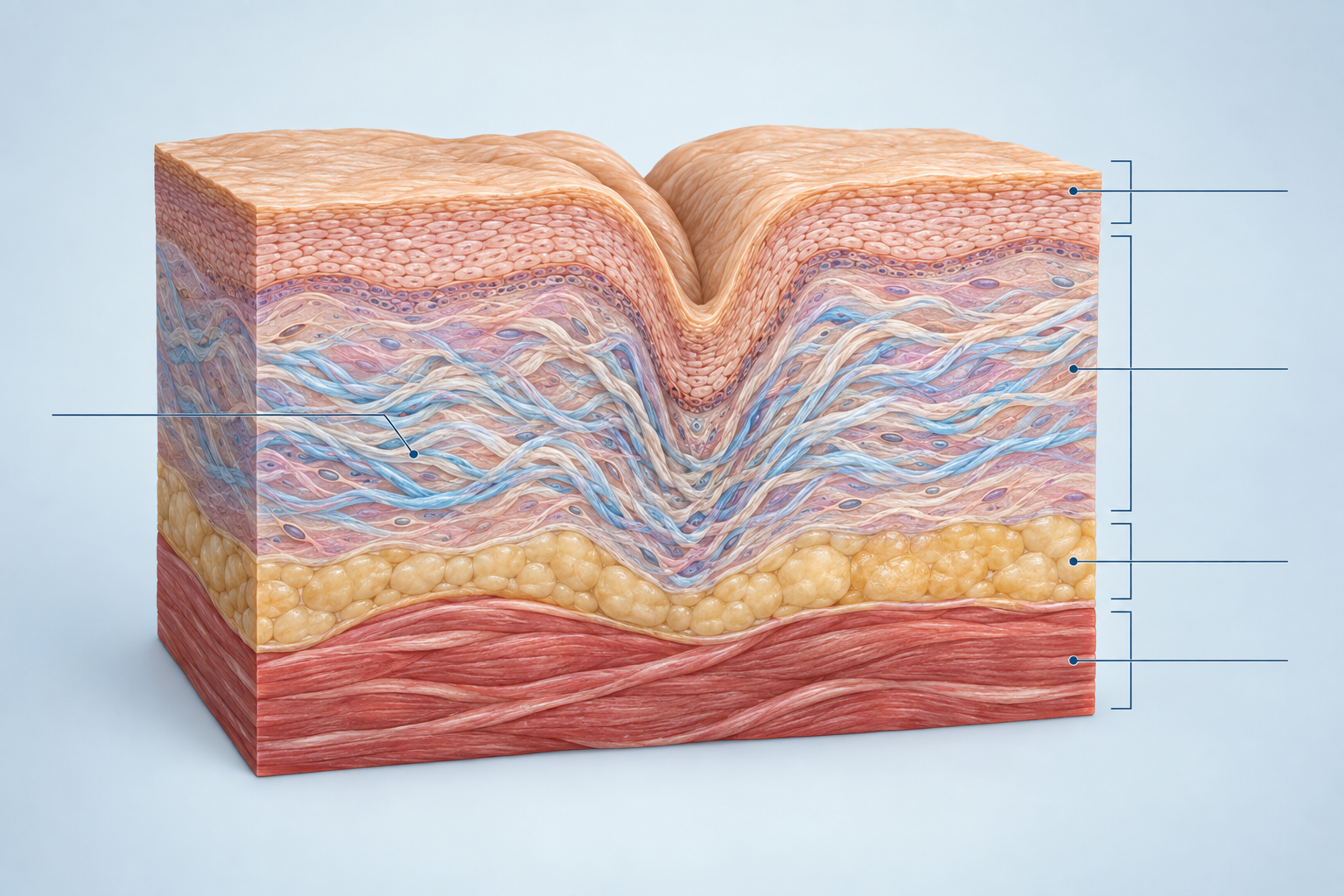

Deep facial wrinkles — the kind that remain visible even when your face is completely relaxed — are among the most common concerns patients bring to aesthetic consultations. Unlike fine surface lines, etched facial lines form over years of repeated muscle movement, collagen loss, and cumulative sun exposure, which means they typically require more targeted approaches than basic skincare alone can provide. This article explains the main clinical options available, how each one works, what realistic improvement looks like, and the factors that influence which treatment may be most appropriate for a given patient.
Key Takeaways
- Deep wrinkles are caused by a combination of repeated muscle movement, progressive collagen loss, and skin thinning — no single treatment addresses all three mechanisms simultaneously.
- Botulinum toxin injections, dermal fillers, laser resurfacing, radiofrequency treatments, and chemical peels each target different aspects of facial ageing and may be used alone or in combination.
- Results vary considerably between patients depending on skin type, wrinkle depth, age, lifestyle, and the specific treatment chosen.
- Most non-surgical treatments require maintenance sessions to sustain results; none offer permanent correction.
- A thorough consultation with a qualified practitioner is essential before choosing any treatment, as suitability depends on individual anatomy, medical history, and realistic goals.
Why Deep Wrinkles Form and Why They Are Harder to Treat
Understanding why deep wrinkles develop helps explain why treating them is more complex than addressing early-stage fine lines. The skin's structural integrity depends on collagen and elastin fibres produced by fibroblasts in the dermis. From the mid-twenties onwards, collagen production gradually declines, and the existing fibres become less organised. At the same time, repeated facial expressions — frowning, squinting, smiling — create mechanical stress along predictable lines. Over time, these dynamic lines become static wrinkles: creases that are visible at rest, not just during movement.
Additional factors accelerate this process. Ultraviolet radiation degrades collagen and elastin directly, which is why sun-exposed areas such as the forehead, perioral region, and cheeks tend to show deeper lines earlier. Smoking impairs skin microcirculation and collagen synthesis. Volume loss in the underlying fat compartments and bone remodelling cause the skin to lose its support structure, making existing lines appear deeper. This multi-factorial origin means that the most effective approach to deep facial wrinkles often involves addressing more than one contributing factor.
Botulinum Toxin Injections for Dynamic Deep Lines
Botulinum toxin — available under brand names including Botox, Dysport, and Azzalure — works by temporarily blocking the nerve signals that cause specific facial muscles to contract. When the underlying muscle activity is reduced, the overlying skin is no longer repeatedly folded, which allows existing lines to soften and prevents further deepening. Botulinum toxin is most effective for dynamic wrinkles: lines that are primarily driven by muscle movement, such as horizontal forehead lines, glabellar frown lines between the brows, and crow's feet around the eyes.

For deep static wrinkles — lines that remain clearly visible when the face is at rest — botulinum toxin alone is often insufficient. It can reduce the severity of these lines by eliminating the muscular component, but it cannot replace lost volume or resurface the skin. In practice, many patients with deep dynamic lines see meaningful softening after treatment, while those with heavily etched static lines may find that botulinum toxin improves but does not fully resolve the concern. Results typically become visible within a few days to two weeks and generally last three to four months, after which repeat treatment is needed to maintain the effect.
Side effects are usually mild and temporary, including localised bruising, swelling, or tenderness at injection sites. More significant complications such as eyelid ptosis (drooping) or asymmetry are uncommon when treatment is performed by an experienced practitioner but are a recognised risk. Botulinum toxin is not suitable during pregnancy or breastfeeding, and certain neuromuscular conditions may be a contraindication.
Dermal Fillers for Volume Loss and Deep Facial Lines
Dermal fillers are injectable substances used to restore volume, smooth deep lines, and improve facial contour. The most widely used fillers in aesthetic medicine contain hyaluronic acid, a naturally occurring molecule that attracts and retains water within the tissue. Hyaluronic acid fillers are reversible using an enzyme called hyaluronidase, which is an important safety consideration. Other filler types include calcium hydroxylapatite and poly-L-lactic acid, which work partly by stimulating the body's own collagen production over time.
For deep nasolabial folds (the lines running from the nose to the corners of the mouth), marionette lines, and perioral lines, dermal fillers can provide immediate visible improvement by physically filling the depression beneath the skin. The result is a smoother surface contour rather than a change in skin texture. Filler placed in the mid-face to restore volume in the cheeks can also indirectly reduce the appearance of lower-face lines by lifting and supporting the overlying tissue.
The longevity of hyaluronic acid fillers varies depending on the product formulation, the treatment area, and individual metabolism, but most patients can expect results to last between six and eighteen months. Denser, more cross-linked formulations used for deeper lines tend to last longer than lighter products used for superficial concerns. Risks include bruising, swelling, asymmetry, nodule formation, and — in rare but serious cases — vascular occlusion, which can occur if filler is inadvertently injected into or compresses a blood vessel. This risk underscores the importance of treatment by a practitioner with detailed anatomical knowledge and appropriate emergency protocols.
Laser Resurfacing for Skin Texture and Deep Wrinkle Reduction
Laser resurfacing is one of the most established clinical approaches for reducing deep wrinkles, particularly those caused by skin thinning, sun damage, and collagen loss rather than volume deficit alone. Ablative lasers — including carbon dioxide (CO2) and erbium lasers — remove the outer layers of skin in a controlled manner, triggering a wound-healing response that stimulates new collagen formation and produces smoother, tighter skin as it heals. Fractional laser systems deliver energy in a grid pattern, treating a fraction of the skin surface at each session while leaving surrounding tissue intact, which reduces recovery time compared with fully ablative treatment.
Ablative fractional CO2 laser resurfacing has a substantial body of clinical evidence supporting its effectiveness for moderate to deep facial wrinkles, particularly perioral lines and forehead lines. Improvement in wrinkle depth and skin texture is typically progressive over three to six months as new collagen matures. A single treatment session may produce significant results, though some patients benefit from more than one session depending on wrinkle severity and skin condition.
Recovery after ablative laser resurfacing involves a meaningful period of downtime. The skin will be red, swollen, and may weep or crust for one to two weeks following treatment, with residual redness potentially persisting for several weeks to months. Patients with darker skin tones face a higher risk of post-inflammatory hyperpigmentation (PIH) — temporary or sometimes prolonged darkening of the treated area — and require careful assessment before ablative laser treatment. Other risks include infection, scarring, and changes in skin pigmentation. Non-ablative laser and light-based treatments carry less downtime but also produce more modest results for deep wrinkles.
Radiofrequency Treatments and Skin Tightening
Radiofrequency (RF) energy heats the deeper layers of the skin and underlying tissue, causing immediate collagen contraction and stimulating longer-term collagen remodelling. RF treatments are available in several forms: non-invasive surface devices, microneedling radiofrequency (which combines fine needles with RF energy delivery into the dermis), and more intensive surgical-grade RF systems. Microneedling RF in particular has gained clinical interest for its ability to deliver controlled thermal energy at precise depths, which may improve skin laxity and reduce the appearance of deep lines with less surface disruption than ablative lasers.
Results from radiofrequency treatments for deep wrinkles tend to be more gradual than those from ablative laser resurfacing. Improvement in skin firmness and line depth typically develops over two to six months as collagen remodelling progresses, and multiple sessions are often recommended. The evidence base for RF treatments continues to develop, and results vary considerably between devices, protocols, and individual patients. RF treatments are generally better suited to patients with mild to moderate skin laxity and early to moderate wrinkle depth rather than severely etched lines.
Downtime is generally shorter than with ablative lasers, particularly for non-ablative RF devices, though microneedling RF may cause several days of redness and mild swelling. Risks include temporary redness, swelling, bruising, and — less commonly — burns or changes in pigmentation if treatment parameters are not appropriately calibrated for the patient's skin type.
Chemical Peels for Surface Wrinkle Improvement
Chemical peels use acidic solutions to remove the outer layers of skin, stimulating cell turnover and, at deeper peel depths, collagen production. They are categorised by depth: superficial peels (such as low-concentration glycolic or salicylic acid) address surface texture and mild lines; medium-depth peels (such as trichloroacetic acid, or TCA) penetrate further and can improve moderate wrinkles; deep peels (such as phenol-based formulations) reach the reticular dermis and can produce significant improvement in deep wrinkles, but carry the most substantial risks and the longest recovery.
For deep facial wrinkles, medium to deep chemical peels may offer meaningful improvement in skin texture and line depth, particularly for perioral and periorbital lines. However, deep phenol peels carry significant risks including prolonged healing, permanent skin lightening (which can create a visible demarcation line), cardiac arrhythmia risk during the procedure, and scarring. These risks mean that deep peels are performed less frequently in contemporary practice and require careful patient selection and medical oversight. Medium-depth TCA peels represent a more commonly used option for moderate wrinkle improvement with a more manageable risk profile, though they still require several days to a week of recovery.
Combination Approaches and Treatment Planning
Because deep facial wrinkles typically result from multiple overlapping processes — muscle activity, volume loss, collagen degradation, and skin thinning — the most comprehensive results are often achieved through a combination of treatments rather than a single modality. A common clinical approach might involve botulinum toxin to address the dynamic muscular component, dermal fillers to restore volume and directly fill deep folds, and a resurfacing treatment such as fractional laser or a medium-depth peel to improve skin texture and stimulate collagen.
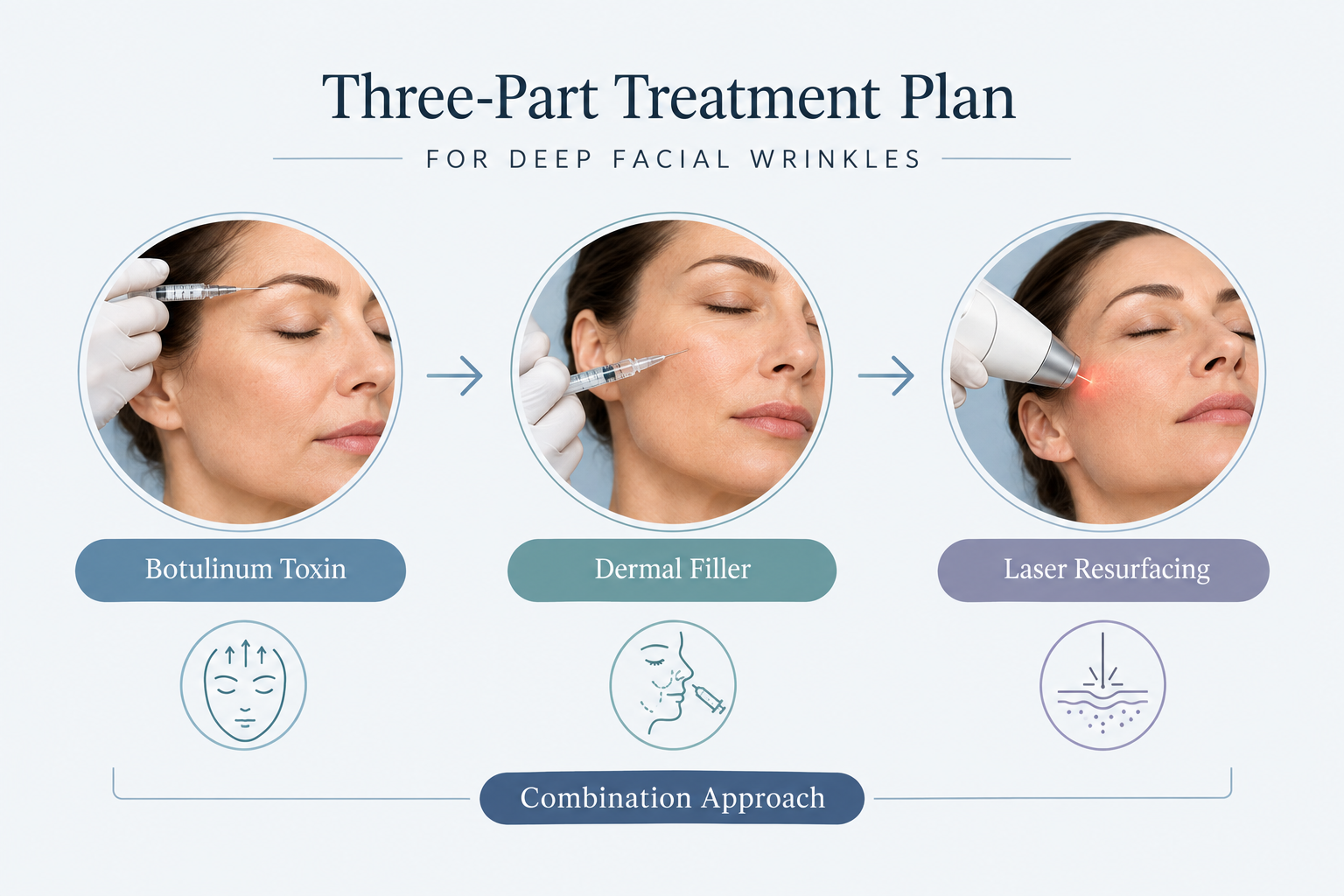
Combination treatment planning requires careful sequencing. For example, resurfacing treatments are generally performed before or well after filler injections to avoid disrupting placed product or introducing infection risk. Botulinum toxin is sometimes administered before resurfacing to reduce muscle movement during healing. The appropriate sequence and interval between treatments should be determined by the treating practitioner based on the specific treatments chosen and the patient's individual circumstances.
It is worth noting that combination approaches increase both the potential for improvement and the cumulative risk and cost. Patients should have a clear understanding of the full treatment plan, expected timeline, likely maintenance requirements, and total investment before proceeding.
Who May Be Suitable for Deep Wrinkle Treatments
Suitability for any of these treatments depends on a range of individual factors that a qualified practitioner will assess during consultation. General considerations include:
- Wrinkle type and depth: Dynamic lines respond well to botulinum toxin; static lines with volume loss respond better to fillers; surface texture and collagen-related lines may benefit most from resurfacing.
- Skin type and tone: Patients with darker skin tones face a higher risk of pigmentation changes with ablative lasers and deep peels and require careful assessment and potentially alternative approaches.
- Medical history: Certain conditions, medications (including anticoagulants), active skin infections, autoimmune conditions, and a history of keloid scarring may affect suitability for specific treatments.
- Pregnancy and breastfeeding: Most aesthetic treatments are not recommended during pregnancy or breastfeeding.
- Realistic expectations: Patients who understand that improvement rather than elimination of deep wrinkles is the realistic goal, and who accept the need for maintenance, tend to have more satisfying outcomes.
- Previous procedures: Prior treatments, including surgical procedures, previous filler placement, or isotretinoin use, may influence timing and treatment choice.
Risks, Limitations, and What to Expect Realistically
Every treatment discussed in this article carries a risk profile, and none offers a permanent solution to deep facial wrinkles. The most important limitation to understand is that deep, long-established wrinkles — particularly those with significant dermal scarring or substantial volume loss — may show only partial improvement even with the most appropriate treatment. Patients who expect complete elimination of deep lines are likely to be disappointed; patients who expect meaningful softening and improvement in overall skin quality are more likely to find the results worthwhile.
Maintenance is a consistent feature of all non-surgical approaches. Botulinum toxin requires repeat treatment every three to four months. Dermal fillers need topping up every six to eighteen months depending on the product and area. Laser and RF results are longer-lasting but not permanent, as the ageing process continues. Patients should factor ongoing maintenance costs and time into their decision-making.
Choosing a qualified, experienced practitioner is one of the most significant factors influencing both safety and outcome. Treatments such as filler injections and laser resurfacing carry serious potential complications when performed without adequate training or in inappropriate settings. Regulatory requirements for practitioners vary by country, and patients are advised to verify credentials and seek treatment in a clinical environment with appropriate emergency protocols.
Frequently Asked Questions
Can skincare products alone treat deep facial wrinkles?
Topical skincare — particularly products containing retinoids, vitamin C, peptides, and broad-spectrum sunscreen — can improve skin texture, slow further collagen loss, and reduce the appearance of fine lines over time. However, for established deep wrinkles, topical products alone are unlikely to produce significant visible improvement. They are most valuable as part of a maintenance strategy alongside clinical treatments and for preventing further deterioration.
How many treatment sessions are typically needed?
This depends entirely on the treatment chosen and the severity of the wrinkles. Botulinum toxin and dermal fillers typically produce results after a single session, though a follow-up appointment to assess and refine the result is common. Laser resurfacing may require one to three sessions. Radiofrequency treatments often involve a course of three to six sessions. A practitioner will advise on the likely number of sessions needed after assessing the individual patient.
Is there a treatment that works for all types of deep wrinkles?
No single treatment addresses every cause of deep facial wrinkles. The most appropriate option depends on whether the lines are primarily dynamic (muscle-driven), static (volume and collagen-related), or a combination of both. Many patients with deep wrinkles benefit from a combination approach tailored to their specific concerns and anatomy.
What is the recovery time for deep wrinkle treatments?
Recovery varies significantly. Botulinum toxin and hyaluronic acid filler injections typically involve minimal downtime — most patients return to normal activities the same day, though bruising or swelling may be visible for a few days. Ablative laser resurfacing involves one to two weeks of active healing and potentially several weeks of residual redness. Medium-depth chemical peels require approximately five to seven days of recovery. Radiofrequency treatments generally involve one to three days of mild redness and swelling.
At what age should someone consider treatment for deep wrinkles?
There is no universal age threshold. The decision is based on the degree of concern, the nature of the wrinkles, and the patient's goals rather than age alone. Some patients in their thirties develop deep dynamic lines that respond well to early botulinum toxin treatment; others in their fifties or sixties seek resurfacing or filler treatment for established static lines. A consultation with a qualified practitioner is the appropriate starting point regardless of age.
Can deep wrinkles return after treatment?
Yes. All non-surgical treatments for deep wrinkles are temporary to varying degrees. The ageing process continues after treatment, and without maintenance, lines will gradually return or deepen further. Consistent sun protection, a good skincare routine, and timely maintenance treatments can help prolong results.
Choosing the Right Treatment for Deep Facial Wrinkles
The best treatment for deep wrinkles on the face is not a single universal answer — it depends on the specific type and location of the lines, the underlying causes, the patient's skin type and medical history, and what level of downtime and investment is acceptable. Botulinum toxin is well-suited to dynamic lines driven by muscle movement. Dermal fillers address volume-related folds and deep static lines. Laser resurfacing and radiofrequency treatments target collagen loss and skin quality. Chemical peels offer a further option for surface texture and moderate line depth. For many patients with established deep wrinkles, a thoughtfully planned combination approach delivers the most comprehensive improvement.
What matters most before committing to any treatment is an honest, thorough consultation with a qualified aesthetic practitioner who can assess your specific concerns, explain realistic outcomes, and recommend an approach matched to your anatomy and goals. Improvement in deep facial lines is achievable for most patients, but it requires appropriate treatment selection, realistic expectations, and a commitment to maintenance over time.
