


Key Takeaways
- Deep frown lines form between the eyebrows due to repeated contraction of the corrugator and procerus muscles, compounded by age-related collagen loss and photodamage.
- The most important first step is distinguishing dynamic frown lines (present only during expression) from static, etched lines (visible even at rest) — because each type responds to different treatments.
- Botulinum toxin is widely considered the first-line treatment for dynamic glabellar lines; deeper, static lines often benefit from a combination treatment approach involving fillers and energy-based devices.
- No treatment permanently erases deep frown lines, but consistent, well-planned treatment can significantly soften them and slow further development.
- A clinical assessment by a qualified practitioner is essential before choosing any treatment — individual anatomy, skin quality, and severity all influence the best option.
What Are Deep Frown Lines and What Causes Them?
Deep frown lines — clinically referred to as glabellar lines — are the vertical creases that develop between the eyebrows, often forming the characteristic double groove sometimes called the “elevens.” They are among the earliest and most noticeable signs of facial ageing, and they can give the face a permanently tired, stern, or worried appearance even when a person feels entirely relaxed.
The primary anatomical driver is the corrugator and procerus muscle group. The corrugator supercilii muscles pull the brows inward and downward when you frown or squint, while the procerus draws the skin of the nose bridge upward. Every time these muscles contract — whether from concentration, sun glare, stress, or habitual expression — the overlying skin is folded. Over years and decades, this repeated mechanical stress creates lasting creases in the skin.
Muscle action alone, however, does not fully explain why lines deepen with age. From the mid-twenties onwards, collagen and elastin production in the dermis gradually slows. These structural proteins give skin its firmness and ability to spring back after being creased. As collagen levels fall and the dermis thins, the skin loses the resilience needed to smooth out between expressions. Photodamage from cumulative UV exposure accelerates this process, breaking down collagen fibres and reducing the skin’s capacity to repair itself. Smoking, dehydration, poor sleep, and genetic factors each contribute additional risk.
Dynamic vs. Static Frown Lines: Why the Distinction Matters
Understanding whether your frown lines are dynamic or static is arguably the most important step before choosing any treatment — and it is a distinction that many generic skincare guides overlook entirely.

Dynamic frown lines appear when the corrugator and procerus muscles contract — when you squint, frown, or concentrate — but fade when your face relaxes. These lines indicate that the skin still has reasonable elasticity and that muscle movement is the dominant cause. Neuromodulator treatments such as botulinum toxin work by temporarily reducing the muscle contractions responsible, giving the skin time to rest and often smooth out substantially.
Static (etched) lines are visible even when the face is completely at rest. They indicate that repeated muscle action has created a permanent crease in the dermis, and that collagen loss has prevented the skin from bouncing back. A wrinkle relaxer alone may soften a static line but is unlikely to erase it. These lines generally require a combination treatment approach that addresses both the muscle movement and the structural deficit in the skin itself.
A useful self-assessment: relax your face fully and look in a mirror. If the lines between your brows are still clearly visible, you likely have static lines and may need more than a single injectable treatment. If they disappear at rest, they are still primarily dynamic, and earlier intervention tends to produce the most satisfying outcomes.
Treatment Comparison at a Glance
| Treatment | Mechanism | Best For | Downtime | Longevity |
|---|---|---|---|---|
| Botulinum toxin (anti-wrinkle injections) | Relaxes corrugator/procerus muscle contraction | Dynamic frown lines; preventative treatment | Minimal (bruising possible) | 3–6 months typically |
| Hyaluronic acid dermal filler | Adds volume to fill the crease | Deep static lines; used alongside botulinum toxin | Minimal to mild | 6–18 months depending on product |
| Sculptra / collagen-stimulating injectables | Stimulates gradual collagen production | Global skin laxity; volume loss; skin quality | Minimal | Up to 2 years; gradual onset |
| Profhilo / injectable skin remodelling | Hydrates dermis; stimulates collagen and elastin | Skin quality and laxity; mild lines | Minimal | 6–12 months; requires initial course |
| Morpheus8 (microneedling + radiofrequency) | Collagen induction via RF energy delivered deep into dermis | Skin laxity; texture; deeper static lines | 3–5 days redness/swelling | Results continue to develop over 3–6 months |
| Ultherapy / HIFU (non-surgical brow lift) | Focused ultrasound stimulates deep collagen remodelling | Brow lifting; skin tightening; mild to moderate laxity | Minimal to mild | 12–18 months typically |
| Microneedling (collagen induction therapy) | Controlled micro-injury stimulates collagen | Skin texture; superficial to moderate lines | 1–3 days redness | Results build over a treatment course |
| Topical retinoids (tretinoin/retinol) | Accelerates cell turnover; stimulates collagen synthesis | Maintenance; early or mild lines; photodamage | None (initial skin adjustment period) | Ongoing; requires consistent daily use |
Botulinum Toxin: The First-Line Treatment for Glabellar Lines
Botulinum toxin — known by brand names including Botox, Dysport, and Xeomin — is the most widely used treatment for dynamic glabellar lines and is generally considered the clinical first choice. Administered as a series of small injections, botulinum toxin temporarily reduces the ability of the corrugator and procerus muscles to contract with full force. The result is a smoother furrowed brow area, with the skin able to rest undisturbed between expressions.
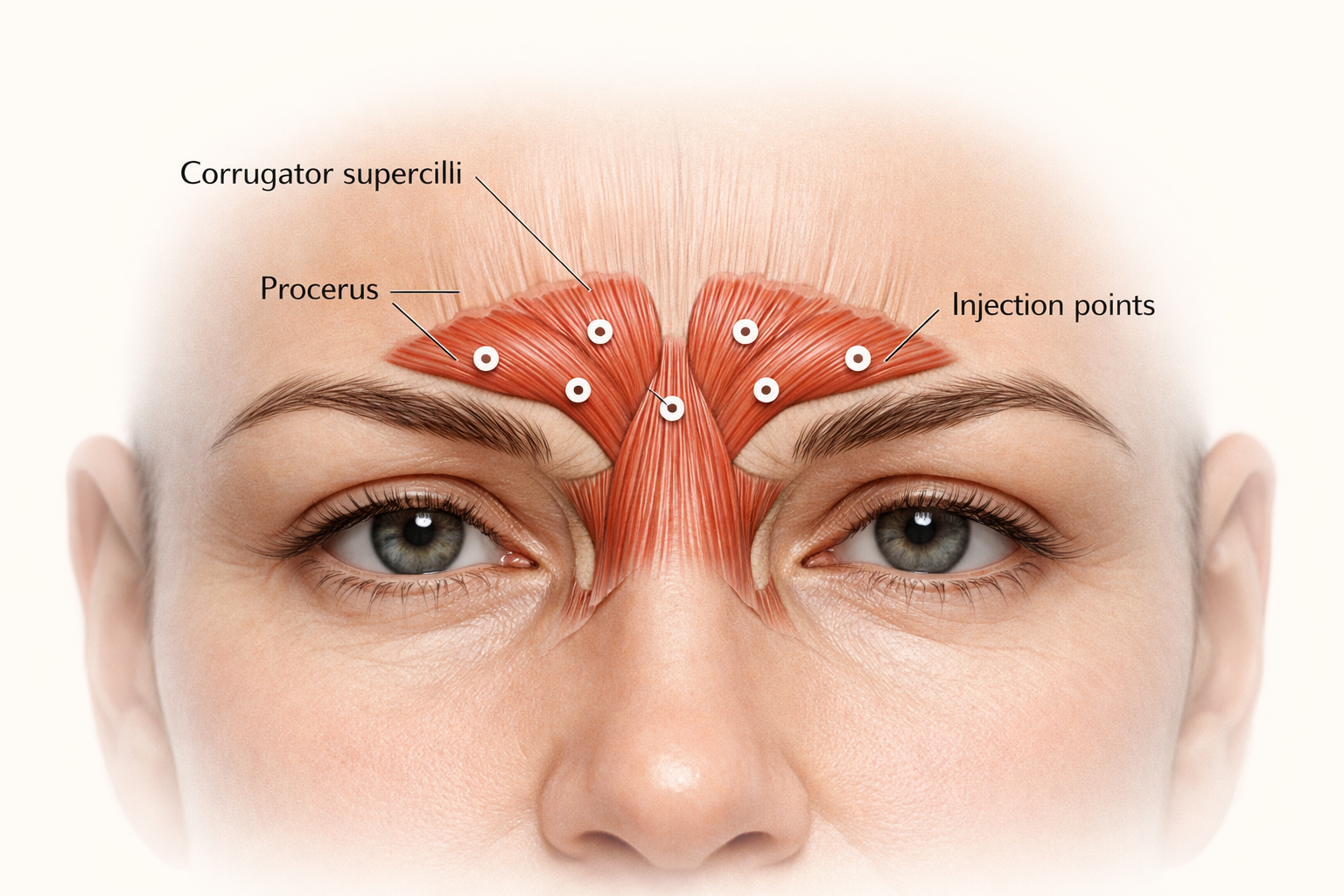
Results typically become visible within three to fourteen days of treatment, with full effect usually apparent by two weeks. Treatment longevity commonly ranges from three to six months, varying with the individual’s muscle mass, metabolism, the product used, and practitioner technique. Over time, patients who maintain regular treatment often notice that lines soften progressively as the muscles receive less frequent reinforcement and the skin accrues rest periods between contractions.
For patients with mild to moderate dynamic frown lines, anti-wrinkle injections alone can produce highly satisfying, natural-looking results. For those with deeper, etched lines, botulinum toxin remains an important foundation but may need to be combined with other approaches. One key advantage of a well-administered wrinkle relaxer is that it can be calibrated carefully to reduce muscle action without eliminating natural expression — the so-called “frozen look” associated with older techniques is largely a product of overdosage and is avoidable in experienced hands.
Preventative anti-wrinkle treatment has also gained considerable attention, particularly among patients in their mid-twenties to early thirties who have early dynamic lines. The rationale is straightforward: reducing muscle movement before lines become etched into the dermis may limit the depth to which static lines eventually develop. The evidence base for this approach is still developing, but the clinical logic is well-established.
Dermal Fillers for Deep Frown Lines
When glabellar lines have become etched into the dermis as static lines — visible at rest regardless of muscle activity — a hyaluronic acid dermal filler can be used to add volume directly beneath the crease, lifting and smoothing it from below. Hyaluronic acid is a naturally occurring substance in the skin that attracts and retains moisture, so these fillers also contribute a degree of hydration to the treated area.
Filler treatment for the glabellar region requires particular care. The area between the brows has a relatively dense vascular network, and injection technique is critically important for safety. For this reason, dermal filler for frown lines is most commonly used as a secondary treatment alongside botulinum toxin — the neuromodulator reduces muscle movement to prevent the filler from being broken down prematurely, while the filler addresses the residual crease that botulinum toxin alone cannot fill. This pairing is a core element of what practitioners describe as a combination treatment approach.
Results from hyaluronic acid fillers are typically visible immediately and may last from six to eighteen months, depending on the specific product’s viscosity, the depth of placement, and how actively the area moves. If results are unsatisfactory, hyaluronic acid fillers have the advantage of being dissolvable using an enzyme called hyaluronidase, which provides a meaningful safety margin.
Collagen-Stimulating Injectables: Sculptra and Profhilo
For patients whose frown lines are accompanied by broader concerns — reduced skin quality, skin laxity across the face, or significant volume loss — collagen-stimulating injectables such as Sculptra or Profhilo may form part of a longer-term treatment strategy.
Sculptra (poly-L-lactic acid) works by gradually stimulating the skin’s own collagen production rather than filling lines directly. It is placed in a diluted form across larger areas and produces results that develop progressively over several months. Treatment longevity with Sculptra can extend up to two years, making it a cost-effective option when considered over time. It is not typically used as a standalone treatment for isolated deep frown lines but may contribute meaningfully within a broader plan.
Profhilo is an injectable skin remodelling treatment that delivers a high concentration of hyaluronic acid into the dermis to improve hydration, skin laxity, and overall tissue quality. Unlike conventional dermal fillers, Profhilo is not designed to fill specific lines but to remodel the quality of the skin more broadly, stimulating collagen and elastin. Patients with skin laxity in the glabellar area alongside mild to moderate lines may find it a useful complement to botulinum toxin.
Energy-Based and Resurfacing Treatments
Energy-based devices play an increasingly useful role in addressing the structural skin changes — collagen depletion, skin laxity, and photodamage — that underlie static frown lines. They work best as part of a planned combination approach rather than as standalone substitutes for injectables in the glabellar area.
Morpheus8
Morpheus8 combines microneedling with radiofrequency energy, delivering controlled heat deep into the dermis and subcutaneous tissue to stimulate collagen remodelling. For the glabellar and periorbital area, it can improve skin texture, firmness, and mild to moderate skin laxity. Results continue to develop for three to six months after treatment, meaning patience is required. A course of two to three sessions is typically recommended, and downtime of three to five days with redness and possible swelling should be expected.
Ultherapy and HIFU
Ultherapy uses high-intensity focused ultrasound (HIFU) to deliver energy to the deeper structural layers of the skin, triggering collagen synthesis at a depth that most surface treatments cannot reach. When applied to the brow area, it may produce a modest non-surgical brow lift effect alongside improved skin firmness. Results generally develop over two to three months and may last twelve to eighteen months. It is particularly relevant for patients who notice brow descent contributing to the appearance of a furrowed brow, but have lines that remain relatively mild.
Microneedling (Collagen Induction Therapy)
Standard microneedling, also known as collagen induction therapy, uses fine needles to create controlled micro-injuries in the dermis, prompting a healing response that includes collagen production. It is most effective for improving skin texture, superficial lines, and photodamage rather than deep static frown lines. A course of treatments is typically required, with results building progressively. Downtime is usually one to three days of redness. It may be particularly useful as a maintenance option or as part of a programme that includes other modalities.
Chemical Peels and Skin Resurfacing
Medium to deep chemical peels can improve skin texture, surface lines, and photodamage by removing damaged outer layers and stimulating new skin growth. In the context of frown lines, they are most useful for addressing the skin quality component — improving overall texture and helping topical treatments penetrate more effectively — rather than for addressing deep glabellar creases directly. Downtime and suitability vary considerably depending on the depth of peel selected.
Topical Treatments and At-Home Skincare
Topical treatments cannot reverse deep static frown lines, but they play an important supporting role in maintaining skin quality, slowing further deterioration, and enhancing the effects of clinical treatments.
Topical retinoids — including prescription-strength tretinoin and over-the-counter retinol — are the most evidence-supported topical option for reducing fine lines and improving skin texture. They work by accelerating skin cell turnover and stimulating collagen synthesis in the dermis. Consistent use over months and years can meaningfully improve superficial lines and the skin’s overall resilience. An adjustment period involving some dryness or sensitivity is common when starting, particularly with higher-strength formulations.
Broad-spectrum SPF is the most impactful daily preventative measure available. Photodamage is a significant accelerant of collagen breakdown in the glabellar area, and daily sunscreen use — regardless of weather — helps preserve skin integrity and prolongs the results of any clinical treatment.
Hyaluronic acid serums and peptide-based moisturisers provide hydration and may support the skin’s surface barrier, making lines appear less pronounced and the skin more plump in the short term. They are valuable adjuncts to a broader skincare protocol but should not be expected to treat deep structural creases on their own.
Combination Treatment Planning: How Treatments Work Together
For most patients with deep frown lines, the most effective approach is not a single treatment but a planned combination that addresses the different contributing factors simultaneously. A typical combination plan might include botulinum toxin to reduce muscle movement as the foundation, a hyaluronic acid dermal filler to soften residual static lines, and an energy-based device or injectable skin remodeller to improve the overall quality and firmness of the skin in the area.
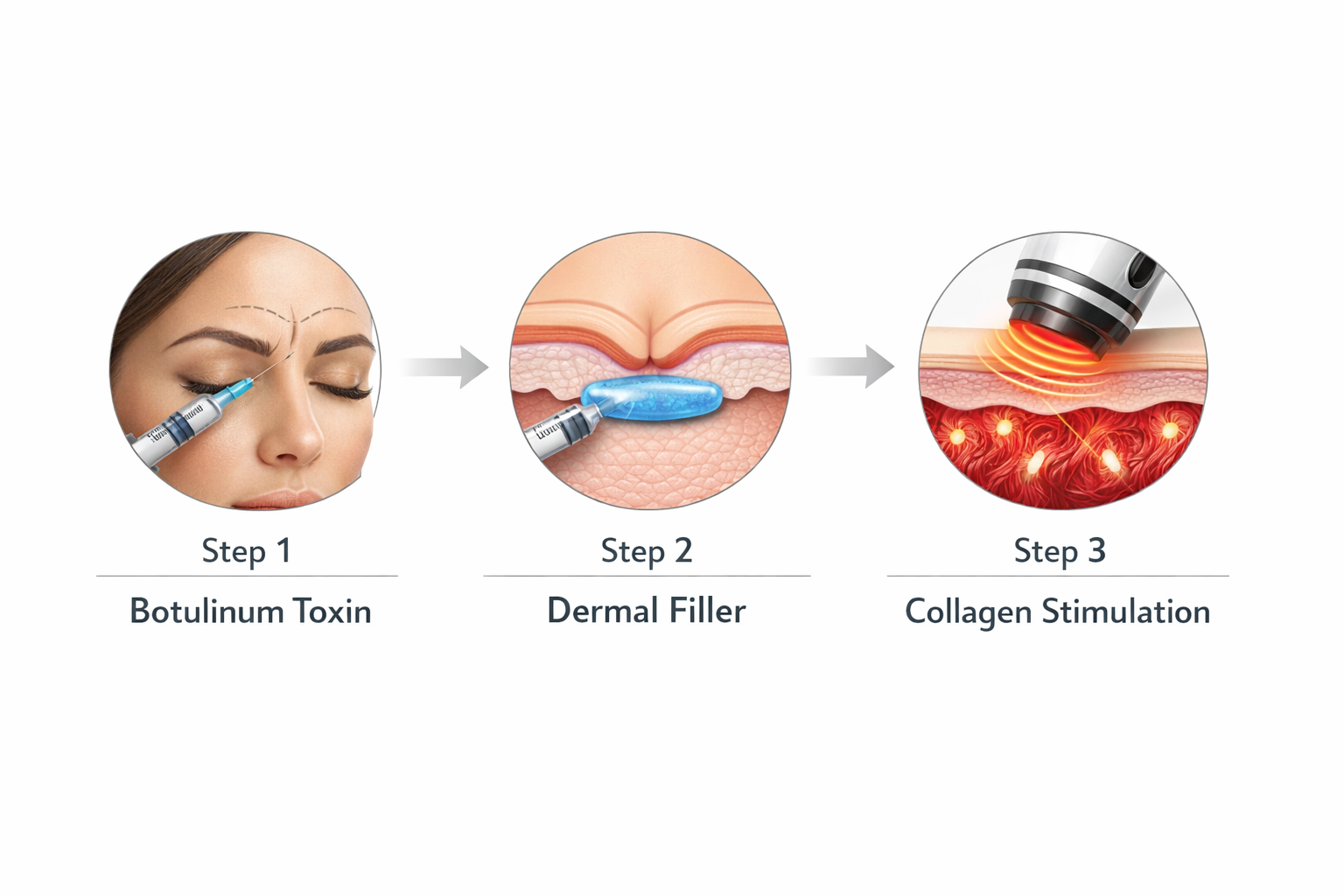
Timing matters in combination planning. Botulinum toxin is often administered first, allowing the muscle activity to settle before filler is placed — this helps the filler last longer and reduces the risk of displacement. Energy-based treatments are usually scheduled separately, with sufficient recovery between sessions. A qualified practitioner will develop a phased treatment plan based on the individual’s anatomy, the severity of their lines, and their goals and budget.
It is also worth noting that realistic expectations are essential. Deep-set glabellar lines that have been present for many years cannot always be fully eliminated. However, a well-designed combination approach can substantially soften them, prevent further deepening, and improve the overall tone and quality of the skin in the area.
Who May Not Be Suitable for These Treatments
Each treatment has relevant contraindications that a practitioner will assess before proceeding. As general guidance: botulinum toxin is contraindicated during pregnancy and breastfeeding, in patients with certain neuromuscular conditions, and in those taking specific medications that affect neuromuscular transmission. Dermal fillers carry additional considerations around bleeding disorders and anticoagulant medications. Energy-based devices may not be appropriate for patients with certain implanted devices, active skin infections in the treatment area, or specific skin conditions. Anyone with a history of keloid scarring should discuss this with their practitioner before microneedling or resurfacing treatments.
A thorough consultation — including a review of medical history, current medications, and previous treatments — is essential before beginning any treatment programme. This is not a bureaucratic formality; it is the safeguard that allows treatment to be planned safely and effectively for each individual.
Frequently Asked Questions
Can deep frown lines be permanently removed?
No treatment currently available can permanently remove deep frown lines. Botulinum toxin, fillers, and energy-based treatments all produce results that last for a defined period and require maintenance. Consistent treatment over time can produce a cumulative improvement, and early preventative intervention may limit how deep lines eventually become, but the effects of ageing and muscle movement continue.
Is botulinum toxin or dermal filler better for frown lines?
The most suitable option depends on whether your lines are dynamic or static. Botulinum toxin is generally preferred for dynamic lines because it directly addresses the muscle activity driving them. Hyaluronic acid dermal filler is more useful for static, etched lines where a crease persists at rest. For many patients with established deep frown lines, a combination of both produces the best natural-looking results.
At what age should I start treating frown lines?
There is no universally correct age. Some practitioners offer preventative anti-wrinkle treatment to patients in their mid-twenties who have early dynamic lines, on the basis that reducing muscle activity before lines become etched may limit long-term depth. Others prefer to wait until lines are more clearly established. The decision should be made in consultation with a qualified practitioner who can assess your individual anatomy, skin quality, and movement patterns.
How long does treatment for frown lines last?
Treatment longevity varies by treatment type. Botulinum toxin typically lasts three to six months. Hyaluronic acid fillers may last from six to eighteen months. Energy-based treatments such as Ultherapy can produce results lasting twelve to eighteen months. Collagen-stimulating injectables like Sculptra may provide benefit for up to two years. Individual metabolism, lifestyle, and the specific products or devices used all affect duration.
Is there downtime after frown line treatment?
Botulinum toxin and most dermal filler treatments involve minimal downtime — bruising or mild swelling may occur but typically resolves within a few days. Energy-based treatments like Morpheus8 involve more noticeable downtime of three to five days. Chemical peels vary significantly depending on depth. Your practitioner will advise on what to expect for the specific treatment selected.
Can skincare alone treat deep frown lines?
Topical skincare — particularly tretinoin or retinol, combined with daily broad-spectrum SPF — can improve skin quality and reduce the appearance of early or fine lines. However, established deep static frown lines involve structural changes in the dermis that topical products cannot meaningfully reverse. Skincare plays a valuable supporting and preventative role but is not a substitute for clinical treatment when lines are already deep.
Choosing the Right Treatment for Your Frown Lines
The best treatment for deep frown lines is the one that is appropriately matched to the type and severity of lines you have, your skin quality, your anatomy, and your personal goals. For most patients with early or moderate dynamic frown lines, botulinum toxin administered by a qualified practitioner offers a well-evidenced, minimally invasive starting point with a strong track record of natural-looking results. Where lines are deeper, static, and accompanied by reduced skin quality or laxity, a combination treatment approach — layering neuromodulator treatment with hyaluronic acid dermal filler and potentially an energy-based modality — tends to produce more complete and longer-lasting improvement.
Supporting clinical treatment with a consistent daily skincare routine that includes a topical retinoid and broad-spectrum sun protection helps maintain results and slow the progression of further lines over time. Preventative anti-wrinkle treatment is a reasonable option to discuss with a practitioner if you are noticing early dynamic lines in your twenties or thirties and want to limit their future depth.
If you are considering treatment for deep glabellar lines, a consultation with a qualified aesthetic practitioner is the logical first step. A thorough clinical assessment — reviewing your line type, muscle activity, skin quality, and overall facial anatomy — allows a treatment plan to be built around your individual needs rather than a generic protocol. Realistic expectations and a clear understanding of what each treatment can and cannot achieve will help you make a well-informed decision.
