
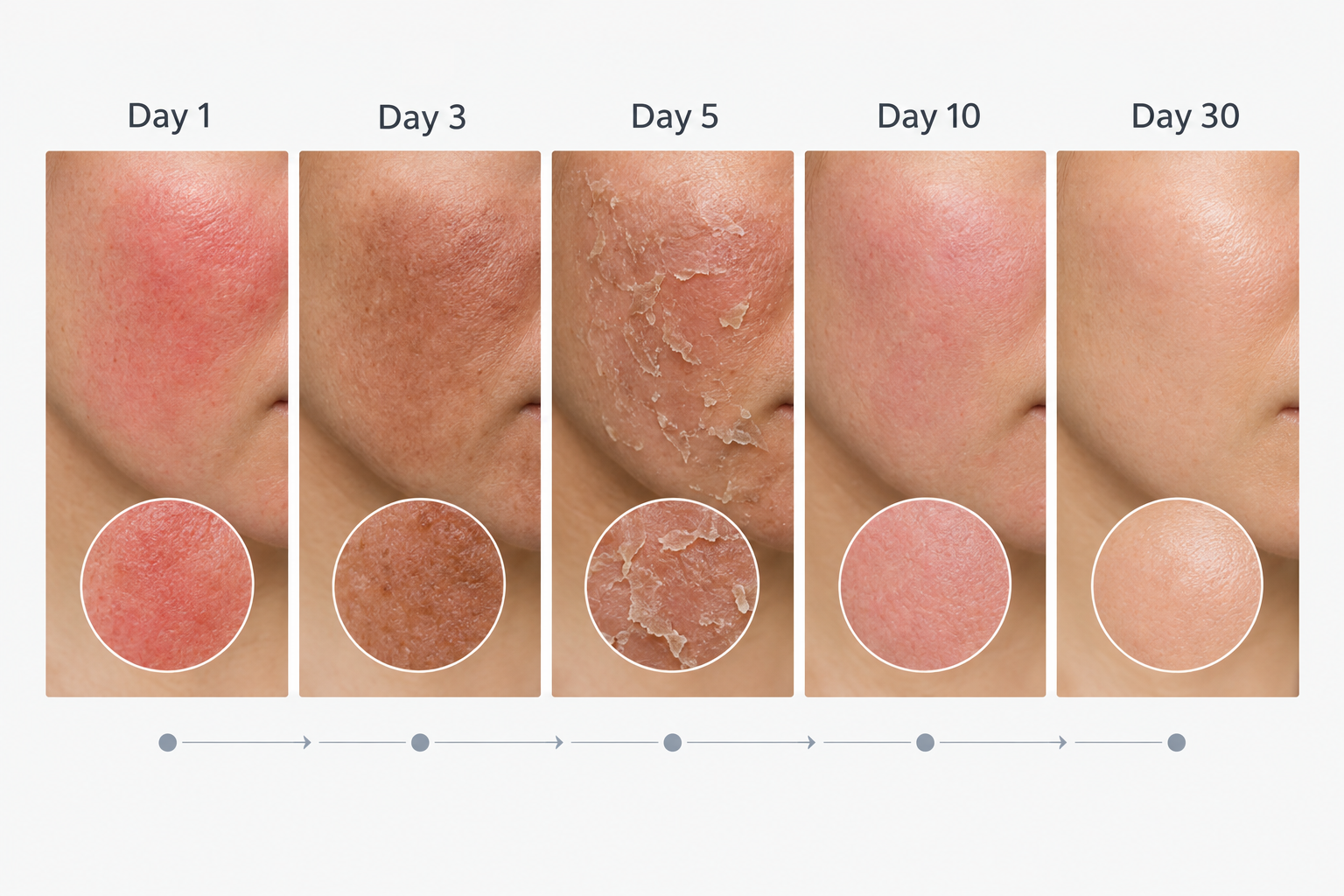

Understanding the chemical peel process day by day helps you prepare realistically, manage your skin correctly during recovery, and recognise what is normal versus what warrants a call to your practitioner. The experience varies considerably depending on the peel depth — superficial, medium, or deep — so this guide covers each stage with that distinction in mind.
Key Takeaways
- The chemical peel recovery timeline differs significantly between superficial, medium-depth, and deep peels, ranging from a few days of mild flaking to two or more weeks of active peeling and redness.
- Visible peeling typically begins between days two and four and resolves within one to two weeks for most medium-depth peels.
- Sun protection and gentle skincare are essential throughout the healing process to reduce the risk of post-inflammatory hyperpigmentation and other complications.
- Final results — including improvements in skin tone, texture, fine lines, and pigmentation — often become fully visible four to six weeks after treatment, once the skin has completed its remodelling phase.
- A qualified practitioner should assess your skin type, concerns, and medical history before recommending a peel depth or formulation.
What Is a Chemical Peel and How Does It Work?
A chemical peel is a skin resurfacing treatment in which a chemical solution — commonly an alpha-hydroxy acid (AHA), trichloroacetic acid (TCA), or phenol — is applied to the skin to induce controlled exfoliation. The solution disrupts the bonds holding dead and damaged skin cells together, prompting the outer layers to shed and stimulating the production of new collagen and healthier epidermal cells beneath. The depth of the peel determines how many layers of skin are affected, which in turn determines the intensity of the recovery process and the degree of potential improvement.
Superficial peels, such as those using low-concentration glycolic acid or salicylic acid, target only the outermost layer of the epidermis. Medium-depth peels — typically using TCA at concentrations between 20% and 35%, or a combination of agents — reach the upper dermis. Deep peels, most commonly phenol-based formulations, penetrate into the mid-dermis and require the most significant recovery period. Each category produces a different day-by-day experience, and understanding these differences is central to setting realistic expectations.
Before the Peel: Preparation and Pre-Treatment Phase
The chemical peel process begins before the treatment appointment itself. Most practitioners recommend a pre-treatment skincare regimen lasting two to four weeks, which may include topical retinoids, hydroquinone, or AHA-based products. This preparation phase helps to prime the skin, promote more even penetration of the peel solution, and reduce the risk of post-inflammatory hyperpigmentation — particularly important for patients with medium to darker skin tones.
During the consultation, your practitioner will review your medical history, current medications, and any history of cold sores (oral herpes simplex), as chemical peels can trigger a viral outbreak in susceptible individuals. Antiviral prophylaxis is commonly prescribed before medium and deep peels for this reason. Patients using isotretinoin are generally advised to discontinue it for at least six months before undergoing a medium or deep peel, as the medication can impair wound healing. Sun exposure should be minimised in the weeks leading up to treatment, and self-tanning products should be avoided.
The Treatment Day: What Happens During the Appointment
On the day of the peel, the skin is cleansed thoroughly to remove oils, makeup, and any residue that could interfere with even penetration. The practitioner then applies the chemical solution using a brush, gauze, or cotton applicator, working systematically across the treatment area. Most patients experience a tingling or burning sensation during application, which varies in intensity depending on the peel strength. A handheld fan is often used to provide comfort during this phase.
For superficial peels, the solution is typically neutralised after a set contact time and the appointment may last 30 to 45 minutes in total. Medium-depth peels may involve multiple passes or layered application, and the frosting effect — a white or grey discolouration of the skin surface indicating protein coagulation — is used as a clinical endpoint. Deep phenol peels require careful cardiac monitoring due to the systemic absorption of phenol and are performed under sedation or anaesthesia in a clinical setting; these are considerably less common in routine aesthetic practice than superficial or medium-depth options.
Immediately after the peel, the skin typically appears red, feels tight, and may have a sunburned appearance. A soothing emollient or post-peel mask is usually applied before you leave the clinic.
Chemical Peel Process Day by Day: The Recovery Timeline
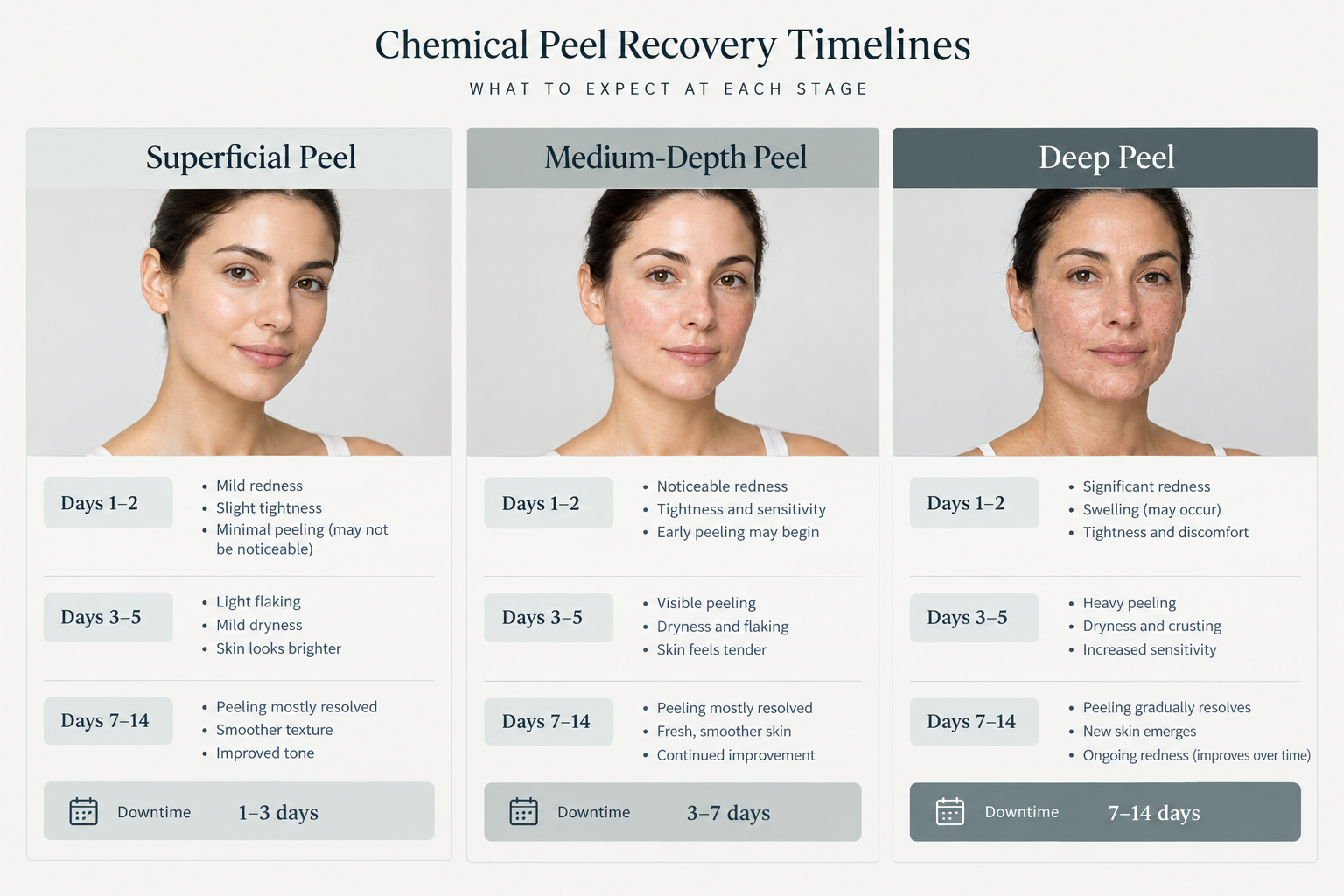
The day-by-day recovery experience is the aspect patients most commonly want to understand before committing to treatment. The following timeline reflects typical experiences for each peel depth, though individual variation is significant and your practitioner’s specific aftercare instructions always take precedence.
Superficial Peel Recovery Timeline
Superficial chemical peels — including low-concentration glycolic acid peels, lactic acid peels, and salicylic acid peels — produce the mildest recovery experience. Many patients describe the process as similar to a mild sunburn followed by subtle flaking rather than dramatic peeling.
- Day 1: Skin appears pink or lightly flushed. There may be mild tightness and sensitivity. Makeup can often be applied the following day if the skin is not broken.
- Days 2–3: Mild dryness and fine flaking may begin. The skin may feel slightly rough to the touch. Moisturiser and broad-spectrum SPF are essential.
- Days 4–5: Flaking typically resolves. Skin may look brighter and feel smoother. Any residual pinkness usually fades.
- Day 7 onwards: Skin generally appears refreshed. Results from a single superficial peel are subtle; a course of treatments spaced two to four weeks apart is typically recommended for more noticeable improvement.
Medium-Depth Peel Recovery Timeline
Medium-depth peels, most commonly TCA peels, produce a more pronounced and visible recovery process. This is the peel depth most patients are referring to when they search for a detailed day-by-day timeline.
- Day 1 (treatment day): Skin is red, swollen, and may feel hot or tight. Some patients experience mild oedema, particularly around the eyes. A thick emollient is applied and should be kept on the skin.
- Day 2: Redness and swelling may intensify. The skin begins to feel very tight. A brownish or bronzed discolouration may develop as the treated skin starts to darken before it peels. This is a normal part of the process.
- Day 3: The skin continues to darken and tighten. Peeling has not yet begun for most patients, but the surface may feel leathery. It is important not to pick or pull at the skin at any stage.
- Day 4: Peeling typically begins, often starting around the mouth and chin — areas where facial movement accelerates the process. The skin separates in sheets or large flakes rather than fine dust. This stage can be socially uncomfortable and most patients prefer to remain at home.
- Day 5: Active peeling continues across the cheeks, forehead, and nose. The new skin underneath appears pink, smooth, and sensitive. Keeping the skin well moisturised helps manage tightness and discomfort.
- Day 6–7: Peeling is usually at its most visible during this period. Large areas of skin may be shedding simultaneously. The new skin is fragile and highly sensitive to sun exposure.
- Day 8–10: Most of the surface peeling resolves for the majority of patients. The skin looks pink and may feel slightly raw. Redness begins to fade gradually.
- Days 10–14: The skin surface is largely healed. Residual pinkness or erythema may persist, particularly in patients with fair skin. Makeup can usually be reintroduced once the skin is fully intact, though mineral-based formulations are generally better tolerated initially.
- Weeks 3–6: Redness continues to fade. Skin texture and tone improvements become progressively more visible as collagen remodelling continues beneath the surface. Final results are typically assessed at four to six weeks post-treatment.
Deep Peel Recovery Timeline
Deep phenol peels produce the most significant recovery process and are reserved for patients with substantial photodamage, deep wrinkles, or significant acne scarring who have been carefully selected and counselled. Recovery involves one to two weeks of significant downtime, with redness that may persist for several months. Deep peels are performed less frequently in contemporary aesthetic practice and require specialist clinical oversight. The day-by-day experience is broadly similar in sequence to a medium peel but considerably more intense in degree, with swelling, crusting, and prolonged erythema being more pronounced. Full recovery and final results may take three to six months.
What Is Normal During Recovery — and What Is Not
During the chemical peel healing process, certain experiences are expected and do not indicate a problem. Redness, tightness, darkening of the skin before peeling begins, visible shedding of skin in sheets or flakes, and temporary sensitivity are all part of the normal post-peel process. Mild itching as the skin heals is also common.
However, some signs warrant prompt contact with your practitioner. These include severe or worsening pain beyond the first day or two, blistering that was not anticipated, signs of infection such as increasing warmth, pus, or fever, a cold sore outbreak, or significant swelling that does not begin to resolve within 48 hours. Persistent or worsening redness beyond the expected recovery window, or the development of dark patches (post-inflammatory hyperpigmentation), should also be assessed promptly, as early intervention can improve outcomes.
Aftercare: How to Support Healing Day by Day
Correct aftercare is as important as the peel itself in determining the final outcome. Your practitioner will provide specific instructions, but the following principles apply broadly across medium and deep peel recovery.
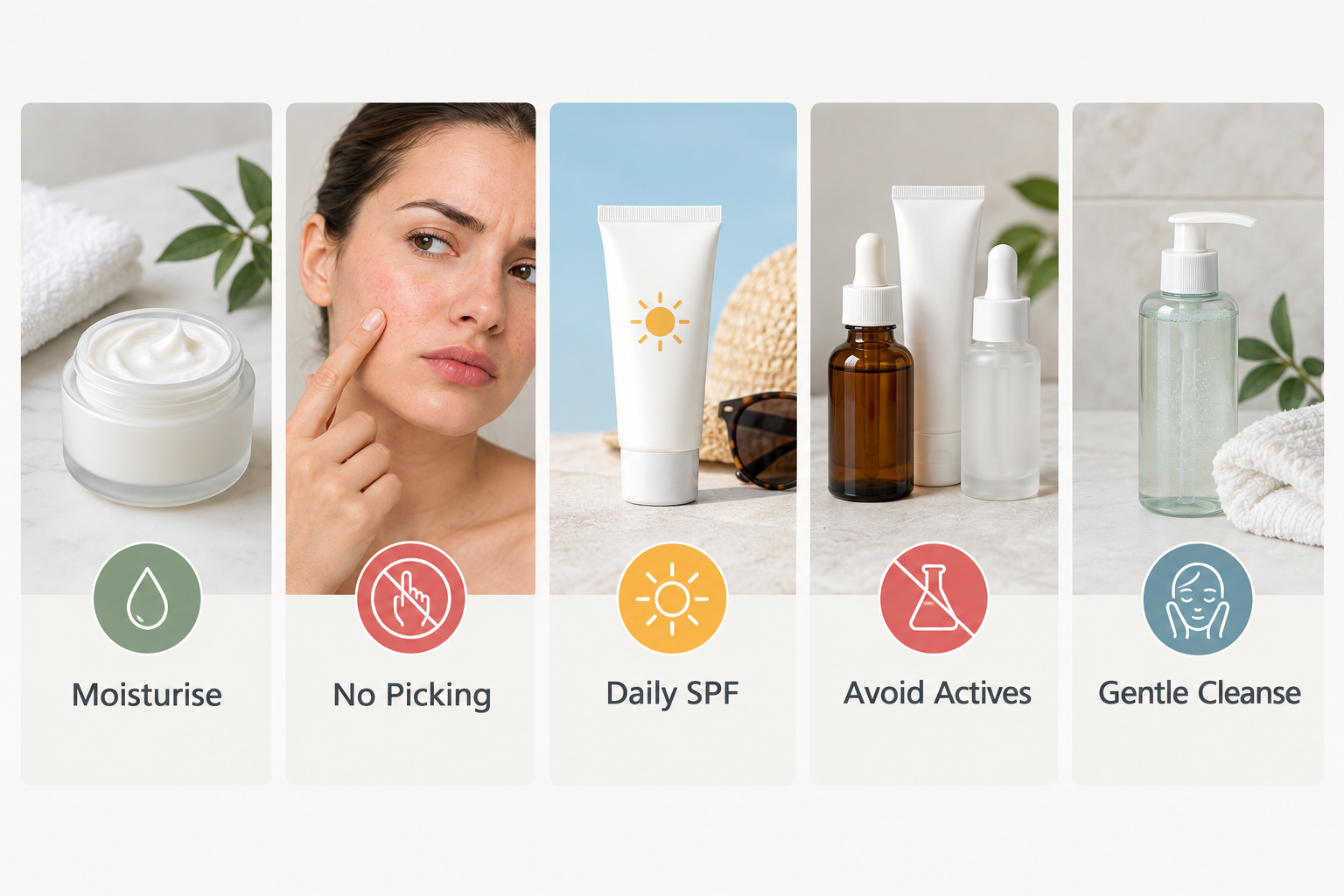
- Keep the skin moisturised: A bland, fragrance-free emollient should be applied generously and frequently throughout the peeling phase. Allowing the skin to dry out increases discomfort and may impair healing.
- Do not pick, peel, or pull: Removing skin before it is ready to shed naturally increases the risk of scarring and post-inflammatory hyperpigmentation. This is one of the most important rules of chemical peel aftercare.
- Avoid sun exposure: Newly healed skin is highly vulnerable to UV damage and pigmentation changes. Broad-spectrum SPF 30 or higher should be applied daily once the skin has re-epithelialised, and physical sun avoidance is recommended throughout recovery.
- Avoid active skincare ingredients: Retinoids, AHAs, BHAs, vitamin C serums, and other active ingredients should be paused until the skin has fully healed and your practitioner confirms it is safe to reintroduce them.
- Avoid heat and exercise: Hot showers, saunas, steam rooms, and vigorous exercise that increases facial flushing should be avoided during the active healing phase, typically for at least one week after a medium peel.
- Cleanse gently: Use a mild, non-foaming cleanser and lukewarm water. Avoid rubbing or using a flannel on the skin while it is peeling.
When Do Chemical Peel Results Become Visible?
One of the most common questions patients have is when they will actually see the improvement they were hoping for. The answer depends on the peel depth and the concern being treated. After a superficial peel, a brighter and smoother complexion may be noticeable within a few days once the mild flaking resolves. However, meaningful improvement in pigmentation, fine lines, or acne scarring from a single superficial peel is modest, and a course of treatments is usually required.
After a medium-depth TCA peel, the skin may look quite raw and pink for the first one to two weeks, which can make it difficult to assess results during this period. As the redness fades over weeks three to six, improvements in skin texture, uneven skin tone, sun damage, and fine lines typically become more apparent. Collagen remodelling — the deeper structural improvement that contributes to firmer, smoother skin — continues for several months after the peel, meaning that the full benefit may not be visible until approximately three to six months post-treatment.
It is important to have realistic expectations. Chemical peels can produce meaningful improvements in skin quality, but they do not halt the ageing process, and results are not permanent. Maintenance treatments, ongoing sun protection, and a consistent skincare routine all contribute to sustaining the outcome.
Risks, Side Effects, and Limitations
Chemical peels carry a range of potential side effects and risks that vary with peel depth, skin type, and individual factors. Common and expected side effects include redness, swelling, peeling, dryness, and temporary sensitivity. These are part of the normal healing process rather than complications.
More significant risks include post-inflammatory hyperpigmentation, which is more common in patients with medium to darker skin tones (Fitzpatrick skin types III–VI) and can be triggered by sun exposure during recovery or by peeling the skin prematurely. Hypopigmentation — a loss of pigment in the treated area — is a risk associated primarily with deep peels and may be permanent. Scarring is uncommon when peels are performed by a qualified practitioner on appropriately selected patients, but the risk increases with deeper peels, incorrect aftercare, or picking at the skin. Infection, including bacterial infection and herpes simplex reactivation, is possible and is why prophylactic antiviral treatment is recommended for medium and deep peels in susceptible individuals.
Patients with a history of keloid scarring, certain autoimmune conditions, or those who are pregnant or breastfeeding are generally not suitable candidates for medium or deep chemical peels. A thorough consultation is essential to identify individual risk factors before proceeding.
Alternatives to Chemical Peels
Chemical peels are one of several options for skin resurfacing and rejuvenation. Understanding the alternatives helps patients make an informed decision about which approach may best suit their goals, skin type, and tolerance for downtime.
- Microdermabrasion: A mechanical exfoliation treatment that removes the outermost skin cells using fine crystals or a diamond-tipped wand. It produces minimal downtime but more limited results than medium or deep peels.
- Laser resurfacing: Ablative lasers such as CO2 and erbium:YAG lasers can achieve results comparable to medium or deep peels for photodamage, wrinkles, and scarring, with a similar or longer recovery period. Non-ablative and fractional laser options offer a more gradual improvement with less downtime.
- Microneedling: Collagen induction therapy using fine needles to stimulate dermal remodelling. Microneedling is associated with less risk of post-inflammatory hyperpigmentation than chemical peels in patients with darker skin tones and may be combined with topical agents for enhanced effect.
- HydraFacial: A multi-step treatment combining cleansing, exfoliation, extraction, and hydration. HydraFacial produces no meaningful downtime and is suitable for skin maintenance, but it does not achieve the depth of resurfacing associated with medium or deep chemical peels.
- Topical retinoids: Prescription-strength retinoids such as tretinoin produce gradual skin renewal over months and can address fine lines, pigmentation, and texture with consistent use, though results develop more slowly than with in-clinic resurfacing treatments.
The most appropriate option depends on the specific skin concern, the patient’s skin type, their tolerance for downtime, and their overall treatment goals. A qualified practitioner can help determine which approach — or combination of approaches — is most likely to be beneficial.
Frequently Asked Questions
How long does the peeling phase last after a medium-depth peel?
For most patients undergoing a medium-depth TCA peel, active peeling begins around day three or four and largely resolves by days seven to ten. The total duration varies depending on the individual’s skin, the specific peel formulation used, and how consistently aftercare instructions are followed.
Can I wear makeup during the chemical peel recovery process?
Makeup should generally be avoided until the skin has fully re-epithelialised — meaning the surface is intact and no longer raw or actively peeling. For medium-depth peels, this is typically around day ten to fourteen. Your practitioner will advise when it is safe to reintroduce cosmetics, and mineral-based products are usually recommended initially as they tend to be better tolerated by recently healed skin.
Why does my skin look darker before it starts to peel?
The darkening or bronzing of the skin in the days following a medium-depth peel is a normal part of the process. It occurs because the treated skin undergoes protein coagulation and begins to desiccate before it separates from the new skin forming beneath. This darkening typically precedes the onset of visible peeling and is not a sign of a problem.
Is it normal to experience itching during recovery?
Mild itching is common during the healing phase and usually indicates that the skin is regenerating. Keeping the skin well moisturised can help manage this sensation. Scratching or rubbing the skin should be avoided, as this can disrupt healing and increase the risk of scarring or pigmentation changes. If itching is severe or accompanied by other concerning symptoms, contact your practitioner.
How soon after a chemical peel can I go back to work?
After a superficial peel, most patients return to normal activities the following day. After a medium-depth peel, most patients prefer to take seven to ten days away from work or social commitments due to the visible peeling and redness. After a deep peel, two or more weeks of downtime is typically required. Individual recovery varies, and your practitioner can give you a more specific estimate based on the peel performed.
Will I need more than one chemical peel to see results?
For superficial peels, a course of treatments — typically four to six sessions spaced two to four weeks apart — is usually recommended to achieve meaningful improvement in skin tone, texture, and mild pigmentation. A single medium-depth peel can produce more noticeable results, though some patients benefit from a repeat treatment after several months. Deep peels are generally performed as a single treatment for significant photodamage or deep wrinkles.
Can chemical peels be used on all skin tones?
Chemical peels can be used across a range of skin tones, but the risk of post-inflammatory hyperpigmentation is higher in patients with medium to darker skin tones (Fitzpatrick types III–VI). Superficial peels using salicylic acid or low-concentration lactic acid are generally considered more suitable for these patients than medium or deep peels. Careful patient selection, pre-treatment preparation, and diligent sun protection are particularly important in this group. A practitioner experienced in treating diverse skin tones should be consulted.
Planning Your Chemical Peel: What to Consider Before Booking
The chemical peel process day by day is manageable for most patients when they are well-prepared and have realistic expectations. Superficial peels offer a low-downtime option for gradual skin maintenance, while medium-depth peels can produce more significant improvements in skin texture, pigmentation, and fine lines at the cost of a more involved recovery period. Deep peels remain an option for carefully selected patients with substantial photodamage but require specialist oversight and a longer commitment to recovery.
The most important step before any chemical peel is a thorough consultation with a qualified practitioner who can assess your skin type, identify your specific concerns, review your medical history, and recommend the most appropriate peel depth and formulation. Aftercare adherence — particularly avoiding sun exposure, resisting the urge to pick at peeling skin, and keeping the skin moisturised — plays a significant role in both the safety and the outcome of the treatment. If you are considering a chemical peel, discussing your goals and any concerns with a qualified aesthetic practitioner is the most reliable way to determine whether it is the right approach for your skin.
