


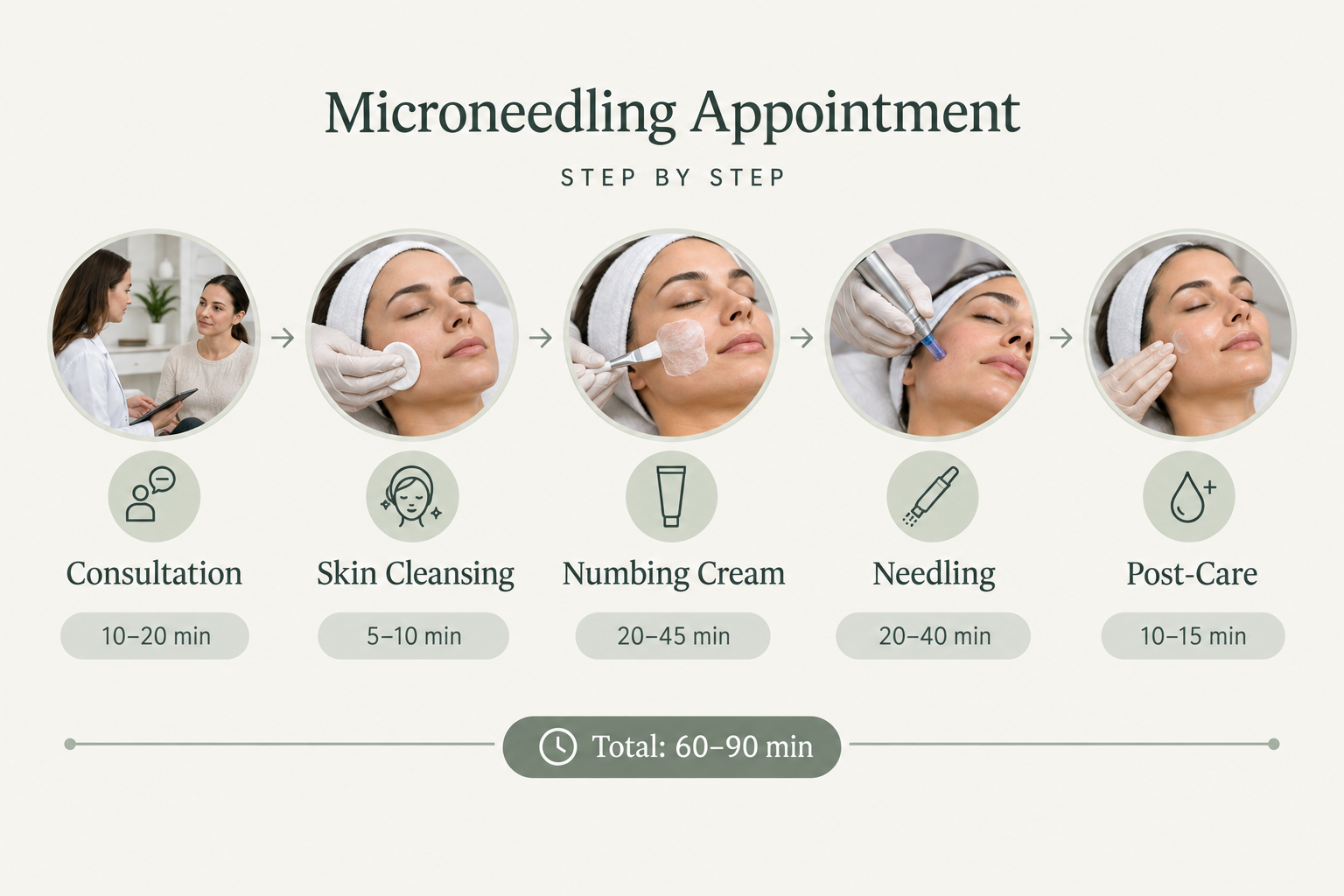
Microneedling appointments typically take between 60 and 90 minutes from arrival to leaving the clinic, though the actual needling procedure itself usually lasts only 20 to 40 minutes. Understanding what happens before, during, and after the treatment helps you plan your day and set realistic expectations about the full appointment experience.
Key Takeaways
- The needling procedure itself usually takes 20 to 40 minutes, depending on the treatment area and the number of passes performed.
- Topical numbing cream is applied beforehand and typically requires 20 to 45 minutes to take effect, which adds significantly to the total appointment time.
- A full microneedling appointment, including consultation, numbing, treatment, and aftercare advice, commonly runs between 60 and 90 minutes.
- Larger treatment areas, combination protocols, and deeper needle depths can extend session duration.
- Most patients require a course of sessions rather than a single treatment, with intervals of four to six weeks between appointments being common.
What Is Microneedling?
Microneedling is a minimally invasive skin treatment that uses a device fitted with fine needles to create controlled micro-injuries in the skin’s surface. These micro-channels stimulate the skin’s natural wound-healing response, which includes the production of collagen and elastin — two structural proteins responsible for skin firmness, texture, and elasticity. The procedure is performed by trained practitioners using either a motorized pen-style device or, less commonly, a dermaroller.
Microneedling is used to address a range of skin concerns, including fine lines, acne scarring, enlarged pores, uneven skin texture, and mild skin laxity. It can also be used to improve the absorption of topically applied serums, which some practitioners incorporate into the treatment protocol. Results are generally gradual, appearing over several weeks as collagen remodelling progresses, and a course of multiple sessions is usually recommended for meaningful improvement.
How Long Does a Microneedling Session Take?
The total time spent at the clinic for a microneedling appointment is typically 60 to 90 minutes, though this varies depending on the treatment area, the protocol used, and whether any additional steps are included. Breaking the appointment into its component stages helps clarify where that time is spent.
Pre-Treatment Consultation and Skin Assessment
Before the procedure begins, the practitioner will review your skin concerns, medical history, and suitability for treatment. For first-time patients, this assessment may take 10 to 20 minutes. At follow-up appointments, this stage is usually shorter, covering any changes since the previous session and confirming the treatment plan.
Skin Cleansing and Preparation
The treatment area is thoroughly cleansed to remove makeup, sunscreen, and surface oils before any numbing product is applied. This preparation step typically takes five to ten minutes and is essential for both hygiene and the effectiveness of the topical anaesthetic.
Topical Numbing Cream
Topical anaesthetic cream is applied to the skin and left in place for 20 to 45 minutes before the needling begins. This is often the longest single stage of the appointment. The numbing cream significantly reduces discomfort during the procedure, and practitioners generally allow adequate time for it to take full effect before proceeding. Rushing this stage can result in greater patient discomfort, so most clinics build sufficient dwell time into the appointment schedule.
The Microneedling Procedure Itself
Once the skin is numb and the numbing cream has been removed, the practitioner applies a serum or sterile solution to the skin and begins the needling. For a standard full-face treatment, the needling phase typically takes 20 to 30 minutes. Smaller areas, such as the neck or décolletage treated in isolation, may take less time, while treating the face and neck together or adding the scalp can extend this phase to 40 minutes or more.
The practitioner moves the device systematically across the treatment area, adjusting needle depth and speed according to the skin zone being treated. Thinner skin around the eyes and lips generally requires a shallower depth and a more careful approach, which can slow the pace in those areas. The number of passes — how many times the device moves over each zone — also influences how long this phase takes.
Post-Treatment Care and Aftercare Advice
After needling is complete, a soothing serum, hyaluronic acid, or calming mask is typically applied to support the skin’s initial recovery. The practitioner will also provide aftercare instructions covering what to avoid in the hours and days following treatment. This final stage usually takes ten to fifteen minutes.
Factors That Affect Microneedling Session Duration
Several variables influence how long a microneedling appointment takes, and patients should be aware of these when planning their schedule.
Treatment Area Size
Treating the face alone is the most common protocol and falls within the standard 20 to 30 minute needling window. Adding the neck, décolletage, or hands extends the procedure time proportionally. Body microneedling for concerns such as stretch marks on the abdomen or thighs involves considerably larger surface areas and can extend the needling phase to 45 to 60 minutes or longer.
Needle Depth and Skin Concern
Deeper needle depths, which may be used for more established acne scarring or significant textural irregularities, often require more careful technique and additional passes, adding time to the procedure. Superficial treatments targeting general skin quality or fine lines are typically faster.
Combination Protocols
Some clinics offer microneedling combined with additional treatments such as radiofrequency energy (RF microneedling), platelet-rich plasma (PRP), or growth factor serums. RF microneedling devices deliver radiofrequency energy through the needles simultaneously, and the treatment cycle for each section of skin takes longer than standard microneedling. PRP preparation, which involves drawing and processing a small blood sample before the appointment, adds further time. Combination appointments may run to two hours or more in total.
Patient Skin Sensitivity
Patients with more sensitive skin or lower pain tolerance may require a longer numbing period or a slower, more cautious treatment pace. Practitioners adjust their approach based on patient feedback during the session, which can affect overall duration.
First Appointment Versus Follow-Up Sessions
Initial appointments tend to run longer because they include a more detailed consultation, a full skin assessment, and time to explain the procedure and aftercare in depth. Follow-up sessions within a course of treatment are often slightly shorter because the assessment and education components are already established.
How Many Microneedling Sessions Are Typically Needed?
A single microneedling session can produce some improvement in skin texture and radiance, but meaningful results for concerns such as acne scarring, enlarged pores, or fine lines generally require a course of treatments. Most practitioners recommend a course of three to six sessions, spaced approximately four to six weeks apart, to allow adequate time for collagen remodelling between appointments.
The appropriate number of sessions depends on the skin concern being addressed, its severity, and the individual’s skin response. Mild textural concerns may respond well to three sessions, while deeper or more established scarring may benefit from a longer course. Maintenance sessions every three to six months are sometimes recommended after an initial course to sustain results, though individual needs vary and should be assessed by the treating practitioner.
What to Expect During the Appointment
Patients often describe the sensation during microneedling as a mild scratching or vibrating feeling across the skin. With adequate topical anaesthetic, most people find the procedure tolerable, though some areas — particularly the forehead, nose, and upper lip — can feel more sensitive than others. Discomfort is generally described as mild to moderate rather than painful when numbing has been properly applied.
During the procedure, the skin will appear red and may feel warm, similar to a mild sunburn. Some pinpoint bleeding is normal, particularly at deeper needle depths, and is part of the controlled injury response that drives collagen stimulation. Practitioners monitor the skin’s response throughout and adjust technique accordingly.
Downtime and Recovery After Microneedling
Microneedling is often described as a low-downtime procedure, but it is not a no-downtime treatment. Understanding the recovery timeline helps patients plan appointments around social or professional commitments.
Immediately After Treatment
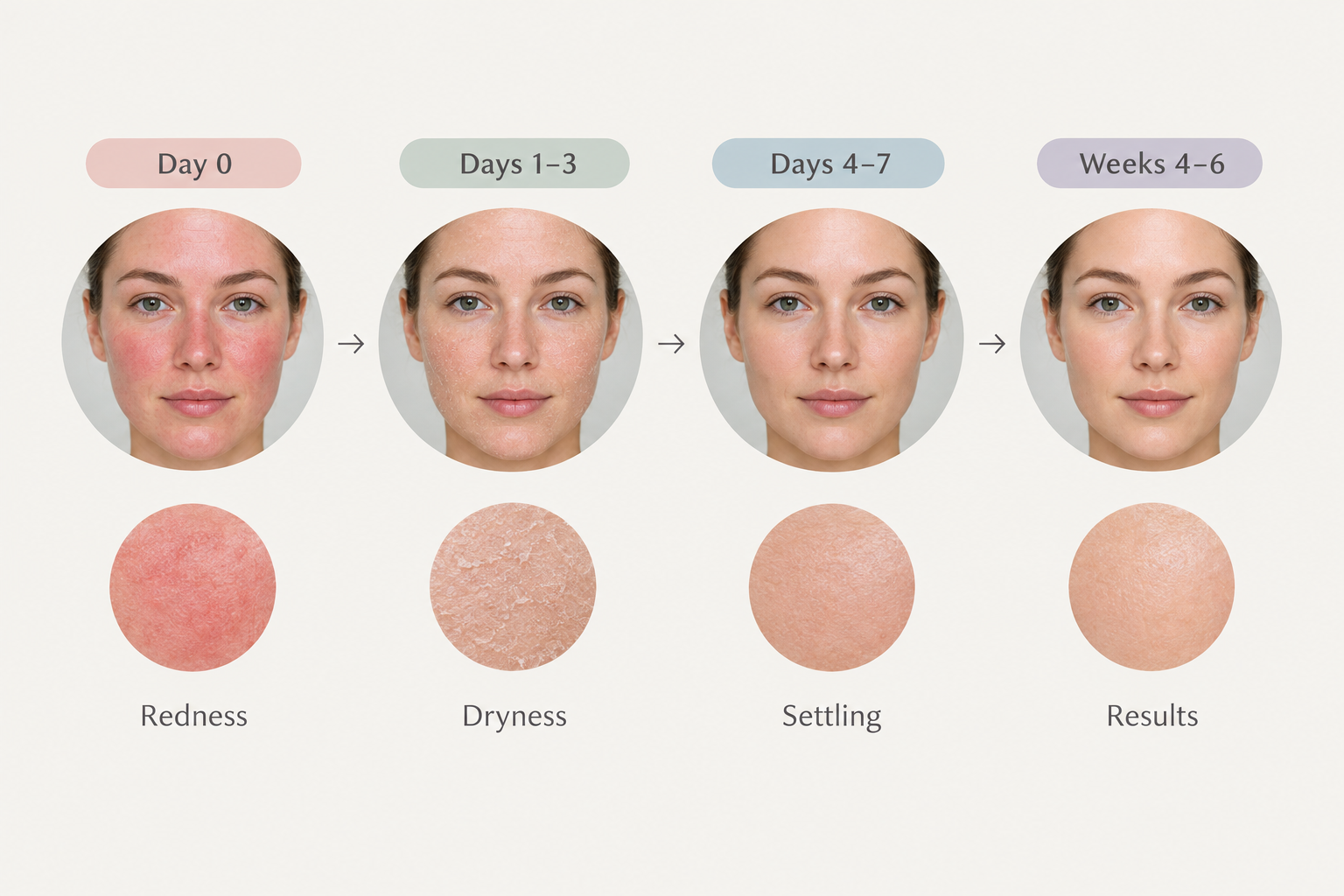
The skin will appear red, flushed, and slightly swollen immediately after the session, resembling a moderate sunburn. This is a normal and expected response. Some patients also notice minor pinpoint marks or mild bruising, particularly in thinner-skinned areas. These immediate effects are most pronounced in the first 12 to 24 hours.
Days One to Three
Redness typically begins to subside within 24 to 48 hours for standard treatments. Mild dryness, tightness, and flaking may occur as the skin begins to heal. Patients are generally advised to avoid makeup for at least 24 hours, avoid direct sun exposure, and use only gentle, fragrance-free skincare products during this period. Sunscreen is essential once the skin has settled sufficiently to tolerate it.
Days Four to Seven
Most patients find that visible redness has resolved by day three to five, and the skin begins to look and feel more normal. Some patients notice an initial improvement in skin texture and radiance during this phase as surface healing completes. Deeper collagen remodelling, however, continues for weeks to months beneath the surface.
When Results Become Visible
Visible improvements in skin texture, tone, and firmness typically become more apparent four to six weeks after a session, as new collagen matures. Patients undergoing a course of treatments often notice cumulative improvement with each successive session. Results from a full course may continue to develop for three to six months after the final appointment.
Risks and Side Effects to Be Aware Of
Microneedling is generally considered a well-tolerated procedure when performed by a trained practitioner using appropriate equipment, but it carries risks that patients should understand before proceeding.
- Prolonged redness or irritation: Most redness resolves within a few days, but some patients experience more persistent redness, particularly at deeper treatment depths.
- Infection: Creating micro-channels in the skin temporarily increases the risk of bacterial or viral infection. Strict hygiene protocols and appropriate aftercare reduce this risk, but it cannot be eliminated entirely.
- Post-inflammatory hyperpigmentation: Patients with darker skin tones or a history of hyperpigmentation may be at greater risk of developing temporary darkening of the skin following treatment. Careful patient selection and appropriate needle depth are important factors in minimising this risk.
- Bruising and swelling: Mild bruising and swelling can occur, particularly around the eyes and in areas with thinner skin.
- Herpes simplex reactivation: Patients with a history of cold sores may experience a flare following microneedling. Practitioners may recommend antiviral prophylaxis in these cases.
- Scarring: Although rare when the procedure is performed correctly, inappropriate technique or inadequate aftercare can contribute to adverse skin changes.
Patients should disclose their full medical history, current medications, and any previous skin treatments before proceeding. Microneedling is generally not recommended during pregnancy, over active skin infections, over raised moles or lesions, or in patients taking certain medications such as isotretinoin. A thorough pre-treatment assessment by a qualified practitioner is essential.
Who May Be Suitable for Microneedling?
Microneedling may be suitable for adults seeking improvement in skin texture, fine lines, mild laxity, acne scarring, enlarged pores, or uneven skin tone. It can be used on a range of skin tones, though the approach and needle depth should be carefully tailored for patients with darker skin to reduce the risk of post-inflammatory hyperpigmentation.
Suitability depends on individual skin health, medical history, and treatment goals. A clinical assessment by a qualified practitioner is necessary to determine whether microneedling is appropriate and to design a treatment plan matched to the patient’s specific concerns.
Alternatives to Microneedling
Patients considering microneedling may also wish to discuss alternative or complementary treatments with their practitioner, depending on their skin concerns and goals.
- Chemical peels: Use acid solutions to exfoliate the skin and stimulate renewal. Superficial peels have minimal downtime, while medium-depth peels involve a longer recovery period. May be suitable for pigmentation, texture, and mild scarring.
- Laser resurfacing: Ablative and non-ablative laser treatments can address similar concerns to microneedling, often with greater intensity and potentially longer downtime. May be more effective for deeper scarring or significant photodamage in appropriate candidates.
- RF microneedling: Combines standard microneedling with radiofrequency energy delivered through the needles, which may provide additional skin tightening benefits. Sessions typically take longer than standard microneedling and are generally more expensive.
- Microdermabrasion: A mechanical exfoliation treatment with minimal downtime. Less intensive than microneedling and generally suited to surface-level texture concerns rather than scarring or significant laxity.
- Polynucleotides or skin boosters: Injectable treatments that may improve skin hydration, quality, and fine lines through different mechanisms. Can be used alongside or as an alternative to microneedling depending on the concern.
No single treatment is universally superior. The most appropriate option depends on the individual’s skin concerns, skin type, tolerance for downtime, and treatment goals, and should be discussed with a qualified practitioner.
Frequently Asked Questions
Can I return to work the same day as my microneedling appointment?
Many patients return to desk-based work on the same day, though the skin will appear red and flushed for several hours after treatment. If your work involves close face-to-face contact or you are uncomfortable with visible redness, scheduling the appointment before a rest day or weekend may be preferable. Strenuous exercise and heat exposure, including saunas and steam rooms, are generally advised against for 24 to 48 hours.
How long after microneedling can I wear makeup?
Most practitioners advise avoiding makeup for at least 24 hours after microneedling to reduce the risk of introducing bacteria or irritants into the micro-channels while the skin is healing. Mineral makeup is sometimes considered acceptable sooner, but this should be confirmed with your treating practitioner based on your specific treatment depth and skin response.
Does the session take longer for body areas than for the face?
Yes. Body microneedling for concerns such as stretch marks on the abdomen, thighs, or buttocks involves significantly larger surface areas than a facial treatment. The needling phase alone for body areas can take 45 to 60 minutes or more, and the total appointment time is correspondingly longer. Numbing requirements for body areas may also differ.
Is one microneedling session enough to see results?
A single session may produce some improvement in skin radiance and texture, but most practitioners recommend a course of three to six sessions for meaningful and lasting results, particularly for acne scarring, enlarged pores, or fine lines. Individual response varies, and the treating practitioner can advise on the appropriate number of sessions based on your skin concerns and how your skin responds to initial treatment.
How far apart should microneedling sessions be scheduled?
Sessions are typically spaced four to six weeks apart to allow the skin adequate time to heal and for collagen remodelling to progress between appointments. Scheduling sessions too closely together does not allow sufficient recovery time and may increase the risk of adverse effects. Your practitioner will recommend an interval appropriate for your skin and the treatment depth used.
Does RF microneedling take longer than standard microneedling?
Yes. RF microneedling devices deliver radiofrequency energy through the needles at each treatment point, and the device must remain in contact with the skin for a set period at each position. This makes the needling phase considerably slower than standard microneedling. A full-face RF microneedling session may take 45 to 60 minutes for the needling phase alone, with total appointment time often exceeding 90 minutes.
Planning Your Microneedling Appointment Realistically
Microneedling is a practical treatment for patients seeking gradual, evidence-supported improvement in skin texture, scarring, and early signs of ageing, but it requires realistic planning. Allowing 60 to 90 minutes for a standard facial appointment — and longer if body areas or combination protocols are involved — ensures you are not rushed and that the numbing phase has adequate time to work effectively.
Understanding that results develop gradually over weeks and that a course of sessions is usually needed helps set appropriate expectations before committing to treatment. Downtime is generally manageable, but the skin will need care and protection in the days following each session. If you are considering microneedling, a consultation with a qualified practitioner is the appropriate starting point to assess your suitability, discuss your goals, and receive a treatment plan tailored to your skin.
