


Collagen supplements have become one of the best-selling wellness products globally, with claims ranging from smoother skin and stronger joints to better athletic recovery and thicker hair. But do collagen supplements actually work, or is the marketing running well ahead of the science? The honest answer is nuanced: the evidence is cautiously positive for some outcomes — particularly skin elasticity and joint discomfort — while remaining weak or inconclusive for others. This article examines what the most current clinical research says, where funding bias distorts the picture, and what you can realistically expect if you decide to try a collagen supplement.
Key Takeaways
- A landmark review of 113 clinical trials and approximately 8,000 participants published in 2025 found meaningful evidence that collagen supplements can improve skin elasticity and hydration, and may reduce osteoarthritis pain and stiffness — but the quality of individual studies varies considerably.
- High-quality, non-industry-funded studies show weaker results for skin aging than industry-funded trials, making funding bias an important factor when interpreting the evidence.
- Sports performance claims and hair and nail benefits have the least robust scientific support and should be treated with caution.
- Hydrolyzed collagen peptides and undenatured type II collagen work through different mechanisms and are suited to different goals; understanding the distinction helps you choose more wisely.
- Lifestyle factors — particularly sunscreen use, avoiding smoking, and regular exercise — remain the most consistently evidence-supported approaches for healthy skin aging and are often underemphasized alongside supplement discussions.
What Is Collagen and Why Does It Decline With Age?
Collagen is the most abundant structural protein in the human body, forming the scaffolding of skin, cartilage, tendons, ligaments, and bone. It is built from chains of amino acids — primarily glycine, proline, and hydroxyproline — arranged into a triple-helix structure that gives tissue its tensile strength and resilience. There are at least 28 known collagen types, but Type I (skin, bone, tendons), Type II (cartilage), and Type III (skin, blood vessels) are the most clinically relevant when discussing supplements.
Collagen decline with age is well established. Endogenous collagen production drops approximately 1% per year after the mid-twenties, accelerating after menopause in women due to falling oestrogen levels. Ultraviolet radiation, smoking, high sugar intake, and chronic stress all accelerate collagen degradation further. By the time visible signs of aging appear — fine lines, reduced skin firmness, joint stiffness — the underlying collagen matrix has already been losing density for years. This biological reality is what makes the supplement market so appealing, but it does not automatically mean that taking collagen orally can reverse or meaningfully slow that process.
How Do Collagen Supplements Work? Two Distinct Mechanisms
Understanding how collagen supplements are supposed to work is essential for evaluating the evidence, because two fundamentally different mechanisms are involved depending on the product type.
Hydrolyzed Collagen Peptides
Hydrolyzed collagen — also called collagen hydrolysate or collagen peptides — is produced by breaking down animal-derived collagen (bovine, marine, or chicken) into shorter peptide chains using enzymes or heat. These shorter chains have higher bioavailability than intact collagen protein, meaning they are more readily absorbed through the gut wall and enter the bloodstream as bioactive peptides, particularly dipeptides such as Pro-Hyp and Hyp-Gly. Once in circulation, these peptides are thought to accumulate in skin and cartilage tissue, where they may stimulate dermal fibroblasts to increase their own collagen synthesis — essentially signalling the body to produce more endogenous collagen. Typical doses studied in clinical trials range from 2.5 g to 10 g per day.
Undenatured Type II Collagen (UC-II)
Undenatured type II collagen operates through a completely different mechanism known as oral tolerance. Rather than providing amino acid building blocks, UC-II — derived from chicken sternum cartilage — is taken at a very low dose (typically 40 mg per day) in its native, undenatured form. When it reaches the gut-associated lymphoid tissue, it is thought to trigger a regulatory immune response that reduces the autoimmune-like inflammation attacking joint cartilage in osteoarthritis. This oral tolerance mechanism means UC-II is not interchangeable with hydrolyzed collagen; it is specifically relevant to joint health rather than skin or muscle outcomes.
Collagen for Skin: What the Evidence Shows
Skin health is the area where collagen supplement research is most extensive and where the evidence is strongest — though still imperfect. The 2025 landmark review, which synthesized data from 113 clinical trials and 16 systematic reviews involving approximately 8,000 participants, found consistent improvements in skin elasticity and hydration among participants taking hydrolyzed collagen peptides compared with placebo. Several randomized, placebo-controlled trials using objective measurement tools such as cutometry (skin elasticity) and corneometry (skin hydration) have reported statistically significant improvements after 8 to 12 weeks of supplementation.
However, a 2025 meta-analysis of 23 randomized controlled trials published in the American Journal of Medicine introduced an important caveat: when studies were stratified by funding source, high-quality non-industry-funded studies showed no statistically significant benefit for skin aging outcomes, while industry-funded studies consistently showed positive results. This funding bias does not mean collagen supplements definitely do not work for skin, but it does mean the evidence base is less independent than the volume of positive studies might suggest. Methodological quality also varies — many trials have small sample sizes, short durations of 8 to 12 weeks, and rely on subjective self-assessment rather than objective clinical measurement.
The most plausible interpretation is that hydrolyzed collagen peptides may produce modest improvements in skin elasticity and hydration with consistent long-term use, particularly in older adults with established collagen decline. Dramatic wrinkle reversal or significant anti-aging transformation is not supported by the current evidence base.
Evidence Strength by Outcome: A Practical Overview
| Outcome | Evidence Strength | Best-Studied Form | Typical Dose | Notes |
|---|---|---|---|---|
| Skin elasticity and hydration | Moderate (cautiously positive) | Hydrolyzed collagen peptides | 2.5–10 g/day | Funding bias present; effect size modest |
| Osteoarthritis pain and stiffness | Moderate | Hydrolyzed collagen or UC-II | 10 g/day or 40 mg/day UC-II | WOMAC score improvements reported; more independent data needed |
| Bone mineral density | Emerging / limited | Hydrolyzed collagen peptides | 5 g/day | Some positive signals; insufficient long-term data |
| Muscle recovery and sports performance | Weak | Hydrolyzed collagen peptides | 15–20 g/day (studied) | Largest review found little supporting evidence |
| Hair density and nail strength | Very weak | Various | Not established | Minimal high-quality trial data available |
Collagen for Joints and Bone Health
Joint health is the second area where clinical evidence is most developed. Osteoarthritis pain and stiffness have been assessed in multiple randomized controlled trials using validated outcome measures including the WOMAC score, which evaluates pain, stiffness, and physical function in knee and hip osteoarthritis. A 2025 double-blind randomized controlled trial on hydrolyzed collagen for osteoarthritis, published on PubMed, reported improvements in joint pain and function compared with placebo over a 24-week period. UC-II has also been studied specifically for knee osteoarthritis, with some trials suggesting it may outperform glucosamine and chondroitin on certain pain measures, though the evidence base remains smaller.
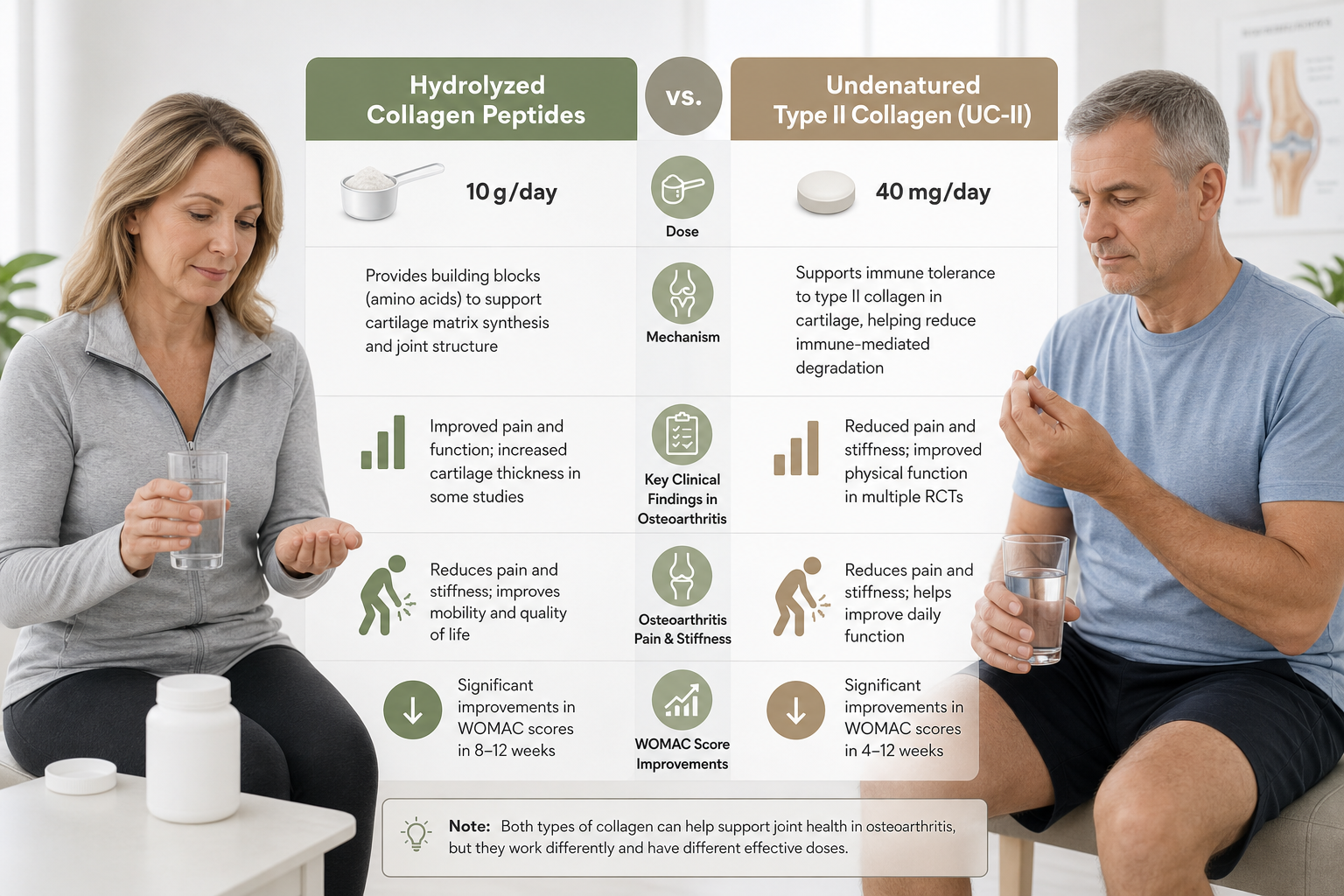
The proposed mechanism — that collagen peptides accumulate in cartilage and stimulate chondrocytes to produce more extracellular matrix components — is biologically plausible, and some imaging studies have shown measurable changes in cartilage tissue. For bone mineral density, early data suggest that collagen supplementation combined with calcium and vitamin D may offer modest additional benefit, but long-term data beyond 12 months are very limited, which prevents a full assessment of durability and safety for chronic use.
Where the Hype Outpaces the Evidence
Sports performance claims represent one of the most aggressively marketed but least well-supported areas of collagen supplementation. Despite widespread promotion to athletes for muscle recovery, tendon repair, and exercise performance, the largest systematic review to date found little evidence that collagen supplements meaningfully improve exercise performance or recovery outcomes compared with placebo. Some smaller studies have examined tendon health and connective tissue repair in athletes, with mixed results, but the overall evidence does not support the broad sports performance claims commonly seen in marketing materials.
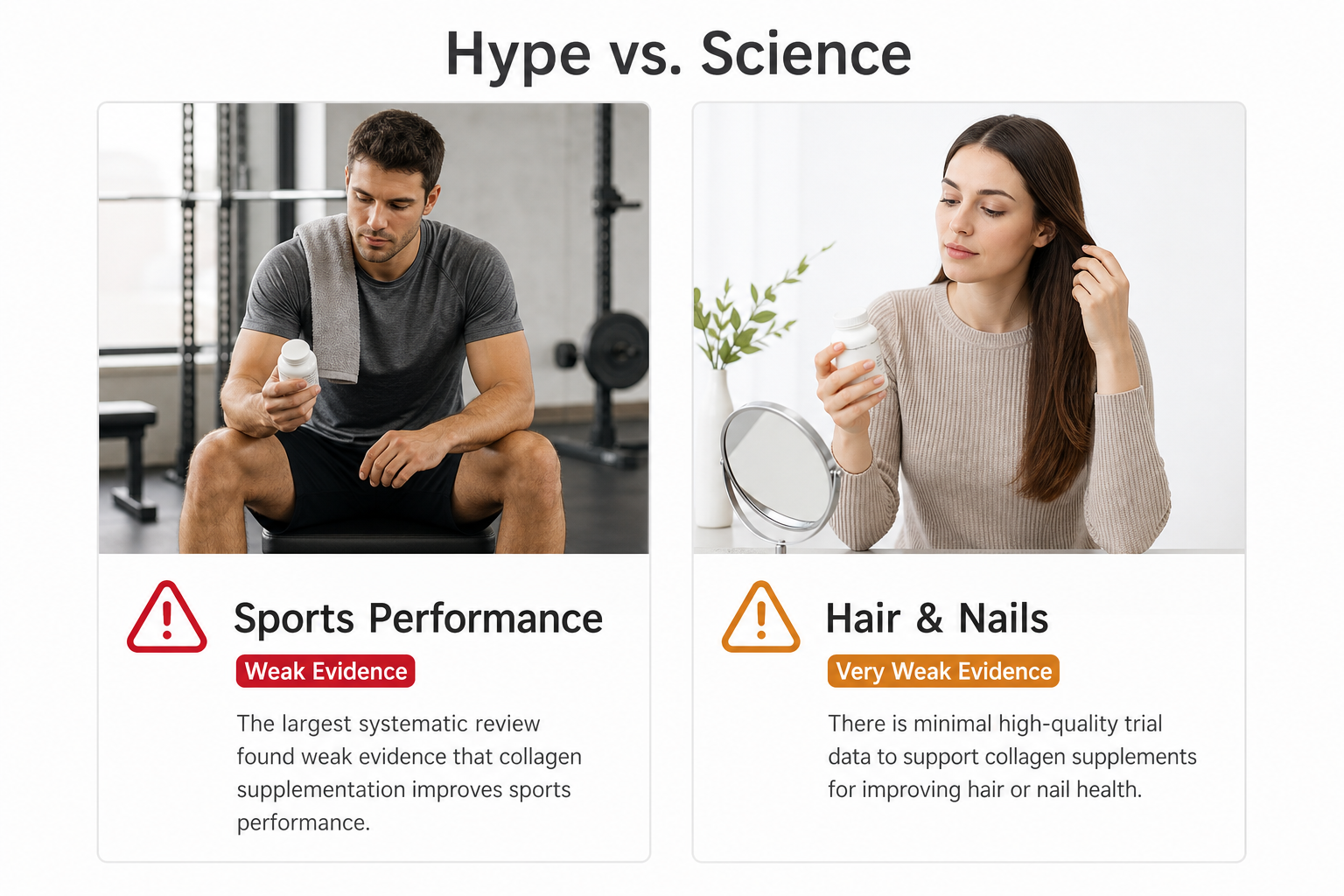
Hair and nail benefits are similarly weakly supported. A small number of studies have reported improvements in nail brittleness and hair density, but these trials are generally short, small, and methodologically limited. Hair thinning has multiple causes — hormonal, nutritional, genetic, and inflammatory — and there is no strong evidence that collagen supplementation addresses any of these root causes directly. Consumers should be cautious about products making strong hair and nail claims without independent clinical evidence.
Marine vs. Bovine Collagen: Does the Source Matter?
Most collagen supplements are derived from either bovine (cow hide and bones) or marine (fish skin and scales) sources, with chicken-derived collagen used primarily for UC-II joint products. Marine collagen is predominantly Type I and is often marketed as having superior bioavailability due to its smaller peptide size, though head-to-head comparative trials are limited and the clinical significance of any absorption difference is unclear. Bovine collagen contains both Type I and Type III collagen and is widely used in skin-focused products. Both sources have been used in positive clinical trials, and neither has been shown to be definitively superior for skin or joint outcomes in well-controlled studies.
For individuals with fish or shellfish allergies, marine collagen is contraindicated. Those with religious or dietary restrictions around beef should opt for marine or plant-derived alternatives. It is worth noting that vegan collagen supplements do not contain actual collagen — plants cannot produce the animal-specific collagen protein. Instead, these products typically contain vitamin C, zinc, and amino acid precursors intended to support the body’s own collagen synthesis, which is a different proposition from taking pre-formed collagen peptides.
How Long Does Collagen Take to Work?
Clinical trials suggest that meaningful changes in skin elasticity and hydration typically require at least 8 weeks of consistent supplementation, with most studies running for 12 to 24 weeks. Joint outcomes in osteoarthritis trials have generally been assessed over 12 to 24 weeks, with some participants reporting gradual improvements in pain and stiffness from around 8 weeks onward. There is no reliable evidence that short-term use of a few weeks produces meaningful clinical benefit, and the effects observed in trials appear to depend on consistent long-term use rather than intermittent supplementation.
What happens when you stop taking collagen supplements is less well studied. The limited available data suggest that any benefits to skin and joint parameters may diminish after discontinuation, implying that ongoing use would be required to maintain any effect — a practical and financial consideration worth factoring into the decision.
Safety, Side Effects, and What to Look for on a Label
Collagen supplements have a generally favorable short-term safety profile in the doses studied in clinical trials. The most commonly reported side effects are mild gastrointestinal symptoms including bloating, a feeling of fullness, and occasional nausea, particularly at higher doses. Allergic reactions are possible, especially with marine collagen in individuals with fish or shellfish sensitivities, and with bovine collagen in those with beef allergies. As noted above, long-term safety data beyond 12 months are limited, which is an important gap given that many users take these products indefinitely.
Collagen supplements are not regulated as medicines in most countries, meaning manufacturers are not required to prove efficacy or safety before selling their products. When choosing a supplement, look for products that are third-party tested by organizations such as NSF International or Informed Sport, which verify that the product contains what the label claims and is free from contaminants including heavy metals. Check that the dose per serving matches the amounts used in clinical trials (typically 2.5–10 g for hydrolyzed collagen peptides, or 40 mg for UC-II). Added vitamin C is a useful inclusion, as vitamin C acts as a collagen synthesis cofactor — it is required for the hydroxylation of proline and lysine during collagen formation, meaning it supports the body’s ability to build new collagen regardless of whether you are supplementing.
Natural Ways to Support Collagen Production
Sunscreen use, not smoking, and regular physical exercise remain the most consistently evidence-supported approaches for preserving skin collagen and slowing visible aging — and these are often underemphasized in discussions dominated by supplement marketing. Ultraviolet radiation is the single largest environmental driver of collagen degradation in skin, and daily broad-spectrum SPF use has decades of evidence behind it. Smoking accelerates collagen breakdown through oxidative stress and impairs the microvascular supply that skin tissue depends on.

Diet also plays a meaningful role. Vitamin C-rich foods support endogenous collagen production as a cofactor in collagen synthesis. Adequate dietary protein provides the glycine, proline, and hydroxyproline that the body uses to build collagen. Bone broth contains naturally occurring collagen peptides and gelatin, though the concentration and bioavailability compared with standardized supplements is variable and difficult to quantify. Retinoids — including prescription tretinoin and over-the-counter retinol — have strong evidence for stimulating dermal fibroblast activity and increasing collagen production in skin, and represent a well-established topical alternative or complement to oral supplementation.
A Note on the Mood and Cognitive Angle
An emerging and underreported area of collagen research concerns potential effects on mood and cognitive function. Some researchers have proposed that glycine — the most abundant amino acid in collagen — may have calming and sleep-supportive effects, and that collagen-derived peptides may cross the blood-brain barrier and influence neurotransmitter activity. The evidence here is very preliminary and does not yet support strong clinical claims, but it represents a genuinely novel direction in collagen research that may develop further in coming years.
Frequently Asked Questions
Do collagen supplements actually reach the skin or joints?
Research using isotope-labelled collagen peptides has shown that hydrolyzed collagen peptides are absorbed from the gut and can be detected in skin and cartilage tissue after oral supplementation. Whether the amounts that accumulate are sufficient to produce clinically meaningful changes in collagen structure is still debated, but the basic premise of absorption and tissue distribution has biological support.
Is hydrolyzed collagen better than regular collagen protein?
Hydrolyzed collagen has been broken into shorter peptide chains, which improves its bioavailability compared with intact collagen protein. Standard dietary protein sources such as meat, fish, and eggs also provide the amino acids needed for collagen synthesis, but they do not deliver the specific bioactive dipeptides (Pro-Hyp, Hyp-Gly) that hydrolyzed collagen provides and that are thought to signal fibroblast activity directly.
Can collagen supplements replace medical skin treatments?
No. Collagen supplements may offer modest supportive benefits for skin quality, but they are not equivalent to evidence-based medical aesthetic treatments such as retinoids, laser resurfacing, radiofrequency skin tightening, or injectable treatments that address specific structural concerns. A qualified practitioner can help identify which approach — or combination of approaches — is most appropriate for your individual skin concerns.
Are collagen supplements safe to take long-term?
Short-term use at studied doses appears to be well tolerated for most people. However, robust long-term safety data beyond 12 months are limited, which means the full picture of chronic use is not yet established. People with allergies to fish, shellfish, or beef should choose their collagen source carefully. Anyone with a medical condition or taking medications should discuss supplementation with their doctor before starting.
Do collagen gummies or drinks work as well as powder?
The delivery format matters less than the dose and quality of the collagen peptides. Many gummies contain significantly lower doses than those used in clinical trials, and some contain added sugars that may counteract skin health goals. Collagen powder dissolved in liquid is generally the most straightforward way to achieve the doses studied in research. Always check the dose per serving on the label rather than relying on the product format.
Does vitamin C help collagen supplements work better?
Vitamin C is a collagen synthesis cofactor — it is required for the enzymatic steps that stabilize the collagen triple helix. Adequate vitamin C intake supports the body’s ability to produce new collagen regardless of whether you are supplementing. Some collagen products include added vitamin C for this reason, and ensuring sufficient dietary vitamin C intake is a sensible complement to supplementation.
Should You Try Collagen Supplements? A Balanced Assessment
The evidence on collagen supplements is neither as strong as the marketing suggests nor as dismissible as the most skeptical voices claim. For skin elasticity and hydration, and for osteoarthritis-related joint discomfort, there is a reasonable body of clinical evidence — cautiously positive, but tempered by funding bias, variable study quality, and modest effect sizes. For sports performance, hair, and nails, the evidence is too weak to justify the claims commonly made. Long-term safety data remain limited across all outcome areas.
If you are considering collagen supplementation, the most rational approach is to choose a product that is third-party tested, contains a clinically relevant dose of hydrolyzed collagen peptides (2.5–10 g per day for skin and general use, or 40 mg UC-II for joint-specific goals), and to commit to consistent long-term use for at least 12 weeks before assessing any benefit. Supplementation is most likely to be useful as part of a broader approach that includes sun protection, a nutrient-rich diet, adequate protein intake, and — where appropriate — evidence-based medical or aesthetic treatments tailored to your specific concerns. A consultation with a qualified practitioner can help you determine whether collagen supplementation fits meaningfully into your individual health and aesthetic goals, or whether other approaches may offer more reliable results.
