


Microneedling has become one of the most widely discussed non-surgical skin treatments, and a common question from prospective patients is whether it can genuinely tighten loose or lax skin. The short answer is that microneedling can produce a measurable improvement in skin firmness and texture for many patients, but the degree of tightening depends on several factors including skin laxity, age, treatment depth, and the number of sessions completed. This article explains how microneedling works, what the clinical evidence suggests, what results are realistic, and how to decide whether it may be worth discussing with a qualified practitioner.
Key Takeaways
- Microneedling stimulates collagen and elastin production through controlled micro-injuries, which can improve skin firmness and texture over time.
- Results are gradual and typically require a course of treatments rather than a single session; most patients need three to six sessions for meaningful improvement.
- Microneedling is generally better suited to mild to moderate skin laxity; significant or advanced skin sagging may require more intensive interventions.
- Radiofrequency microneedling delivers additional heat energy into the dermis and may produce more pronounced tightening than standard microneedling alone.
- Downtime is usually short, but risks including redness, swelling, infection, and post-inflammatory hyperpigmentation should be understood before treatment.
How Microneedling Works
Microneedling — also called collagen induction therapy — uses a device fitted with fine needles to create thousands of controlled micro-channels in the skin’s surface. These micro-injuries are small enough to avoid significant tissue damage but sufficient to trigger the skin’s natural wound-healing response. During this response, the body increases production of collagen and elastin, two structural proteins responsible for skin firmness, elasticity, and resilience. Over the weeks following treatment, this new collagen gradually remodels the dermis, which can lead to firmer, smoother, and more even-toned skin.
The depth to which the needles penetrate is adjustable and is selected by the practitioner based on the treatment area and the concern being addressed. Shallower depths are typically used for fine lines and surface texture, while deeper settings may be used when targeting more significant laxity or acne scarring. The controlled nature of the injury is what distinguishes microneedling from more aggressive resurfacing procedures, and it is also why multiple sessions are generally required to accumulate a meaningful collagen response.
Does Microneedling Actually Tighten Skin?
Clinical studies and systematic reviews support the conclusion that microneedling can improve skin laxity, though the degree of improvement varies between patients and studies. Research published in peer-reviewed dermatology journals has demonstrated measurable increases in dermal collagen density and improvements in skin elasticity following a course of microneedling treatments. Patients and clinicians have reported visible tightening of the skin on the face, neck, and décolletage, as well as improvements in fine lines and overall skin quality.
It is important to understand that microneedling produces a biological process rather than an immediate mechanical effect. Unlike surgical procedures that physically remove or reposition tissue, microneedling works by encouraging the skin to rebuild its own structural support. This means results develop gradually over weeks to months, and the improvement is proportional to the skin’s capacity to produce new collagen — a capacity that naturally declines with age. Younger patients with good skin quality and mild laxity tend to respond more readily than older patients with more advanced skin sagging.
The evidence is strongest for improvements in skin texture, fine lines, and mild to moderate laxity. For patients with significant skin looseness — for example, pronounced jowling, heavily crepey neck skin, or post-weight-loss laxity — standard microneedling alone is unlikely to produce the degree of tightening that surgical options or more energy-based devices can achieve. A realistic and honest assessment of what microneedling can and cannot do is essential before committing to a course of treatment.
Radiofrequency Microneedling: An Enhanced Option
Radiofrequency (RF) microneedling combines the collagen-stimulating effect of traditional microneedling with the delivery of radiofrequency energy directly into the dermis through the needle tips. The heat generated by the radiofrequency energy causes immediate contraction of existing collagen fibres and stimulates a more robust long-term collagen remodelling response compared with standard microneedling alone. Devices used for RF microneedling include platforms such as Morpheus8, Genius, and Sylfirm X, among others.
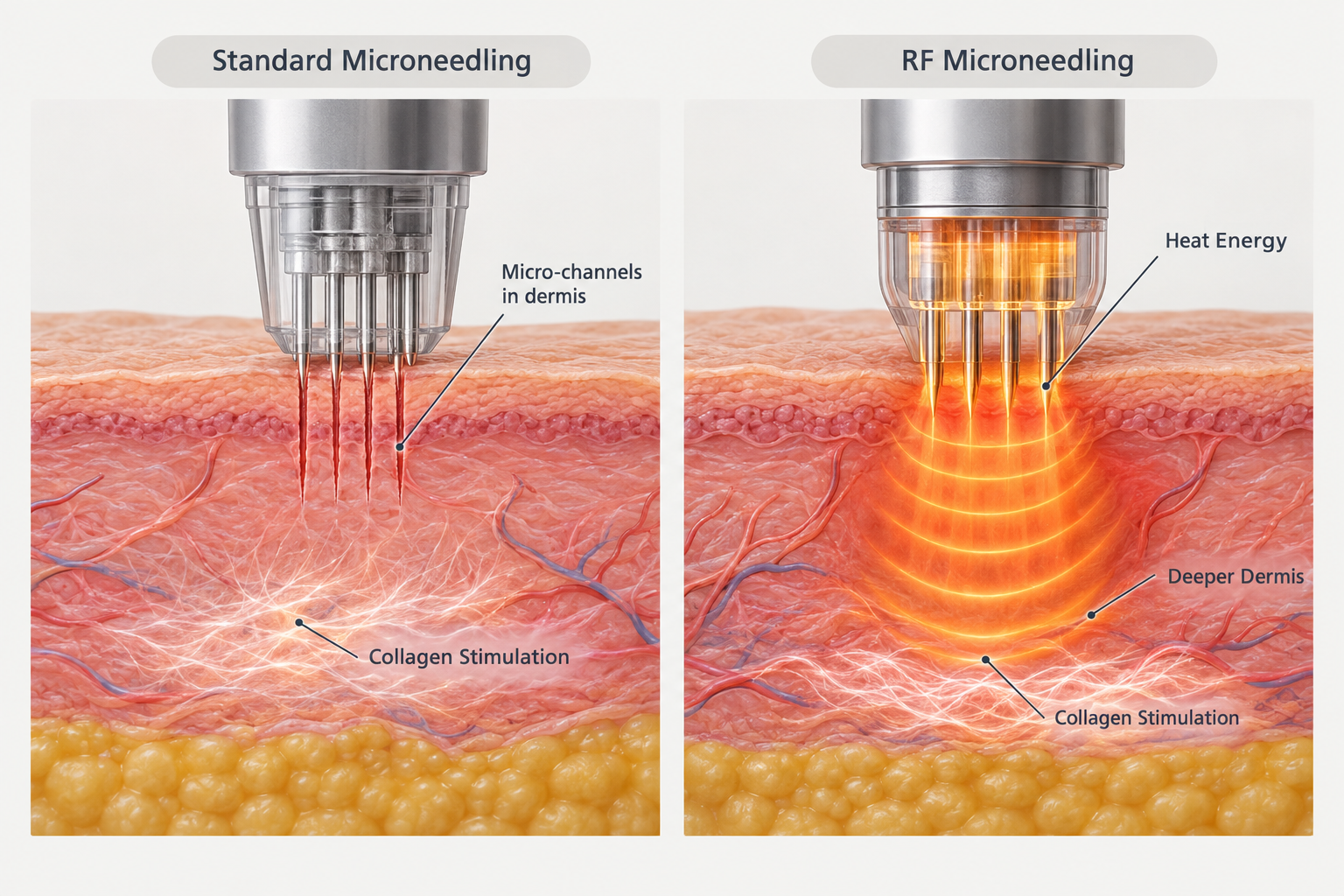
Clinical evidence for RF microneedling and skin tightening is generally more favourable than for standard microneedling, particularly for moderate skin laxity on the lower face, jawline, neck, and body. The addition of heat energy means the treatment can address both the superficial and deeper layers of the dermis, and some devices also target the subdermal fat layer to produce a more comprehensive remodelling effect. However, RF microneedling typically involves more discomfort, a slightly longer recovery period, and a higher cost per session than standard microneedling. It also carries its own set of risks, including the possibility of burns or uneven skin texture if not performed correctly.
For patients whose primary concern is skin tightening rather than surface texture alone, RF microneedling may be worth discussing as an alternative or upgrade to standard microneedling. The choice between the two should be guided by the degree of laxity, the treatment area, the patient’s tolerance for downtime, and the practitioner’s clinical assessment.
Treatment Areas Where Microneedling May Help
Microneedling is most commonly used on the face, where it can address fine lines around the eyes and mouth, mild skin laxity on the cheeks and jawline, enlarged pores, uneven skin tone, and acne scarring. The neck and décolletage are also frequently treated, as these areas often show early signs of skin thinning and crepiness that respond reasonably well to collagen stimulation. Some practitioners use microneedling on the abdomen, thighs, and upper arms to address stretch marks and mild skin laxity in these areas, though evidence for body applications is less extensive than for facial treatments.
The scalp is another area where microneedling has been studied, primarily in the context of hair loss rather than skin tightening. Microneedling on the scalp may enhance the absorption of topical hair growth treatments and stimulate follicle activity, though this is a separate application from skin tightening and is not the focus of this article.
What to Expect During a Microneedling Session
A typical microneedling appointment begins with a consultation or review of the treatment plan, followed by the application of a topical numbing cream to the area being treated. The numbing cream is usually left in place for around 30 to 45 minutes before treatment begins. Once the skin is adequately anaesthetised, the practitioner passes the microneedling device across the skin in a systematic pattern, adjusting needle depth as needed for different zones of the face or body.
The sensation during treatment is often described as a mild scratching or vibrating feeling. Most patients find the procedure tolerable with adequate numbing, though areas with thinner skin — such as around the eyes or over bony prominences — may feel more sensitive. A full facial treatment typically takes between 20 and 45 minutes depending on the area covered and the device used. After the needling is complete, a soothing serum or growth factor solution is often applied to the skin to support recovery.
Immediately after treatment, the skin typically appears red and may feel warm, tight, or slightly swollen — similar in appearance to mild sunburn. This initial reaction usually subsides within 24 to 48 hours for standard microneedling, though RF microneedling may involve more pronounced redness and swelling lasting three to five days or longer depending on the intensity of the treatment.
How Many Sessions Are Needed?
A single microneedling session can initiate the collagen remodelling process, but meaningful skin tightening generally requires a course of treatments. Most clinical protocols and practitioner recommendations suggest three to six sessions spaced four to six weeks apart for facial skin tightening. The spacing allows the skin time to complete each healing cycle before the next treatment is applied. Maintenance sessions every six to twelve months may help sustain results over time.
The number of sessions that will be most beneficial for a specific patient depends on the degree of laxity being addressed, the patient’s age and skin condition, the device and needle depth used, and whether adjunctive treatments such as topical growth factors or platelet-rich plasma (PRP) are incorporated. PRP, derived from the patient’s own blood, is sometimes applied during or after microneedling with the aim of enhancing the healing response, though the additional benefit of combining PRP with microneedling for skin tightening specifically remains an area of ongoing research.
When Results Appear and How Long They Last
Because microneedling works by stimulating the body’s own collagen production, results do not appear immediately after treatment. Most patients begin to notice improvements in skin texture and firmness around four to six weeks after their first session, with more significant changes becoming visible after completing a full course of treatments. The full benefit of a treatment course may not be apparent until two to three months after the final session, as collagen remodelling continues during this period.
The longevity of microneedling results varies between patients. Improvements in skin quality and mild tightening may last twelve to eighteen months or longer in some patients, particularly when a good skincare routine is maintained and sun protection is used consistently. However, the natural ageing process continues after treatment, and the skin will gradually lose collagen over time regardless of previous microneedling. Periodic maintenance treatments are typically recommended to sustain the improvements achieved during the initial course.
Risks and Side Effects
Microneedling is generally considered a low-risk procedure when performed by a trained and experienced practitioner using appropriate equipment, but it is not without potential adverse effects. Understanding these risks is an important part of making an informed decision.
- Redness and swelling: Expected after treatment and usually resolves within one to three days for standard microneedling. RF microneedling may cause more prolonged redness.
- Skin sensitivity: The treated skin may feel tender and sensitive to touch, heat, and skincare products for several days after treatment.
- Dryness and peeling: Mild flaking or peeling of the skin surface can occur as the healing process progresses, typically in the days following treatment.
- Post-inflammatory hyperpigmentation (PIH): Darker skin tones carry a higher risk of developing temporary or, in some cases, prolonged darkening of the skin in treated areas. This risk can be reduced by appropriate patient selection, conservative treatment parameters, and pre-treatment skin preparation.
- Infection: The micro-channels created during treatment temporarily increase the skin’s vulnerability to bacterial, viral, and fungal infection. Patients with a history of cold sores (herpes simplex) may require antiviral prophylaxis before treatment. Strict hygiene and aftercare protocols are essential.
- Bruising: Mild bruising can occur, particularly in areas with thinner skin or in patients taking blood-thinning medications.
- Scarring: Rare but possible, particularly if the skin is treated too aggressively or if aftercare instructions are not followed.
- Milia: Small white cysts can occasionally develop after microneedling, particularly if occlusive products are applied during the healing phase.
Serious complications are uncommon when microneedling is performed correctly, but they are more likely when treatment is carried out by inadequately trained practitioners, when inappropriate devices are used, or when patients with contraindications are treated. At-home microneedling rollers carry a higher risk of infection and uneven results compared with professional treatments and are not equivalent to clinic-based procedures.
Who May Be Suitable for Microneedling Skin Tightening
Microneedling for skin tightening may be worth discussing with a practitioner if you have mild to moderate skin laxity, fine lines, or a general loss of skin firmness that you would like to address without surgery or significant downtime. It tends to be most effective for patients in their thirties to fifties who are beginning to notice early signs of skin ageing but whose laxity has not yet progressed to the point where surgical intervention would be the more appropriate recommendation.
Patients with good overall skin health, realistic expectations, and the commitment to complete a full course of treatments are generally the most suitable candidates. A thorough consultation with a qualified practitioner is necessary to assess individual suitability, discuss goals, and determine whether microneedling — standard or RF — is the most appropriate option for the specific concerns being presented.
Who May Not Be Suitable
Microneedling is not appropriate for everyone, and certain conditions or circumstances may make treatment inadvisable or require postponement. A practitioner should conduct a full medical history review before proceeding. Microneedling is generally not recommended for patients who:
- are pregnant or breastfeeding;
- have active acne, rosacea flares, eczema, psoriasis, or other inflammatory skin conditions in the treatment area;
- have an active skin infection, cold sore, or open wound in the area to be treated;
- have a history of keloid scarring or hypertrophic scarring;
- are taking isotretinoin (a retinoid medication for acne) or have recently completed a course — practitioners typically advise waiting six months after stopping isotretinoin before microneedling;
- have a bleeding disorder or are taking anticoagulant medications;
- have had recent radiation therapy to the treatment area;
- have implanted electronic devices such as a pacemaker (particularly relevant for RF microneedling).
Patients with darker skin tones should discuss the risk of post-inflammatory hyperpigmentation with their practitioner and ensure that the treating clinician has appropriate experience with their skin type.
Alternatives to Microneedling for Skin Tightening
Microneedling is one of several non-surgical options that may help improve skin firmness. Understanding the alternatives can help patients and practitioners identify the most appropriate approach for a given concern.
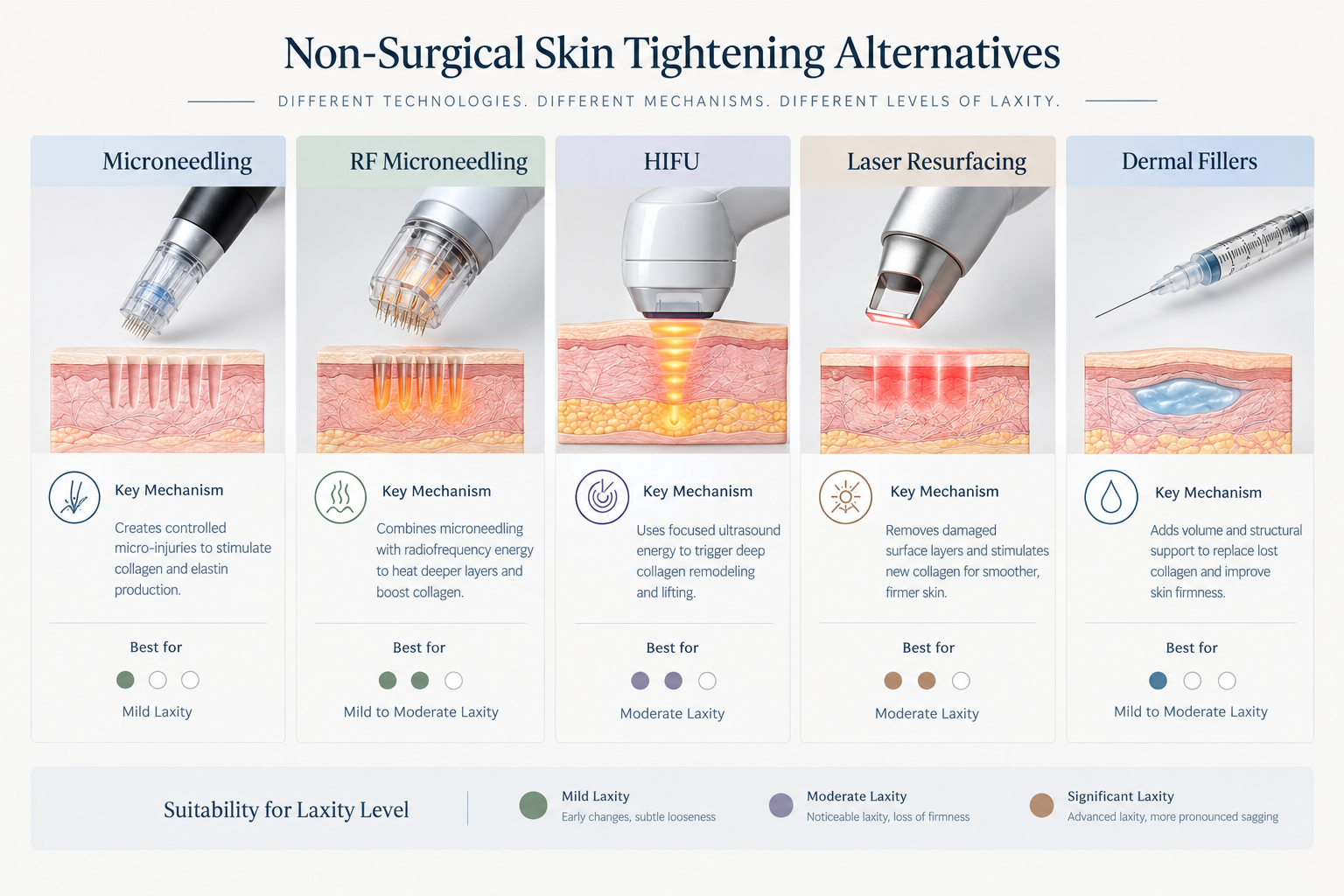
Radiofrequency (RF) skin tightening devices deliver heat energy into the dermis without needles, stimulating collagen contraction and remodelling. Treatments such as Thermage use monopolar radiofrequency and are often described as suitable for patients who want a single-session option with no significant downtime, though results may be more gradual and variable than with RF microneedling.
High-intensity focused ultrasound (HIFU), delivered by devices such as Ultherapy, targets the deeper structural layers of the skin and the superficial muscular aponeurotic system (SMAS) — the same layer addressed in surgical facelifts. HIFU may produce more pronounced lifting and tightening than standard microneedling for patients with moderate laxity, but it is associated with more discomfort during treatment and a higher cost per session.
Laser skin resurfacing treatments, including fractional CO2 and erbium lasers, can produce significant improvements in skin texture, fine lines, and mild laxity. Ablative laser treatments generally involve more downtime than microneedling but may achieve more dramatic results in a smaller number of sessions. Non-ablative fractional lasers offer a middle ground with less downtime but typically require more sessions.
Dermal fillers do not tighten skin in the same way as collagen-stimulating treatments, but they can restore volume and improve the appearance of skin laxity by providing structural support. Biostimulatory fillers such as poly-L-lactic acid (Sculptra) and calcium hydroxylapatite (Radiesse) work partly by stimulating collagen production and may complement microneedling in a comprehensive treatment plan.
Surgical options such as a facelift, neck lift, or blepharoplasty remain the most effective interventions for significant skin laxity and are the appropriate recommendation when non-surgical treatments are unlikely to achieve the patient’s goals. A qualified practitioner should be transparent about when a surgical referral may be more appropriate than continuing with non-surgical treatments.
Frequently Asked Questions
How many microneedling sessions does it take to see skin tightening?
Most patients require a course of three to six sessions spaced four to six weeks apart before meaningful skin tightening becomes visible. Some improvement in skin texture may be noticeable after the first or second session, but the full collagen remodelling response develops over several months. The exact number of sessions needed depends on the degree of laxity, the patient’s age, and the treatment parameters used.
Is RF microneedling better than standard microneedling for tightening?
Radiofrequency microneedling generally produces more pronounced skin tightening than standard microneedling alone because it combines collagen stimulation with the immediate thermal contraction of existing collagen fibres. It may be a more appropriate option for patients with moderate laxity or those who want more significant results. However, it typically involves more discomfort, a longer recovery, and a higher cost per session. A practitioner can advise which option is more suitable based on individual assessment.
Can microneedling tighten loose skin on the neck?
Microneedling can be used on the neck and may help improve mild crepiness and skin quality in this area. However, the neck is a challenging area to treat, and results for significant neck laxity are generally more modest than for facial skin. RF microneedling or HIFU may be more appropriate for patients with more pronounced neck laxity. A clinical assessment is needed to determine the most suitable approach.
How long do microneedling skin tightening results last?
Results from a course of microneedling treatments may last twelve to eighteen months or longer in some patients, depending on age, skin condition, lifestyle factors, and sun exposure. The ageing process continues after treatment, so periodic maintenance sessions are usually recommended to sustain improvements. Consistent use of SPF and a good skincare routine can help prolong results.
Is microneedling suitable for all skin tones?
Microneedling can be performed on a range of skin tones, but patients with medium to darker skin tones face a higher risk of post-inflammatory hyperpigmentation. It is important to choose a practitioner with experience treating your skin type and to discuss this risk during the consultation. Pre-treatment skin preparation and conservative treatment parameters can help reduce this risk.
Can microneedling replace a surgical facelift?
Microneedling cannot replicate the results of a surgical facelift. It is a useful option for mild to moderate skin laxity and skin quality concerns, but it cannot physically reposition tissue or remove excess skin. Patients with significant skin sagging are likely to achieve more meaningful results from surgical intervention. A qualified practitioner should provide an honest assessment of what non-surgical treatments can realistically achieve for a given level of laxity.
Is Microneedling a Realistic Option for Your Skin Tightening Goals?
Microneedling can produce genuine improvements in skin firmness, texture, and overall quality for patients with mild to moderate skin laxity, and the evidence supporting its role in collagen stimulation is reasonably well established. It is a practical option for patients who want a non-surgical approach with manageable downtime and are willing to commit to a course of treatments rather than expecting immediate results from a single session.
The treatment is not a substitute for surgery when significant laxity is present, and it works best as part of a broader approach to skin health that includes appropriate sun protection, a consistent skincare routine, and realistic expectations. Radiofrequency microneedling may offer enhanced tightening for patients whose concerns go beyond surface texture, and alternatives such as HIFU, laser resurfacing, or biostimulatory treatments may be more appropriate depending on individual goals and anatomy.
If you are considering microneedling for skin tightening, a consultation with a qualified and experienced practitioner is the most important first step. A thorough assessment of your skin, a clear discussion of what is achievable, and an honest comparison of the available options will help you make a well-informed decision about whether microneedling — or another treatment — is the right approach for your specific concerns.
