
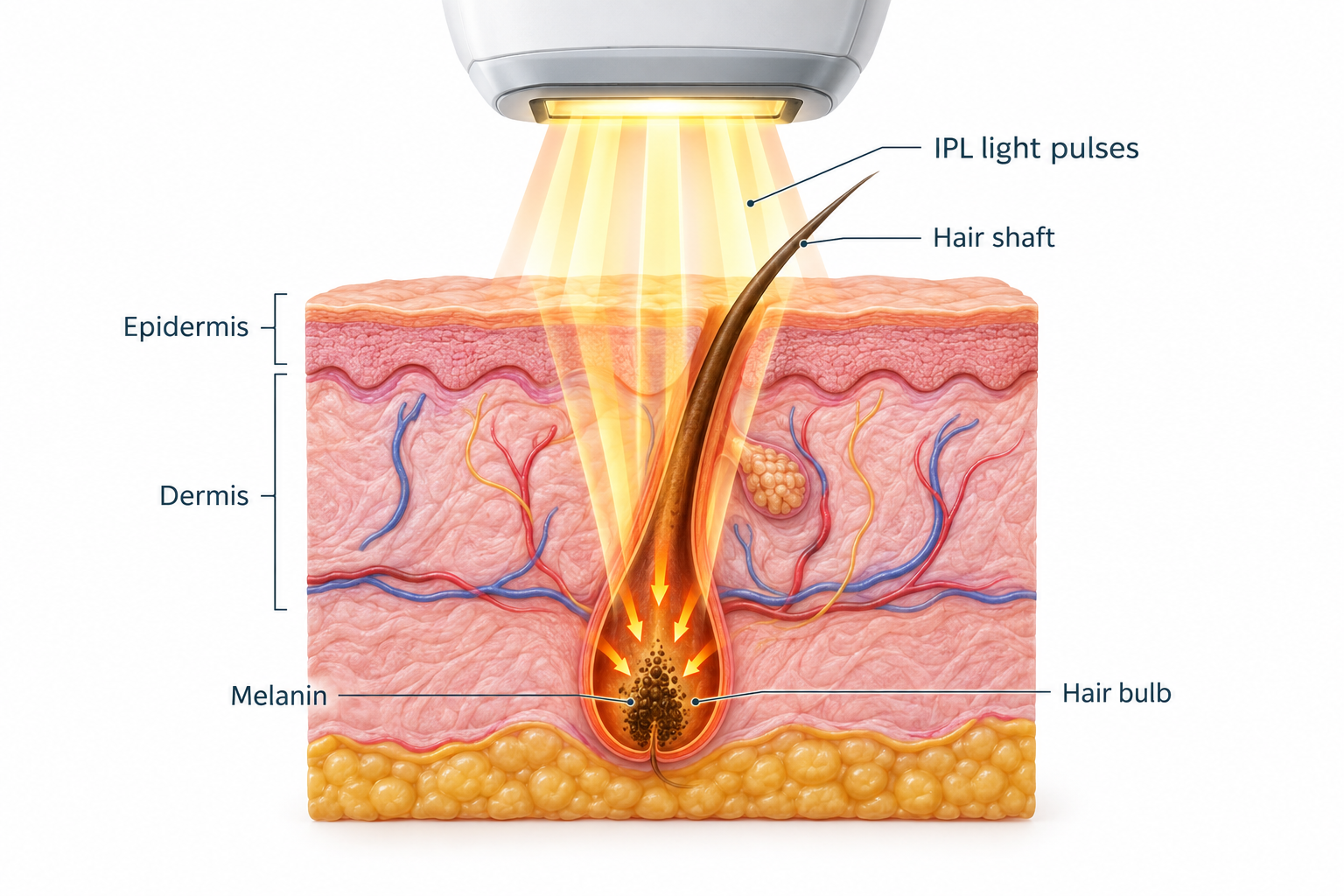

IPL hair removal uses broad-spectrum light energy to target the pigment in hair follicles, gradually reducing hair growth over a course of treatments. It is one of the most widely used light-based hair reduction methods available in professional clinics, and understanding how it works can help you decide whether it may be appropriate for your skin type, hair colour, and goals before booking a consultation.
Key Takeaways
- IPL stands for intense pulsed light and works by delivering broad-spectrum light that is absorbed by melanin in the hair follicle, generating heat that disrupts the follicle’s ability to produce hair.
- IPL hair removal is most effective on people with lighter skin tones and darker hair, because the contrast between skin and hair pigment allows more selective targeting of the follicle.
- Multiple sessions are typically required because IPL can only affect follicles in the active growth phase at the time of treatment.
- Results vary between individuals; most people experience significant hair reduction rather than permanent complete removal, and some maintenance sessions may be needed over time.
- IPL carries a meaningful risk of side effects on darker skin tones and is not suitable for everyone — a thorough clinical assessment before treatment is essential.
What Is IPL and How Does It Differ from Laser?
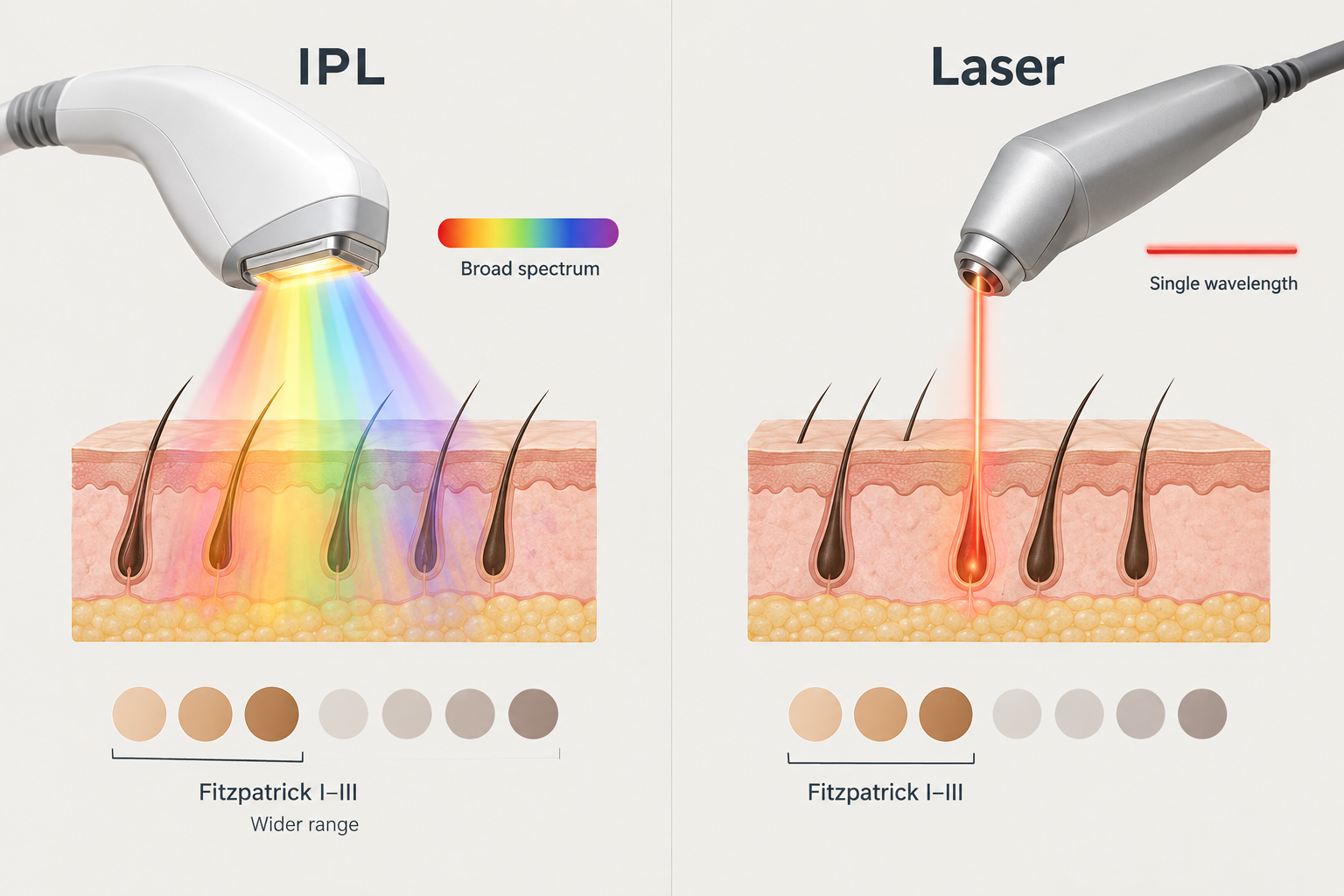
Intense pulsed light, commonly abbreviated as IPL, is a light-based technology that emits multiple wavelengths of light simultaneously, typically spanning a broad spectrum of around 500 to 1200 nanometres. This distinguishes IPL from laser devices, which emit a single, highly focused wavelength. Because IPL produces a broad band of light rather than a coherent beam, it interacts with a wider range of chromophores — the light-absorbing molecules in tissue — which is why the same IPL device can be used for hair reduction, pigmentation treatment, and vascular concerns depending on the filters applied.
In the context of hair removal, IPL devices use cut-off filters to restrict the emitted spectrum to wavelengths that are preferentially absorbed by melanin, the pigment found in hair and skin. The light is delivered in pulses rather than a continuous beam, and the pulse duration, fluence (energy delivered per unit area), and filter selection can be adjusted by the practitioner to suit the individual’s skin tone and hair characteristics. This adjustability is one of IPL’s practical advantages in a clinical setting, though it also means that outcomes depend significantly on the skill and experience of the person operating the device.
The Mechanism of IPL Hair Removal
The biological principle underlying IPL hair removal is called selective photothermolysis. This concept, first described in the early 1980s, explains how a specific wavelength of light can be chosen to match the absorption characteristics of a target chromophore — in this case melanin — while minimising damage to surrounding tissue. When IPL energy is absorbed by melanin in the hair shaft and follicle, it is converted into heat. If sufficient heat is generated within the follicle, it damages the structures responsible for hair growth, particularly the hair bulb and the stem cells in the bulge region of the follicle.
The effectiveness of this process depends on the thermal relaxation time of the target — the time it takes for the heated structure to lose half its heat to surrounding tissue. For IPL hair removal to work selectively, the pulse duration should ideally be shorter than or equal to the thermal relaxation time of the hair follicle, so that heat is confined to the follicle rather than spreading to the surrounding dermis. Practitioners adjust pulse duration settings to balance efficacy against the risk of collateral thermal injury to the skin.
Melanin exists in two forms: eumelanin, which produces brown and black pigment, and pheomelanin, which produces red and yellow pigment. IPL wavelengths are absorbed most efficiently by eumelanin, which is why IPL hair removal tends to be most effective on dark brown or black hair. Lighter hair colours — blonde, grey, red, and white — contain less eumelanin and therefore absorb less light energy, making IPL significantly less effective or ineffective for these hair types.
Why Multiple Sessions Are Needed
Hair follicles cycle through three distinct phases: anagen (active growth), catagen (transition), and telogen (resting). IPL hair removal is only effective during the anagen phase, when the hair shaft is still attached to the follicle and melanin is actively present in the bulb. At any given time, only a proportion of follicles in a treatment area are in the anagen phase — this proportion varies by body site, ranging from roughly 20% to 85% depending on the area.
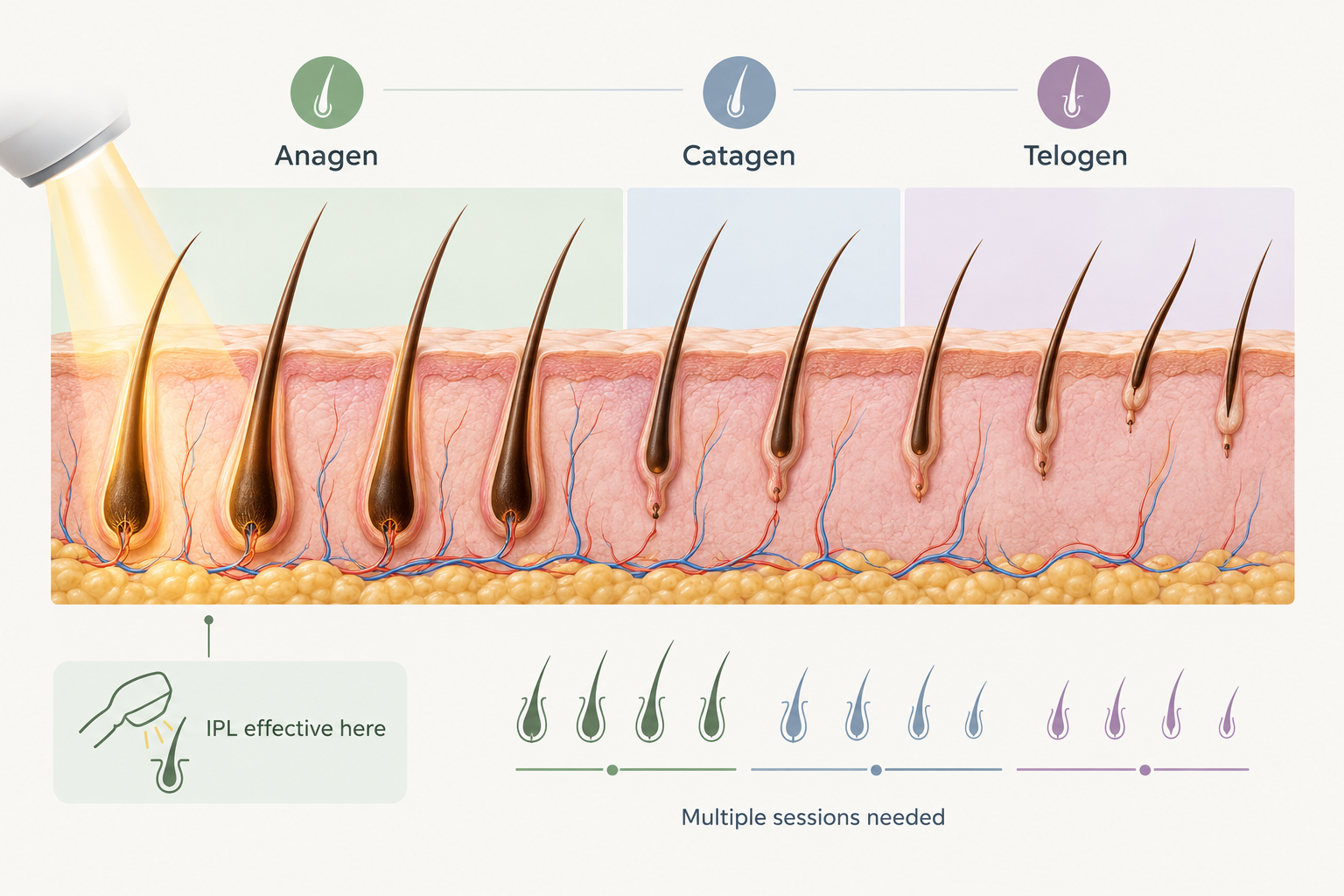
Because a single IPL session can only target follicles that are actively growing at that moment, a course of treatments spaced several weeks apart is necessary to progressively treat follicles as they cycle into the anagen phase. Most clinical protocols for IPL hair removal involve between six and eight sessions, though the exact number depends on the treatment area, hair density, individual hair growth cycles, and the patient’s response to treatment. Some areas, such as the face, may require more frequent sessions than areas like the legs, because facial hair cycles more rapidly.
After completing an initial course, many patients find that periodic maintenance sessions — perhaps once or twice a year — help to manage regrowth, particularly for hormonally influenced areas such as the upper lip, chin, or bikini line. Hormonal changes related to conditions such as polycystic ovary syndrome (PCOS) can stimulate new follicle activity, which may reduce the longevity of results in affected individuals.
Who May Be Suitable for IPL Hair Removal
Patient selection is one of the most important factors in achieving safe and effective outcomes with IPL hair removal. The treatment works best when there is a clear contrast between the melanin in the hair follicle and the melanin in the surrounding skin. This means that individuals with lighter skin tones and darker hair colours are generally the most suitable candidates.
Skin tone is commonly assessed using the Fitzpatrick scale, a six-point classification system ranging from type I (very fair, always burns) to type VI (deeply pigmented, never burns). IPL hair removal is generally considered most appropriate for Fitzpatrick skin types I to III, and can be used with caution in type IV with appropriate device settings and an experienced practitioner. For Fitzpatrick types V and VI, the risk of adverse effects — including burns, hyperpigmentation, and hypopigmentation — is substantially higher, because the skin itself contains significant melanin that competes with the hair follicle for light absorption. In these cases, alternative technologies such as Nd:YAG laser, which uses a longer wavelength that penetrates more deeply and is less absorbed by epidermal melanin, may be a safer option.
Individuals who may not be suitable for IPL hair removal include those who:
- have a recent tan or sunburned skin in the treatment area;
- are pregnant or breastfeeding;
- are taking photosensitising medications, such as certain antibiotics or retinoids;
- have active skin infections, open wounds, or inflammatory skin conditions in the treatment area;
- have a history of keloid scarring;
- have epilepsy triggered by light;
- have certain hormonal conditions that may drive ongoing hair growth;
- have very light, grey, red, or white hair, which contains insufficient melanin for effective treatment.
A thorough consultation and patch test before beginning a course of IPL treatment is standard clinical practice and helps identify contraindications and establish appropriate device settings for the individual.
What Happens During an IPL Hair Removal Session
Before treatment, the area to be treated is typically shaved — not waxed or epilated — so that the hair shaft is present within the follicle but not above the skin surface. Shaving preserves the melanin target within the follicle while removing surface hair that could absorb light energy and cause superficial burns. Patients are usually advised to avoid sun exposure, self-tanning products, and certain topical treatments in the weeks leading up to each session.
During the appointment, a cooling gel is often applied to the skin to protect the epidermis and improve contact between the IPL handpiece and the skin surface. The practitioner places the handpiece against the skin and delivers pulses of light across the treatment area. Most IPL devices incorporate a built-in cooling mechanism — such as a chilled sapphire tip or contact cooling — to reduce discomfort and protect the outer layers of skin during energy delivery.
The sensation during IPL treatment is commonly described as a warm snap or flick against the skin, similar to the feeling of a rubber band being released. Discomfort levels vary depending on the treatment area, the energy settings used, and individual pain tolerance. Areas with thinner skin or denser hair, such as the upper lip or bikini line, tend to be more uncomfortable than areas like the legs or arms. Session duration depends on the size of the area being treated, ranging from a few minutes for a small area such as the upper lip to around 45 minutes for both legs.
Expected Results and Realistic Outcomes
After each IPL session, treated hairs typically shed over the following one to three weeks as the damaged follicles release the hair shaft. The skin may appear slightly red or feel warm immediately after treatment, similar to mild sunburn, and this usually settles within a few hours to a day. Some patients notice temporary follicular oedema — small raised bumps around each treated follicle — which generally resolves within 24 to 48 hours.
Over the course of a full treatment programme, most patients experience a meaningful reduction in hair density and thickness. Clinical studies on IPL hair removal generally report reductions in hair count of between 50% and 80% after a completed course, though results vary considerably between individuals and treatment areas. It is important to understand that IPL hair removal is more accurately described as long-term hair reduction rather than permanent hair removal, as some follicles may recover partial function over time, particularly in hormonally sensitive areas.
The term “permanent hair reduction” is used by some regulatory bodies to describe a long-lasting decrease in the number of hairs that regrow after treatment, acknowledging that complete and permanent removal of all hair is not a guaranteed outcome for most patients. Realistic expectations — established during the pre-treatment consultation — are an important part of patient satisfaction.
Risks and Side Effects of IPL Hair Removal
IPL hair removal is generally well tolerated when performed by a trained practitioner on an appropriate candidate, but it is not without risk. Understanding the potential side effects helps patients make an informed decision and recognise when to seek advice after treatment.
Common and usually temporary side effects include:
- redness and mild swelling in the treated area, typically resolving within hours;
- a sensation of warmth or mild sunburn-like discomfort;
- temporary follicular oedema (small bumps around treated follicles);
- skin sensitivity in the days following treatment.
Less common but more significant risks include:
- Hyperpigmentation — darkening of the skin, more common in individuals with darker skin tones or those who have had recent sun exposure;
- Hypopigmentation — lightening of the skin, which may be temporary or, in some cases, prolonged;
- Burns and blistering — resulting from excessive energy delivery or inadequate skin cooling, particularly on tanned or darker skin;
- Scarring — rare but possible following burns or blistering;
- Paradoxical hypertrichosis — an uncommon phenomenon in which IPL stimulates rather than reduces hair growth, more frequently reported in individuals with darker skin tones or when sub-therapeutic energy levels are used.
The risk of adverse effects is meaningfully reduced when treatment is performed by an experienced practitioner using a clinically appropriate device, with proper skin assessment, patch testing, and individualised parameter selection. Patients should avoid sun exposure and use broad-spectrum sunscreen on treated areas between sessions to reduce the risk of pigmentation changes.
IPL Hair Removal vs Laser Hair Removal
IPL and laser hair removal both use light energy and the principle of selective photothermolysis to target hair follicles, but they differ in important ways that affect suitability, efficacy, and safety for different patients.
| Characteristic | IPL Hair Removal | Laser Hair Removal |
|---|---|---|
| Light type | Broad-spectrum (multiple wavelengths) | Single, coherent wavelength |
| Targeting precision | Less precise; broader tissue interaction | More precise; focused on specific chromophore |
| Best suited to | Lighter skin, darker hair (Fitzpatrick I–III) | Wider range; Nd:YAG suitable for darker skin |
| Effectiveness on light hair | Limited; poor results on blonde, grey, white hair | Also limited; same melanin dependency applies |
| Treatment speed | Generally faster for large areas | Can be slower for large areas depending on device |
| Versatility | Can treat pigmentation and vascular concerns too | Typically hair-specific per device |
| Risk on darker skin | Higher risk without appropriate settings | Lower risk with Nd:YAG (1064 nm) laser |
| Number of sessions | Typically 6–8 sessions | Typically 6–8 sessions |
| Downtime | Minimal; redness settles within hours | Minimal; similar recovery profile |
Diode laser and alexandrite laser devices are commonly used for hair removal in lighter skin types and may offer more consistent energy delivery than IPL for this purpose. Nd:YAG laser, operating at 1064 nm, is generally considered the safer option for individuals with Fitzpatrick skin types V and VI because its longer wavelength is less absorbed by epidermal melanin. The choice between IPL and laser hair removal should be guided by a clinical assessment of skin type, hair characteristics, treatment area, and the devices available at the clinic.
At-Home IPL Devices vs Professional IPL Treatment
Consumer IPL devices for home use have become widely available and are marketed for hair removal on lighter skin tones. These devices operate on the same broad principle as professional IPL systems but deliver significantly lower energy levels — a deliberate safety measure to reduce the risk of burns in an unsupervised setting. The lower fluence of home devices generally means that results develop more slowly and may be less pronounced than those achieved with professional clinical equipment.
Home IPL devices are typically designed for use on Fitzpatrick skin types I to IV and include built-in skin tone sensors that prevent activation on skin that is too dark for safe use at the device’s energy output. They are not suitable for use on the face in most cases, and are generally not recommended for use around the eyes, on tattooed skin, or over areas with active skin conditions.
Professional IPL treatment in a clinical setting offers the advantage of higher energy delivery, adjustable parameters, active cooling systems, and the oversight of a trained practitioner who can assess suitability, monitor the skin’s response, and adjust settings between sessions. For individuals seeking meaningful and efficient hair reduction, professional treatment is generally more effective than home devices, though it involves a greater time and financial commitment.
Frequently Asked Questions
How many IPL sessions will I need?
Most clinical protocols recommend between six and eight sessions for a primary course of IPL hair removal, spaced approximately four to eight weeks apart depending on the treatment area. Some individuals may need additional sessions, and periodic maintenance treatments may be beneficial for managing regrowth over time, particularly in hormonally influenced areas.
Does IPL hair removal hurt?
Most patients describe the sensation as a warm snap or mild flick against the skin. Discomfort is generally tolerable and brief, though it varies by treatment area and individual sensitivity. Areas with thinner skin or denser hair tend to be more uncomfortable. Modern IPL devices incorporate cooling mechanisms that help reduce discomfort during treatment.
Can IPL be used on any skin tone?
IPL hair removal is most appropriate for lighter skin tones (Fitzpatrick types I to III) and carries a higher risk of adverse effects, including burns and pigmentation changes, on darker skin tones. Individuals with Fitzpatrick types V and VI are generally better served by Nd:YAG laser hair removal, which is considered safer for deeply pigmented skin. A clinical assessment is essential before treatment.
Will IPL remove hair permanently?
IPL hair removal is more accurately described as long-term hair reduction rather than permanent removal. Most patients experience a significant and lasting decrease in hair density and thickness, but some regrowth may occur over time, particularly in areas influenced by hormonal activity. Maintenance sessions can help manage this.
Can IPL treat blonde, grey, or white hair?
IPL is not effective on hair that contains little or no melanin, including white, grey, and most blonde hair. The treatment relies on melanin in the follicle absorbing light energy, so hair types with insufficient pigment do not respond adequately. Alternative approaches such as electrolysis may be considered for these hair colours, though a practitioner can advise on the most appropriate option.
How long does it take to see results from IPL hair removal?
Treated hairs typically shed within one to three weeks after each session. Visible reduction in hair density usually becomes noticeable after two to four sessions, with more significant results accumulating over the full course of treatment. Final results are generally assessed several weeks after the last session, once the skin has fully responded.
Is there any downtime after IPL hair removal?
Downtime is minimal. Most patients experience temporary redness and mild warmth in the treated area that settles within a few hours. Avoiding sun exposure, heat, and certain skincare products for a short period after each session is typically advised. Most people can return to normal activities on the same day.
Is IPL Hair Removal the Right Choice for You?
IPL hair removal can be an effective and practical option for reducing unwanted hair in individuals who are well-suited to the treatment — particularly those with lighter skin tones and darker hair who are looking for a long-term reduction in hair growth across larger body areas. The broad-spectrum nature of IPL technology, combined with adjustable parameters, makes it a versatile tool in a clinical setting, and its relatively low downtime makes it compatible with most people’s daily routines.
However, IPL hair removal is not universally appropriate. Its effectiveness is meaningfully limited for lighter hair colours, and the risk of adverse effects is higher in individuals with darker skin tones if the treatment is not performed with appropriate care and equipment. Hormonal factors can influence the longevity of results, and realistic expectations — understanding that significant reduction rather than complete permanent removal is the more likely outcome — are important for patient satisfaction.
If you are considering IPL hair removal, a thorough consultation with a qualified practitioner is the appropriate starting point. A clinical assessment of your skin type, hair characteristics, medical history, and treatment goals will help determine whether IPL is the most suitable approach, or whether an alternative such as diode laser, alexandrite laser, or Nd:YAG laser may better match your individual profile. Taking the time to understand the mechanism, the realistic outcomes, and the commitment involved in a full course of treatment will help you make a well-informed decision.
