

Quick Comparison
| Characteristic | Dysport | Botox |
|---|---|---|
| Active ingredient | AbobotulinumtoxinA | OnabotulinumtoxinA |
| Manufacturer | Ipsen / Galderma | Allergan Aesthetics (AbbVie) |
| FDA cosmetic approval | 2009 (glabellar lines) | 2002 (glabellar lines), 2013 (crow’s feet), 2017 (forehead lines) |
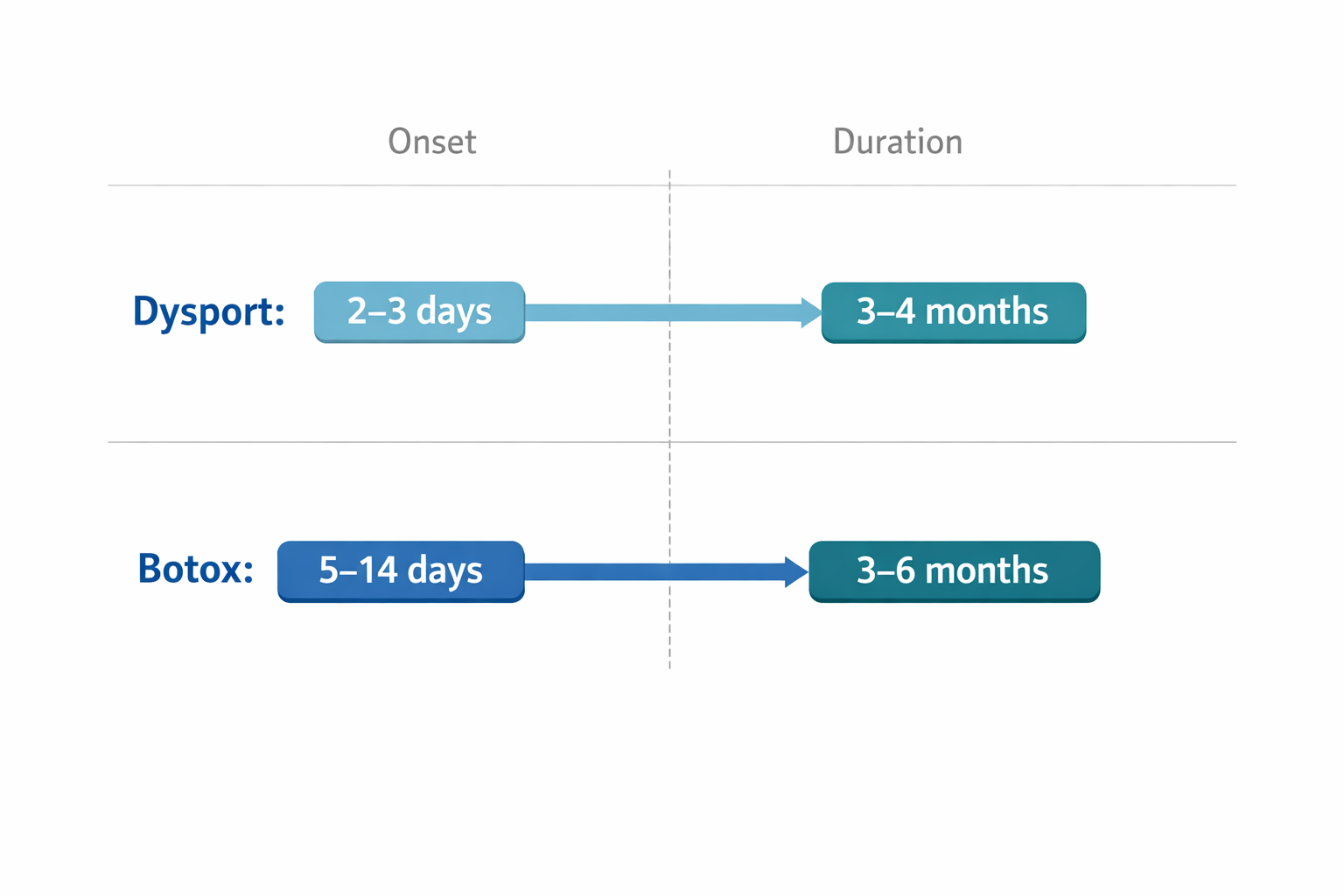
| Onset time | Typically 2–3 days | Typically 5–7 days, up to 14 days |
| Duration | Approximately 3–4 months | Approximately 3–6 months |
| Diffusion potential | Higher — spreads more broadly | Lower — more localized effect |
| Unit conversion ratio | ~2.5 Dysport units per 1 Botox unit | Reference standard |
| Best suited for | Larger treatment areas, faster visible results | Precise, targeted areas; well-established safety record |
| Common medical uses | Cervical dystonia | Cervical dystonia, hyperhidrosis, chronic migraine, more |
| Downtime | Minimal (hours) | Minimal (hours) |
What Are Dysport and Botox?
Both Dysport and Botox are prescription cosmetic injectables derived from botulinum toxin type A, a purified protein produced by the bacterium Clostridium botulinum. When injected in very small, controlled amounts into specific facial muscles, both products temporarily reduce muscle activity by blocking the nerve signals that trigger contraction. This relaxation softens dynamic wrinkles — the lines formed by repeated facial expressions such as frowning, squinting, and raising the eyebrows.
Dysport’s active ingredient is abobotulinumtoxinA, while Botox contains onabotulinumtoxinA. Although both are classified as botulinum toxin type A neuromodulators and share the same fundamental mechanism — inhibiting the release of acetylcholine at the neuromuscular junction — they are distinct pharmaceutical products with different protein structures, molecular weights, and clinical profiles. Understanding those differences is what helps patients and practitioners make an informed choice.
How They Work: The Shared Mechanism
Both products work by binding to nerve terminals at the neuromuscular junction and preventing the release of acetylcholine, the chemical messenger that tells a muscle to contract. Without that signal, the targeted muscle remains relaxed rather than contracting, and the overlying skin appears smoother. The effect is temporary because the nerve terminal gradually regenerates its signaling capacity over several months, at which point muscle activity returns and maintenance treatment may be needed.
Neither product destroys muscle tissue or alters the skin itself. The improvement in expression lines comes entirely from reducing the repetitive muscular movement that deepens those lines over time. Deeper, static wrinkles present even at rest may see less improvement from either product compared to lines that are primarily movement-driven.
Formulation Differences: Why They Are Not Simply Interchangeable
Despite sharing the same active toxin complex, Dysport and Botox differ at the formulation level in ways that have real clinical consequences. Dysport contains a smaller molecular weight protein complex and a lower concentration of accessory proteins per unit compared to Botox. This means that Dysport’s unit of measurement does not equal a Botox unit — the two cannot be directly substituted on a one-to-one basis.
The widely accepted unit conversion ratio is approximately 2.5 Dysport units for every 1 Botox unit, though some practitioners use a ratio closer to 3:1 depending on the area treated and the individual patient. This difference in dosing is one of the most common sources of confusion for patients comparing prices. A treatment quoted at a lower per-unit price for Dysport may not actually be less expensive once the higher number of units required is factored into the total treatment cost. Comparing quotes requires looking at the total session price for the specific areas being treated, not the unit price alone.
Dysport is also more diluted in its standard reconstitution, which contributes to its tendency to spread more broadly from the injection site — a property known as diffusion potential.
Onset Time: Which Works Faster?
Dysport generally shows visible results within 2 to 3 days of treatment, while Botox typically takes 5 to 7 days and can take up to 14 days to reach its full effect. This difference in onset time is one of the most practically significant distinctions for patients with a specific event or deadline in mind.
For someone planning ahead for a wedding, photoshoot, or social occasion, Dysport’s faster onset can be an advantage — though practitioners generally recommend having any injectable treatment at least two weeks before an important event to allow for the full result to develop and any minor swelling or bruising to resolve. Botox’s slower onset is not a disadvantage in routine treatment cycles, but it does mean patients need to plan further in advance if timing matters.
Duration: How Long Do Results Last?
Treatment longevity is comparable between the two products but not identical. Dysport results typically last approximately 3 to 4 months, while Botox results may last 3 to 6 months depending on the patient, the area treated, and the dosage used. Some patients report that Botox lasts slightly longer in certain areas, though individual variation is significant and no fixed duration can be guaranteed for either product.
Factors that can influence how long either product lasts include metabolic rate, the strength of the muscles being treated, physical activity levels, and how frequently a patient has previously been treated. First-time patients sometimes find that results do not last as long as in subsequent sessions, as the muscles may initially retain more activity than in patients with a longer treatment history.
Diffusion and Spread: Precision vs. Coverage
Diffusion — the tendency of a product to spread beyond the primary injection site — is one of the most clinically meaningful differences between Dysport and Botox, and it functions as both a potential advantage and a potential risk depending on the treatment area.
Dysport’s higher diffusion potential means that a single injection point may affect a slightly wider area of muscle. For larger treatment areas such as the forehead, where broader coverage is desirable, this property can mean effective treatment with fewer injection points and a more even result. This is part of why some practitioners prefer Dysport for addressing forehead lines across a wide surface.
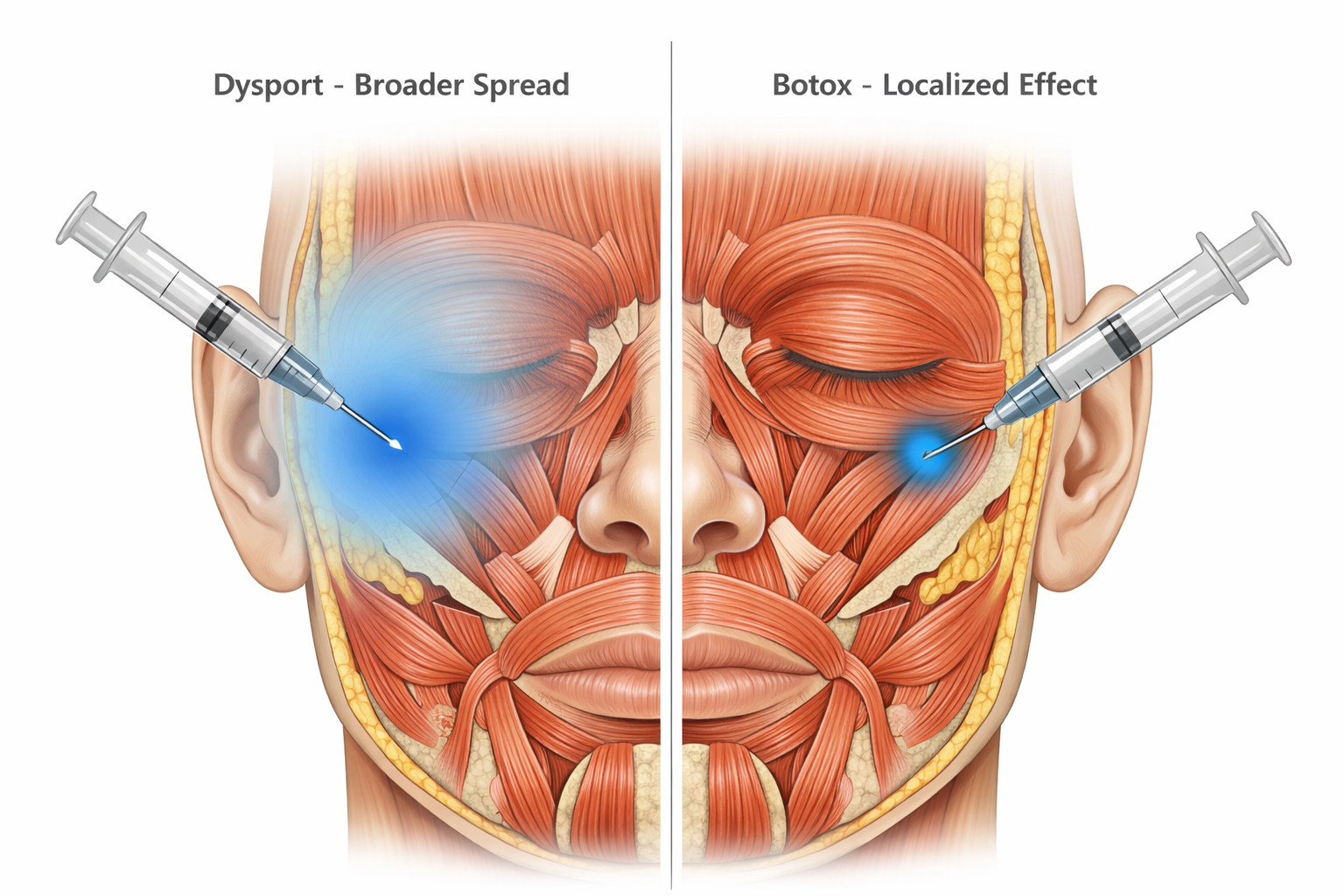
For smaller, more anatomically confined areas — such as fine lines around the lips, the corners of the eyes, or precise brow-shaping work — Botox’s more localized effect is generally preferred. Greater precision reduces the risk of unintended muscle relaxation in neighboring structures, such as eyelid drooping (ptosis) or uneven brow position, which are among the most common complications when diffusion is not carefully managed.
It is important to understand that the risks associated with unwanted diffusion are largely mitigated by the skill and experience of the injector. In the hands of a skilled injector who understands facial anatomy, both products can be used safely and precisely. The choice between them for any specific area should be guided by practitioner assessment rather than product preference alone.
Pros and Cons of Dysport
Advantages of Dysport
- Faster onset: Results may appear within 2–3 days, making it appealing for patients with shorter planning timelines.
- Broader coverage: Higher diffusion potential can be an advantage for treating larger surface areas such as the forehead with fewer injection points.
- Natural movement in large areas: Some patients and practitioners find that Dysport produces a softer, more natural-looking relaxation across wide muscle groups rather than an isolated, stiff appearance.
- Alternative for patients with Botox tolerance: Patients who appear to have developed a reduced response to Botox over time may respond differently to Dysport due to differences in the protein structure, though this is not guaranteed and should be evaluated by a qualified practitioner.
- FDA-approved for glabellar lines: Dysport received FDA cosmetic approval in 2009 and has a well-established safety record for cosmetic use.
Limitations of Dysport
- Higher diffusion risk in small areas: The same spread that benefits larger areas can cause unintended muscle relaxation in delicate anatomical zones if placement is not precise.
- Dosing complexity: The unit conversion ratio makes direct cost comparisons with Botox less straightforward and can cause confusion if patients are comparing prices without context.
- Slightly shorter duration on average: Some patients find Dysport requires more frequent maintenance appointments than Botox in the same areas.
- Fewer cosmetic FDA-approved indications: Botox currently holds cosmetic FDA approval for more specific treatment areas, which may matter in certain clinical contexts.
- Milk protein allergy consideration: Dysport contains a lactose excipient; patients with known cow’s milk protein allergy should inform their practitioner before treatment.
Pros and Cons of Botox
Advantages of Botox
- Longer track record: Botox has been FDA-approved for cosmetic use since 2002 and has an extensive body of clinical and real-world safety data, making it one of the most studied cosmetic injectables available.
- Precision and localized effect: Lower diffusion potential makes Botox well-suited for small, targeted areas where anatomical precision is important.
- Broader cosmetic FDA-approved indications: FDA-approved indications include glabellar lines, crow’s feet, and forehead lines, giving practitioners a well-defined evidence base for multiple areas.
- Wider range of medical uses: Botox holds FDA approval for a range of medical conditions including chronic migraine, hyperhidrosis (excessive sweating), cervical dystonia, and others — making it the more versatile product for patients seeking treatment for both cosmetic and functional concerns.
- Predictable dosing: The Botox unit is the standard reference point in most clinical settings, which can simplify dosing discussions and comparisons across visits.
Limitations of Botox
- Slower onset: Results typically take 5–14 days to fully develop, which requires more planning lead time.
- More injection points sometimes needed for large areas: The more localized effect may require additional injection sites to cover a broad treatment area evenly, potentially increasing discomfort during the appointment.
- Tolerance can develop over time: A small number of long-term users appear to develop a reduced response to Botox, possibly related to antibody formation against the protein complex. Switching products or adjusting treatment frequency may be options worth discussing with a practitioner.
- Duration still temporary: Like all botulinum toxin treatments, Botox results are not permanent and require ongoing maintenance every 3–6 months to sustain the effect.
Which Areas Suit Each Product?
Treatment area selection is one of the practical factors that most clearly distinguishes when each product may have an advantage. For glabellar lines — the vertical frown lines between the brows, sometimes called the “11s” — both products are FDA-approved and both are widely used with good results. Dysport may produce results slightly faster, while Botox offers a more contained effect that some practitioners prefer in this anatomically complex zone.
For forehead lines, Dysport’s broader coverage may distribute effect more evenly across the wide horizontal muscle (frontalis). For crow’s feet and periorbital areas, Botox’s more localized action is often preferred to avoid unintended effects on eyelid or brow positioning. For the masseter muscle used in jawline slimming or jaw tension treatment, both products are used off-label, and practitioner preference and patient response typically guide the choice.
Cost Comparison: What to Expect
Comparing the cost of Dysport and Botox solely on a per-unit basis is misleading without accounting for the unit conversion ratio. Because approximately 2.5 Dysport units are needed to achieve an equivalent effect to 1 Botox unit, a lower Dysport unit price does not automatically translate to a lower overall session cost.
In practice, the total treatment cost for comparable results from each product is often similar, though this varies by clinic, geographic location, and the number of areas being treated. Patients should ask for a per-session or per-area quote rather than comparing unit prices in isolation. It is also worth factoring in treatment frequency: if one product consistently lasts longer for a particular patient, the total annual cost may differ even if individual session prices appear equivalent.
Safety, Side Effects, and Who Should Avoid Treatment
Both products are broadly safe when administered by a qualified and experienced practitioner, but neither is without risk. Common side effects following either treatment include temporary bruising, redness, swelling at the injection site, and mild headache — most of which resolve within a few days. Less common but more significant risks include eyelid drooping, brow asymmetry, and unintended muscle weakness in adjacent areas, which are more likely to occur with imprecise injection technique or inappropriate product selection for the area.
Both Dysport and Botox are contraindicated during pregnancy and breastfeeding. They should be used with caution in patients with neuromuscular conditions such as myasthenia gravis or Lambert-Eaton syndrome, as botulinum toxin can exacerbate neuromuscular weakness. Patients taking certain medications — including aminoglycoside antibiotics and some muscle relaxants — should disclose these to their practitioner before treatment, as drug interactions can intensify the effect of botulinum toxin.
Patients with a known allergy to any component of either formulation should avoid that product. As noted, Dysport contains a lactose derivative, which is relevant for patients with cow’s milk protein allergy. Both products should only be administered by trained and licensed practitioners; neither is appropriate for self-administration.
The Role of the Injector in Your Results
Perhaps the most underemphasized factor in the Dysport vs Botox discussion is that practitioner expertise frequently has a greater influence on outcomes than product choice alone. A skilled injector who thoroughly understands facial anatomy, muscle depth, and the diffusion characteristics of the product they are using can achieve natural-looking results with either Dysport or Botox. Conversely, an inexperienced injector using either product in an area unsuited to its diffusion profile is more likely to produce uneven or unintended results.
Before booking any botulinum toxin treatment, it is worth asking about the practitioner’s qualifications, training, and experience with the specific product being used. A thorough consultation should include a review of your facial anatomy, your aesthetic goals, and a discussion of which product — and which dosing approach — is likely to best suit your individual needs. The practitioner’s familiarity with both options is often more valuable than a strong preference for one brand.
Alternative Neuromodulators Worth Knowing
Dysport and Botox are the two most widely used botulinum toxin type A cosmetic injectables, but they are not the only options. Xeomin (incobotulinumtoxinA) is a “naked” neuromodulator that contains the active toxin without accessory proteins, which may be relevant for patients who have developed antibody-mediated tolerance to other products. Jeuveau (prabotulinumtoxinA) is a newer cosmetic-only botulinum toxin type A approved specifically for glabellar lines, often positioned as a competitively priced alternative.
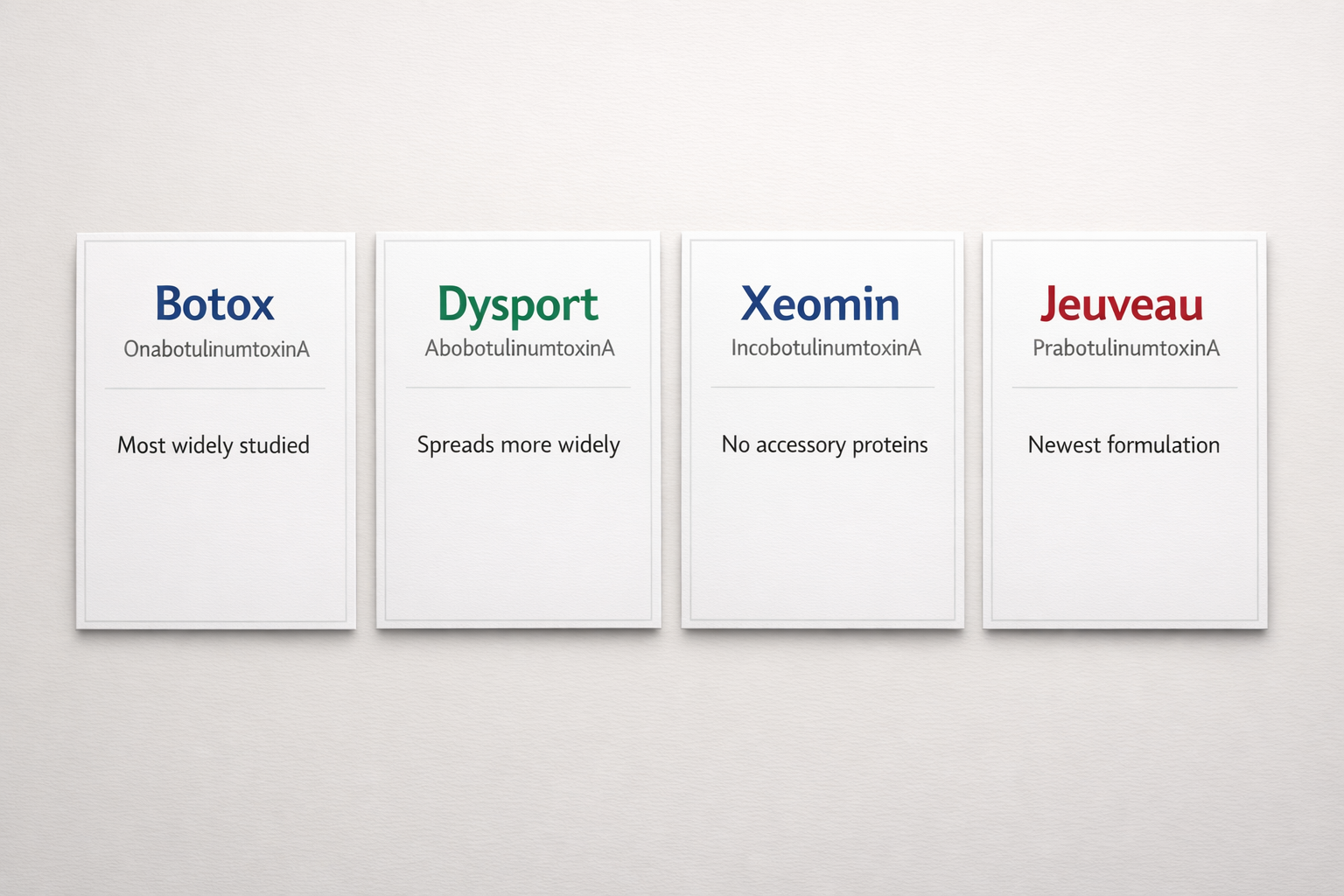
None of these products is universally superior. Each has its own formulation characteristics, unit dosing, and clinical profile. If you have not responded well to one neuromodulator, or if you are exploring options for a particular area, discussing the full range of available products with your practitioner is a reasonable step.
Frequently Asked Questions
Can I switch between Dysport and Botox?
Yes, switching between products is possible and is sometimes recommended when a patient has developed a reduced response to one product or when a practitioner believes a different formulation would better suit the treatment area. Any switch should involve a consultation to reassess dosing, as unit measurements differ between products.
Which product is less likely to cause a “frozen” appearance?
Neither product inherently causes a frozen appearance; this outcome is primarily related to dosage and technique. Overly high doses or injections that suppress too broad a range of muscle movement can produce an unnatural result with either product. Discussing the level of expression you want to retain with your practitioner is the most effective way to avoid this.
Is one product safer than the other?
Both Dysport and Botox have well-established safety records when used by qualified practitioners. Neither is considered categorically safer than the other. The most meaningful safety variable is injector expertise and appropriate product selection for the treatment area.
Does Dysport really work faster?
Clinical experience and published data generally support that Dysport has a faster onset, with many patients noticing results within 2–3 days compared to the 5–14 days commonly associated with Botox. However, individual response varies, and some patients may experience similar onset timelines with both products.
Which is better for forehead lines?
Many practitioners find that Dysport’s broader diffusion characteristics suit the wide horizontal expanse of forehead lines, while Botox may be preferred for more targeted work or in patients where preserving natural brow movement is a priority. The best choice depends on your specific anatomy, goals, and practitioner assessment.
How do I compare costs accurately?
Request a total session price for the area or areas you want treated, rather than comparing unit prices. Because the unit conversion ratio means significantly more Dysport units are required per treatment than Botox units, the per-unit price difference rarely reflects the true cost difference between sessions.
Can either product be used for medical conditions?
Botox holds FDA approval for several medical conditions including chronic migraine, hyperhidrosis, cervical dystonia, and others. Dysport is FDA-approved medically for cervical dystonia and lower limb spasticity. Both may be used off-label by physicians for additional indications, but the broader range of Botox’s FDA-approved indications makes it more commonly prescribed for medical purposes.
Dysport or Botox: Which May Be Right for You?
For most patients, the difference between Dysport and Botox is less about one product being superior and more about which characteristics better align with individual goals, treatment areas, and timelines. If faster visible results matter — for example, ahead of an event — Dysport’s earlier onset can be a genuine practical advantage. If you are seeking precise treatment in a small or anatomically complex area, Botox’s more localized effect may be the better starting point.
Patients with a history of reduced response to one botulinum toxin product may benefit from trying the other, as differences in protein structure and formulation mean the two are not biochemically identical. Equally, patients who have had good results with one product for years have little reason to change unless their practitioner identifies a specific clinical reason to do so.
The most reliable path to a good outcome with either product is a thorough consultation with a qualified, experienced practitioner who is comfortable using both options and can make a recommendation based on your facial anatomy, your aesthetic goals, and your medical history. Neither Dysport nor Botox replaces that clinical judgment — they are tools in a skilled practitioner’s approach, not interchangeable commodities to be chosen by price or trend alone.
