


Exosome therapy has emerged as one of the more discussed options in non-surgical hair restoration, attracting interest from people experiencing androgenetic alopecia, telogen effluvium, and other forms of thinning hair. Unlike conventional treatments such as minoxidil or finasteride, exosome therapy works at a cellular signalling level, aiming to reactivate dormant hair follicles and improve the scalp microenvironment rather than simply slowing loss. This article explains what exosomes are, how they are thought to work, what the current clinical evidence supports, how the treatment compares to platelet-rich plasma (PRP), and what patients can realistically expect before, during, and after treatment.
Key Takeaways
- Exosome therapy is a cell-free, minimally invasive treatment that delivers signalling molecules to hair follicles to support regrowth and reduce thinning.
- Early clinical studies show improvements in hair density and thickness, particularly for androgenetic alopecia, but the overall evidence base is still developing.
- Exosomes are not FDA-approved specifically for hair loss and are currently used as an off-label treatment; product quality varies significantly across providers.
- Compared to PRP, exosomes carry a broader range of growth factors and do not require a blood draw, but they are generally more expensive and less extensively studied in large randomised trials.
- Most patients require a course of sessions, and results typically become visible over three to six months, with a possible temporary regenerative shed in the early weeks.
What Are Exosomes and Why Are They Relevant to Hair Loss?
Exosomes are extracellular vesicles — tiny nanoparticles measuring roughly 30 to 200 nanometres — that are naturally released by cells throughout the body. They are enclosed in a lipid bilayer membrane and carry a cargo of proteins, growth factors, microRNAs, and other signalling molecules that allow cells to communicate with one another. This process, known as paracrine signalling, plays a central role in tissue repair, immune regulation, and cellular regeneration. Because exosomes act as biological messengers rather than living cells themselves, they are described as a cell-free therapy, which distinguishes them from stem cell transplants and reduces certain safety concerns associated with introducing live cells into the body.
In the context of hair loss, the scalp microenvironment around each follicle becomes progressively less supportive over time. In androgenetic alopecia — the most common cause of thinning hair in both men and women — the hormone dihydrotestosterone (DHT) drives a process called hair follicle miniaturisation, in which follicles gradually shrink and produce thinner, shorter hairs before eventually becoming dormant. Exosome therapy aims to interrupt this process by delivering concentrated biological signals that promote follicle survival, stimulate the anagen phase of the hair growth cycle, and reduce the inflammation that contributes to follicle damage.
Where Do the Exosomes Come From?
The source of exosomes matters clinically, because different cell types produce vesicles with different biological properties. The most widely studied source in hair loss research is mesenchymal stem cell-derived exosomes, particularly those harvested from adipose-derived stem cells (ADSCs) — stem cells isolated from fat tissue. ADSC-derived exosomes have been shown in multiple studies to carry a high concentration of growth factors relevant to follicle health, including vascular endothelial growth factor (VEGF), which supports blood vessel formation around follicles, and factors that activate the Wnt/β-catenin signalling pathway, a key regulator of hair follicle cycling.
Other studied sources include exosomes derived from dermal papilla cells (DPCs), umbilical cord mesenchymal stem cells, foreskin-derived MSCs, and bone marrow MSCs. Each source produces a somewhat different molecular profile. More recently, plant-derived exosomes — including those from Ecklonia cava and Thuja orientalis — have been investigated in randomised controlled trials for male androgenetic alopecia, with early results suggesting potential benefit, though this research is at an earlier stage than studies using human cell-derived exosomes. In clinical practice, most providers use commercially prepared allogeneic exosomes (derived from donor cells rather than the patient's own tissue), which are lyophilized — freeze-dried for stability — and reconstituted before use.
How Exosome Therapy Is Thought to Work for Thinning Hair
The proposed mechanisms through which exosomes may benefit thinning hair are multiple and interconnected. At the follicle level, exosomes derived from mesenchymal stem cells appear to promote the proliferation of follicular stem cells and extend the anagen phase — the active growth phase of the hair cycle — while delaying the transition into the resting and shedding phases. Studies in cell cultures and animal models suggest that ADSC exosomes activate the Wnt/β-catenin and PI3K/AKT signalling pathways, both of which are associated with follicle regeneration and hair shaft production.
Exosomes also appear to counteract some of the mechanisms that drive androgenetic alopecia specifically. Research suggests they may suppress the TGF-β1/SMAD3 pathway, which is implicated in DHT-driven follicle miniaturisation, and reduce the inflammatory cytokines that accumulate in the scalp around affected follicles. The anti-inflammatory properties of exosomes are considered particularly relevant in conditions such as alopecia areata, where immune-mediated inflammation is the primary driver of hair loss. Additionally, VEGF carried within exosomes may improve blood flow to the scalp, ensuring follicles receive adequate oxygen and nutrients — a factor that is often compromised in areas of significant thinning.
One practical distinction worth understanding is that exosomes do not create new follicles where none exist. The treatment is most likely to benefit follicles that are miniaturised or dormant but still present, rather than areas of complete scarring or long-established follicle loss. This is why patient selection and the stage of hair loss at the time of treatment are considered important factors in determining likely outcomes.
What Types of Hair Loss May Respond to Exosome Therapy?
The majority of published clinical research focuses on androgenetic alopecia (AGA), which includes both male pattern hair loss and female pattern hair loss (FPHL). This is the most common form of thinning hair and the condition for which the most structured evidence currently exists. However, exosome therapy has also been studied in other forms of alopecia.
Alopecia areata (AA) — an autoimmune condition causing patchy hair loss — has been the subject of several studies, including a 2025 systematic review examining exosome-based therapies specifically for this condition. The immunomodulatory properties of mesenchymal stem cell-derived exosomes make them a theoretically relevant option for AA, and case reports have described responses in steroid-resistant alopecia areata where conventional treatments had failed. Telogen effluvium, a diffuse shedding triggered by stress, illness, nutritional deficiency, or hormonal change, is another condition sometimes treated with exosomes, though the evidence here is less developed. Chemotherapy-induced alopecia has also been explored in preclinical research. Scarring alopecias, where follicles have been permanently destroyed by fibrosis, are generally not considered suitable for exosome therapy.
Exosomes vs. PRP for Hair Loss
Platelet-rich plasma (PRP) has been used for hair loss for over a decade and remains one of the most common regenerative hair treatments. Understanding how exosome therapy compares to PRP helps patients and clinicians make more informed decisions about which approach may be more appropriate for a given situation.
| Feature | Exosome Therapy | PRP (Platelet-Rich Plasma) |
|---|---|---|
| Source | Allogeneic (donor-derived) or autologous | Autologous (patient's own blood) |
| Growth factors | 300+ types of signalling molecules | Approximately 12 key growth factors |
| Preparation | Pre-prepared; no blood draw required | Blood draw and centrifugation at each visit |
| Delivery method | Intradermal injection or microneedling | Intradermal injection |
| Evidence base | Emerging; growing number of clinical studies | More established; larger body of trials |
| Regulatory status | Off-label; not FDA-approved for hair loss | Off-label; not FDA-approved for hair loss |
| Typical cost per session | Higher (approx. £500–£1,500 / $600–$2,000) | Lower (approx. £300–£700 / $400–$1,000) |
| Sessions typically needed | 3–4 initial sessions | 3–4 initial sessions |
| Downtime | Minimal (24–48 hours mild redness) | Minimal (24–48 hours mild redness) |
| Best suited for | AGA, AA, those seeking cell-free option | AGA, early-stage thinning, established option |
The key practical difference is that exosomes carry a significantly broader range of signalling molecules than PRP, which is limited to the growth factors naturally present in a patient's platelets. This may be particularly relevant for patients whose own platelet quality is reduced due to age, nutritional status, or medication. However, PRP benefits from a longer clinical track record and a larger body of randomised controlled trial data. Neither treatment is FDA-approved specifically for hair loss; both are used as off-label treatments in clinical practice. The choice between them is best made in consultation with a practitioner who can assess the individual's hair loss pattern, stage, and overall health.

How Exosome Therapy Is Delivered
The delivery method significantly affects how well exosomes reach the hair follicles, and this is an area where clinical practice varies. The most direct and effective route is intradermal injection, in which exosomes are injected directly into the scalp at the level of the follicles. This approach achieves close to full bioavailability at the target tissue and is the method used in most published clinical studies.
Microneedling-assisted delivery is an alternative approach in which a microneedle device creates micro-channels in the scalp skin, and a topical exosome preparation is applied immediately after. This method can improve penetration compared to topical application alone, but absorption rates are considerably lower than with direct injection — estimated at roughly 2–5% for topical-only application even with microneedling, compared to near-complete delivery with intradermal injection. Some clinics combine both approaches: injections for primary delivery with a topical exosome serum applied post-treatment to extend the biological signal.
At-home topical exosome serums are also commercially available, but the evidence supporting their standalone use is weak. The scalp's skin barrier significantly limits the penetration of exosomes applied without any form of channel-creation, meaning that topical-only products are unlikely to deliver meaningful concentrations to the follicle level. Patients considering at-home products should be aware of this limitation and the fact that the quality and exosome concentration of consumer products varies widely and is largely unregulated.
What the Clinical Evidence Currently Shows
The evidence base for exosome therapy in hair loss is growing but remains at an earlier stage than that for established treatments such as minoxidil, finasteride, or PRP. A 2023 systematic review published in the Journal of Cosmetic Dermatology (Gupta et al.) analysed nine clinical studies involving 125 patients and found consistent improvements in hair density and thickness across studies, with a generally favourable safety profile. A prospective study published in Aesthetic Plastic Surgery in 2024 examined 30 male patients with androgenetic alopecia treated with foreskin-derived MSC exosomes and reported statistically significant improvements in hair density measurements at 12 weeks.
A frequently cited study involving adipose-derived stem cell exosomes in a 39-patient cohort reported approximately a 20% increase in hair density and a 17% increase in hair thickness over a 12-week treatment period, assessed using trichoscopy. A 2025 systematic review comparing exosomes, PRP, and minoxidil for androgenetic alopecia found that exosome therapy produced comparable or superior outcomes to PRP in several measures, though the authors noted that the overall quality of evidence remains limited by small sample sizes and heterogeneous study designs. An RCT examining ADSC exosomes combined with microneedling in 85 patients also reported meaningful improvements on the Norwood-Hamilton scale for male AGA.
For alopecia areata, a 2025 systematic review and a 2026 case report of steroid-resistant AA treated with ADSC exosomes both suggest potential benefit, though the evidence here is at an earlier stage. A 2025 cross-sectional study also found a possible association between exosome therapy and hair repigmentation — a novel finding that warrants further investigation but should not yet be considered an established outcome. Taken together, the current evidence is encouraging but not yet sufficient to draw definitive conclusions about long-term efficacy, optimal dosing, or the best exosome source for specific hair loss types.
The Treatment Process: What to Expect
A typical exosome hair treatment begins with a consultation in which the practitioner assesses the pattern and stage of hair loss, reviews medical history, and determines whether the patient is a suitable candidate. Trichoscopy — a magnified examination of the scalp — may be used to evaluate follicle density and miniaturisation before treatment begins, providing a baseline for measuring progress.
On the day of treatment, the scalp is cleansed and a topical anaesthetic cream is usually applied to minimise discomfort during the injection phase. The exosome preparation — typically a lyophilized product reconstituted with sterile solution — is then administered via intradermal injection across the treatment area. The procedure generally takes 30 to 60 minutes depending on the size of the area being treated. Some practitioners combine the injections with microneedling of the scalp to enhance uptake and stimulate additional follicle activity.
After treatment, patients typically experience mild redness, tenderness, and occasional swelling at the injection sites, which usually resolves within 24 to 48 hours. Most people can return to normal activities the same day or the following day. Strenuous exercise, swimming, and direct sun exposure to the scalp are generally advised against for 24 to 48 hours post-treatment.
Timeline: When to Expect Results and What the Regenerative Shed Means
One of the most important — and least discussed — aspects of exosome hair therapy is the regenerative shed that some patients experience in the two to four weeks following treatment. This temporary increase in shedding occurs because the treatment signals follicles to transition out of a prolonged resting phase and begin a new growth cycle. The shedding of older, miniaturised hairs makes way for new, healthier growth. While alarming if unexpected, this is considered a normal part of the follicle reactivation process rather than a sign that the treatment is not working.
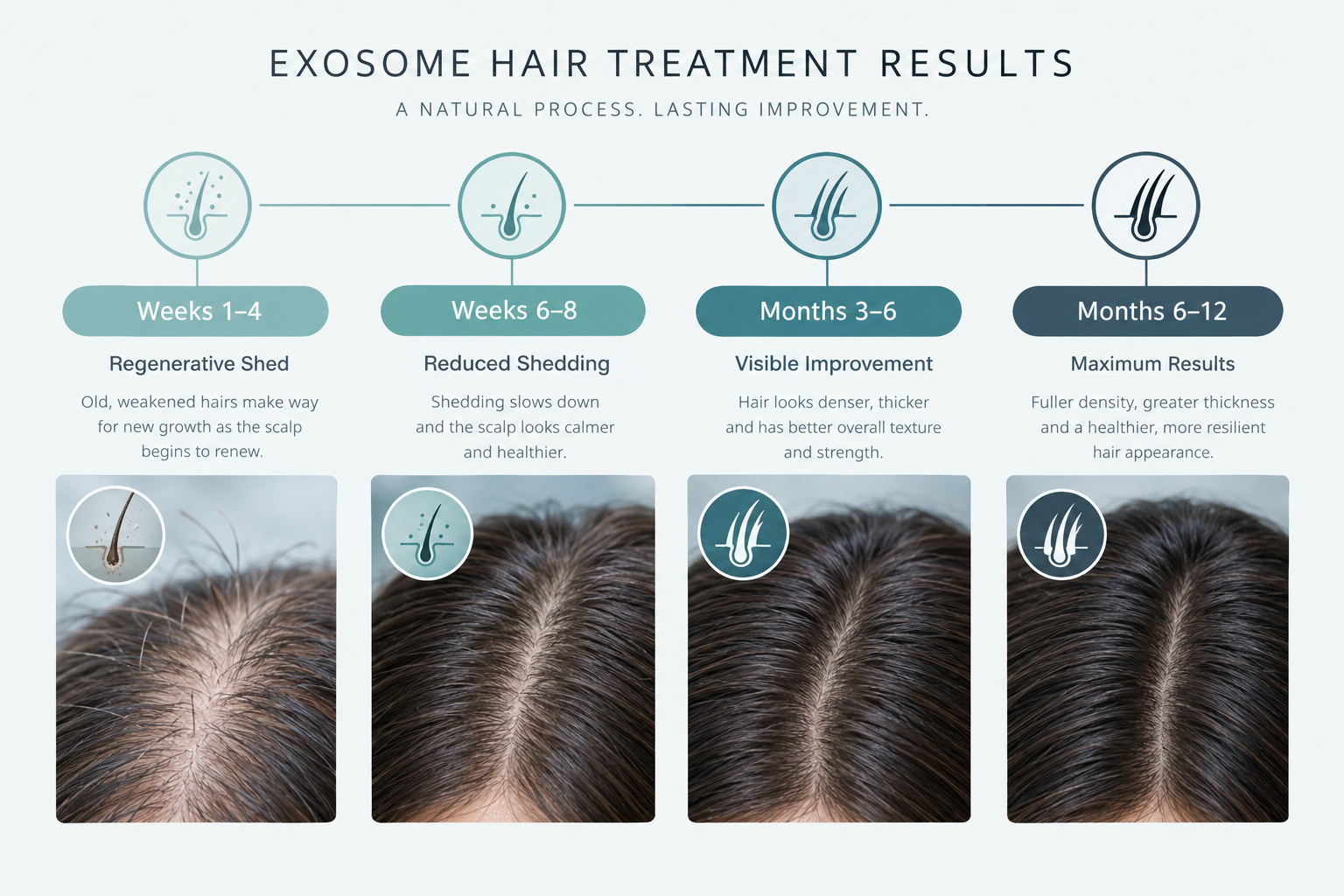
Beyond the initial shed, most patients begin to notice early improvements in hair texture and reduced shedding at around six to eight weeks. More visible changes in hair density and thickness typically become apparent between three and six months, as newly stimulated follicles progress through the anagen phase and produce longer, thicker hair shafts. The most significant improvements are generally seen at six to twelve months after completing a course of treatment. Individual results vary considerably depending on the degree of hair loss, the patient's age, the exosome product used, and the delivery method.
A standard initial course typically involves three to four sessions spaced approximately four weeks apart. Maintenance sessions every six to twelve months may be recommended to sustain results, though the optimal maintenance schedule has not yet been established by large-scale trials.
Safety, Side Effects, and Regulatory Status
Published clinical studies to date have not reported serious adverse events associated with exosome hair therapy when performed using properly prepared, sterile products. The most commonly reported side effects are mild and localised: temporary redness, tenderness, and minor swelling at injection sites, all of which typically resolve within one to two days. No systemic reactions have been documented in the peer-reviewed literature reviewed to date.
However, it is important to understand the regulatory context. Exosome therapy for hair loss is an off-label treatment — meaning exosomes are not specifically approved by the FDA (in the United States), the MHRA (in the United Kingdom), or equivalent regulatory bodies in most countries for this indication. The exosome products used in clinical practice are not subject to the same pre-market approval process as licensed medicines, which means product quality, purity, exosome concentration, and sterility can vary significantly between manufacturers and suppliers. Patients should ask their provider about the source and quality testing of the exosome product being used.
The unregulated nature of the market also means that some products marketed as exosomes may contain very few viable exosomes or may be contaminated. Choosing a reputable clinic that uses products from established, quality-tested suppliers and that can provide information about the product's origin and testing is an important safety consideration.
Who May Be a Suitable Candidate
Exosome therapy is most likely to benefit patients who have active but miniaturised or dormant hair follicles — meaning hair loss that is ongoing but has not yet resulted in complete follicle destruction. Patients in the earlier to moderate stages of androgenetic alopecia, those experiencing telogen effluvium, or those with alopecia areata who have not responded adequately to conventional treatments may be worth discussing with a qualified practitioner.
Patients who may not be suitable candidates include those with scarring alopecias (such as lichen planopilaris or frontal fibrosing alopecia), where follicles have been permanently replaced by fibrous tissue and cannot be reactivated. Active scalp infections, open wounds, or significant scalp inflammation at the time of treatment are also contraindications. Patients who are pregnant or breastfeeding are generally advised to defer elective treatments. Those taking anticoagulant medications or with certain autoimmune conditions should discuss their medical history in detail with their practitioner before proceeding. A thorough clinical assessment is essential to determine whether exosome therapy is appropriate for an individual's specific type and stage of hair loss.
Combination Approaches and Emerging Protocols
Exosome therapy is increasingly being used alongside other hair loss treatments rather than as a standalone intervention. Combining exosomes with low-level laser therapy (LLLT) is one emerging protocol, with the rationale that LLLT independently stimulates follicle activity and may enhance the uptake of exosome-delivered signals. Some clinicians also combine exosome injections with topical minoxidil as a maintenance strategy between sessions, using the established vasodilatory effect of minoxidil to complement the regenerative signalling of exosomes.
The combination of exosomes with microneedling — either as a standalone scalp treatment or using radiofrequency microneedling — is another approach gaining traction in clinical practice. The mechanical stimulation of microneedling creates a wound-healing response in the scalp that may amplify the follicle-stimulating effects of the exosomes applied or injected at the same time. These combination protocols are promising but are at an early stage of formal clinical evaluation, and patients should approach them with realistic expectations.
Frequently Asked Questions
How many exosome sessions are typically needed for thinning hair?
Most clinical protocols involve three to four initial sessions spaced approximately four weeks apart. The number of sessions required depends on the degree of hair loss, the patient's response to treatment, and the specific product and delivery method used. Maintenance sessions every six to twelve months may be recommended after the initial course.
How does exosome therapy differ from a stem cell hair treatment?
Exosome therapy is a cell-free therapy — it uses the signalling molecules produced by stem cells rather than the stem cells themselves. This means no live cells are injected, which removes certain risks associated with cell-based therapies. The biological signals delivered are similar to those that stem cells would release naturally in a regenerative context.
Is the regenerative shed after exosome treatment permanent?
No. The regenerative shed is a temporary phase, typically lasting two to four weeks, in which older miniaturised hairs are shed as follicles transition into a new growth cycle. It is considered a normal part of the treatment response. New hair growth generally becomes visible within six to twelve weeks after the shed.
Can exosome therapy be used alongside minoxidil or finasteride?
In many cases, yes. Exosome therapy and conventional medical treatments for hair loss are not mutually exclusive, and some clinicians recommend continuing established treatments alongside exosome sessions. However, any changes to existing medication should be discussed with the prescribing clinician before proceeding.
Are at-home exosome serums effective for thinning hair?
The evidence for standalone topical exosome products is weak. Without a delivery mechanism such as microneedling to create channels in the scalp skin, the absorption of topically applied exosomes is very limited — estimated at around 2–5% even with microneedling assistance. At-home products may offer some benefit as a complement to in-clinic treatment but are unlikely to produce meaningful results on their own.
Does exosome therapy work for female pattern hair loss?
Female pattern hair loss (FPHL) shares many of the same follicle miniaturisation mechanisms as male androgenetic alopecia, and several studies have included female patients. Early results suggest similar potential benefits, though most published studies have focused predominantly on male AGA. A clinical assessment is needed to determine whether exosome therapy is appropriate for an individual's specific pattern and cause of hair loss.
Is Exosome Therapy Worth Considering for Thinning Hair?
Exosome therapy represents a genuinely novel approach to hair loss that is grounded in established regenerative biology. The early clinical evidence — including systematic reviews, prospective studies, and randomised controlled trials — suggests meaningful improvements in hair density and thickness are achievable, particularly for androgenetic alopecia in its earlier to moderate stages. The treatment's cell-free nature, minimal downtime, and broad molecular profile distinguish it from both PRP and conventional pharmaceutical options.
At the same time, the evidence base is still developing. Most studies to date have been small, and there is no consensus yet on the optimal exosome source, concentration, delivery method, or treatment schedule. The off-label regulatory status and the variability in product quality across the market mean that the choice of provider and product matters considerably. Patients should approach exosome therapy as a promising but not yet fully established treatment, and should have realistic expectations about the timeline and degree of improvement.
For those experiencing progressive thinning hair who have not achieved satisfactory results with conventional treatments, or who are looking for a non-surgical option that works at a biological level, exosome therapy may be worth discussing with a qualified practitioner who can assess suitability, explain the evidence honestly, and recommend a protocol appropriate to the individual's hair loss type and stage.
