
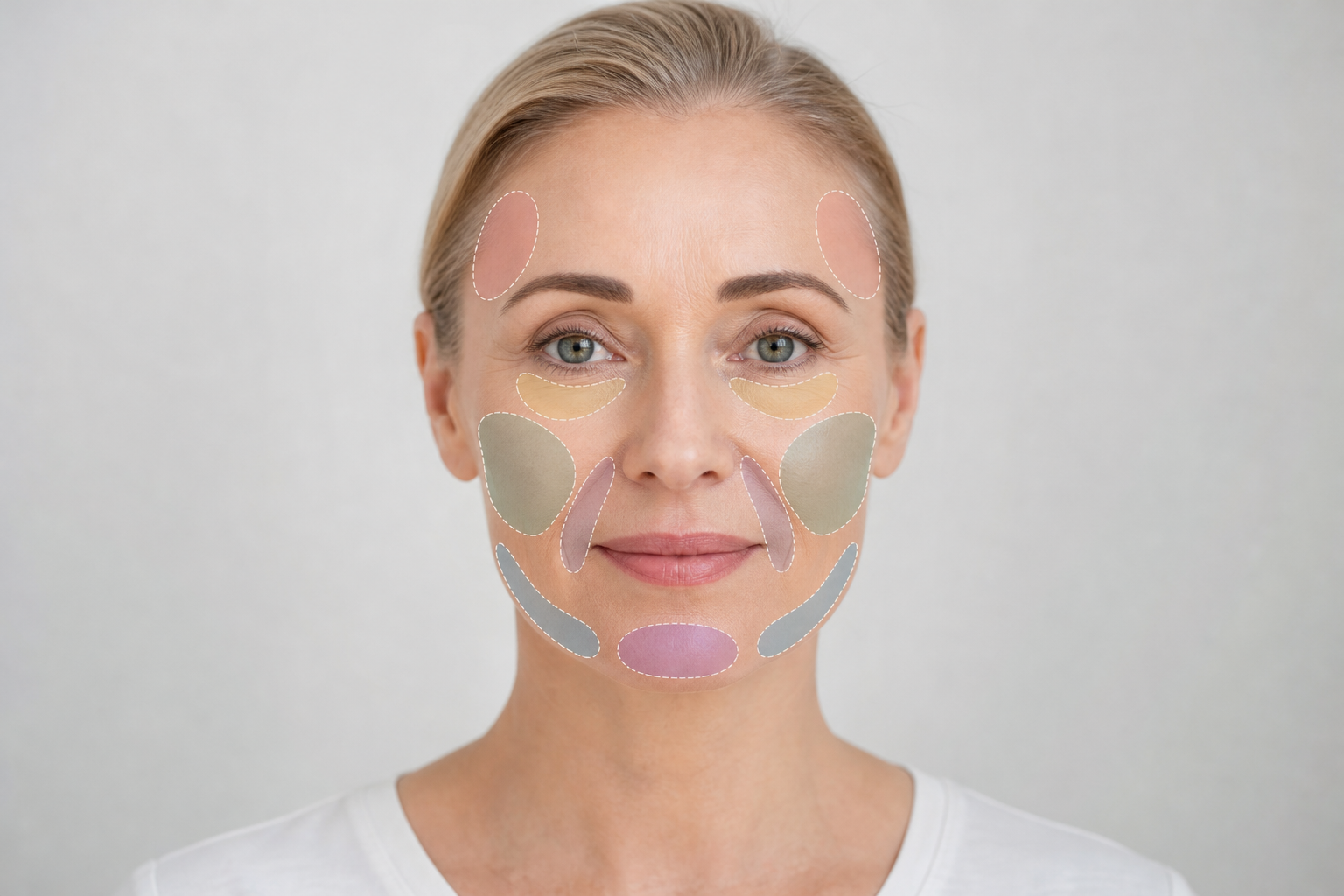

A filler facelift — often called a liquid facelift — uses strategically placed dermal fillers, sometimes combined with neuromodulators, to restore facial volume, soften lines, and create a subtle lifting effect without surgery. It has become one of the most requested non-surgical facial rejuvenation treatments, but it works differently from a surgical facelift and has meaningful limitations that are worth understanding before booking a consultation.
Key Takeaways
- A filler facelift uses injectable fillers — and sometimes Botox or similar neuromodulators — to restore lost volume and improve facial contours without surgery or general anaesthesia.
- It works best for mild to moderate aging changes; it cannot tighten significantly lax skin or address the neck and jowls as effectively as a surgical facelift.
- Results typically last between 12 and 24 months depending on the filler type used, the area treated, and individual metabolism.
- Risks are real and include bruising, swelling, asymmetry, filler migration, and the rare but serious complication of vascular occlusion.
- Cumulative filler use over many years carries its own risks, including filler fatigue and potential complications if surgical correction is later needed.
What Is a Filler Facelift?
A filler facelift is a non-surgical treatment approach in which a qualified injector uses dermal fillers — and often neuromodulators such as Botox or Dysport — to address multiple signs of facial aging in a single session or series of appointments. The term “liquid facelift” is used interchangeably and reflects the injectable nature of the treatment. Unlike a surgical facelift (rhytidectomy), which physically removes excess skin and repositions deeper facial tissues, a face lift with filler works by adding volume to areas that have deflated with age, supporting facial structures, and softening lines and folds.
The concept is rooted in a well-established understanding of how the face ages. With time, the face loses fat, bone density, and collagen, causing the skin to sag and the overall facial shape to change. Strategic filler placement can partially reverse these changes by restoring the scaffolding that once held the face in a more youthful position. The result, when performed well, is a refreshed appearance rather than an obviously altered one.
How Does a Filler Facelift Work?
Facial aging is not simply a matter of skin becoming loose. The underlying fat compartments shrink, the cheekbones lose projection, the temples hollow, and the jawline loses definition. This structural deflation causes the overlying skin to fold and descend, creating nasolabial folds, marionette lines, and jowling. A filler facelift addresses this by restoring volume at key anatomical points, which in turn provides support to the tissues above and around them.
When hyaluronic acid fillers or other injectable materials are placed in the cheeks, for example, they can lift the mid-face and reduce the depth of nasolabial folds without directly injecting the fold itself. Similarly, adding volume to the temples prevents the brow from descending laterally, and jawline contouring can sharpen a softened lower face. This is why experienced injectors often describe the approach as treating the cause of aging rather than just its surface appearance.
Neuromodulators such as Botox or Dysport are frequently combined with fillers in a liquid facelift. By relaxing specific muscles that pull the face downward — such as the depressor anguli oris at the corners of the mouth — neuromodulators complement the volumising effect of fillers and can extend the overall result.
Types of Fillers Used in a Liquid Facelift
Not all dermal fillers are the same, and a well-planned filler facelift typically uses different products in different areas based on the depth of injection, the degree of lift required, and the tissue characteristics of each zone.
Hyaluronic Acid (HA) Fillers
Hyaluronic acid fillers — including brands such as Juvederm, Restylane, Belotero, and the RHA collection — are the most widely used products in non-surgical facial rejuvenation. Hyaluronic acid is a naturally occurring substance in the skin that attracts and retains water, so HA fillers integrate well with tissue and produce a soft, natural feel. Different formulations within the HA category vary in thickness and cross-linking, making some better suited to deep structural support (such as Juvederm Voluma for the cheeks) and others to finer lines or lip enhancement. A key advantage of hyaluronic acid fillers is that they are reversible: the enzyme hyaluronidase can dissolve them if a result is unsatisfactory or if a complication occurs.
Collagen-Stimulating Fillers
Radiesse (calcium hydroxyapatite) and Sculptra (poly-L-lactic acid, or PLLA) work differently from HA fillers. Rather than simply adding volume, these collagen-stimulating fillers trigger the body’s own collagen production over weeks to months. Sculptra, in particular, requires a series of sessions and produces gradual results that can last up to two years or longer. Radiesse provides immediate volume as well as longer-term collagen stimulation. An important distinction is that neither Radiesse nor Sculptra can be dissolved with hyaluronidase, which means that if an adverse outcome occurs, management options are more limited than with HA fillers.
Neuromodulators as Part of the Treatment
Botox, Dysport, Xeomin, and similar neuromodulators are not fillers, but they are commonly included in a liquid facelift plan. They reduce dynamic wrinkles caused by muscle movement — such as forehead lines, crow’s feet, and frown lines — and can be used to relax downward-pulling muscles to enhance the lifting effect of fillers. The combination of volume restoration and muscle relaxation often produces a more complete result than either treatment alone.
Treatment Areas
A filler facelift is not a single injection but a multi-point approach tailored to each patient’s anatomy and concerns. Common treatment areas include:
- Temples: Restoring volume here prevents brow descent and reduces a hollowed, gaunt appearance.
- Cheeks and cheekbones: Mid-face volume is often the primary focus; lifting the cheeks indirectly reduces nasolabial folds and supports the lower face.
- Nasolabial folds: The lines running from the nose to the corners of the mouth can be softened with targeted filler placement.
- Marionette lines: Lines descending from the mouth corners toward the chin respond well to filler, particularly when combined with neuromodulators at the corners of the mouth.
- Jawline: Jawline contouring with filler can sharpen a softened or irregular lower face border.
- Chin: Chin projection can be enhanced to improve facial balance and reduce the appearance of jowling.
- Under-eye hollows (tear trough): This is a technically demanding area where filler can reduce the shadowed appearance beneath the eyes, though it carries a higher risk profile and requires significant injector expertise.
- Lips and mouth corners: Volume and definition can be restored to lips that have thinned with age, and downturned corners can be lifted.
Some practitioners use named frameworks — such as the 5-point, 7-point, 8-point, or 9-point facelift — to describe the specific injection sites they address. These are not standardised medical protocols but rather structured approaches that different clinics use to ensure consistent coverage of key anatomical zones.
What Happens During the Procedure?
A filler facelift appointment typically begins with a detailed consultation and facial assessment. A thorough injector will evaluate your facial anatomy, skin quality, degree of volume loss, and skin laxity before recommending a treatment plan. This assessment determines which fillers are appropriate, how many syringes may be needed, and which areas to prioritise.
Before injections begin, a topical numbing cream containing lidocaine is usually applied to the treatment areas and left for 20 to 30 minutes. Many modern fillers also contain lidocaine within the formulation itself, which further reduces discomfort during injection. The injections are performed using either fine needles or blunt-tipped cannulas, depending on the area and the injector’s technique. Cannulas are often preferred in higher-risk areas because they are less likely to puncture blood vessels.
The procedure itself typically takes between 30 and 90 minutes depending on the number of areas treated. Immediately after, the injector may gently massage the filler to ensure even distribution. Ice packs are commonly applied to reduce swelling and bruising. Most patients can return to normal activities the same day or the following day, though some visible swelling and bruising is expected for several days.
Pre-Treatment Preparation
Preparing appropriately before a filler appointment can reduce the risk of bruising and swelling. Most practitioners advise the following in the days leading up to treatment:
- Avoid blood-thinning medications such as aspirin, ibuprofen, and naproxen unless prescribed for a medical condition (always check with your prescribing doctor before stopping any medication).
- Avoid alcohol for at least 24 to 48 hours before treatment.
- Discontinue supplements known to thin the blood, such as high-dose fish oil, vitamin E, and ginkgo biloba, for approximately one week prior.
- Avoid scheduling treatment close to a major event, as bruising and swelling may take up to two weeks to fully resolve.
- Inform your injector of any previous filler treatments, including the products used and when they were administered.
Results: What to Realistically Expect
Results from a filler facelift are visible immediately after treatment, though initial swelling can temporarily exaggerate the effect. Once swelling subsides — usually within one to two weeks — the true result becomes apparent. Most patients notice a refreshed, more rested appearance with improved facial contours rather than a dramatically different look.
The degree of improvement depends heavily on the extent of volume loss, the skill of the injector, and the products used. Patients with mild to moderate aging changes tend to see the most satisfying outcomes. Those with significant skin laxity, deep jowling, or excess skin may find that filler alone cannot achieve the degree of correction they are hoping for.
It is important to understand what a liquid facelift cannot do. It cannot tighten loose skin, remove excess tissue, or reposition the deeper facial structures in the way that a surgical facelift does. It also has limited effect on the neck, which is a primary concern for many patients considering facial rejuvenation. Managing these expectations honestly before treatment is a hallmark of a responsible injector.
How Long Do Results Last?
The longevity of a filler facelift depends on the type of filler used, the area treated, and individual factors such as metabolism and lifestyle. As a general guide:
- Hyaluronic acid fillers in the cheeks and mid-face typically last 12 to 18 months, though some formulations such as Juvederm Voluma may last up to 24 months in suitable patients.
- HA fillers in higher-movement areas such as the lips or nasolabial folds tend to break down more quickly, often within 6 to 12 months.
- Radiesse generally lasts 12 to 18 months, with collagen stimulation extending some benefit beyond the filler’s physical presence.
- Sculptra results can persist for up to two years or more, though the treatment requires multiple sessions to build the effect gradually.
Maintenance treatments are typically needed once or twice a year to sustain results. Over time, some patients find that less filler is needed at each maintenance appointment as collagen stimulation accumulates, particularly with products like Sculptra.
Filler Facelift vs. Surgical Facelift
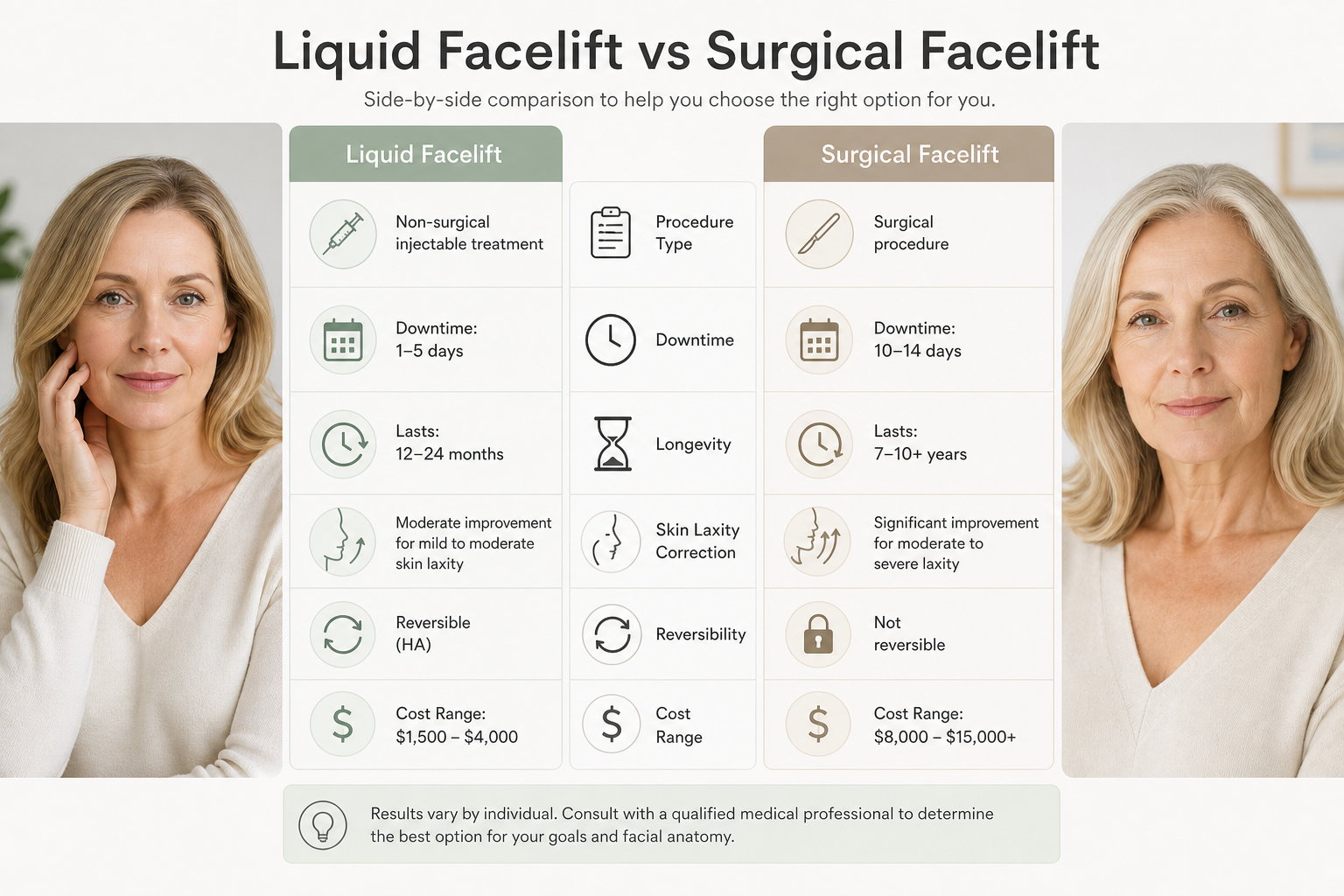
Understanding the difference between a non-surgical and surgical approach is essential for setting realistic expectations. The table below summarises the key distinctions.
| Characteristic | Filler Facelift (Liquid Facelift) | Surgical Facelift (Rhytidectomy) |
|---|---|---|
| Procedure type | Non-surgical, injectable | Surgical, requires anaesthesia |
| Primary mechanism | Volume restoration, structural support | Skin removal, tissue repositioning |
| Addresses skin laxity | Limited — works best for mild to moderate laxity | Yes — removes and tightens excess skin |
| Addresses the neck | Minimal effect | Yes, especially with a neck lift component |
| Downtime | Minimal — typically 1 to 5 days of visible bruising/swelling | 10 to 14 days or more |
| Longevity of results | 12 to 24 months; requires maintenance | 7 to 10+ years |
| Reversibility | HA fillers are reversible with hyaluronidase; others are not | Not reversible |
| Approximate cost | £1,500 to £5,000+ per treatment cycle | £8,000 to £20,000+ (one-time, longer-lasting) |
| Risk profile | Lower overall, but vascular occlusion is a serious risk | Higher surgical risks including scarring, nerve injury |
| Best suited for | Mild to moderate aging, volume loss, early jowling | Moderate to significant laxity, jowling, neck changes |
Neither approach is universally superior. A filler facelift suits patients who are not ready for surgery, have mild to moderate concerns, or want a low-downtime option. A surgical facelift remains the most effective long-term solution for significant skin laxity, jowling, and neck changes. Some patients use non-surgical treatments in their 40s and transition to surgery in their 50s or 60s when the degree of change warrants it.
The Risk of Filler Fatigue and Cumulative Overfilling
One topic that deserves more attention than it typically receives is the risk of filler fatigue — a term used to describe the distorted facial appearance that can result from repeated filler treatments over many years. When filler is added session after session without adequate assessment of what remains from previous treatments, the face can begin to look puffy, unnatural, or disproportionate. This is particularly common when filler is placed in the cheeks repeatedly, leading to an overly rounded mid-face that no longer reflects natural anatomy.
A responsible injector will assess the cumulative filler burden at each appointment and may recommend a period without treatment, or even dissolution of existing HA filler with hyaluronidase, before adding more. Patients should be cautious of any provider who recommends additional syringes at every visit without a thorough assessment of what is already present.
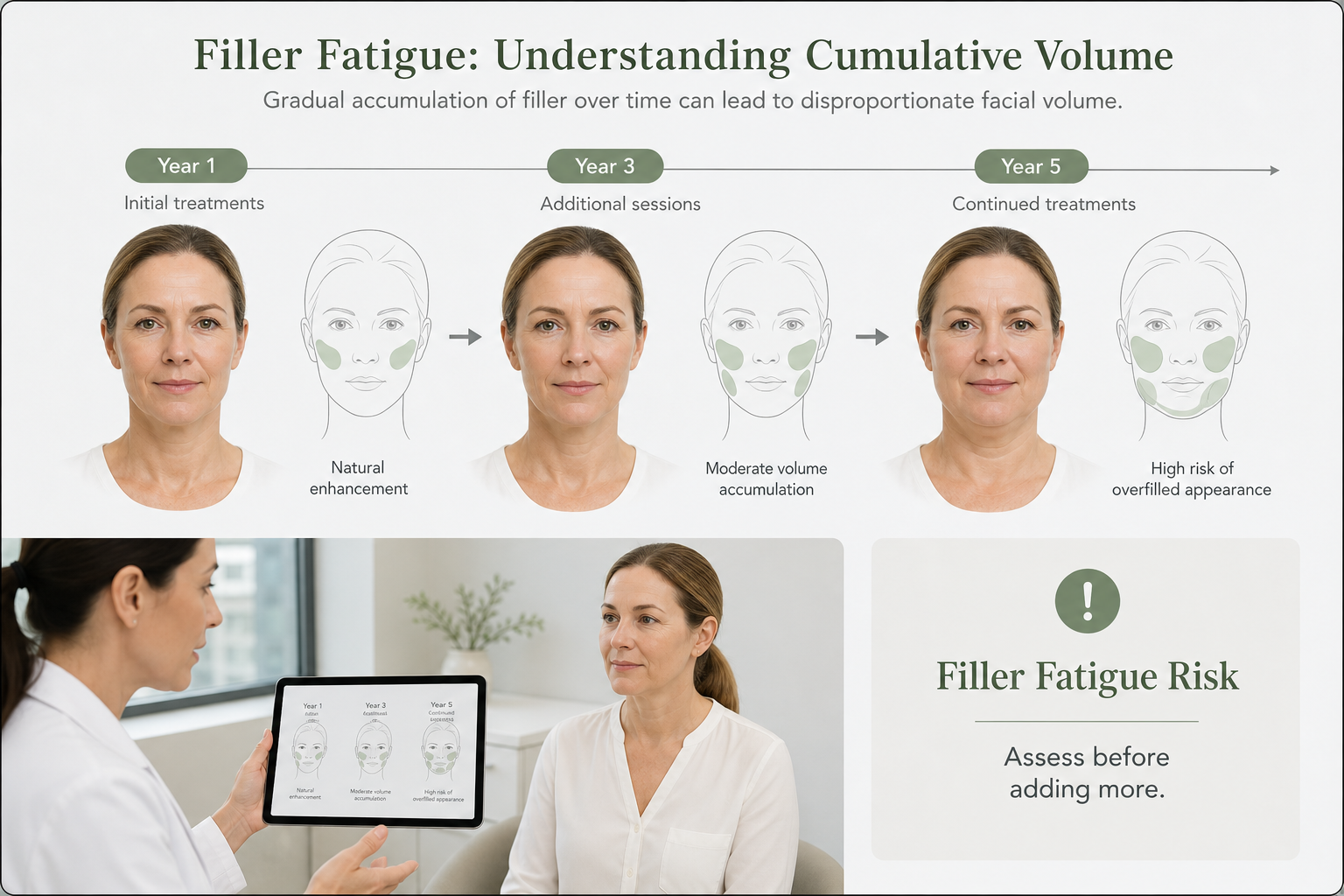
There is also an emerging body of evidence suggesting that repetitive panfacial filler injections over many years can complicate subsequent surgical facelift procedures. A study published in the Aesthetic Surgery Journal found that prior filler use was associated with challenges during facelift surgery, including palpable filler material and potential effects on tissue planes. Patients who anticipate wanting surgical correction in the future should discuss this with both their injector and any surgeon they consult.
Risks and Side Effects
A filler facelift is not without risk, and patients should receive a thorough discussion of potential adverse effects before proceeding. Common and expected side effects include bruising, swelling, redness, and tenderness at injection sites, which typically resolve within one to two weeks. Less common but possible complications include:
- Lumps or irregularities: Filler that is not evenly distributed or that migrates slightly can create visible or palpable lumps. HA fillers can often be dissolved if this occurs.
- Asymmetry: Facial asymmetry is common before treatment and can be difficult to correct perfectly with filler. Some asymmetry may also result from uneven filler placement.
- Filler migration: Over time, filler can shift from its original placement, particularly in high-movement areas.
- Infection: Rare but possible; signs include increasing pain, warmth, and redness beyond the first few days.
- Allergic reaction: Uncommon with modern HA fillers but possible.
- Vascular occlusion: This is the most serious risk associated with dermal filler injections. If filler is inadvertently injected into or compresses a blood vessel, it can block blood flow to the skin or, in rare cases, to the eye, potentially causing tissue death or vision loss. This is a medical emergency requiring immediate treatment. The risk is minimised by choosing an experienced, medically trained injector who understands facial anatomy and has hyaluronidase available.
Reversibility is an important safety consideration. Hyaluronic acid fillers can be dissolved with hyaluronidase, which is why many practitioners prefer HA products, particularly in higher-risk areas. Radiesse and Sculptra cannot be dissolved in the same way, which means that complications with these products require different management strategies and may take longer to resolve.
Who May Be a Suitable Candidate?
A filler facelift may be worth discussing with a qualified practitioner if you:
- Have mild to moderate signs of facial aging, including early volume loss, softened contours, and fine to moderate lines.
- Are not ready for surgery or prefer to avoid the downtime and risks associated with a surgical facelift.
- Have realistic expectations about what injectable treatment can achieve.
- Are in good general health and are not pregnant or breastfeeding.
- Have no active skin infections, inflammatory skin conditions, or relevant allergies in the treatment area.
A filler facelift is less likely to meet expectations if you have significant skin laxity, pronounced jowling, or substantial neck changes. In these cases, a surgical consultation may provide a more honest assessment of what is achievable. It is also worth noting that patients with a history of extensive prior filler treatments may need dissolution before new filler can be placed effectively.
Combining Filler with Other Non-Surgical Treatments
A filler facelift can be part of a broader non-surgical rejuvenation strategy. Several complementary treatments may enhance or extend the results when combined thoughtfully:
- Radiofrequency microneedling: Stimulates collagen and can improve skin texture and mild laxity, addressing the skin quality that filler alone does not change.
- High-intensity focused ultrasound (HIFU/Ultherapy): Targets deeper tissue layers to produce a modest lifting effect, which may complement the volumising effect of fillers.
- Thread lifts: Dissolvable threads can provide mechanical lifting of soft tissue and may be combined with filler for patients with mild to moderate laxity who are not surgical candidates.
- Laser resurfacing: Improves skin surface quality, pigmentation, and fine lines — concerns that filler does not address.
- Skin boosters and polynucleotides: Improve skin hydration and quality at a cellular level, complementing the structural changes made by filler.
Combining treatments requires careful planning and sequencing. Not all treatments should be performed simultaneously, and a practitioner experienced in multi-modality facial rejuvenation is best placed to advise on the right combination and timing for your individual concerns.
Choosing the Right Injector
The outcome of a filler facelift depends heavily on the skill, training, and judgment of the person performing it. Most reputable guidance recommends seeking a board-certified injector with formal medical training — typically a doctor, dentist, or nurse prescriber with specific postgraduate training in aesthetic medicine and facial anatomy. When evaluating a provider, consider:
- Their medical qualifications and specific training in injectable treatments.
- Whether they have access to hyaluronidase and are trained to manage vascular complications.
- Whether they conduct a thorough consultation and facial assessment before recommending treatment.
- Whether they discuss risks honestly and do not simply tell you what you want to hear.
- Whether their before-and-after portfolio reflects natural-looking results consistent with your goals.
Red flags include practitioners who offer very low prices without explanation, who do not ask about your medical history, who cannot explain what products they are using, or who pressure you into more syringes than you initially discussed.
Frequently Asked Questions
Is a filler facelift painful?
Most patients describe the procedure as mildly uncomfortable rather than painful. Topical numbing cream is applied beforehand, and many fillers contain lidocaine within the formulation. Sensitive areas such as the lips or tear trough may cause more discomfort than the cheeks or jawline.
How many syringes does a liquid facelift require?
This varies considerably depending on the degree of volume loss and the number of areas being treated. A modest treatment addressing two or three areas might use two to four syringes, while a more comprehensive panfacial approach could require six or more. Your injector should explain their recommendation and the reasoning behind it during the consultation.
Can a filler facelift replace surgery?
For patients with mild to moderate aging changes, a filler facelift can provide meaningful improvement without surgery. However, it cannot replicate the results of a surgical facelift for patients with significant skin laxity, deep jowling, or neck changes. It is better understood as a complementary or interim option rather than a direct replacement for surgery in all cases.
What is the recovery time after a filler facelift?
Most patients experience bruising and swelling for three to seven days, with some residual swelling possible for up to two weeks. The majority of people can return to work and social activities within one to three days, though this varies by individual and the extent of treatment.
Can filler be removed if I don’t like the result?
Hyaluronic acid fillers can be dissolved using hyaluronidase, which works quickly and effectively. Collagen-stimulating fillers such as Radiesse and Sculptra cannot be dissolved in the same way; management of unwanted results with these products is more complex and may require time for the material to naturally break down.
How much does a filler facelift cost?
Costs vary by clinic, location, and the number of syringes used. Individual syringes of dermal filler typically range from approximately £300 to £700 in the UK, or $600 to $1,200 in the US. A full liquid facelift treatment using multiple syringes across several areas commonly ranges from £1,500 to £5,000 or more. Maintenance treatments add to the cumulative cost over time, which is worth factoring into a long-term comparison with surgical options.
Are there any long-term risks from repeated filler treatments?
Yes. Repeated filler treatments over many years can lead to filler fatigue — an accumulation of product that distorts natural facial proportions. There is also evidence that extensive prior filler use can complicate surgical facelift procedures if surgery is later pursued. Regular assessment by an experienced injector, and willingness to pause or dissolve filler when appropriate, helps manage this risk.
Is a Filler Facelift the Right Choice for Your Concerns?
A filler facelift offers a genuinely useful option for patients experiencing early to moderate facial aging who want meaningful improvement without surgery, general anaesthesia, or extended downtime. When performed by a skilled, medically trained injector using appropriate products and a personalised treatment plan, the results can be natural-looking and satisfying — restoring a refreshed version of your own face rather than an altered one.
The honest limitations are equally important to understand. A face lift with filler cannot tighten significantly loose skin, address the neck, or produce results that last as long as surgery. Cumulative treatments carry their own risks, including filler fatigue and potential complications for future surgical candidates. These are not reasons to avoid the treatment, but they are reasons to approach it with clear expectations and a provider who prioritises your long-term facial health over the number of syringes sold.
If you are considering a liquid facelift, a consultation with a board-certified injector who takes time to assess your anatomy, discuss your goals honestly, and explain both the benefits and the limitations is the most important first step. For patients with more advanced aging changes, a combined consultation with a plastic surgeon or facial surgeon may help you understand the full range of options available.
