

The time between laser hair removal sessions is not arbitrary — it is determined by the biology of your hair growth cycle and the specific area being treated. Most patients need to wait between four and eight weeks between appointments, but the exact interval depends on where on the body you are treating, your hair type, your skin tone, and how your hair responds as the course progresses. Getting the spacing right is one of the most important factors in achieving consistent, long-term hair reduction.
Key Takeaways
- Most body areas require four to eight weeks between sessions, with facial areas at the shorter end and legs or back at the longer end.
- Laser hair removal only works on follicles in the active growth phase (anagen phase), which is why multiple sessions spaced over time are essential.
- Going too soon wastes a session and risks skin irritation; waiting too long allows previously targeted follicles to partially recover.
- Session intervals often lengthen naturally as the course progresses, because regrowth slows after each treatment.
- Hormonal conditions, skin tone, laser technology, and treatment consistency all influence how your schedule should be structured.
Why Session Spacing Matters: The Hair Growth Cycle
Laser hair removal works through a process called selective photothermolysis, in which laser energy is absorbed by melanin (the pigment) in the hair shaft and converted to heat. That heat travels down to the follicle and causes follicle damage sufficient to inhibit or permanently prevent future growth. The critical limitation is that this process only works effectively when the hair is in the anagen phase — the active growth stage — because this is when the hair shaft is physically connected to the follicle and melanin concentration is highest.
At any given moment, only a proportion of your hairs are in the anagen phase. The remainder are in the catagen phase (a brief transitional stage) or the telogen phase (the resting stage, when the hair is shed and the follicle is dormant). Hairs in the catagen and telogen phases are largely unresponsive to laser treatment. This is why a single session cannot eliminate all hair in an area — and why the treatment interval between sessions must be long enough for the next wave of follicles to enter their active growth phase before you return.
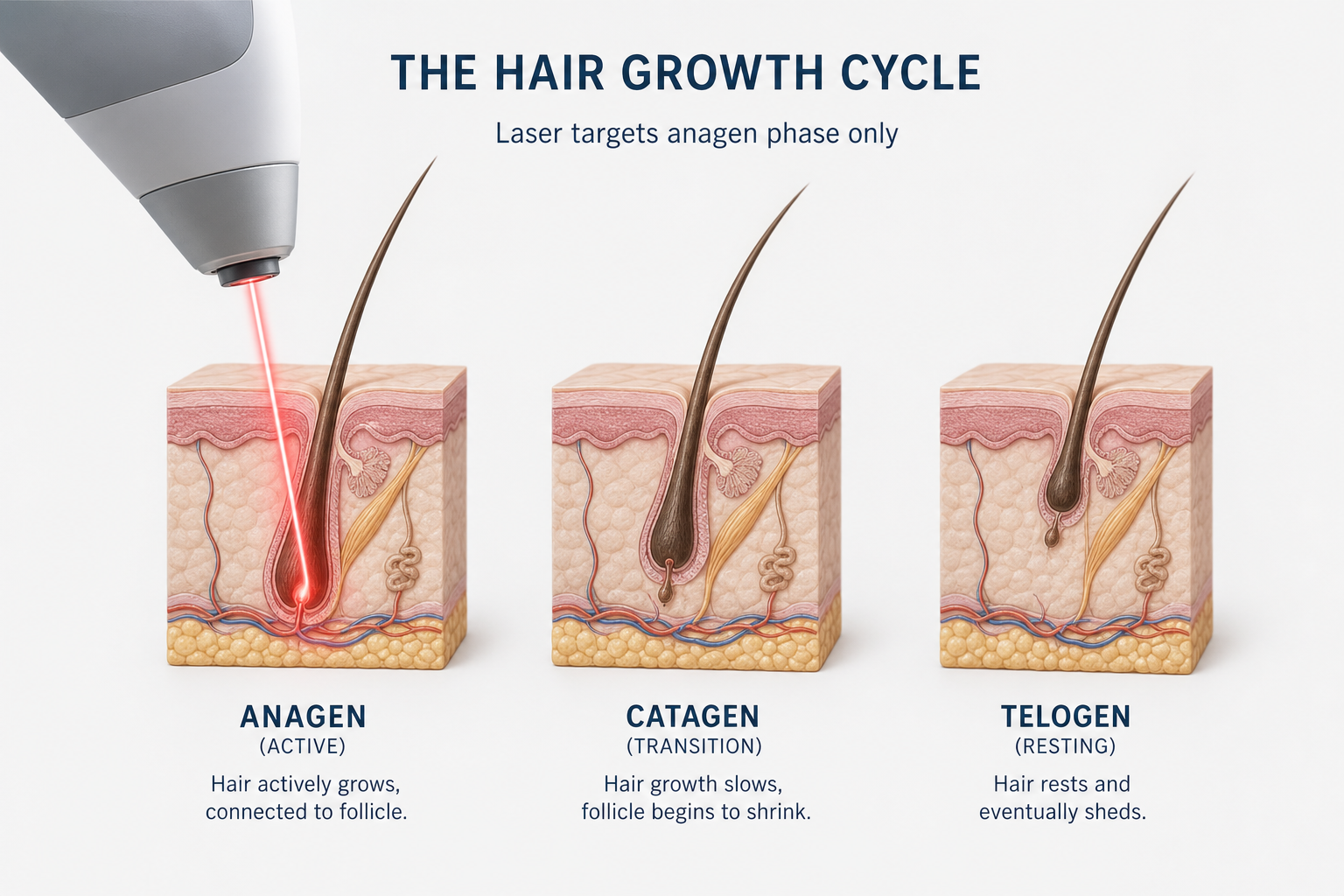
If you book too soon, you risk treating the same follicles that were already targeted in the previous session, while the new cohort of anagen hairs has not yet emerged. If you wait too long, previously treated follicles may partially recover, and the overall course becomes less efficient. Consistent, well-timed session spacing is the foundation of effective treatment.
How Long Between Sessions by Body Area
The hair growth cycle duration varies significantly by body area, which is why the recommended treatment interval differs depending on where you are being treated. The table below summarises typical intervals and session counts for common treatment areas. These are general clinical guidelines; your practitioner may adjust them based on your individual response.
| Body Area | Typical Interval | Estimated Sessions | Notes |
|---|---|---|---|
| Upper lip / chin | 4 weeks | 6–10 | Hormonal area; may need more sessions and ongoing maintenance |
| Full face | 4–6 weeks | 6–8 | Shorter cycle; hormonal influence common |
| Underarms | 4–6 weeks | 6–8 | Responds well; often one of the faster areas to treat |
| Bikini line / Brazilian | 6 weeks | 6–10 | Hormonally sensitive; PCOS can increase session count |
| Arms | 6–8 weeks | 6–8 | Slower growth cycle; finer hair may respond less dramatically |
| Lower legs | 6–8 weeks | 6–10 | Slowest growth cycle; patience required |
| Back / shoulders | 6–8 weeks | 8–12 | Dense, often hormonally driven in men; may need more sessions |
| Chest / abdomen | 6–8 weeks | 6–10 | Variable density; hormonal influence in men |
| Beard line (men) | 4–6 weeks | 8–12+ | Very dense, androgen-driven; among the most challenging areas |
Facial areas such as the upper lip and chin have a faster hair growth cycle, which is why four-week intervals are standard. Larger body areas such as the legs and back have a slower cycle, meaning follicles take longer to cycle back into the anagen phase — hence the six-to-eight-week wait. Booking appointments outside these windows, in either direction, reduces the efficiency of each session.
Factors That Affect Your Session Spacing
While the body-area table above provides a reliable starting point, several individual factors can shift the recommended interval for a given patient.
Hormonal Hair Growth
Hormonal hair growth is one of the most significant variables in laser hair removal planning. Conditions such as polycystic ovary syndrome (PCOS), thyroid dysfunction, or elevated androgen levels can drive persistent or accelerated hair regrowth, particularly on the face, chin, bikini line, and abdomen. Patients with these conditions often require shorter intervals between early sessions and a higher total session count to achieve comparable results. Hormonal fluctuations across the menstrual cycle can also affect skin sensitivity — some practitioners recommend scheduling sessions in the first half of the cycle, when sensitivity tends to be lower, though individual responses vary.
Fitzpatrick Skin Type
Your Fitzpatrick skin type — a clinical scale from Type I (very fair) to Type VI (very dark) — influences both the laser settings used and, in some cases, the treatment interval. Patients with darker skin tones (Types IV–VI) are typically treated with lower fluence settings and longer wavelengths such as the Nd:YAG laser (1064 nm) to reduce the risk of pigmentation changes. These lower energy settings may mean that slightly longer intervals are needed between sessions to allow the skin to recover fully and to ensure safe, effective results. Your practitioner should tailor the interval to your skin type rather than applying a one-size-fits-all schedule.
Hair Colour and Density
Laser hair removal relies on melanin in the hair shaft to absorb laser energy. Dark, coarse hair contains the highest concentration of eumelanin and responds most predictably to treatment. Fine or light-coloured hair contains less melanin and may require more sessions or adjusted settings. Hair density also plays a role: very dense areas such as the male beard or back may need more sessions overall, though the interval between them remains guided by the growth cycle of that area.
Laser Technology
Different laser platforms have slightly different clinical profiles. The Alexandrite laser (755 nm) is highly effective for lighter skin tones and is often used for faster treatment of larger areas. The diode laser offers a middle ground suitable for a range of skin tones. The Nd:YAG laser (1064 nm) is the preferred choice for darker skin tones due to its deeper penetration and lower melanin absorption in the epidermis. While the hair growth cycle remains the primary driver of session spacing, the device used and the energy settings applied can influence how the skin responds between sessions and whether the interval needs to be adjusted.
Men vs. Women: Different Scheduling Needs
Male patients treating the beard line, back, or chest face a distinct challenge. Hair in these areas is typically denser, coarser, and more strongly driven by androgens than equivalent areas in women. This means the total number of sessions required is often higher, and the response between sessions may be less predictable. Men treating the beard line in particular should expect a longer overall course — sometimes twelve or more sessions — and should discuss realistic expectations with their practitioner before starting. The interval between sessions follows the same growth-cycle logic, but the treatment plan as a whole tends to be more extended.
What Happens If You Go Too Soon?
Booking a session before the recommended interval has passed is one of the most common and costly scheduling mistakes. If you return too early, the follicles that were successfully targeted in the previous session are still in recovery, and the new cohort of anagen-phase hairs has not yet emerged in sufficient numbers. The result is that the laser is largely retreating already-treated follicles rather than reaching a fresh wave of active ones. This wastes both the session and the cost associated with it, without meaningfully advancing your results.
There is also a practical skin safety concern. Treating skin that has not fully recovered from the previous session increases the risk of irritation, redness, and in some cases temporary pigmentation changes. Most clinics will decline to treat a patient who presents too early, and for good reason. If you are unsure whether enough time has passed, contact your clinic before attending — a brief consultation can save you an unnecessary appointment.
What Happens If You Wait Too Long?
Missing the recommended window in the other direction — waiting significantly longer than advised — also has consequences for your results. Hair follicles that were damaged but not fully destroyed in a previous session have the capacity to partially repair themselves over time. If the interval stretches to twelve weeks or more without treatment, some of those follicles may recover enough to resume producing hair, effectively undoing part of the previous session’s work.
Waiting too long also means that the cohort of anagen-phase hairs that emerged at the optimal treatment window has already cycled into the catagen or telogen phase by the time you attend. You may still treat some active follicles, but the session is less efficient than it would have been at the correct interval. Patchy results and uneven hair reduction across a treatment area are often linked to inconsistent session spacing rather than the laser itself.
If you have already missed a session, the practical advice is straightforward: book as soon as possible rather than waiting until the next scheduled slot. A delayed session is better than a skipped one. Your practitioner can reassess your current hair growth pattern and adjust the remaining schedule accordingly.
How Session Intervals Change as Your Course Progresses
A detail that most patients are not told upfront is that session intervals typically lengthen as the course progresses. In the early sessions — usually the first three or four — the interval is kept at the shorter end of the recommended range for that body area, because there is a large population of active follicles to target. As the course advances and hair density reduces, the remaining follicles take longer to cycle back into the anagen phase. By sessions seven to ten, it is common for practitioners to extend the interval to eight, ten, or even twelve weeks, reflecting the slower regrowth pattern.
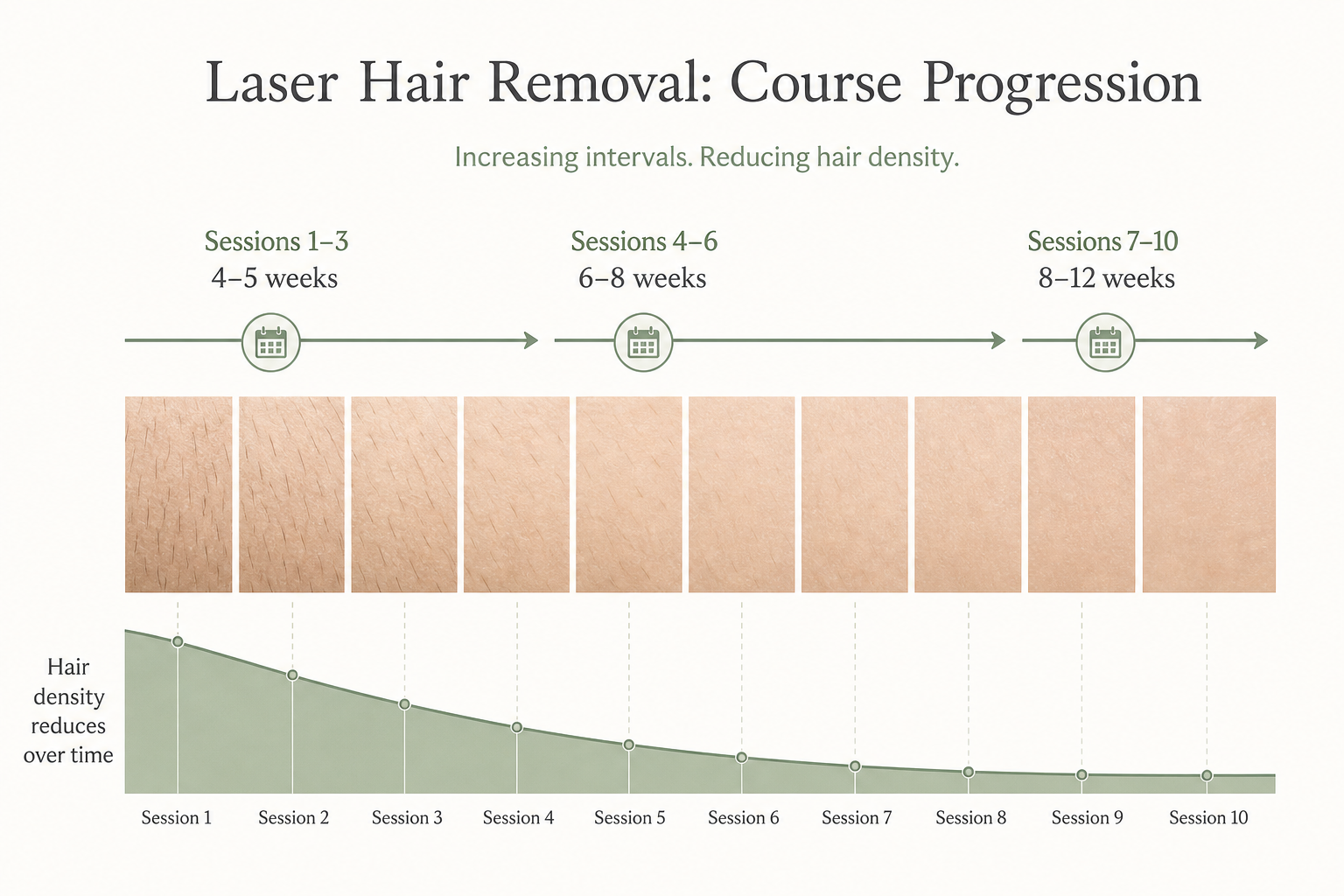
This interval progression is a sign that the treatment is working, not that something has gone wrong. Patients who interpret the longer gaps as a reason to stop treatment early often miss the final sessions that consolidate long-term hair reduction. Completing the full recommended course — even when regrowth appears minimal — gives the best chance of achieving the 70–90% permanent hair reduction that is clinically realistic for most candidates.
Maintenance Sessions After Your Initial Course
Laser hair removal is classified by the FDA as achieving permanent hair reduction rather than permanent hair removal. This distinction matters: most patients achieve a substantial and lasting reduction in hair density and thickness, but some follicles may remain active or reactivate over time, particularly in hormonally sensitive areas. Maintenance sessions — typically one or two per year — help to address any regrowth and preserve the results of the initial course.
The timing of maintenance sessions is guided by the same principle as the initial course: treat when new anagen-phase hairs are present. For most patients, an annual maintenance session is sufficient. Those with hormonal hair growth conditions such as PCOS may benefit from more frequent touch-ups, particularly on the face and bikini line. Your practitioner can advise on a maintenance schedule based on how your hair has responded over the course of treatment.
Practical Scheduling Tips
A few practical considerations can help you get the most from your treatment schedule.
- Shave, do not wax or pluck. Shaving between sessions is not only permitted but recommended — it removes the hair shaft above the skin without disturbing the follicle. Waxing or plucking removes the hair root, which means the follicle is absent when the laser fires, making the session ineffective for those hairs. Avoid waxing or plucking for at least four weeks before each appointment.
- Avoid sun exposure before and after sessions. Tanned or sun-damaged skin increases the risk of adverse reactions. Many practitioners recommend starting a course in autumn or winter, when sun exposure is naturally lower, and maintaining sun protection throughout treatment.
- Book your next appointment before you leave the clinic. Pre-scheduling helps you stay within the recommended treatment interval and avoids the gaps that lead to patchy results.
- Be consistent. Treatment consistency is one of the strongest predictors of outcome. Patients who complete their full course at the recommended intervals consistently achieve better long-term hair reduction than those who attend irregularly.
- Communicate hormonal changes to your practitioner. Starting or stopping hormonal contraception, a new PCOS diagnosis, or a change in thyroid medication can all affect hair growth patterns and may warrant a review of your treatment plan.

Risks, Limitations, and a Rare Side Effect Worth Knowing
Laser hair removal is generally well tolerated when performed by a qualified practitioner using appropriate settings for your skin type. Common temporary side effects include redness, mild swelling, and a sensation similar to mild sunburn in the treated area, typically resolving within a few hours to a day. Pigmentation changes — either darkening (hyperpigmentation) or lightening (hypopigmentation) of the skin — are possible, particularly in patients with darker skin tones treated with inappropriate settings or intervals.
A rare but documented side effect is paradoxical hypertrichosis — a condition in which laser treatment stimulates rather than reduces hair growth in the treated or adjacent area. This is more commonly reported in patients with lighter, finer hair or in hormonally sensitive areas, and it is one reason why a thorough consultation and patch test before beginning a full course are important. If you notice increased hair growth after starting treatment, report it to your practitioner promptly so that the treatment plan can be reviewed.
Laser hair removal is not suitable for everyone. It is generally not recommended during pregnancy, over active skin infections or inflammatory skin conditions, or in areas with tattoos. Patients taking certain photosensitising medications may also need to pause treatment. A full medical history review at consultation is essential to identify any contraindications relevant to your situation.
Frequently Asked Questions
Can I have laser hair removal every 2 weeks?
No. A two-week interval is too short for any body area. The hair growth cycle requires a minimum of four weeks — and often six to eight — for a new cohort of anagen-phase follicles to emerge. Treating too soon wastes the session and may irritate the skin without improving results.
What if I miss a session by several weeks?
Book your next session as soon as possible rather than waiting for the next scheduled slot. A delayed session is better than skipping one entirely. Your practitioner can assess your current hair growth and adjust the remaining schedule if needed.
Why am I still seeing hair between sessions?
Hair shedding after a session typically occurs over one to three weeks as treated follicles expel the damaged hair shaft. New hair appearing after that is likely from follicles that were in the catagen or telogen phase during your last session and have since entered the anagen phase — which is exactly what the next session is designed to target. Some visible hair between sessions is normal and expected.
Does the interval change for hormonal areas like the face or bikini line?
Yes. Hormonally sensitive areas such as the upper lip, chin, and bikini line often require shorter intervals — typically four to six weeks — and a higher total session count. Hormonal hair growth driven by conditions such as PCOS can also mean that maintenance sessions are needed more frequently after the initial course.
How many sessions will I need in total?
Most patients require six to eight sessions for a standard body area, though this varies. Hormonally driven areas, very dense hair, and male beard or back treatments may require ten to twelve sessions or more. Results also depend on hair colour, skin tone, and treatment consistency. A realistic expectation for most candidates is 70–90% long-term hair reduction after a full course.
Is there a best time of year to start laser hair removal?
Starting in autumn or winter is a practical choice for many patients. Sun exposure is lower, making it easier to avoid the pre- and post-treatment sun avoidance that is recommended throughout a course. Beginning in cooler months also means the initial course is often complete before summer, when treated skin is more likely to be exposed.
Can laser hair removal cause more hair to grow?
In rare cases, a phenomenon called paradoxical hypertrichosis has been reported, where laser treatment appears to stimulate hair growth rather than reduce it. This is uncommon and more likely in patients with fine or light hair in hormonally sensitive areas. If you notice increased hair growth after starting treatment, discuss it with your practitioner so the approach can be reviewed.
Planning Your Laser Hair Removal Schedule Effectively
The most important thing to understand about laser hair removal session spacing is that the intervals are not a matter of clinic preference — they are determined by the biology of your hair growth cycle. Attending at the right time, for the right body area, gives each session the best possible chance of targeting a fresh cohort of active follicles and contributing meaningfully to long-term hair reduction.
A well-structured treatment plan accounts for your body area, skin tone, hair characteristics, and any hormonal factors that may influence regrowth. It also builds in the expectation that intervals will lengthen as the course progresses and that maintenance sessions may be needed to preserve results over time. Patients who approach the process with realistic expectations and commit to treatment consistency tend to achieve the most satisfying outcomes.
If you are unsure whether your current schedule is correctly spaced, or if you have missed sessions and are wondering how to get back on track, a consultation with a qualified laser practitioner is the most reliable next step. They can assess your current hair growth pattern, review your treatment history, and recommend a schedule tailored to your individual needs.
