
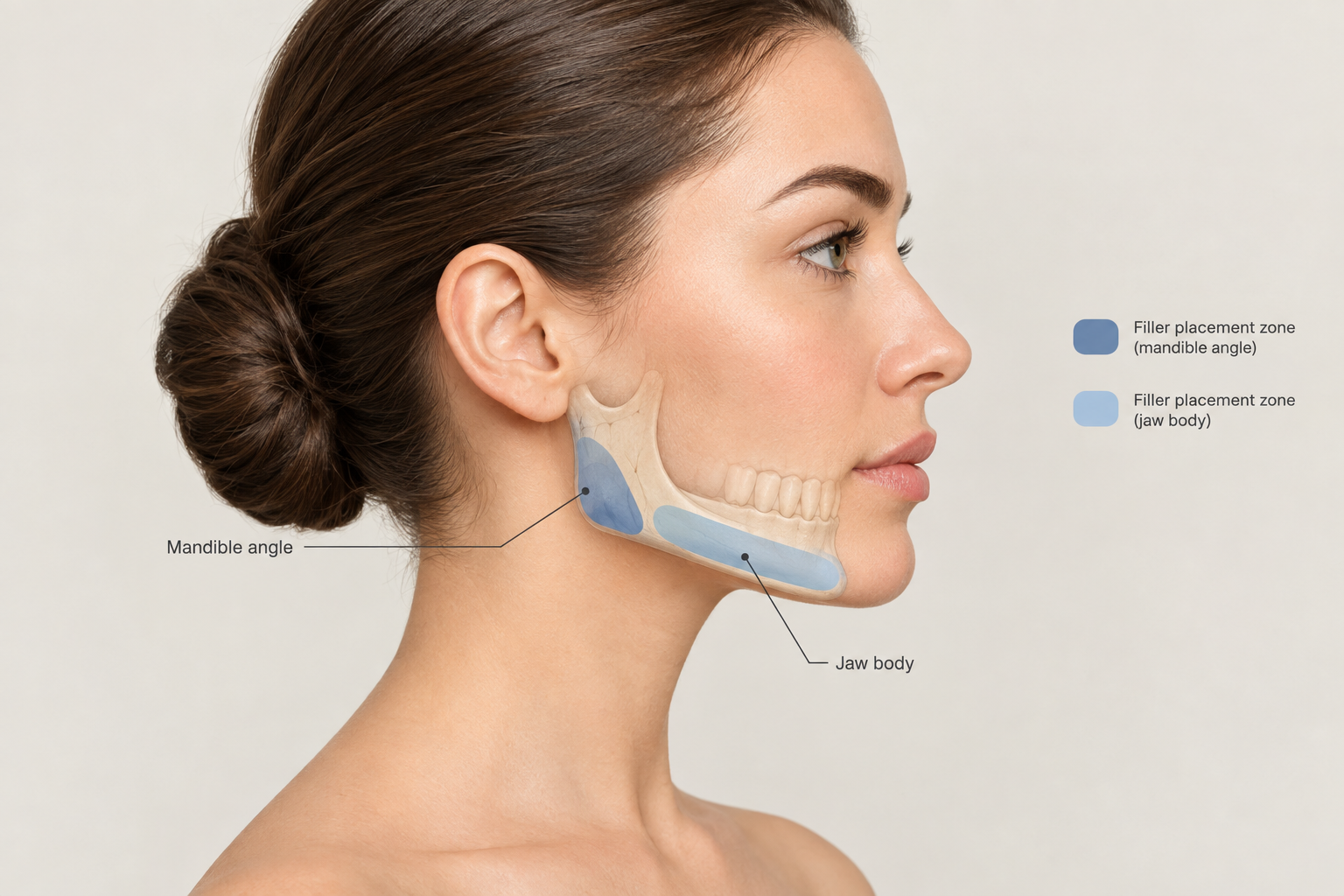

Jaw filler is one of the more popular non-surgical options for reshaping and defining the lower face, but one of the most common questions patients ask before committing to treatment is how long the results will actually last. The honest answer is that jaw filler longevity varies considerably from person to person, typically ranging from around 12 to 24 months, and sometimes longer depending on several clinical and lifestyle factors. Understanding what influences that timeline — and what to realistically expect before, during, and after treatment — can help you decide whether jaw filler is the right approach for your goals.
Key Takeaways
- Jaw filler results typically last between 12 and 24 months, though individual variation is significant and some patients may see effects persist longer.
- The type of dermal filler used, the volume injected, your metabolism, and the injector’s technique all influence how long results last.
- Hyaluronic acid fillers are the most commonly used product for jaw definition and can be partially or fully dissolved if needed.
- Maintenance treatments are usually required to sustain results over time, and the interval between sessions varies by patient.
- Jaw filler carries real risks that should be discussed with a qualified medical practitioner before treatment.
What Is Jaw Filler and How Does It Work?
Jaw filler refers to the injection of a dermal filler product — most commonly a hyaluronic acid (HA) gel — into the jawline area to add definition, improve symmetry, or create a more structured lower facial contour. Hyaluronic acid is a naturally occurring substance found in the skin and connective tissue, and when formulated as a cross-linked gel, it can be injected to add volume and shape to specific anatomical areas. For the jaw, practitioners typically target the angle of the jaw, the body of the mandible, or the chin-jaw junction, depending on the patient’s anatomy and aesthetic goals.
Some practitioners use non-HA fillers such as calcium hydroxylapatite (CaHA) products for the jaw, as these tend to be firmer and may offer slightly longer-lasting results in some patients. The choice of product depends on the patient’s anatomy, the degree of definition desired, and the practitioner’s clinical judgement. Unlike HA fillers, CaHA products cannot be dissolved with an enzyme called hyaluronidase, which is an important consideration when discussing reversibility and risk management.
The treatment itself is typically performed in a clinic setting, takes between 30 and 60 minutes, and involves a series of small injections along the jawline. A topical anaesthetic or local anaesthetic may be used to manage discomfort. Results are visible almost immediately, though some initial swelling means the final outcome may take one to two weeks to fully settle.
How Long Does Jaw Filler Typically Last?
For most patients treated with hyaluronic acid jaw filler, results last somewhere between 12 and 18 months, with some individuals retaining visible definition for up to 24 months or beyond. This range reflects genuine biological variability rather than a marketing estimate. The jawline is a relatively high-movement area compared to, for example, the cheeks or temples, which means the filler is subject to mechanical forces from chewing, talking, and facial expression — all of which can accelerate breakdown of the product over time.
Firmer, more highly cross-linked HA fillers designed specifically for structural support tend to last longer in the jaw area than softer products intended for superficial lines or lip enhancement. Practitioners generally select a product with appropriate rheological properties — meaning the right balance of firmness, elasticity, and cohesivity — for the jaw, which contributes to both the aesthetic result and the longevity of that result.
Calcium hydroxylapatite fillers, such as those in the Radiesse family, may last slightly longer in some patients — often cited in the range of 12 to 18 months or more — partly because CaHA stimulates some degree of collagen production in addition to providing immediate volume. However, individual results still vary, and the absence of a reversibility option with CaHA is a meaningful clinical trade-off.
Factors That Affect How Long Jaw Filler Lasts
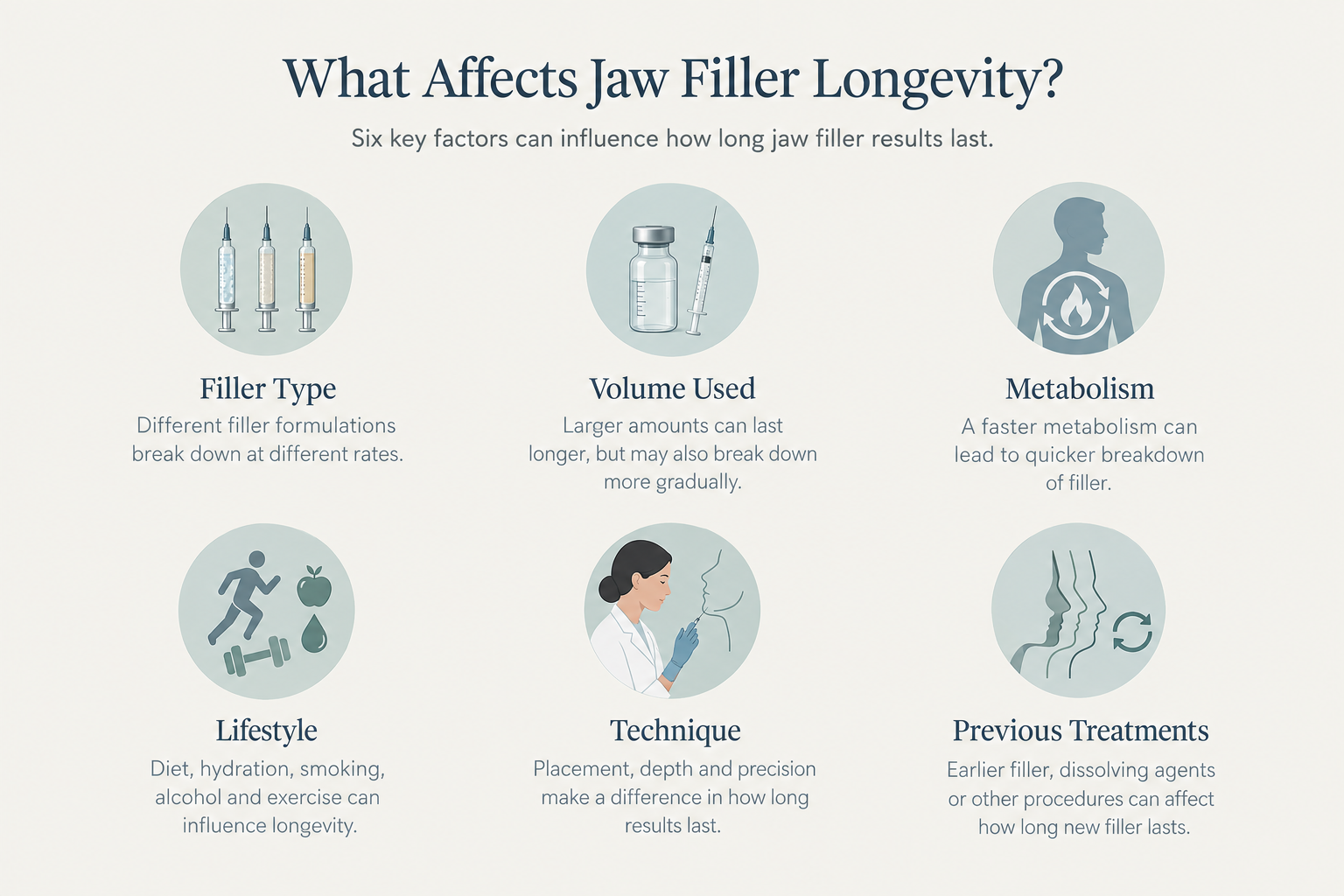
Several interconnected factors influence the rate at which jaw filler breaks down and how long the visible result is maintained. No single factor is entirely predictive on its own, and the interaction between them is why longevity varies so much between patients.
Filler Type and Formulation
Not all dermal fillers are the same. Hyaluronic acid fillers vary in their degree of cross-linking, particle size, and gel consistency. Products with a higher degree of cross-linking are generally more resistant to enzymatic breakdown and mechanical stress, which translates to longer-lasting results in areas like the jaw. Practitioners choose products based on the structural demands of the treatment area, and using an appropriate formulation is one of the most important clinical decisions affecting longevity.
Volume of Filler Used
The amount of filler injected influences how long a visible result persists. Larger volumes may maintain a noticeable effect for longer simply because there is more product present as gradual breakdown occurs. However, the appropriate volume is determined by the patient’s anatomy and goals — overfilling to extend longevity is not a clinically sound approach and can lead to an unnatural appearance or increased complication risk.
Individual Metabolism
Hyaluronic acid is broken down by enzymes called hyaluronidases, which are naturally present in the body. Patients with a faster metabolic rate or higher baseline hyaluronidase activity may break down HA filler more quickly than others. This is one reason why some patients find their results fade noticeably within 9 to 12 months while others retain definition for considerably longer. Metabolism is not something that can be reliably predicted before treatment, though a patient’s history with previous filler treatments can offer some indication.
Lifestyle and Physical Activity
High levels of physical activity, particularly intense cardiovascular exercise, may accelerate filler metabolism due to increased blood flow and metabolic demand. Patients who exercise frequently sometimes report that their filler results do not last as long as those with more sedentary lifestyles. Sun exposure, smoking, and poor skin hydration may also affect the longevity of results indirectly by influencing the surrounding tissue environment, though the direct evidence for these specific effects on filler duration is limited.
Injector Technique and Placement
The skill and experience of the practitioner performing the treatment significantly affects both the quality and the longevity of jaw filler results. Accurate placement of the product in the correct tissue plane — typically deep, close to the periosteum or bone — provides better structural support and tends to last longer than superficial placement. Technique also influences the risk of complications, which is why jaw filler should only be performed by a qualified medical professional with appropriate training in facial anatomy and injectable treatments.
Number of Previous Treatments
Some evidence and clinical observation suggest that patients who have had repeated filler treatments in the same area over time may retain results for longer with subsequent sessions. This may be partly related to the gradual accumulation of collagen stimulated by the filler, and partly because some residual product from previous treatments may still be present. This is not a universal finding, and it does not mean that repeated treatments are without risk.
What Happens as Jaw Filler Breaks Down?
As hyaluronic acid jaw filler gradually metabolises, the definition it created slowly diminishes. This process is usually gradual rather than sudden, meaning patients typically notice a slow softening of the jawline contour over several months rather than an abrupt change. In most cases, the jaw returns to something close to its pre-treatment appearance as the filler is fully absorbed, though the timeline for this varies.
In some patients, particularly those who have had multiple treatments over several years, there may be residual filler present in the tissue for longer than expected. This is an area of ongoing clinical discussion, and it underlines the importance of having a thorough consultation before each treatment to assess what product may still be present and whether additional filler is appropriate.
If a patient is unhappy with the result at any point — whether due to asymmetry, overfilling, or a change in aesthetic preference — hyaluronic acid jaw filler can be partially or fully dissolved using hyaluronidase injections. This is one of the key advantages of HA fillers over non-reversible alternatives.
Maintenance: How Often Will You Need Top-Up Treatments?
Most patients who wish to maintain their jaw filler results will need a top-up treatment approximately every 12 to 18 months, though this varies based on the factors discussed above. Some patients return annually, while others find their results last long enough that they return every two years or less frequently. There is no fixed schedule that applies to everyone.
At each maintenance appointment, a practitioner should reassess the current state of the jawline, evaluate how much product may remain, and determine the appropriate volume for the top-up. It is not always necessary to use the same volume as the original treatment. Over time, some patients find they need less product to maintain their result, while others may require a similar or adjusted amount depending on how their facial anatomy has changed with age.
Patients should be cautious about clinics that recommend very frequent top-up treatments without a clear clinical rationale, as repeated filler accumulation in the same area carries its own risks, including the potential for product migration, chronic swelling, or an unnatural appearance.
Risks and Side Effects of Jaw Filler
Jaw filler is not a risk-free procedure. Common side effects include temporary swelling, bruising, redness, and tenderness at the injection sites, most of which resolve within a few days to two weeks. These are expected responses to the injection process rather than complications.
More significant risks include asymmetry, lumpiness or irregularity in the filler distribution, and infection. The jaw area is anatomically complex, with important blood vessels and nerves in close proximity to the injection sites. Vascular occlusion — where filler inadvertently enters or compresses a blood vessel — is a rare but serious complication that can, in severe cases, lead to tissue damage or, in extremely rare instances, vision changes if filler migrates toward the ophthalmic circulation. This risk underlines why jaw filler must only be performed by a practitioner with thorough knowledge of facial vascular anatomy and access to hyaluronidase for emergency use.
Delayed complications such as inflammatory nodules or biofilm-related reactions can occur weeks, months, or even years after treatment. These are uncommon but are more likely in patients with a history of dental procedures, illness, or immune challenges after filler placement. Patients should inform their practitioner of any planned dental work, as this may temporarily increase the risk of filler-related infection.
A thorough pre-treatment consultation should cover your medical history, any medications you take (particularly blood thinners, which may increase bruising), previous filler treatments, and any known allergies. Jaw filler is generally not recommended during pregnancy or breastfeeding.
Who May Be Suitable for Jaw Filler?
Jaw filler may be worth discussing with a qualified practitioner if you are concerned about a lack of jawline definition, mild asymmetry, or a less structured lower facial contour that you would like to address without surgery. It may also be considered as part of a broader non-surgical facial balancing approach, sometimes alongside chin filler or other treatments.
Suitable candidates are generally adults in good health who have realistic expectations about what a non-surgical treatment can achieve. Jaw filler can improve definition and create the appearance of a more structured jawline, but it cannot replicate the results of surgical jaw contouring procedures such as genioplasty or mandibular osteotomy in patients with significant skeletal discrepancies.
Jaw filler may not be appropriate for patients with active skin infections near the treatment area, certain autoimmune conditions, a history of severe allergic reactions to filler components, or those taking medications that significantly impair healing or immune function. A clinical assessment is required to determine individual suitability.
Alternatives to Jaw Filler
For patients who want jawline definition but are uncertain about filler, or for whom filler may not be the most appropriate option, several alternatives are worth considering.
Botulinum toxin injections into the masseter muscles (the large chewing muscles at the sides of the jaw) can reduce the bulk of these muscles over time, creating a slimmer lower face in patients whose jaw width is primarily due to muscle hypertrophy rather than bone structure. This is a different goal from jaw filler — it reduces width rather than adding definition — but the two treatments are sometimes combined for complementary results. Botulinum toxin effects in the masseter typically last around four to six months before a repeat treatment is needed.
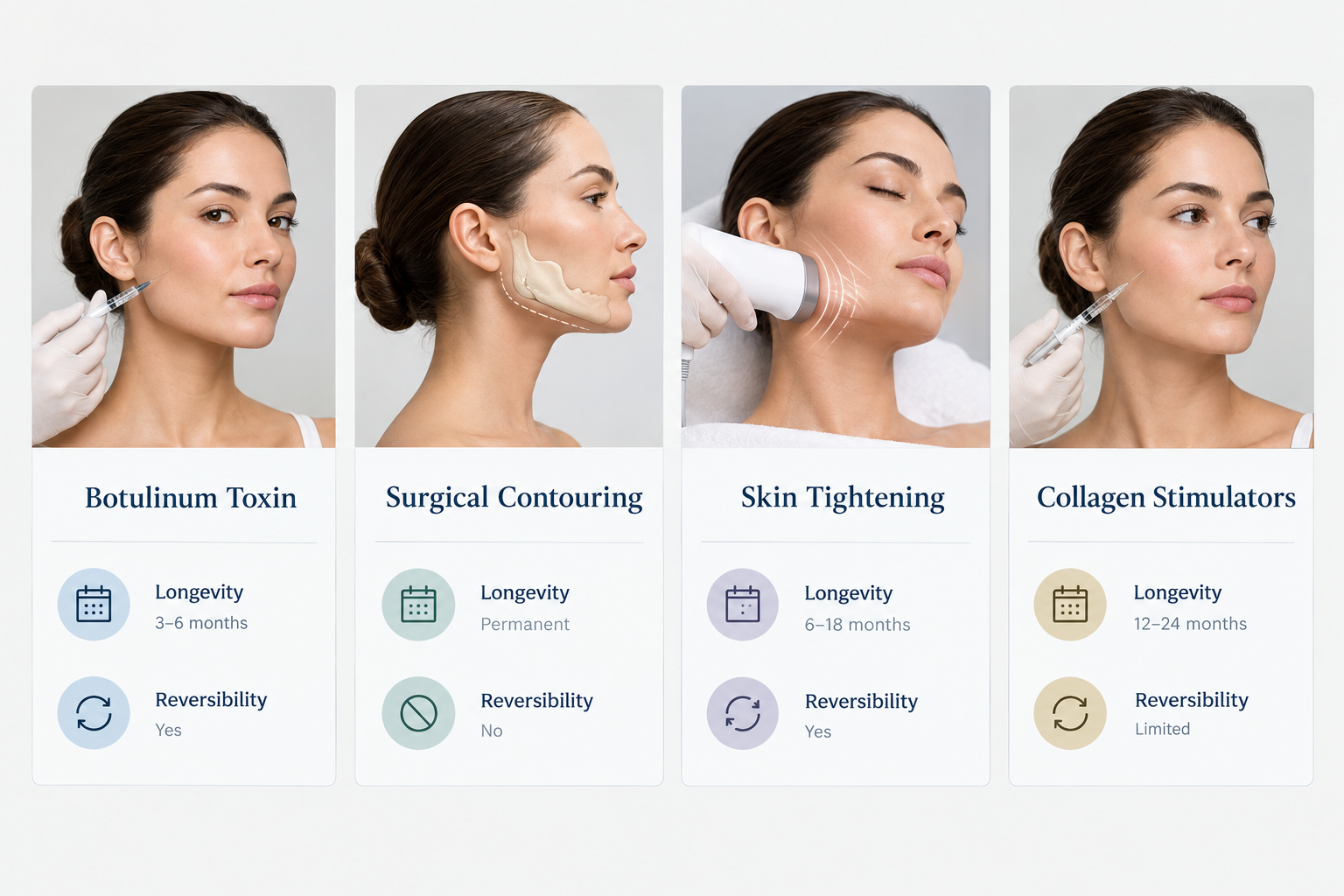
Surgical jaw contouring, including procedures such as genioplasty, mandibular angle reduction, or chin implants, offers permanent or long-lasting structural changes that non-surgical treatments cannot replicate. Surgery carries greater risks and recovery time but may be more appropriate for patients with significant anatomical concerns or those seeking a permanent solution.
Skin tightening treatments such as radiofrequency, ultrasound-based devices (for example, high-intensity focused ultrasound), or thread lifts may improve the appearance of the jawline by addressing skin laxity rather than adding volume. These may be more relevant for patients whose primary concern is skin looseness rather than a lack of bony definition.
Collagen-stimulating injectables such as poly-L-lactic acid (PLLA) or calcium hydroxylapatite work differently from HA fillers by stimulating the body’s own collagen production over time. Results develop gradually and may last longer than HA fillers in some patients, though these products are not reversible and require a different treatment approach.
Frequently Asked Questions
Can jaw filler last longer than two years?
In some patients, particularly those with slower filler metabolism or those who have had repeated treatments over time, residual jaw filler may remain visible beyond 24 months. However, this is not the typical experience, and the degree of visible definition usually diminishes gradually as the product breaks down. Individual variation is significant.
Does jaw filler hurt?
Most patients experience some discomfort during jaw filler injections, though this is usually manageable. Topical anaesthetic cream is commonly applied before treatment, and many filler products contain lidocaine (a local anaesthetic) within the gel itself, which helps reduce discomfort during the procedure. The jaw area can be more sensitive than some other facial regions due to the proximity of nerves.
How soon can I see results after jaw filler?
Results from jaw filler are visible almost immediately after treatment, but initial swelling can make the outcome appear more pronounced than the final result. Most practitioners advise waiting at least two weeks for swelling to fully resolve before assessing the outcome. If asymmetry or other concerns remain after this period, a review appointment should be arranged.
Will my jaw look unnatural as the filler breaks down?
For most patients, jaw filler breaks down gradually and evenly, meaning the transition back toward the pre-treatment appearance is subtle rather than dramatic. Uneven breakdown leading to an irregular appearance is possible but not the typical experience. If you notice significant asymmetry or lumpiness at any stage, consult your practitioner.
Can I have jaw filler dissolved if I don’t like the result?
Hyaluronic acid jaw filler can be dissolved using hyaluronidase injections, which break down the HA gel relatively quickly. This is one of the main advantages of HA fillers. Non-HA fillers such as calcium hydroxylapatite cannot be dissolved in the same way, which is an important consideration when choosing a product.
Is jaw filler safe to combine with other treatments?
Jaw filler is sometimes combined with chin filler, cheek filler, or botulinum toxin injections as part of a broader facial balancing approach. Whether combination treatment is appropriate depends on your individual anatomy, goals, and the clinical judgement of your practitioner. Not all treatments are suitable to perform simultaneously, and spacing between certain procedures may be recommended.
How do I choose a practitioner for jaw filler?
Jaw filler should be performed by a qualified medical professional — such as a doctor, dentist, or nurse prescriber with specialist training in aesthetic injectables — who has a thorough understanding of facial anatomy, particularly the vascular structures of the lower face. You should be offered a full consultation before treatment, including a discussion of risks, realistic outcomes, and alternatives. Practitioners should also have access to hyaluronidase for emergency use.
Planning Jaw Filler: What to Weigh Before Your Consultation
Jaw filler can be an effective non-surgical option for improving lower facial definition, and for many patients the results last long enough to make the treatment worthwhile on a maintenance basis. The typical longevity of 12 to 18 months — sometimes extending to 24 months or beyond — means that most patients who are happy with their results will need to factor in periodic top-up treatments as part of their long-term plan.
The decision to proceed should be based on a realistic understanding of what jaw filler can and cannot achieve, a clear awareness of the risks involved, and a thorough consultation with a qualified practitioner who can assess your individual anatomy and recommend the most appropriate product and approach. Jaw filler is not suitable for everyone, and for some patients an alternative treatment — whether non-surgical or surgical — may better address their underlying concern.
If you are considering jaw filler, use your consultation to ask about the specific product being recommended, the expected longevity based on your individual profile, what a maintenance schedule might look like, and what would happen if you chose not to continue treatment. A practitioner who answers these questions clearly and without pressure is a good indicator that you are in the right hands.
