
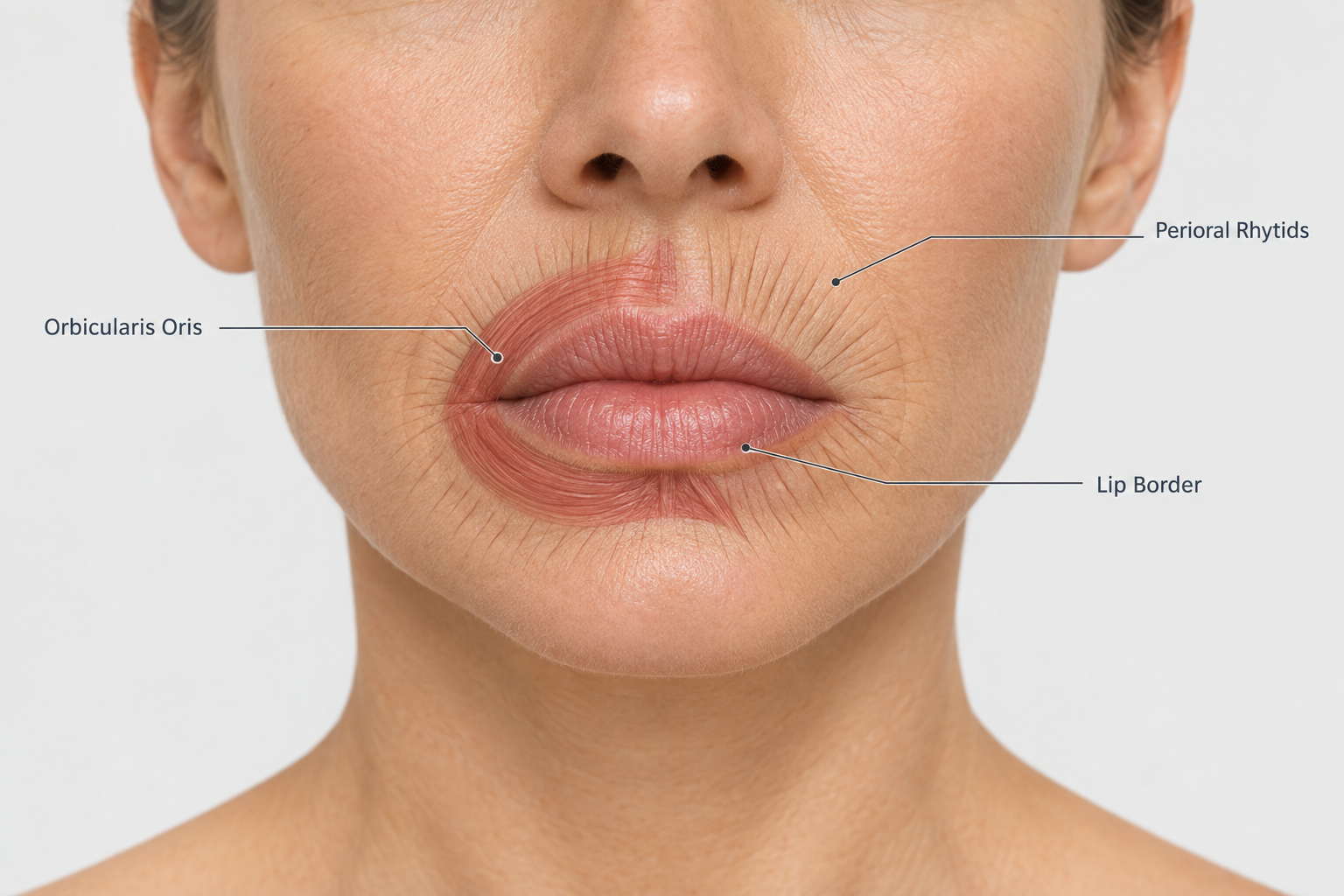

Vertical lip lines — sometimes called lipstick lines, smoker's lines, or perioral rhytids — are fine to moderate creases that radiate outward from the border of the lips. They develop gradually as a result of repeated muscle movement, collagen loss, and skin thinning, and they can cause lipstick to bleed into surrounding skin. For many people they are one of the more frustrating signs of facial ageing because they are difficult to conceal and tend to deepen over time. Several professional treatments can meaningfully reduce their appearance, though no single approach works equally well for everyone, and realistic expectations matter before committing to any procedure.
Key Takeaways
- Vertical lip lines form through a combination of repetitive muscle movement, collagen breakdown, and volume loss around the mouth — meaning effective treatment often requires addressing more than one factor.
- Botulinum toxin, dermal filler, skin resurfacing treatments, and combination approaches are the most commonly used professional options, each with different mechanisms, results, and recovery profiles.
- No treatment permanently eliminates perioral lines; maintenance is required for all options, and results vary considerably between individuals.
- Risks in the perioral area deserve careful consideration, particularly with injectable treatments, because the anatomy around the mouth is complex.
- A thorough consultation with a qualified practitioner is essential to identify which treatment or combination may be appropriate for your specific concerns and skin type.
Why Vertical Lip Lines Form
Understanding why perioral lines develop helps explain why treating them can be more complex than addressing wrinkles in other areas of the face. The orbicularis oris is a circular muscle that surrounds the mouth and controls movements such as pursing, puckering, and speaking. Over years of repeated contraction, the overlying skin develops creases perpendicular to the direction of muscle pull — the same mechanism that creates forehead lines and crow's feet elsewhere on the face.
Collagen and elastin loss accelerates this process. From the mid-twenties onward, the skin gradually produces less collagen, reducing its ability to spring back after repeated movement. The perioral skin is relatively thin compared with other facial areas, which makes it particularly susceptible to this structural change. Cumulative sun exposure degrades collagen further and contributes to the uneven skin texture that makes fine lines more visible.
Volume loss in the lips and surrounding tissues also plays a role. As the lip body deflates slightly with age and the bony support of the jaw changes, the skin above the lip loses some of its underlying scaffolding, allowing surface lines to become more pronounced. Smoking accelerates all of these processes through both the repetitive pursing motion and the direct effect of tobacco smoke on skin collagen — which is why these creases are sometimes called smoker's lines, though they develop in non-smokers too.
Lipstick bleed occurs when the capillary action of fine surface channels draws pigment away from the lip border into the surrounding skin. Reducing the depth and number of these channels through treatment can help restore a cleaner lip edge.
Professional Treatment Options for Vertical Lip Lines
Several evidence-informed treatments are used in aesthetic practice to reduce perioral lines. Most practitioners consider the severity of the lines, the patient's skin quality, their anatomy, and their goals before recommending a single treatment or a combination approach.

Botulinum Toxin Injections
Botulinum toxin — available under brand names including Botox, Dysport, and Azzalure — works by temporarily reducing the activity of the orbicularis oris muscle. When injected in small, carefully placed doses around the lip border, it softens the repeated muscular contractions that deepen perioral lines over time. This approach is sometimes described as a lip flip when a small amount is placed at the upper lip border, which can also create a subtle outward roll of the lip edge.
The perioral area requires considerably lower doses than areas such as the forehead or glabellar region, and precision is important. Too much relaxation of the orbicularis oris can impair lip function — affecting speech, the ability to use a straw, or the seal needed for wind instruments — so experienced practitioners use conservative amounts and assess the patient's functional needs beforehand. Results typically become visible within five to fourteen days and may last approximately eight to twelve weeks in this area, which is often shorter than results seen elsewhere on the face due to the high frequency of muscle use around the mouth.
Botulinum toxin for perioral lines works best for dynamic lines — those most visible during movement — rather than deep static lines that are present at rest. It is frequently combined with other treatments for more comprehensive improvement.
Dermal Filler for Perioral Lines
Hyaluronic acid dermal filler can be used to address vertical lip lines by physically filling the creases and restoring some of the volume lost from the lip body and surrounding tissues. Hyaluronic acid is a naturally occurring substance in the skin that attracts and retains water, and when injected into or around perioral lines it can plump the skin from beneath, reducing the visible depth of the creases.
Filler in this area requires careful technique. The perioral region has a relatively dense network of small blood vessels, and the risk of vascular complications — though uncommon when treatment is performed by a trained practitioner — is a meaningful consideration. Practitioners experienced in perioral anatomy will typically use a fine needle or cannula, inject slowly, and aspirate where appropriate. Hyaluronic acid filler has the advantage of being dissolvable with hyaluronidase if a complication or an unsatisfactory result occurs.
Results from hyaluronic acid filler in perioral lines may last approximately six to twelve months, though this varies depending on the product used, the depth of injection, individual metabolism, and the degree of muscle activity in the area. Overfilling the perioral region can create an unnatural appearance, so a conservative, staged approach is generally preferred.
Skin Resurfacing Treatments
Resurfacing treatments target the surface and mid-layers of the skin to stimulate collagen remodelling and improve overall skin texture. Several modalities are used for perioral lines, each with a different depth of action, recovery profile, and evidence base.
Laser resurfacing — including ablative options such as carbon dioxide (CO2) laser and erbium laser, and non-ablative or fractional devices — can produce meaningful improvement in perioral lines by removing or heating the outer skin layers and triggering new collagen formation. Ablative laser resurfacing tends to produce more dramatic results for deeper lines but involves a longer recovery period, typically one to two weeks of visible healing, and carries a higher risk of side effects including prolonged redness, pigmentation changes, and, rarely, scarring. Fractional laser treatments, which treat a pattern of microscopic columns rather than the entire surface, offer a more moderate improvement with a shorter recovery, often five to ten days of redness and peeling. Skin type is an important consideration with laser resurfacing, as darker skin tones carry a higher risk of post-inflammatory hyperpigmentation.
Chemical peels at medium to deep depths — such as trichloroacetic acid (TCA) peels — can also improve perioral line texture and skin quality. Superficial peels provide minimal improvement for established lines but may help with overall skin tone and texture. Medium-depth peels require several days of recovery and careful sun protection afterward. As with laser treatments, skin type and history of cold sores (herpes simplex) are relevant factors, as resurfacing can trigger a viral outbreak in susceptible individuals; antiviral prophylaxis is commonly prescribed before treatment.
Radiofrequency microneedling combines the collagen-stimulating effect of microneedle channels with radiofrequency energy delivered into the dermis. This approach can improve skin texture and mild to moderate perioral lines with a relatively modest recovery — typically two to five days of redness and mild swelling — and carries a lower risk of pigmentation changes compared with ablative laser, making it a consideration for a broader range of skin tones. Multiple sessions are usually required.
Microneedling
Microneedling alone — using a device that creates controlled micro-injuries in the skin — stimulates the skin's natural wound-healing response and collagen production. For fine perioral lines and overall skin texture improvement, microneedling may offer gradual benefit over a course of treatments, typically three to six sessions spaced four to six weeks apart. It is generally well tolerated, with redness and mild sensitivity lasting one to three days. Results for deeper established lines tend to be more modest compared with laser or radiofrequency microneedling.
Polynucleotides and Skin Boosters
Polynucleotide injections — derived from purified DNA fragments — are increasingly used in aesthetic practice to improve skin quality, hydration, and fine line appearance. When injected into the perioral skin, polynucleotides may support tissue regeneration and improve the overall condition of the skin in the area, potentially making fine lines less visible. Evidence for polynucleotides specifically in perioral lines is still developing, and results tend to be more subtle than those achieved with resurfacing or filler. They may be a useful adjunct in a combination approach, particularly for patients focused on skin quality improvement rather than volume restoration.
Hyaluronic acid skin boosters — injected superficially to improve skin hydration and elasticity — work on a similar principle of improving the skin's structural environment. Like polynucleotides, they are unlikely to significantly reduce deep static lines on their own but may complement other treatments.
Combination Approaches
Because vertical lip lines typically involve both a dynamic muscular component and a structural skin quality component, many practitioners find that combining treatments produces better outcomes than any single modality alone. A common combination approach might involve botulinum toxin to reduce muscle activity, a small amount of hyaluronic acid filler to address deeper creases or restore lip border definition, and a resurfacing treatment to improve overall skin texture. The sequencing and timing of combined treatments matters, and a practitioner experienced in perioral rejuvenation can advise on the most appropriate plan for individual anatomy and goals.
What to Expect During and After Treatment
The treatment experience varies considerably depending on which procedure is chosen. Injectable treatments — botulinum toxin and dermal filler — are typically performed in a clinic appointment lasting twenty to forty-five minutes. Topical anaesthetic cream is often applied beforehand to improve comfort. Some swelling, redness, and bruising around the injection sites is common and usually resolves within a few days, though bruising can occasionally persist for up to two weeks. Patients are generally advised to avoid strenuous exercise, alcohol, and significant heat exposure for twenty-four to forty-eight hours after injectable treatments.
Resurfacing treatments involve a longer recovery. After ablative laser or a medium-depth chemical peel, the skin will be visibly red, swollen, and may weep or crust during the healing phase. Strict sun avoidance and careful skincare are essential during recovery. Fractional and non-ablative treatments involve less visible downtime but still require sun protection and gentle skincare for several weeks. Microneedling and radiofrequency microneedling typically involve a shorter recovery of a few days.
Results from injectable treatments may be visible within days to two weeks. Resurfacing results develop more gradually as collagen remodelling occurs over weeks to months, with continued improvement sometimes visible for up to six months after treatment. Multiple sessions are often required for resurfacing and microneedling approaches.
Risks and Side Effects to Consider
All professional treatments for perioral lines carry potential risks, and these should be discussed thoroughly during a consultation before proceeding.
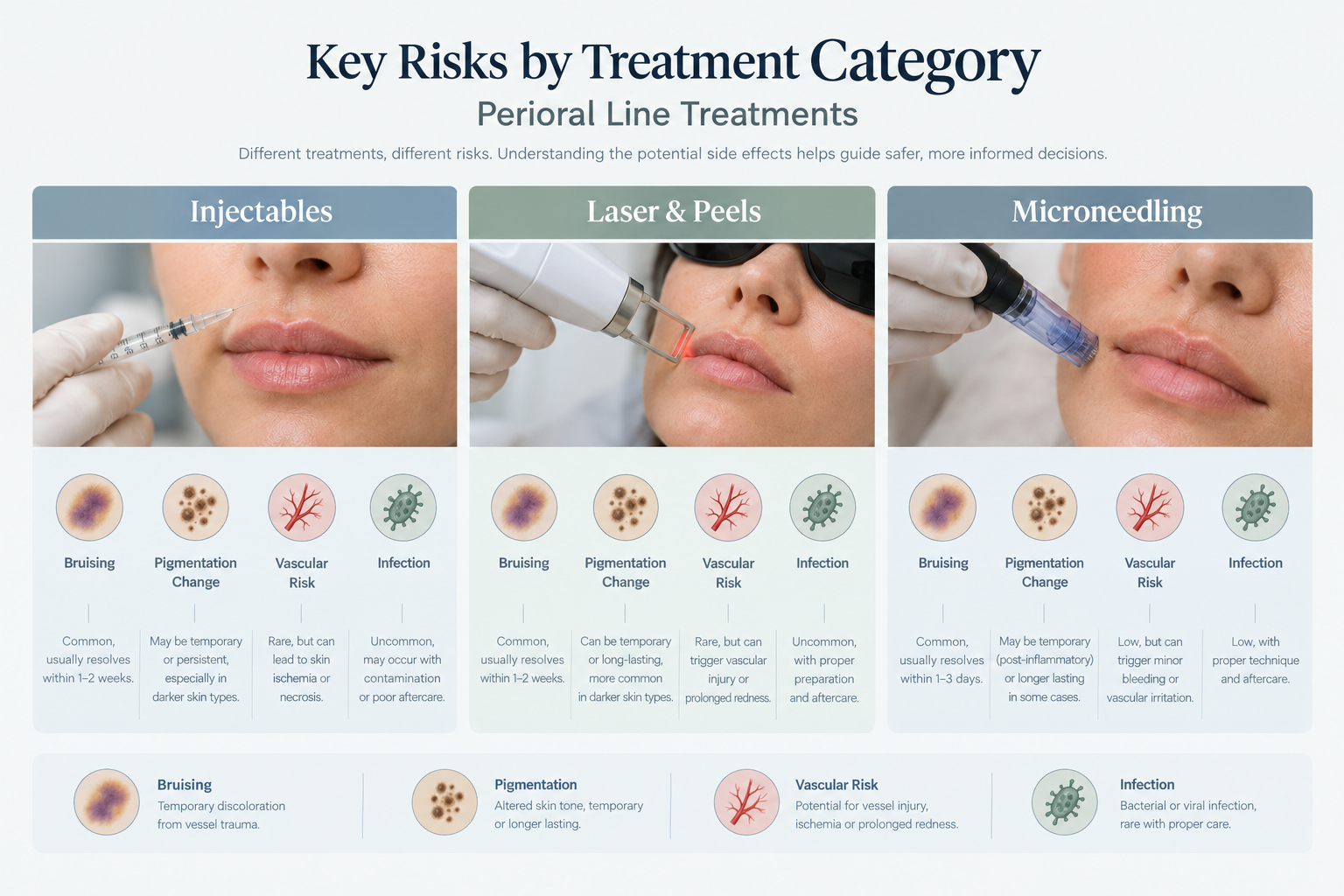
- Botulinum toxin: Temporary functional changes to lip movement, asymmetry, difficulty with certain sounds or activities, bruising, and headache. Effects are temporary but may last several weeks if unwanted.
- Dermal filler: Bruising, swelling, asymmetry, lumpiness, migration of filler, Tyndall effect (a bluish discolouration from superficially placed filler), infection, and — most seriously — vascular occlusion, which can compromise blood supply to the skin. Vascular complications are uncommon but require immediate treatment; practitioners should have hyaluronidase available.
- Laser resurfacing: Prolonged redness, post-inflammatory hyperpigmentation (particularly in darker skin tones), hypopigmentation, infection, scarring, and herpes simplex reactivation.
- Chemical peels: Redness, peeling, pigmentation changes, infection, and scarring at deeper depths.
- Microneedling and radiofrequency microneedling: Redness, swelling, bruising, infection, and pigmentation changes.
The perioral area is anatomically complex, and the risk profile of any injectable treatment is meaningfully influenced by the practitioner's knowledge of local anatomy and their technique. Choosing a qualified, experienced practitioner — ideally a doctor, dentist, or nurse prescriber with specific training in facial aesthetics — reduces but does not eliminate these risks.
Who May Be Suitable and Who May Not
Suitability for perioral line treatments depends on several individual factors. Botulinum toxin for this area may not be appropriate for people who rely heavily on precise lip function — professional musicians who play wind instruments, for example, or public speakers who notice even subtle changes in articulation. Dermal filler may not be suitable for patients with a history of cold sores without appropriate antiviral cover, active skin infection, or certain autoimmune conditions. Resurfacing treatments require careful patient selection based on skin type, history of keloid scarring, and current medications including isotretinoin.
Pregnancy and breastfeeding are contraindications for most aesthetic injectable and resurfacing treatments. A full medical history, including current medications and previous procedures in the area, should be taken before any treatment is planned.
At-Home Approaches and Their Limitations
While professional treatments offer the most meaningful improvement for established vertical lip lines, certain skincare ingredients may help slow their progression or modestly improve skin texture over time. Topical retinoids — vitamin A derivatives available in prescription and over-the-counter strengths — have the most robust evidence for stimulating collagen production and improving fine lines with consistent long-term use. Broad-spectrum SPF50 sunscreen applied daily to the perioral area helps prevent further UV-related collagen degradation. Topical vitamin C serums may support collagen synthesis and provide antioxidant protection.
It is important to be realistic about what topical products can achieve for moderate to deep perioral lines. Skincare can support skin health and may slow progression, but it is unlikely to significantly reduce established creases in the way that professional treatments can. Lip balms and hydrating products can temporarily plump the skin surface and make fine lines less visible, but this effect is cosmetic and transient.
Frequently Asked Questions
How many treatment sessions will I need?
This depends on the treatment chosen and the severity of the lines. Botulinum toxin and dermal filler are typically single-session treatments that require maintenance every few months to a year. Microneedling and radiofrequency microneedling usually require a course of three to six sessions. Laser resurfacing may achieve significant improvement in one to two sessions for ablative treatments, or require more sessions for fractional approaches. Your practitioner will advise based on your individual assessment.
Will treatment for lip lines affect how my lips look or move?
Botulinum toxin in the perioral area can subtly affect lip movement and may cause a temporary change in how certain sounds are produced. This is usually mild and resolves as the toxin wears off. Dermal filler, if placed carefully and conservatively, should not significantly alter lip movement. Resurfacing treatments do not affect muscle function. Any concerns about functional changes should be discussed with your practitioner before treatment.
Can vertical lip lines be permanently removed?
No current treatment permanently eliminates perioral lines. All available options provide temporary to medium-term improvement, and maintenance treatments are required to sustain results. Deeper ablative resurfacing may produce longer-lasting structural improvement to skin quality, but the underlying ageing process continues, and lines will gradually return or deepen without ongoing care.
Is there a best age to start treating perioral lines?
There is no universally correct age. Some people develop fine perioral lines in their thirties, while others may not notice them until later. Earlier intervention with preventive measures — sun protection, retinoids, and conservative injectable treatments — may slow progression, but the decision to pursue professional treatment is individual and should be based on personal goals rather than age alone.
Does treating lip lines hurt?
Most injectable treatments involve mild to moderate discomfort that is well managed with topical anaesthetic cream. The perioral area can be more sensitive than other facial areas. Resurfacing treatments vary from mild warmth and tingling with non-ablative approaches to more significant discomfort with ablative procedures, which are usually performed with stronger anaesthesia or sedation depending on the depth of treatment.
Can I wear lipstick after treatment?
After injectable treatments, most practitioners advise avoiding makeup for at least four to six hours and sometimes twenty-four hours. After resurfacing treatments, makeup should be avoided until the skin has healed sufficiently, which may be several days to two weeks depending on the depth of treatment. Your practitioner will give specific aftercare guidance.
What is the difference between lip filler and treatment for lip lines?
Lip filler typically refers to adding volume to the lip body itself — increasing fullness and definition. Treatment for perioral lines with filler focuses on the fine creases above and below the lip border rather than the lip itself. Some practitioners address both in the same appointment, but they are distinct goals requiring different injection techniques and placement.
Deciding on the Right Approach for Your Perioral Lines
Vertical lip lines and lipstick bleed lines are a common aesthetic concern with several genuinely effective professional treatment options available. The most appropriate approach depends on the depth and nature of the lines, your skin type, your tolerance for downtime, and your overall goals. Fine dynamic lines may respond well to conservative botulinum toxin alone or combined with a skin booster. Deeper static lines with significant texture change are more likely to benefit from a resurfacing treatment, possibly combined with filler to address volume loss. Many patients achieve the best outcomes through a tailored combination approach planned over time rather than a single treatment.
Realistic expectations are important. Meaningful improvement is achievable for most people, but complete elimination of perioral lines is not a realistic goal with current treatments, and all results require maintenance. The risks in this area — particularly with injectable treatments — make practitioner selection a significant factor in both safety and outcome. A thorough consultation with a qualified aesthetic practitioner who can assess your anatomy, discuss your goals, and explain the realistic benefits and limitations of each option is the most valuable first step.
