

Lip shape is one of the most defining features of the lower face, and it varies considerably from person to person. Some people seek enhancement to restore volume lost with age, while others want to refine the natural contour of their lips or address asymmetry. Understanding how different lip shapes respond to aesthetic treatment — and what enhancement can realistically achieve — helps prospective patients approach a consultation with informed expectations.
Key Takeaways
- Lip shape varies widely between individuals, and the most suitable enhancement approach depends on existing anatomy, not a universal ideal.
- Hyaluronic acid dermal fillers are the most commonly used treatment for lip augmentation and reshaping, offering temporary and adjustable results.
- Enhancement can address volume, projection, border definition, symmetry, and the relationship between the upper and lower lip — but results depend on individual anatomy and practitioner technique.
- Risks including swelling, bruising, asymmetry, and rare but serious vascular complications mean that practitioner selection and a thorough consultation are essential.
- Results from hyaluronic acid lip filler typically last between six and twelve months, though this varies between individuals.
Understanding Lip Shapes and Anatomy
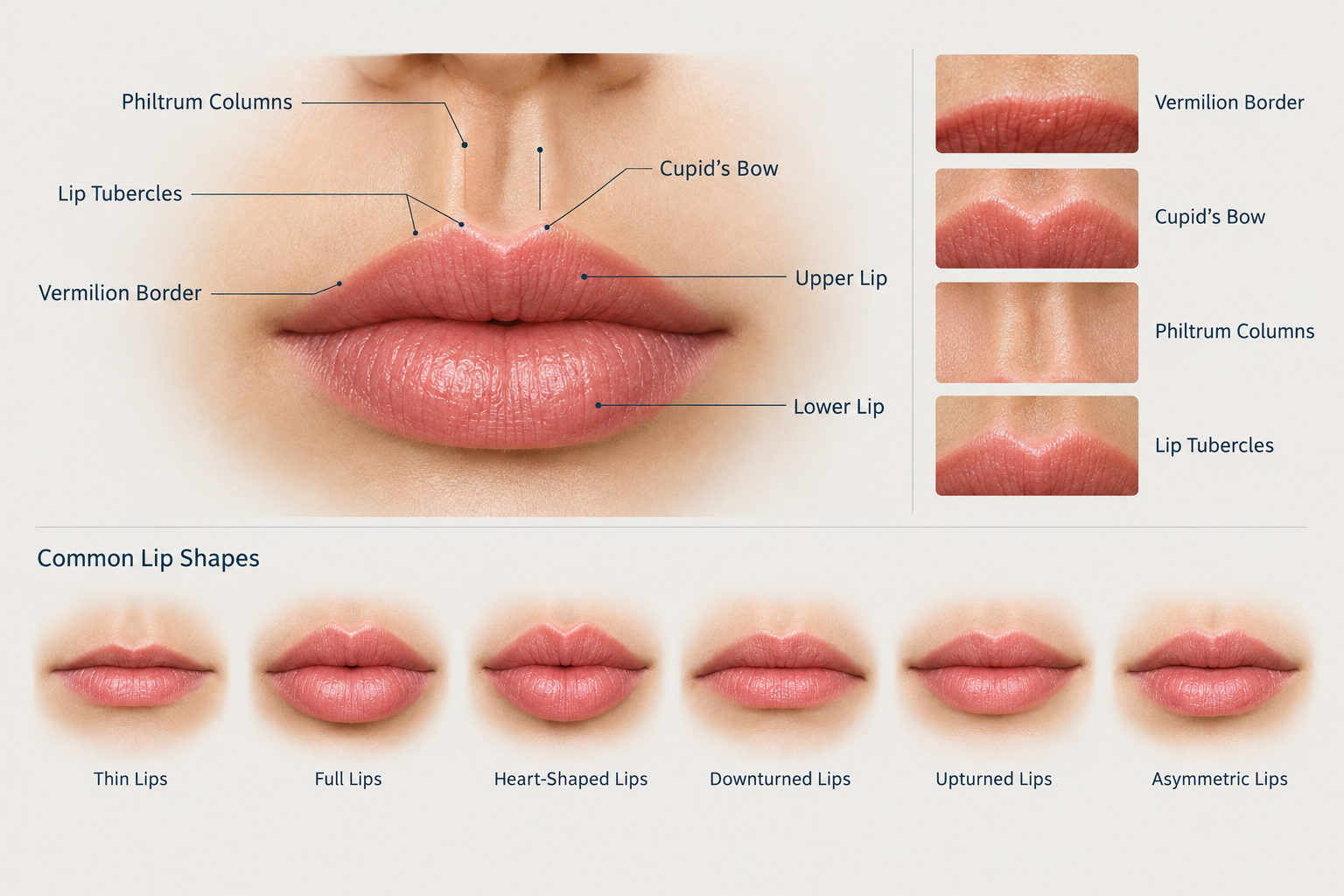
The lips are composed of several distinct anatomical zones, each contributing to the overall appearance of the mouth. The vermilion border forms the defined edge between the lip tissue and surrounding skin. The Cupid's bow is the double-curved upper lip border that creates the characteristic M-shape at the centre. The philtrum columns — the two vertical ridges running from the base of the nose to the upper lip — frame the central lip area and influence how prominent the Cupid's bow appears. The tubercles are the three soft projections of the upper lip body, and the lower lip typically has two lobes that create a gentle fullness.
Common lip shape categories include thin lips with minimal volume, lips with a flat or poorly defined Cupid's bow, lips with uneven upper-to-lower proportions, asymmetric lips where one side differs from the other, and lips that have lost definition or volume due to ageing. There is no single ideal lip shape; aesthetic preferences vary across cultures, age groups, and individuals. A well-planned enhancement should work with a patient's existing facial proportions rather than impose a standardised look.
With age, the lips tend to lose volume and projection, the vermilion border becomes less defined, the philtrum elongates, and the corners of the mouth may turn downward. These changes are gradual and can affect lip shape significantly over time, which is why some patients seek treatment for restoration rather than augmentation.
How Dermal Fillers Can Enhance Lip Shape
Hyaluronic acid dermal fillers are the most widely used treatment for lip enhancement. Hyaluronic acid is a naturally occurring substance in the body that attracts and retains water, and when injected into lip tissue it adds volume, improves hydration, and can reshape specific areas of the lip. Because hyaluronic acid fillers are reversible using an enzyme called hyaluronidase, they offer a degree of adjustability that makes them particularly suitable for lip work, where precision matters.
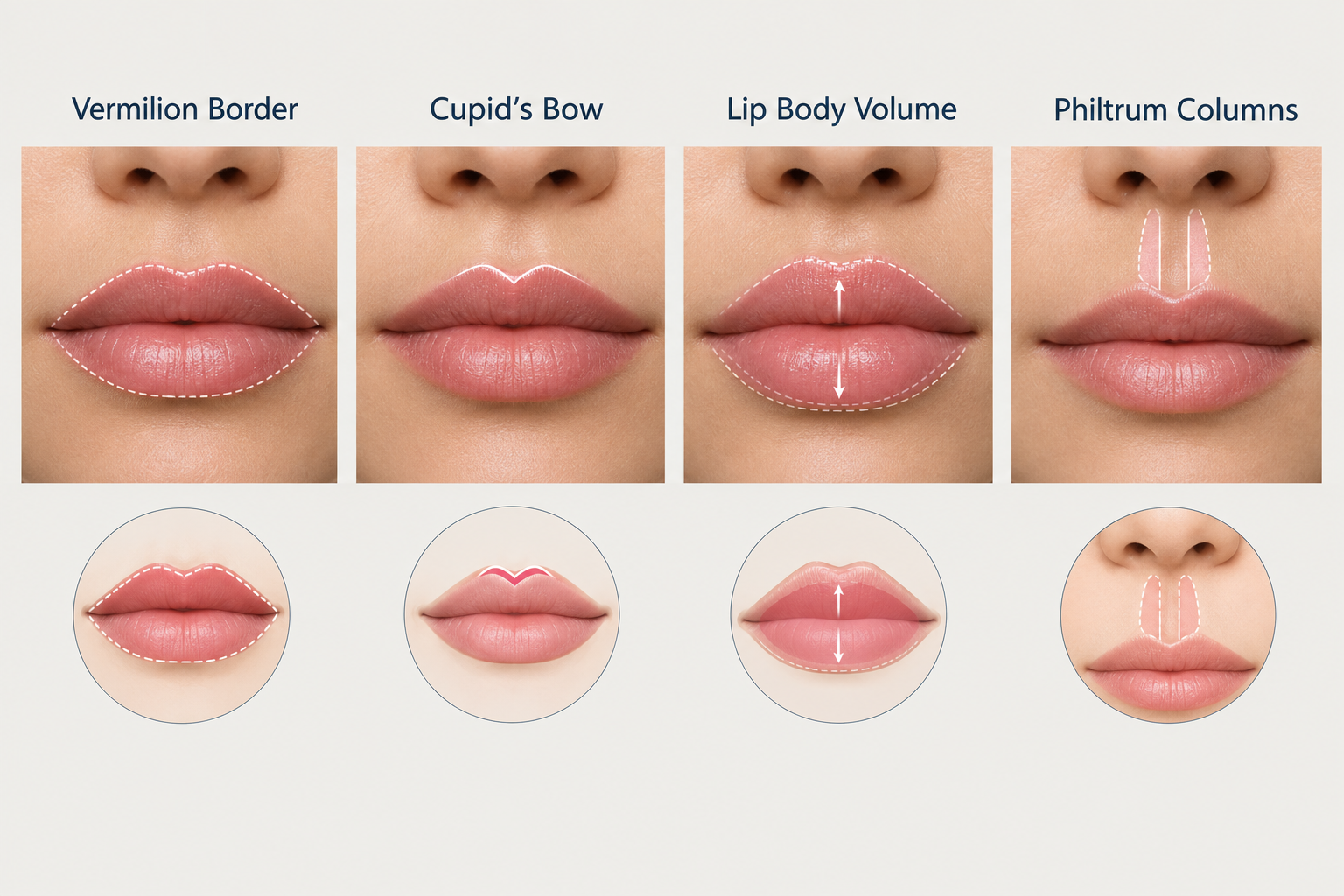
Different lip shapes benefit from different injection approaches. A practitioner may focus on the vermilion border to sharpen definition, add volume to the body of the lip for fullness, enhance the Cupid's bow to create a more pronounced upper lip contour, or project the central tubercle for a more three-dimensional appearance. Addressing lip asymmetry typically requires careful assessment of both sides and targeted placement rather than a uniform approach. The relationship between the upper and lower lip — often described in terms of proportion — is also considered, as overfilling one lip relative to the other can create an unbalanced result.
The choice of filler product matters. Hyaluronic acid fillers vary in their consistency, cross-linking density, and rheological properties — meaning how they behave under pressure and movement. Thinner, more fluid formulations are generally preferred for delicate areas such as the vermilion border, while slightly firmer products may be used to add structural projection. A practitioner experienced in lip anatomy will select the appropriate product and technique based on the patient's specific lip shape and goals.
Lip Shape Enhancement Techniques
Several recognised techniques are used to address different lip shape concerns, and a practitioner may combine more than one approach within a single treatment session.
Vermilion Border Definition
Injecting along the vermilion border creates a sharper, more defined lip edge. This technique is particularly useful for patients whose lip border has become less distinct with age, or for those who want a cleaner outline without necessarily adding significant volume to the lip body. A well-defined border can make the lips appear larger even when only a small amount of filler is used.
Cupid's Bow Enhancement
The Cupid's bow shape of the upper lip is a feature many patients want to preserve or accentuate. Filler placed at the peaks of the Cupid's bow and along the philtrum columns can lift and define this area, creating a more sculpted upper lip appearance. Patients with a naturally flat upper lip border may benefit from this approach to introduce more visible contour.
Lip Body Volume
Adding volume to the body of the lip — the soft tissue between the border and the inner mucosa — creates fullness and projection. This is the most common goal for patients with naturally thin lips or those experiencing age-related volume loss. The amount of filler used is typically measured in fractions of a millilitre, and experienced practitioners often recommend a conservative initial treatment to allow the patient to assess the result before adding more.
Lip Corner Lifting
Downturned lip corners can give the face a resting expression that appears unhappy or tired. Small amounts of filler placed at the oral commissures — the corners of the mouth — can subtly lift this area. In some cases, botulinum toxin injections into the depressor anguli oris muscle are used alongside or instead of filler to address downturned corners, depending on the underlying cause.
Philtrum Column Enhancement
Defining the philtrum columns with filler can create the appearance of a more lifted upper lip and a more prominent Cupid's bow without adding significant volume to the lip body itself. This technique is sometimes used in patients who want subtle reshaping rather than obvious augmentation.
What to Expect During a Lip Filler Appointment
A lip filler appointment typically begins with a consultation, during which the practitioner assesses the patient's lip shape, facial proportions, skin quality, and medical history. Photographs are often taken for reference. The practitioner should discuss realistic outcomes, the amount of product likely to be used, and any relevant risks before treatment proceeds.
Before injection, a topical anaesthetic cream is usually applied to the lip area and left for a short period to reduce discomfort. Many hyaluronic acid fillers also contain lidocaine, a local anaesthetic, within the formulation, which further reduces discomfort during injection. Most patients describe the sensation as a mild stinging or pressure rather than significant pain, though individual tolerance varies.
The injection process itself typically takes between fifteen and thirty minutes. The practitioner may use a fine needle, a blunt-tipped cannula, or a combination of both, depending on the technique and the areas being treated. After injection, the practitioner will gently massage the area to distribute the product evenly and assess the result. Patients are usually able to see an immediate change, though initial swelling means the final result is not visible until the swelling has resolved, typically within one to two weeks.
Realistic Results and Limitations
Lip filler can meaningfully improve lip shape, definition, and volume, but it works within the constraints of existing anatomy. Patients with very thin lips may achieve noticeable improvement but are unlikely to achieve the same result as someone with more natural lip tissue to work with. Significant asymmetry can often be improved but may not be fully corrected in a single session. The appearance of the lips also changes with facial expression, speaking, and smiling, so a result that looks balanced at rest should also be assessed in motion.
The longevity of hyaluronic acid lip filler varies between individuals. Most patients find that results last between six and twelve months, though some experience faster breakdown due to higher lip movement, metabolism, or the specific product used. Maintenance treatments are typically needed to sustain the result over time. It is worth noting that repeated filler treatments over many years may have cumulative effects on lip tissue, and this is an area where practitioners should provide honest guidance based on individual circumstances.
Lip filler cannot change the fundamental bone structure of the jaw or chin, alter the position of the teeth, or correct concerns that originate from muscle activity rather than volume. For some patients, a combination approach — for example, addressing chin projection or nasolabial folds alongside lip treatment — may produce a more harmonious overall result, but this should be discussed carefully rather than assumed.
Risks and Side Effects
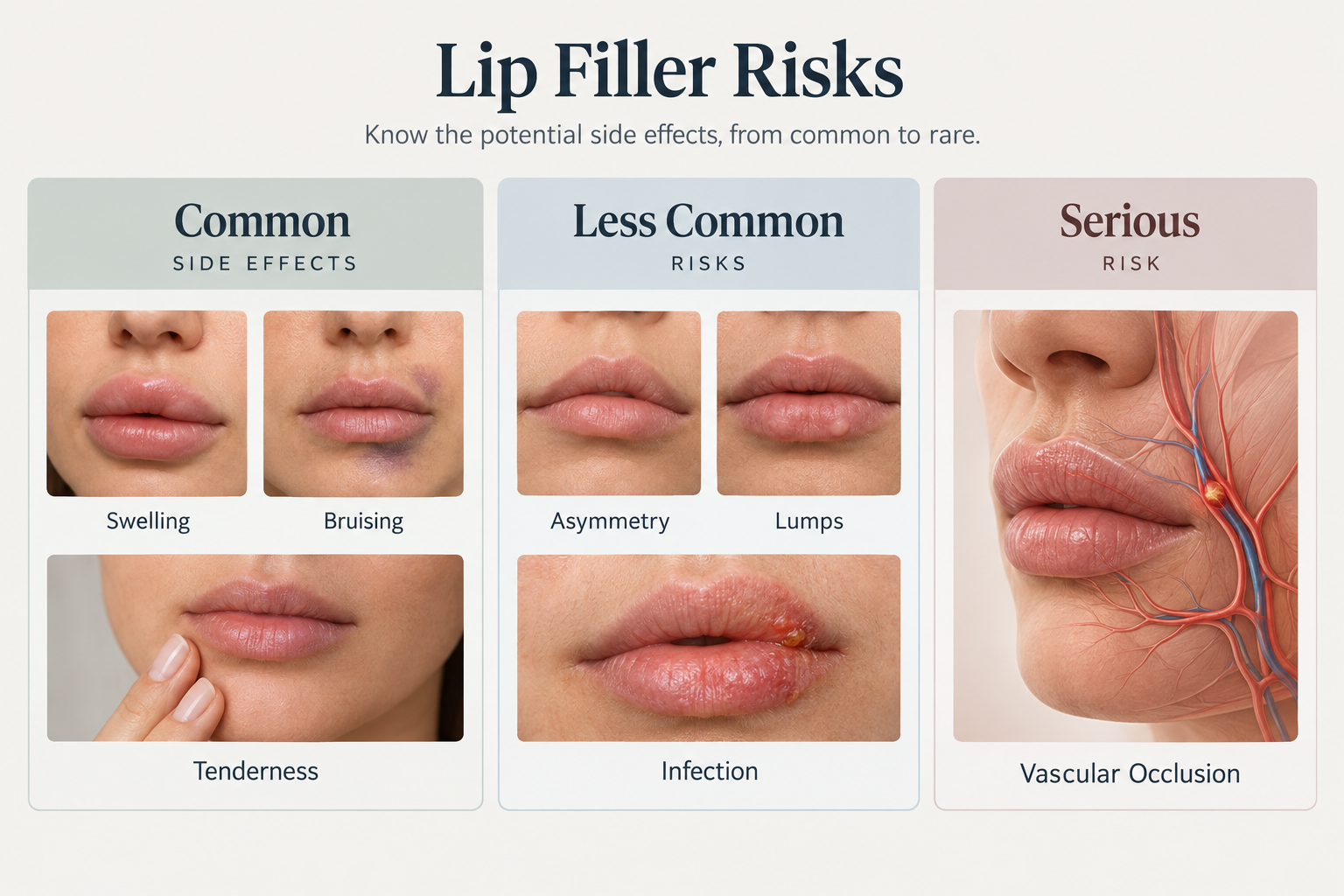
Lip filler carries a range of possible side effects and risks that patients should understand before proceeding. Common and expected side effects include swelling, bruising, tenderness, and redness at the injection sites. These typically resolve within a few days to two weeks. Swelling is often more pronounced in the lips than in other facial areas due to the vascularity and mobility of the tissue.
Less common but more significant risks include asymmetry, lumps or irregularities in the filler distribution, prolonged swelling, and infection. Allergic reactions to hyaluronic acid fillers are rare but possible. Cold sore reactivation can occur in patients with a history of herpes simplex virus, and antiviral prophylaxis is sometimes recommended before treatment in susceptible individuals.
The most serious risk associated with lip filler — and with facial filler more broadly — is vascular occlusion, where filler material enters or compresses a blood vessel, potentially compromising blood supply to surrounding tissue. In the lip area, this can cause tissue damage and, in rare cases, more serious complications. Vascular occlusion is a medical emergency that requires immediate treatment with hyaluronidase. Choosing a practitioner with appropriate training, knowledge of facial vascular anatomy, and access to hyaluronidase is an important safety consideration.
Patients should also be aware that overfilling the lips — using more product than the anatomy can support — can lead to an unnatural appearance, migration of filler beyond the lip border, or a loss of the natural lip shape over time. A conservative, staged approach is generally considered safer and more aesthetically reliable than attempting to achieve a dramatic result in a single session.
Who May Be Suitable for Lip Shape Enhancement
Lip filler may be suitable for adults who are in good general health, have realistic expectations about what treatment can achieve, and have a specific concern — such as thin lips, poor definition, asymmetry, or age-related volume loss — that can be meaningfully addressed with injectable treatment. A thorough consultation with a qualified practitioner is necessary to assess individual suitability.
Certain factors may affect suitability or require additional consideration. These include active infection or cold sores in or around the mouth, a history of severe allergic reactions, bleeding disorders or use of blood-thinning medications, autoimmune conditions, and pregnancy or breastfeeding. Patients who have previously had lip filler should inform their practitioner, as residual product may affect the treatment plan. Those with a history of significant lip filler complications should discuss this in detail before proceeding.
Age is also a relevant factor. Lip enhancement in younger patients raises different considerations than treatment in older patients seeking restoration. Practitioners should assess whether the patient's goals are realistic and proportionate to their natural anatomy, and should not feel pressured to provide treatment that is unlikely to produce a natural or appropriate result.
Alternatives to Hyaluronic Acid Lip Filler
Hyaluronic acid filler is the most established and widely used option for lip shape enhancement, but it is not the only approach available.
Botulinum toxin injections can be used to address specific lip shape concerns without adding volume. A small amount of botulinum toxin injected into the orbicularis oris muscle — the circular muscle surrounding the mouth — can cause the lip to roll slightly outward, creating the appearance of a fuller lip border. This technique, sometimes called a lip flip, produces a subtle effect and does not add volume in the same way as filler. It may suit patients who want minimal change or who are not yet ready for filler. Results typically last two to four months.
Collagen-stimulating treatments such as polynucleotides or biostimulators are sometimes used in the perioral area to improve skin quality and fine lines around the mouth, though these are not typically used for direct lip augmentation in the same way as hyaluronic acid filler.
Surgical options including lip lift procedures — which shorten the philtrum and increase the visible portion of the upper lip — and lip implants exist for patients seeking more permanent change. These carry greater risks and recovery requirements than injectable treatments and are generally considered when non-surgical options have not achieved the desired result or when the patient's anatomy makes surgical correction more appropriate.
For patients whose primary concern is fine lines around the mouth rather than lip shape itself, skin resurfacing treatments such as laser therapy or chemical peels may be more relevant than injectable augmentation.
Frequently Asked Questions
How much filler is typically used for lip enhancement?
The amount of hyaluronic acid filler used for lip treatment varies depending on the patient's existing lip volume, the specific goals, and the practitioner's approach. Many practitioners start with 0.5 to 1 millilitre for a first treatment, with the option to add more at a follow-up appointment once the initial swelling has resolved. Using less product initially and building gradually tends to produce more natural-looking results.
Will lip filler change the shape of my Cupid's bow?
Yes, targeted filler placement along the peaks of the Cupid's bow and philtrum columns can enhance or define this area. However, the degree of change depends on the patient's natural anatomy. Patients with a very flat upper lip border may see a meaningful improvement, while those with an already defined Cupid's bow may notice more subtle refinement.
How long does swelling last after lip filler?
Swelling after lip filler is common and typically peaks within the first 24 to 48 hours. Most of the swelling resolves within one to two weeks, though some patients notice minor residual swelling for slightly longer. The final result is generally assessed at a two-week review appointment.
Can lip filler be dissolved if I am unhappy with the result?
Hyaluronic acid lip filler can be dissolved using an enzyme called hyaluronidase, which breaks down the filler material. This is one of the key advantages of hyaluronic acid over permanent or semi-permanent alternatives. Dissolution is not always immediate and may require more than one treatment, but it provides a meaningful safety net for patients who are dissatisfied with their result or who experience a complication.
Is there a natural-looking approach to lip enhancement?
Natural-looking results are achievable with a conservative approach — using a small amount of filler, focusing on definition and proportion rather than maximum volume, and working with the patient's existing lip shape rather than against it. Communicating clearly with your practitioner about the level of change you want, and reviewing reference photographs together, helps align expectations before treatment begins.
Can lip shape enhancement address asymmetry?
Lip asymmetry — where one side of the upper or lower lip differs in shape or volume from the other — can often be improved with targeted filler placement. Complete correction is not always possible in a single session, and some degree of natural asymmetry is normal in all faces. A practitioner will assess the cause of the asymmetry before recommending an approach.
What should I avoid after lip filler treatment?
Most practitioners advise avoiding strenuous exercise, excessive heat such as saunas or hot baths, alcohol, and significant pressure on the lips for at least 24 to 48 hours after treatment. Dental appointments that require wide mouth opening are generally best avoided for one to two weeks. Specific aftercare instructions will be provided by your treating practitioner.
Choosing Lip Enhancement That Suits Your Lip Shape
Lip shape enhancement is not a single treatment with a single outcome — it is a range of techniques that can be tailored to address specific concerns, from thin lips and poor definition to asymmetry and age-related volume loss. The most important factor in achieving a result that looks natural and proportionate is a thorough consultation with a qualified, experienced practitioner who takes the time to understand your anatomy, your goals, and your concerns.
Hyaluronic acid dermal filler remains the most versatile and widely used option for lip reshaping, offering adjustable, temporary results with a meaningful safety profile when administered correctly. Alternatives such as botulinum toxin lip flip techniques or surgical lip lift procedures may suit different patients depending on their specific concerns and how much change they are seeking.
Before proceeding with any lip treatment, it is worth asking your practitioner about their experience with lip anatomy, the products they use, how they manage complications, and what a realistic outcome looks like for your particular lip shape. A practitioner who takes a conservative, patient-centred approach and encourages a staged treatment plan is generally a more reliable choice than one who recommends maximum volume in a single session. If you are considering lip shape enhancement, a consultation with a qualified aesthetic practitioner is the appropriate starting point for understanding what may be achievable for you.
