
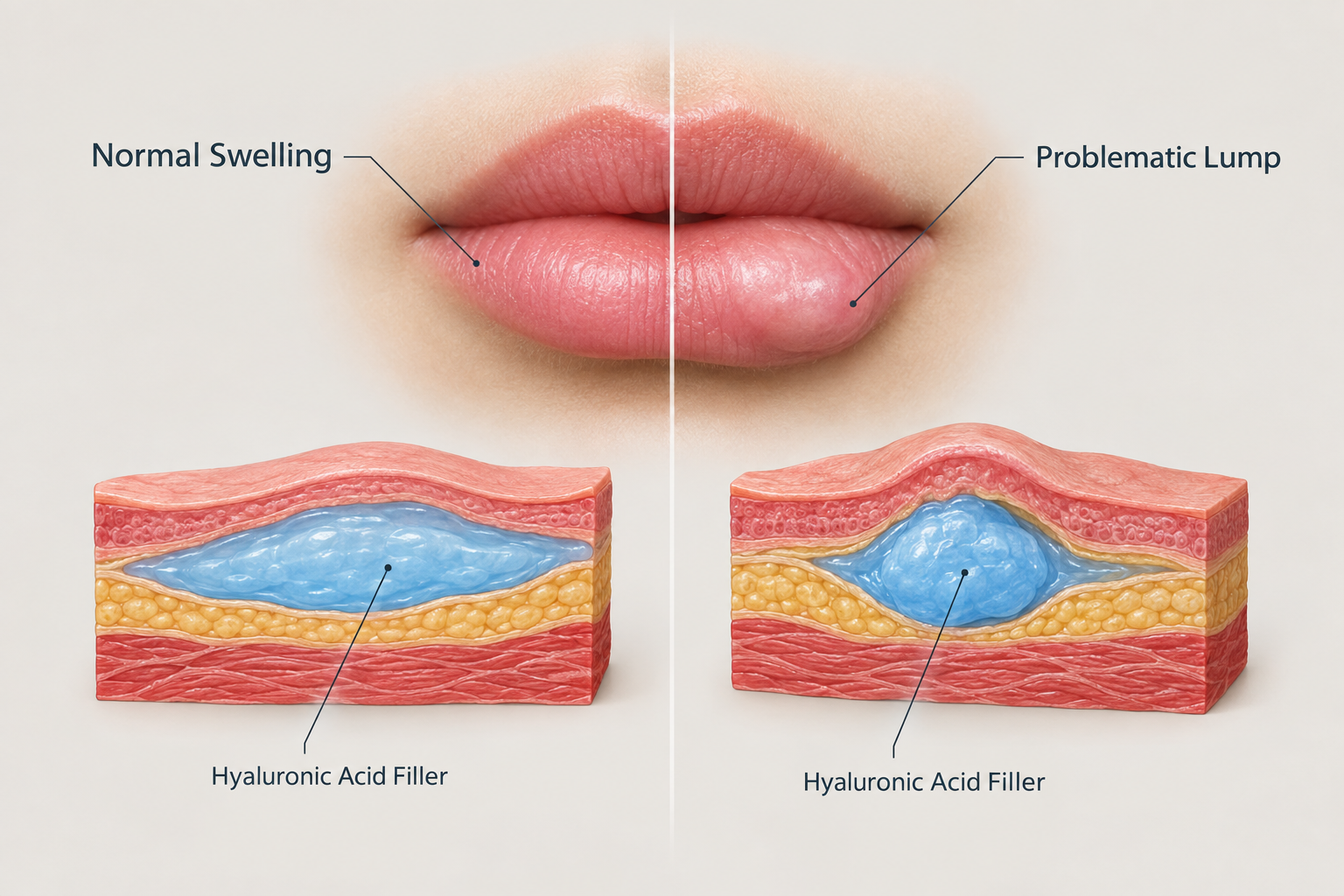

Noticing lumps or bumps after lip filler is one of the most common concerns patients raise following treatment. In many cases, what feels like an uneven lump in the first few days is simply part of the normal healing process. However, some lumps do warrant professional assessment. Understanding the difference between expected post-treatment changes and signs of a genuine complication can help you respond appropriately and avoid unnecessary anxiety — or, equally important, avoid dismissing something that needs attention.
Key Takeaways
- Most lumps felt in the lips within the first one to two weeks after hyaluronic acid filler are caused by swelling, bruising, or the filler settling, and typically resolve without intervention.
- Persistent lumps lasting beyond two to four weeks, or lumps accompanied by pain, redness, warmth, or skin colour changes, should be assessed by a qualified practitioner promptly.
- Granulomas, vascular complications, and delayed hypersensitivity reactions are less common but serious causes of lip lumps that require professional diagnosis and treatment.
- Hyaluronic acid filler lumps can often be dissolved with hyaluronidase if they do not resolve naturally, which is one reason many practitioners prefer hyaluronic acid products for lip augmentation.
- Choosing a qualified, experienced practitioner and attending a thorough pre-treatment consultation significantly reduces the risk of problematic lumps developing.
Why Lumps Form After Lip Filler
Lip filler treatment involves injecting a gel-like substance — most commonly a hyaluronic acid dermal filler — into the lip tissue to add volume, improve shape, or define the lip border. The lips are a highly vascular area with a rich nerve supply, which makes them particularly responsive to injection trauma. When a needle or cannula passes through lip tissue, the body responds with localised inflammation, and this is the primary reason lumps and unevenness are so common in the days immediately following treatment.
Swelling after lip filler can be asymmetric, meaning one side of the lip may appear more swollen or lumpy than the other, even when the filler was placed symmetrically. This is a normal biological response rather than a sign of poor technique. The lips also contain a significant amount of lymphatic tissue, and disruption to lymphatic drainage during injection can contribute to localised fluid accumulation that feels firm or nodular to the touch.
Beyond swelling, the filler product itself may feel uneven in the first few days before it integrates with the surrounding tissue. Hyaluronic acid fillers are hydrophilic, meaning they attract water molecules, and this water-binding property can temporarily increase the apparent size and firmness of the treated area before the filler settles into a more natural distribution.
Normal Lumps: What to Expect in the First Two Weeks
The majority of lumps felt after lip filler treatment fall into the category of normal, expected post-treatment changes. These typically share several recognisable characteristics that distinguish them from more concerning complications.
Normal post-treatment lumps are usually soft or slightly firm to the touch, not hard or fixed. They tend to be non-tender or only mildly sensitive when pressed, and they do not cause significant pain at rest. The overlying skin remains its usual colour — there is no deep redness, purple discolouration, or white blanching of the skin surface. These lumps are also mobile, meaning they shift slightly when the lip is moved or gently pressed, rather than feeling anchored to deeper tissue.
Swelling typically peaks within the first 24 to 72 hours after lip filler and then gradually subsides over the following one to two weeks. During this period, the lips may feel uneven, and small bumps may be visible or palpable along the lip border or within the body of the lip. This is particularly common along the vermilion border — the defined edge between the lip and surrounding skin — where filler is often placed to improve definition.
Bruising can also contribute to the appearance of lumps. Blood that pools beneath the skin surface following injection trauma can create raised, discoloured areas that feel firm. Bruise-related lumps generally follow the typical timeline of bruising: they may darken over the first few days before gradually fading over one to two weeks.
Small, pea-sized bumps that are visible when the lip is stretched or pursed, but not obvious at rest, are another common finding in the first week. These often represent small deposits of filler that have not yet fully integrated and typically smooth out as swelling resolves and the product settles.
When Lumps Are Not Normal: Warning Signs to Recognise
While most lumps after lip filler are benign and self-resolving, certain features should prompt you to contact your practitioner without delay. Recognising these warning signs early is important because some complications respond better to prompt treatment.
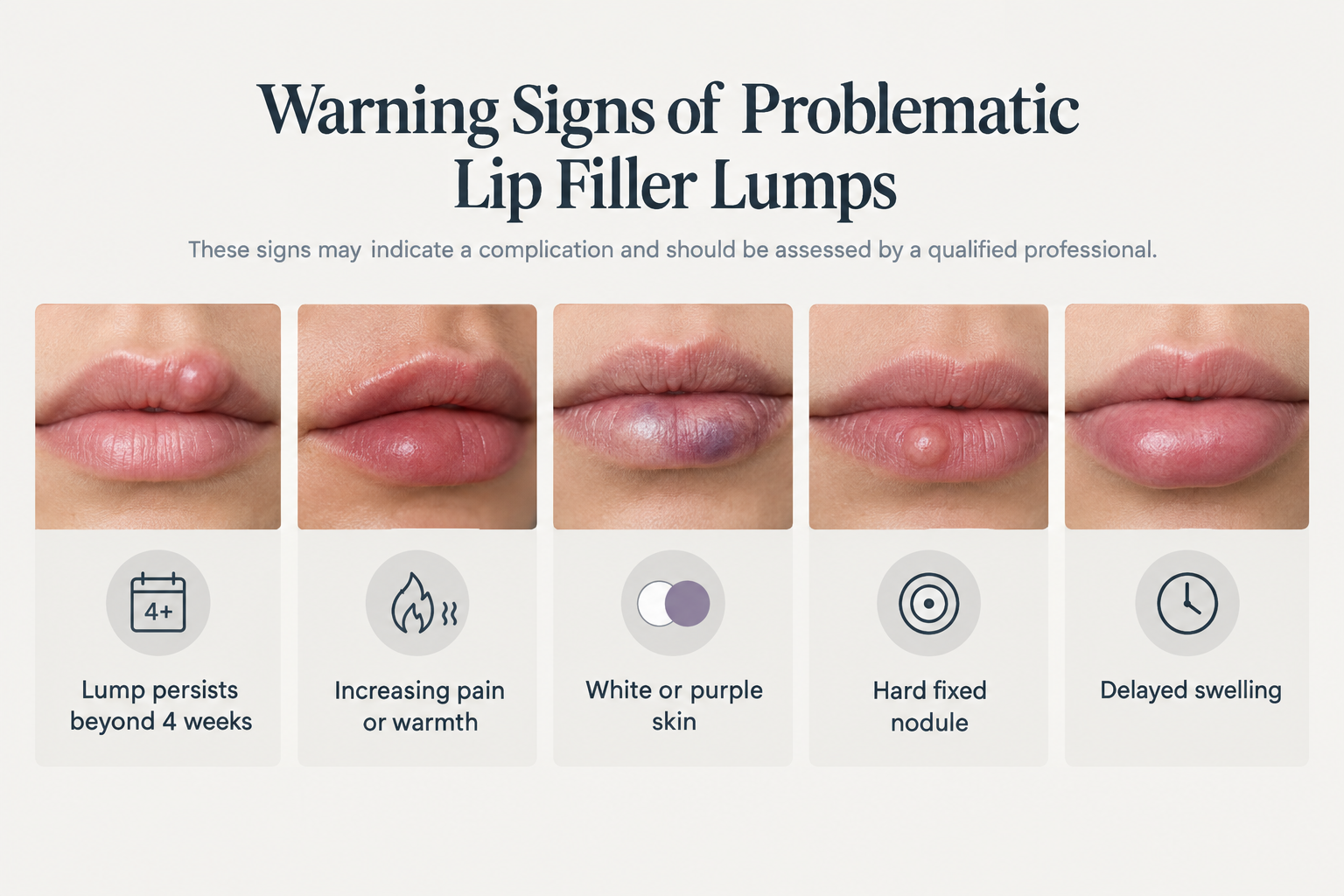
Persistent Lumps Beyond Four Weeks
A lump that remains clearly palpable or visible four weeks after lip filler treatment, once all swelling has fully resolved, is unlikely to be a normal post-treatment finding. Persistent nodules at this stage may represent a granuloma, a biofilm, an area of filler that has migrated, or a delayed inflammatory reaction. These require clinical assessment to determine the appropriate management, which may include hyaluronidase dissolution, anti-inflammatory treatment, or in some cases antibiotics.
Pain, Warmth, and Redness
Mild tenderness in the first 24 to 48 hours after lip filler is expected. However, increasing pain after the first day or two — particularly pain that is disproportionate to the size of the lump — is a warning sign. Warmth and spreading redness around a lump suggest an inflammatory or infectious process that needs professional evaluation. Infection after lip filler is uncommon but possible, and early treatment with appropriate antibiotics is important if infection is confirmed.
Skin Colour Changes: White or Purple Discolouration
White blanching of the skin — where an area of skin turns pale or white — is a potential sign of vascular compromise. This occurs when filler is inadvertently injected into or compresses a blood vessel, reducing blood flow to the surrounding tissue. Vascular occlusion is a rare but serious complication that requires immediate emergency management. If you notice white or pale patches developing on or around the lips during or shortly after treatment, contact your practitioner immediately. Purple or dusky discolouration developing hours after treatment may also indicate compromised blood supply and warrants urgent assessment.
Hard, Fixed Nodules
A lump that feels hard rather than soft, does not move when pressed, and is not associated with the normal swelling timeline may indicate a granuloma — a localised immune reaction to the filler material. Granulomas can develop weeks, months, or even years after filler treatment and are more commonly associated with certain non-hyaluronic acid fillers, though they can occur with any injectable product. They typically require specialist assessment and may be treated with corticosteroid injections, hyaluronidase, or other approaches depending on the filler type involved.
Delayed Swelling or Lumps Appearing Weeks Later
A delayed inflammatory reaction to hyaluronic acid filler can occasionally occur weeks or months after treatment, sometimes triggered by an unrelated illness, dental procedure, or vaccination. This presents as sudden swelling, firmness, or lumpiness in a previously settled treatment area. Delayed hypersensitivity reactions of this kind are uncommon but are a recognised phenomenon and should be assessed by a practitioner familiar with filler complications.
Types of Problematic Lip Lumps: A Closer Look
Granulomas
A granuloma is a localised collection of immune cells that forms when the body attempts to wall off a foreign substance it cannot eliminate. In the context of lip filler, granulomas present as firm, persistent nodules that develop some time after treatment — often months later — and do not respond to simple massage or time. They are more frequently associated with permanent or semi-permanent fillers such as silicone or certain calcium hydroxylapatite products, but can occur with hyaluronic acid fillers in rare cases. Treatment depends on the filler type: hyaluronic acid granulomas may respond to hyaluronidase, while others may require intralesional corticosteroid injections or specialist referral.
Biofilm
A biofilm is a thin layer of bacteria that adheres to the surface of an implanted material — in this case, the filler — and forms a protective matrix that makes the bacteria resistant to standard antibiotic treatment. Biofilm-related complications after lip filler typically present as recurrent episodes of swelling, redness, and lumpiness that partially respond to antibiotics but keep returning. Biofilm is difficult to diagnose and treat, and management usually requires specialist input, often involving prolonged antibiotic courses or dissolution of the filler with hyaluronidase.
Tyndall Effect
The Tyndall effect is a bluish discolouration that can appear when hyaluronic acid filler is placed too superficially beneath thin skin. Light scatters differently through the filler gel when it sits close to the skin surface, creating a visible blue or grey tint. In the lips, this is less common than in areas such as the under-eye region, but it can occur along the lip border if filler is injected too shallowly. The Tyndall effect is not a lump in the traditional sense, but it can make the lip border appear uneven or discoloured. Hyaluronidase treatment is typically effective.
Filler Migration
Filler migration refers to the movement of filler product away from the intended injection site. In the lips, this can result in a visible ridge or lump above the lip border — sometimes described as a “duck lip” appearance — or uneven fullness within the lip body. Migration is more likely when large volumes of filler are placed in a single session, when filler is injected too superficially, or when repeated treatments accumulate product over time without adequate assessment. Hyaluronidase can dissolve migrated hyaluronic acid filler and allow the area to be reassessed before any further treatment.
Managing Lumps After Lip Filler: Practical Steps
If you notice lumps after lip filler treatment, the appropriate response depends on when they appear and what characteristics they have. In the first one to two weeks, gentle care at home is usually all that is needed for normal post-treatment lumps. Applying a cold compress wrapped in a clean cloth for short periods in the first 24 hours can help reduce swelling. Avoiding pressure on the lips, refraining from vigorous exercise for 24 to 48 hours, and staying well hydrated all support normal healing.
Gentle massage of the lips is sometimes recommended by practitioners to help smooth out small irregularities, but this should only be done if your practitioner has specifically advised it and demonstrated the appropriate technique. Vigorous or unsupervised massage is not recommended and may worsen unevenness or displace filler.
If a lump persists beyond two to four weeks, or if any of the warning signs described above are present, contact the clinic or practitioner who performed your treatment. A qualified practitioner can assess whether the lump represents a normal finding, a product irregularity that can be smoothed or dissolved, or a complication requiring further management. Do not attempt to treat a persistent or symptomatic lump at home.
Hyaluronidase: Dissolving Unwanted Filler Lumps
Hyaluronidase is an enzyme that breaks down hyaluronic acid, and it is the primary treatment option for dissolving unwanted hyaluronic acid filler lumps. When a lump after lip filler is caused by product irregularity, migration, or overfilling, hyaluronidase can be injected directly into the affected area to dissolve the filler and restore a more natural appearance. The enzyme works relatively quickly, with visible improvement often apparent within 24 to 48 hours, though some swelling from the hyaluronidase injection itself may temporarily obscure the result.

Hyaluronidase is also used as an emergency treatment for vascular occlusion, where rapid dissolution of filler is needed to restore blood flow. This is one of the key reasons that hyaluronic acid fillers are generally preferred for lip augmentation over permanent or semi-permanent alternatives — the ability to reverse the treatment provides an important safety option that is not available with non-hyaluronic acid products.
Hyaluronidase treatment carries its own small risk of allergic reaction, and a patch test or careful allergy history is appropriate before use. Once the filler has been dissolved and any inflammation has settled, the lips can usually be reassessed and re-treated if desired, typically after a waiting period of several weeks.
Reducing the Risk of Lumps: Choosing the Right Practitioner
The risk of developing problematic lumps after lip filler is significantly influenced by practitioner skill, product selection, and injection technique. Choosing a qualified practitioner with specific training and experience in lip augmentation is one of the most important steps a patient can take. A thorough pre-treatment consultation should include a discussion of your anatomy, the volume of filler appropriate for your goals, the product to be used, and the potential risks including lump formation.
Practitioners who use a conservative approach — placing smaller volumes of filler and building results gradually across multiple sessions if needed — tend to achieve more natural results with a lower risk of visible irregularities. The use of a blunt-tipped cannula rather than a sharp needle for certain injection techniques may also reduce bruising and the risk of vascular injury, though both tools have appropriate applications depending on the treatment area and technique.
Patients should also be aware that repeated lip filler treatments over time can lead to product accumulation, which increases the risk of migration and lumpiness. Regular review with your practitioner, and periodic assessment of whether existing filler should be dissolved before adding more, is a sensible approach to long-term lip filler management.
Frequently Asked Questions
How long do normal lumps after lip filler last?
Most normal lumps caused by swelling, bruising, or filler settling resolve within one to two weeks. By four weeks after treatment, the lips should have settled into their final shape. Any lump that remains clearly palpable or visible beyond this point warrants assessment by your practitioner.
Can I massage lumps after lip filler to smooth them out?
Gentle massage is sometimes recommended by practitioners for specific types of irregularity, but only when they have assessed the lump and advised this approach. Unsupervised or vigorous massage is not recommended, as it may displace filler or worsen unevenness. Always follow the aftercare guidance provided by your treating practitioner.
Is a hard lump after lip filler always serious?
Not necessarily, but a hard lump that does not soften as swelling resolves, or that appears weeks or months after treatment, should be assessed professionally. Hard, fixed nodules may indicate a granuloma or other complication that benefits from early treatment.
What should I do if I notice white skin around my lips after filler?
White or pale blanching of the skin around the lips after filler treatment is a potential sign of vascular occlusion — a rare but serious complication. Contact your practitioner immediately if you notice this. Vascular occlusion requires prompt emergency management to minimise the risk of tissue damage.
Can lumps after lip filler be dissolved?
Lumps caused by hyaluronic acid filler can be dissolved using hyaluronidase, an enzyme injected directly into the affected area. This is one of the advantages of hyaluronic acid fillers over permanent alternatives. Dissolution is typically effective, though some swelling from the treatment itself may be temporarily visible.
Why do I have a lump on one side of my lip but not the other?
Asymmetric swelling and lumpiness after lip filler is common and does not necessarily indicate uneven filler placement. The body’s inflammatory response to injection trauma varies between sides and between individuals. In most cases, asymmetry in the first one to two weeks resolves as swelling subsides. If asymmetry persists beyond four weeks, a review appointment is appropriate.
Can lip filler lumps come back after being dissolved?
Once hyaluronic acid filler has been dissolved with hyaluronidase, the product is broken down and does not return. However, if further filler is injected after dissolution, new lumps could potentially develop if the same contributing factors are present. A careful reassessment of technique, volume, and product choice before re-treatment helps reduce this risk.
When to Seek Help and What to Expect at a Review Appointment
Knowing when to seek professional assessment after lip filler treatment is an important part of being an informed patient. As a general guide, contact your practitioner if a lump is accompanied by increasing pain, warmth, redness, or skin colour changes at any point after treatment; if a lump has not resolved four weeks after treatment; if you develop sudden swelling or lumpiness in a previously settled area weeks or months after treatment; or if you have any concern that something does not feel right.
At a review appointment, a qualified practitioner will assess the lump by examining its location, size, consistency, and any associated symptoms. They may ask about the timeline of the lump, any recent illnesses or procedures, and your treatment history. Depending on their assessment, they may recommend a period of observation, gentle massage, hyaluronidase dissolution, anti-inflammatory medication, or referral for specialist management. A good practitioner will take your concerns seriously and provide a clear explanation of their findings and the recommended next steps.
Most lumps after lip filler have a straightforward explanation and a manageable solution. Attending a review appointment promptly when something concerns you — rather than waiting to see if it resolves on its own — is always the safer approach when warning signs are present.
