

A mini neck lift in the UK typically costs between £3,900 and £9,000, though quotes at either end of that range can reflect very different procedures, levels of surgeon experience, and what is actually included in the price. Understanding what drives that variation is essential before comparing quotes or booking a consultation — and this guide breaks down every significant cost factor, including several that most clinic pages overlook.
Key Takeaways
- Mini neck lift cost UK ranges broadly from approximately £3,900 to £9,000 for a standalone procedure, with London and Harley Street clinics typically at the higher end.
- The total price is made up of several components — surgeon's fee, anaesthetist's fee, theatre fee, pre-operative assessment, and aftercare — and low headline quotes often exclude one or more of these.
- Surgeon credentials, anaesthesia type, operating time, anatomical complexity, and whether the procedure is combined with other surgery all meaningfully affect cost.
- Male patients are generally quoted higher fees due to thicker, more vascular neck tissue, which increases operating time and technical difficulty.
- Revision surgery, if ever needed, represents a significant additional cost that is rarely discussed upfront but is worth factoring into long-term planning.
What Is a Mini Neck Lift and Who Is It For?
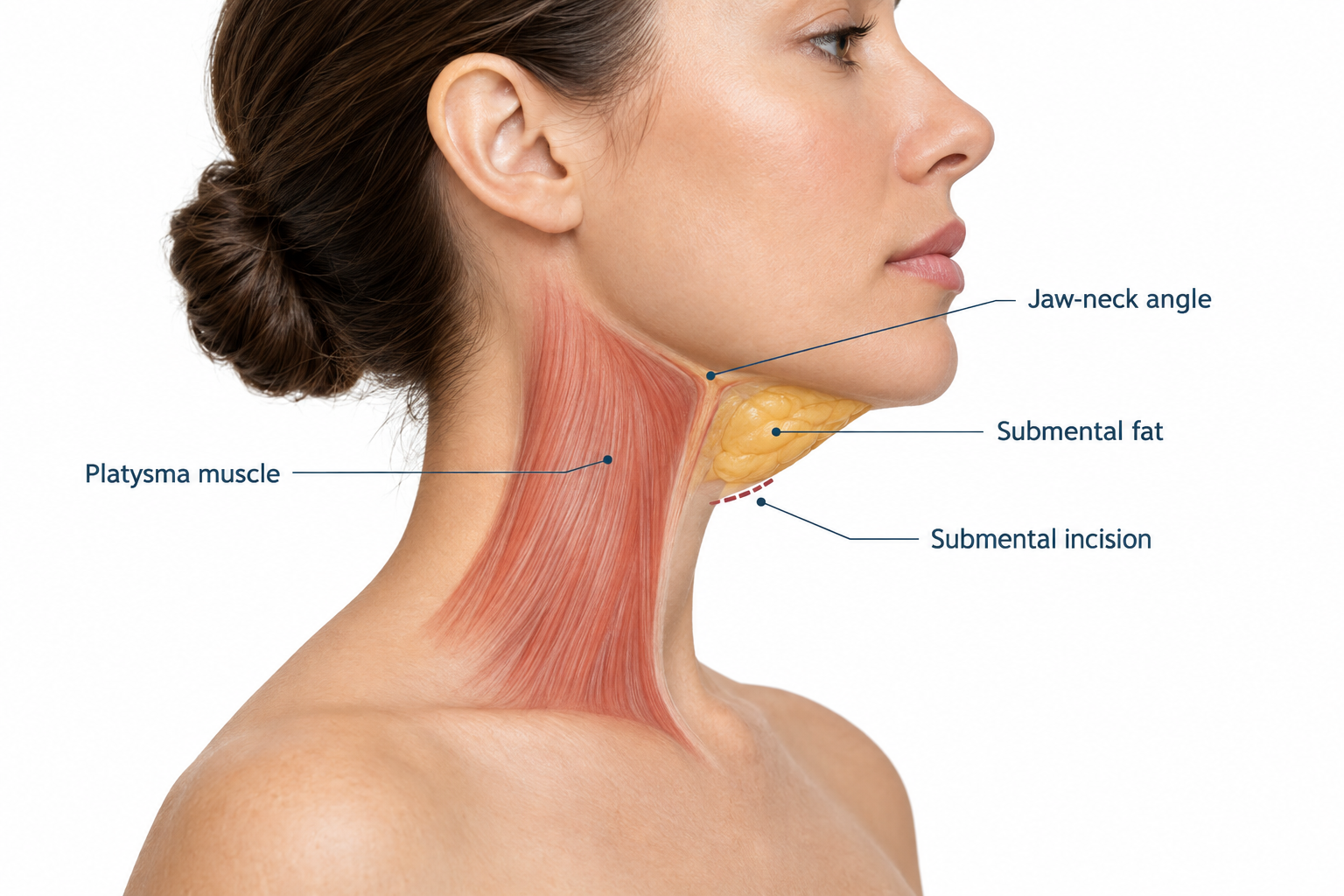
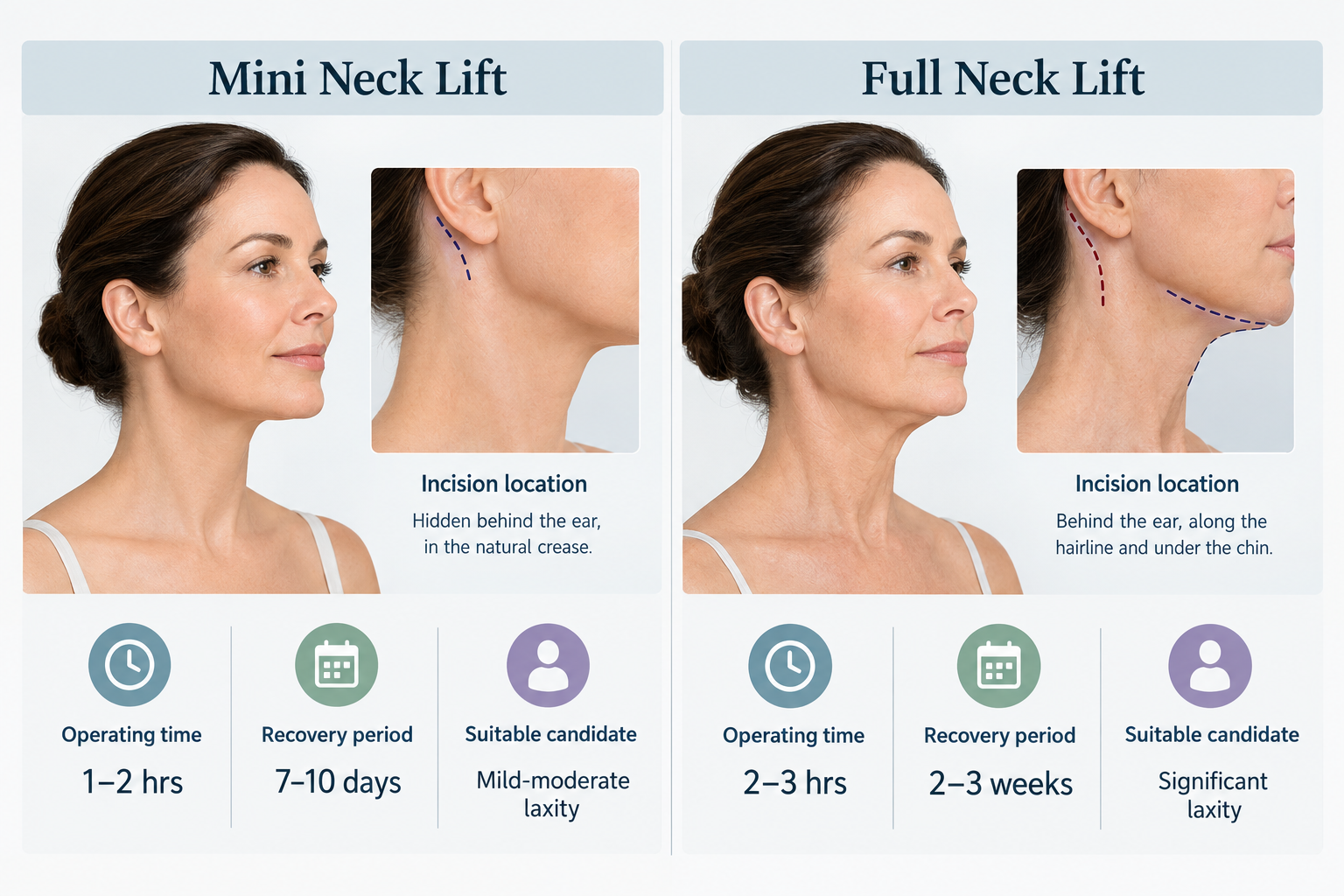
A mini neck lift — also called a short scar neck lift or limited-incision neck lift — is a surgical procedure designed to address mild-to-moderate neck ageing. It typically involves a small submental incision of around 2–3 cm beneath the chin, sometimes combined with small peri-auricular incisions around the ears, to allow the surgeon to tighten underlying structures and remove or redistribute excess tissue. Unlike a full neck lift, it does not usually involve extensive skin excision or posterior hairline incisions, which keeps scarring minimal and recovery shorter.
The procedure is most appropriate for patients who have early platysmal banding — the vertical cords that appear on the front of the neck as the platysma muscle separates with age — along with submental fat accumulation and mild skin laxity. Patients with significant skin redundancy, heavy jowling, or advanced neck ageing are generally better served by a full neck lift or a combined facelift and neck lift. A thorough pre-operative consultation with a qualified surgeon is the only reliable way to determine which procedure matches a patient's anatomy and goals.
How Much Does a Mini Neck Lift Cost in the UK?
Based on publicly available pricing from UK clinics, the indicative cost ranges for neck procedures in 2025 are as follows:
| Procedure | Indicative UK Cost Range | Typical Operating Time |
|---|---|---|
| Standalone mini neck lift | £3,900 – £9,000 | 1 – 2 hours |
| Full neck lift | £7,000 – £13,000 | 2 – 3 hours |
| Mini neck lift combined with facelift | £9,000 – £16,000+ | 3 – 5 hours |
| Neck liposuction / submentoplasty only | £3,000 – £4,500 | 45 – 90 minutes |
These ranges reflect all-inclusive pricing at reputable UK clinics. Quotes at the lower end of the mini neck lift range may exclude the anaesthetist's fee, post-operative follow-up, or compression garments — costs that can add £500 to £1,500 when itemised separately. Always ask for a written breakdown before comparing figures from different providers.
What Factors Affect Mini Neck Lift Cost in the UK?
Surgeon's Fee and Level of Experience
The surgeon's fee is typically the largest single component of the total cost, often accounting for 40–55% of the overall price. Surgeons listed on the GMC Specialist Register with a subspecialty in plastic and reconstructive surgery, and those holding active membership of BAAPS (British Association of Aesthetic Plastic Surgeons) or BAPRAS (British Association of Plastic, Reconstructive and Aesthetic Surgeons), generally command higher fees — and for good reason. These credentials indicate formal specialist training, peer review, and adherence to professional standards that go beyond general medical registration. A surgeon with an extensive portfolio of neck lift cases and recognised specialist status will typically charge more than a general cosmetic practitioner performing the same procedure, and that difference in fee reflects a meaningful difference in training and accountability.
Anaesthesia Type and Anaesthetist's Fee
A mini neck lift can be performed under local anaesthetic with sedation or under TIVA (Total Intravenous Anaesthesia), a form of general anaesthesia that avoids inhaled agents. Local anaesthetic with sedation is generally less expensive and suitable for straightforward cases, while TIVA is preferred for longer or more complex procedures and for patients who are anxious about being awake. The anaesthetist's fee is a separate professional charge, typically ranging from £600 to £1,200 depending on the duration of the procedure and the anaesthetist's seniority. Some low headline quotes omit this fee entirely, so it is important to confirm whether it is included.
Theatre and Facility Fees
Operating in a CQC-regulated facility (regulated by the Care Quality Commission in England, or equivalent bodies HIW in Wales and HIS in Scotland) carries a cost that reflects the safety infrastructure, staffing, and regulatory compliance required. Theatre fees for a mini neck lift typically range from £1,000 to £2,500 depending on operating time and facility type. Day-case procedures performed at a dedicated surgical day unit are generally less expensive than those requiring an overnight stay. Clinics operating from non-regulated environments or offering procedures in settings that fall outside CQC oversight may quote lower facility fees, but this represents a meaningful reduction in patient safety assurance rather than a genuine saving.
Operating Time and Anatomical Complexity
Operating time directly affects theatre costs and, in some pricing models, the surgeon's fee. A straightforward mini neck lift addressing mild submental fat and early platysmal banding may take 60–90 minutes. A more complex case involving corset platysmaplasty — where the platysma muscle edges are sutured together along the midline to correct significant banding — or the removal of subplatysmal fat deposits will extend operating time and increase cost. The extent of skin laxity, the degree of fat accumulation, and the patient's overall neck anatomy all influence how technically demanding the procedure will be.
Gender as a Cost Factor
Male patients are routinely quoted higher fees for neck lift surgery, and this is one of the least-explained cost factors in the UK market. Male neck skin is thicker, more vascular, and contains hair follicles that extend deeper into the dermis, all of which increase the technical difficulty of dissection and the risk of bleeding. The platysma muscle in male patients tends to be heavier, making platysmaplasty more demanding. These anatomical differences typically add 15–25% to the cost of a male mini neck lift compared with an equivalent female procedure, and they also extend operating time. Patients should expect this to be reflected in their quote and should be cautious of any clinic that prices male and female neck lifts identically without explanation.
Clinic Location: London Premium vs Regional Clinics
Clinic location has a measurable effect on mini neck lift pricing across the UK. Harley Street and central London clinics typically charge at the upper end of the price range, reflecting higher property costs, staffing overheads, and the premium associated with a prestigious address. Indicatively, a procedure priced at £6,500–£9,000 in London may be available for £4,500–£6,500 at a reputable regional clinic in Manchester, Birmingham, or Leeds — with comparable surgeon credentials and CQC-regulated facilities. Location alone should not determine where a patient chooses to have surgery, but it is a legitimate factor in understanding why quotes differ between providers.
Standalone vs Combined Procedure
A standalone mini neck lift addresses the neck in isolation. When the procedure is combined with a mini facelift, SMAS facelift, or upper face surgery, the overall cost increases substantially — but the per-procedure cost of each element may be lower than if performed separately, because theatre time, anaesthesia, and pre-operative assessment are shared. Patients considering both facial and neck rejuvenation should ask their surgeon whether a combined approach offers better value and, more importantly, whether it is clinically appropriate for their anatomy and goals.
What Should Be Included in an All-Inclusive Price?
Reputable UK clinics offering all-inclusive pricing for a mini neck lift should include the following within the quoted fee:

- Pre-operative consultation and medical assessment
- Pre-operative blood tests or investigations where required
- Surgeon's fee
- Anaesthetist's fee (where anaesthesia is used)
- Theatre and facility fee
- Compression garments for post-operative use
- Post-operative medications (pain relief, antibiotics if prescribed)
- Suture removal appointment
- Follow-up appointments within the standard aftercare programme
If any of these elements are listed as additional charges, the true cost of the procedure is higher than the headline figure. Asking for a written itemised quote before committing to a consultation fee is a reasonable and sensible step.
Hidden Costs and Red Flags in Low-Cost Quotes
The gap between a £3,900 quote and an £8,500 quote for what appears to be the same procedure is rarely explained clearly on clinic websites. Several factors can account for this disparity, and some of them carry genuine safety implications.
Low-cost quotes may reflect surgery performed by a practitioner who is not on the GMC Specialist Register for plastic surgery — meaning they may have completed a cosmetic surgery course rather than a full surgical training programme. They may also reflect procedures performed in facilities that are not CQC-regulated, where the standards for equipment, staffing, and emergency protocols are not independently verified. Excluded aftercare is another common source of hidden costs: a low headline price that does not include follow-up appointments means that any post-operative concern — swelling, wound healing questions, or complications — may incur additional charges.
Revision surgery represents perhaps the most significant hidden cost risk. If a primary mini neck lift produces an unsatisfactory result — whether due to asymmetry, insufficient correction, or a complication — revision surgery is a separate procedure with its own surgeon's fee, theatre cost, and anaesthesia charge. Some surgeons include a revision policy within their aftercare terms; many do not. Asking about the clinic's approach to revision surgery before proceeding is an important part of informed consent and financial planning.
How to Compare Quotes Fairly
Comparing mini neck lift quotes across UK clinics requires more than looking at the total figure. A practical checklist for prospective patients includes the following questions:
- Is the surgeon listed on the GMC Specialist Register with a plastic surgery subspecialty?
- Are they a member of BAAPS or BAPRAS?
- Is the procedure performed in a CQC-regulated facility?
- Does the quote include the anaesthetist's fee, theatre fee, and aftercare?
- How many follow-up appointments are included, and for how long after surgery?
- What is the clinic's policy on revision surgery if the result is unsatisfactory?
- Is the consultation fee redeemable against the procedure cost?
- What anaesthesia type is being proposed, and why?
A surgeon who takes time to explain the proposed technique — whether a submentoplasty, corset platysmaplasty, or a combination approach — and who discusses the jaw-neck angle, degree of skin laxity, and realistic outcomes is demonstrating the kind of clinical engagement that justifies a higher fee. A quote provided without a face-to-face or video assessment should be treated with caution.
The Realistic Total Cost of a Mini Neck Lift
The procedure fee is not the only financial consideration. Patients planning a mini neck lift should also account for the following when calculating the true cost of the experience:
- Time off work: Most patients return to desk-based work within 7–10 days, but those in physically demanding roles may need 2–3 weeks. Lost income during recovery is a real cost that varies significantly between individuals.
- Travel and accommodation: Patients travelling to London or another city for surgery may need to factor in transport, parking, or overnight accommodation for themselves and a companion.
- Additional compression garments: Some patients require replacement garments during the recovery period, which are not always included in the initial package.
- Post-operative medications: Prescription pain relief and antibiotics may or may not be included; over-the-counter supplements such as arnica are an additional minor cost.
- Potential revision costs: As noted above, revision surgery is not typically covered within the original procedure fee unless explicitly stated.
Financing a Mini Neck Lift in the UK
A mini neck lift is a cosmetic procedure and is not available on the NHS. Private health insurance policies also do not cover elective cosmetic surgery in the vast majority of cases. Many UK clinics offer medical finance options, including 0% APR finance over 6–12 months for eligible patients, or longer-term plans through providers such as Chrysalis Finance. Monthly repayments for a £6,000 procedure over 24 months at a representative APR would typically fall in the range of £250–£320 per month, though the exact terms depend on the finance provider, the patient's credit profile, and the repayment period selected. Finance options should be considered carefully alongside the total cost of the procedure, including interest charges on longer-term plans that are not interest-free.
Mini Neck Lift vs Full Neck Lift: Is the Price Difference Justified?
The choice between a mini neck lift and a full neck lift is primarily a clinical decision based on the degree of neck ageing, not a financial one. A full neck lift involves more extensive dissection, longer operating time, additional incisions including posterior hairline incisions, and a longer recovery period — all of which contribute to its higher cost. For patients with mild-to-moderate skin laxity, early platysmal banding, and localised submental fat, a mini neck lift may achieve comparable improvement to a full neck lift at a lower cost and with less downtime. For patients with significant skin redundancy or advanced neck ageing, a full neck lift is likely to produce a more durable and complete result, making the additional cost clinically justified. Choosing a mini neck lift primarily to save money when a full neck lift is the appropriate procedure is likely to result in an unsatisfactory outcome and potential revision costs.
Non-Surgical Alternatives and Their Costs
For patients who are not yet ready for surgery, or who have only very early neck laxity, non-surgical alternatives may be worth discussing at consultation. These include Renuvion (J-Plasma), a minimally invasive radiofrequency and helium plasma device used for skin tightening; Morpheus8, a fractional radiofrequency microneedling treatment; and Ultherapy, which uses focused ultrasound to stimulate collagen at deeper tissue levels. These treatments typically cost between £1,500 and £4,000 per session and may require multiple sessions to achieve meaningful improvement. They are generally less effective than surgical correction for established platysmal banding or significant skin laxity, but they may be appropriate for borderline candidates or as a maintenance option following surgery. Neck liposuction or submentoplasty alone — addressing submental fat without skin tightening — is another option for patients whose primary concern is a double chin rather than neck laxity, and typically costs £3,000–£4,500.
Frequently Asked Questions
Why do mini neck lift prices vary so much between UK clinics?
Price variation reflects differences in surgeon credentials and experience, anaesthesia type, facility regulation standards, what is included in the quoted fee, and clinic location. A £3,900 quote and an £8,500 quote may describe very different procedures in terms of technique, safety infrastructure, and aftercare. Always request an itemised breakdown and verify the surgeon's specialist registration before comparing figures.
Is a mini neck lift a day-case procedure?
In most cases, yes. A standalone mini neck lift performed under local anaesthetic with sedation or TIVA is typically a same-day discharge procedure, meaning patients go home the same day. An overnight stay may be recommended for combined procedures or for patients with specific medical considerations. Your surgeon and anaesthetist will advise based on your individual circumstances.
Does the consultation fee count towards the procedure cost?
This varies between clinics. Some providers offer a redeemable consultation fee that is deducted from the procedure cost if the patient proceeds. Others charge a non-refundable assessment fee. It is worth confirming this before booking a consultation, particularly if you plan to seek opinions from more than one surgeon.
How long do mini neck lift results last?
Results from a mini neck lift are long-lasting but not permanent. Most patients can expect meaningful improvement for five to ten years, depending on their skin quality, rate of ageing, sun exposure, and lifestyle factors. The underlying ageing process continues after surgery, and some patients choose to have a secondary procedure or complementary non-surgical treatments in later years to maintain their results.
Can I combine a mini neck lift with other procedures to save money?
Combining a mini neck lift with a facelift or eyelid surgery in a single operating session can reduce the overall cost compared with having each procedure separately, because theatre time, anaesthesia, and pre-operative assessment are shared. However, the decision to combine procedures should be based on clinical appropriateness and your surgeon's recommendation, not cost alone. Combined procedures carry a longer recovery period and a higher total upfront cost, even if the per-procedure cost is lower.
Is revision surgery covered in the original price?
Revision surgery is not routinely included in the original procedure fee unless the clinic explicitly states otherwise in writing. Some surgeons offer a defined revision policy — for example, covering technical revisions within a specified period if the result falls short of what was agreed — but this varies significantly between providers. Asking about the revision policy before proceeding is an important part of the consent process.
Planning Your Mini Neck Lift: Making an Informed Decision
Mini neck lift cost in the UK is genuinely variable, and that variation is not arbitrary. It reflects meaningful differences in surgeon training, facility standards, anaesthesia approach, procedural complexity, and what is included in the aftercare package. The most useful approach is to seek consultations with two or three surgeons on the GMC Specialist Register, request itemised written quotes, and evaluate the total cost of the experience — not just the headline figure.
A well-performed mini neck lift by a qualified specialist in a CQC-regulated facility, with comprehensive aftercare, represents a significant but considered investment. Choosing a provider primarily on price, without verifying credentials and what is included, increases the risk of an unsatisfactory result and the potential for additional revision costs that may ultimately exceed the saving. If the procedure cost is a concern, asking about 0% APR finance options at your consultation is a reasonable step — many reputable clinics offer structured payment plans that make the procedure accessible without compromising on the quality of care.
