
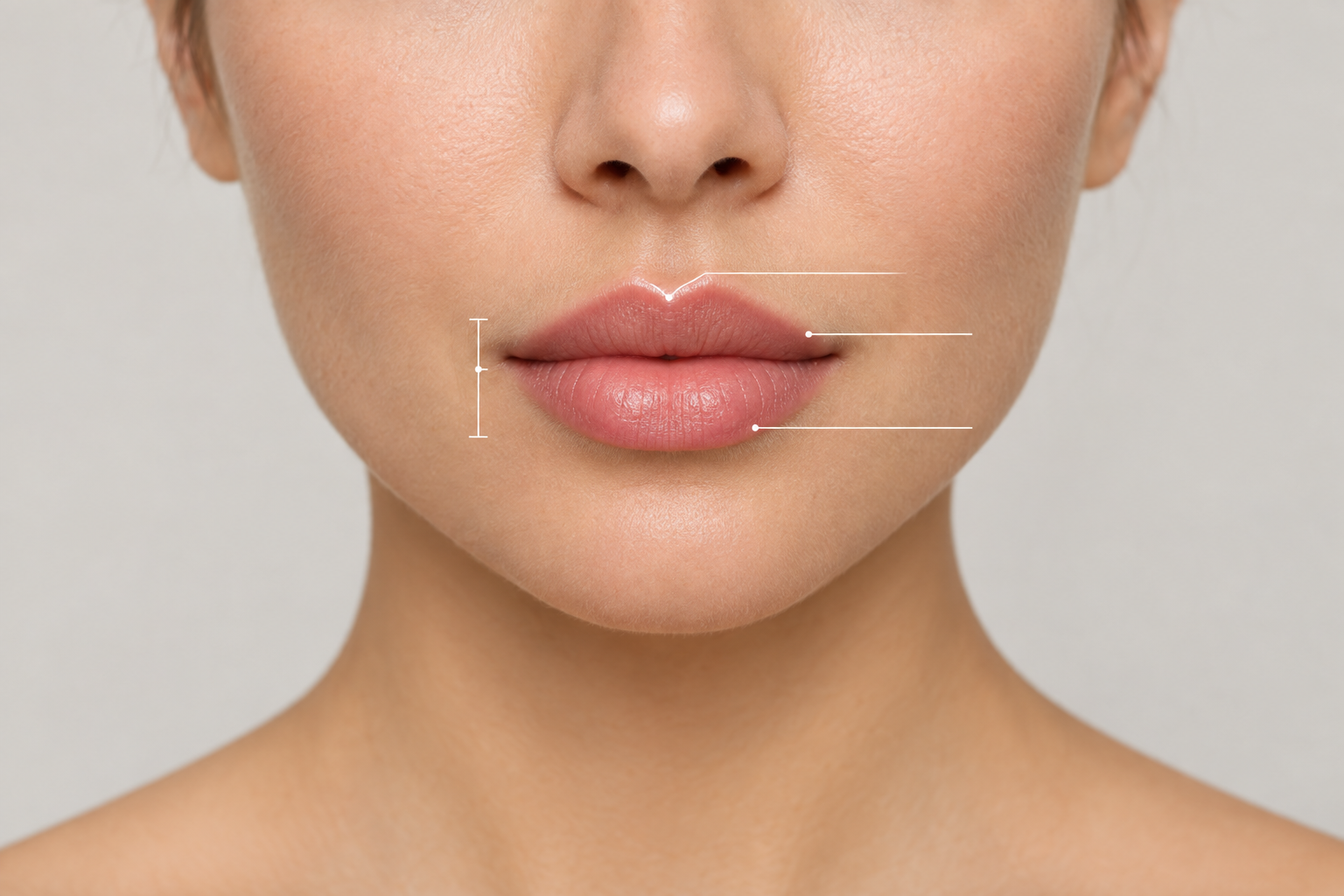

Lip filler has a reputation problem — not because the treatment itself is flawed, but because overfilled, disproportionate results have dominated public perception for years. The reality is that hyaluronic acid lip filler, when chosen carefully and applied with skill, can enhance lip shape, restore lost volume, and improve facial harmony without looking obviously done. This guide explains what natural-looking lip filler actually involves, which products and techniques are most likely to produce subtle results, and what you should know before booking a consultation.
Key Takeaways
- Natural lip filler results depend on product selection, injection technique, and the injector's understanding of your individual lip anatomy — not just the amount of filler used.
- Hyaluronic acid fillers are the most widely used option for lip augmentation because they are temporary, adjustable, and reversible with hyaluronidase if needed.
- A conservative, staged approach — starting with less product and building gradually — is generally more likely to produce proportionate, balanced results than treating the lips aggressively in a single session.
- Swelling after treatment can be significant in the first 48–72 hours; final results typically settle over 10–14 days, so early judgements about the outcome are unreliable.
- Choosing an experienced injector with a portfolio of subtle lip filler before and after results is one of the most important factors in achieving a natural outcome.
What Does "Natural-Looking" Lip Filler Actually Mean?
The phrase "natural-looking" is used frequently in aesthetic medicine, but it means something specific in the context of lip augmentation. A natural result is one where the lips appear enhanced but not obviously treated — where volume, shape, and movement remain consistent with the patient's overall facial proportions. The goal is often described as a "you but better" outcome: lips that look like a healthier, more defined version of your own rather than a different set of lips entirely.
Achieving this requires attention to several factors simultaneously. The upper and lower lip should remain in reasonable proportion — a commonly referenced guideline suggests the upper lip should be roughly 75–80% of the lower lip's volume, though this varies with individual anatomy and ethnic background. Blurring the cupid's bow, overfilling the upper lip relative to the lower, or adding volume without preserving the natural contour of the vermillion border are among the most common reasons results look artificial. Natural lip movement when speaking and smiling is also important; a filler that is too thick or placed incorrectly can restrict movement and create an unnatural appearance at rest and in motion.
Importantly, "natural" does not mean minimal. For patients experiencing age-related volume loss, restoring the lips to their previous fullness may require a meaningful amount of product — but the result can still look entirely appropriate because it is proportionate to the face and consistent with the patient's history. The distinction is between enhancement that fits the face and enhancement that overwhelms it.
Why Do Some Lip Fillers Look Overdone?
Understanding why lip filler results sometimes look unnatural helps clarify what a skilled approach avoids. Overfilling is the most obvious cause — adding more product than the lip tissue can accommodate without distorting the shape. This is particularly common when patients request repeated top-ups without allowing previous filler to fully integrate or degrade, leading to gradual accumulation that distorts the lip border and flattens the cupid's bow.
Product selection also matters. Fillers with a very high viscosity or stiffness — products designed for deeper facial structures — can create an unnaturally firm, immobile appearance when used in the lips. The lips are a highly dynamic area, and the filler needs to move with them. Using a product that is too dense for the delicate lip tissue is a technical error that contributes to the "duck lips" appearance many patients want to avoid.
Technique errors compound these issues. Placing too much volume in the body of the upper lip without supporting the vermillion border, ignoring the oral commissures, or failing to address asymmetry can all produce results that look disproportionate. Poor placement can also cause filler to migrate slightly over time, blurring the lip border and creating a puffy, undefined appearance. Finally, ignoring the relationship between the lips and the surrounding face — the nose, chin, and overall facial structure — means that even technically competent lip work can look out of place.
Which Fillers Are Best for Natural Results?
Most practitioners use hyaluronic acid lip filler for lip augmentation because hyaluronic acid is a naturally occurring substance in the body, the results are temporary, and the treatment is reversible with hyaluronidase if the outcome is unsatisfactory or complications arise. Within the HA filler category, products vary considerably in their gel consistency, cross-linking technology, and particle size — all of which affect how the filler behaves in the lips.
| Filler | Technology | Consistency | Best For | Approximate Duration |
|---|---|---|---|---|
| Juvéderm Volbella XC | Vycross | Soft, low viscosity | Subtle volume, fine lip lines, delicate definition | Up to 12–18 months |
| Juvéderm Ultra XC | Hylacross | Medium | Moderate volume, lip body augmentation | Approximately 12 months |
| Restylane Kysse | XpresHAn Technology | Flexible, dynamic | Natural movement, volume, colour enhancement | Approximately 6–12 months |
| Restylane Silk | NASHA | Fine, smooth | Subtle definition, perioral lines, thin lips | Approximately 6 months |
| RHA 2 | Preserved HA network | Soft, resilient | Dynamic areas, natural movement, subtle volume | Approximately 12–15 months |
Restylane Kysse is frequently cited by practitioners for its ability to maintain natural lip movement, owing to its flexible gel structure. Juvéderm Volbella XC is often preferred for patients seeking very subtle volume or improvement in fine vertical lip lines rather than significant augmentation. RHA 2, part of the Resilient Hyaluronic Acid range, is designed to behave more like the body's own hyaluronic acid in dynamic areas, which may support natural movement in the lips. The right product for any individual depends on their lip anatomy, the degree of enhancement they want, and the injector's clinical assessment — there is no single universally superior option.
Collagen stimulators such as poly-L-lactic acid (Sculptra) are occasionally discussed in the context of lip rejuvenation, but these are not standard first-line options for lip augmentation and require careful patient selection. They are not reversible in the same way as HA fillers.
Injection Techniques That Support a Natural Outcome
The technique used to place filler is at least as important as the product chosen. Several approaches are used in clinical practice, and experienced injectors often combine methods depending on the patient's anatomy and goals.
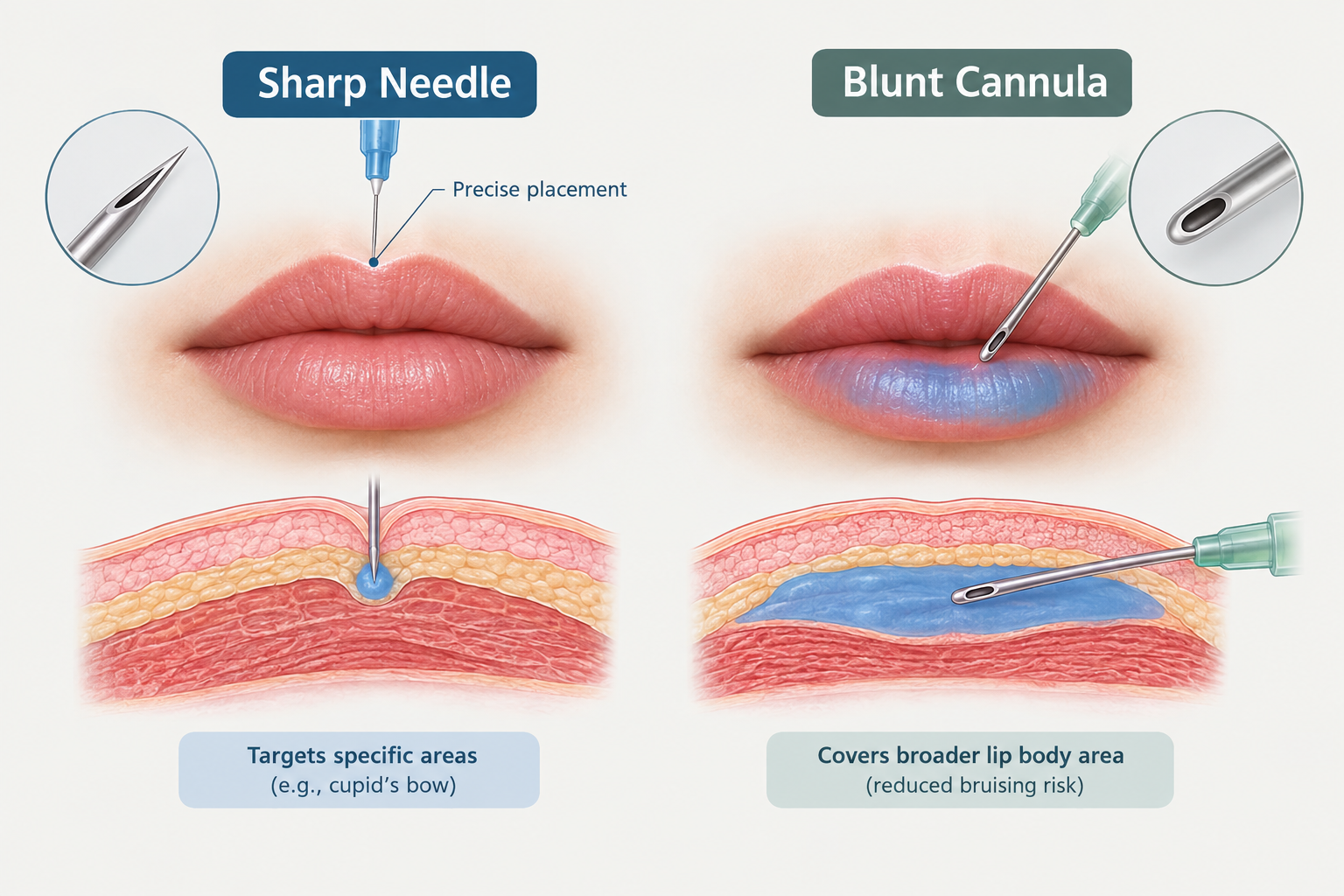
The retrograde linear threading technique involves inserting a fine needle or cannula and depositing filler in a continuous thread as the instrument is withdrawn. This distributes product evenly along the lip border or body and tends to produce smooth, consistent results. The microdroplet method places small, precise deposits of filler at specific points — useful for defining the cupid's bow or adding targeted volume to the lip tubercles without flooding the surrounding tissue. A cannula technique, using a blunt-tipped flexible instrument rather than a sharp needle, may reduce bruising and allow the injector to work across larger areas with fewer entry points, though it requires specific training and is not universally preferred.
Multi-vector approaches — treating the lip from multiple angles and addressing the vermillion border, lip body, and oral commissures as distinct zones — tend to produce more three-dimensional, natural-looking results than single-point injection. Staged or layered sessions, where a conservative amount of filler is placed initially and the patient returns for a review before any additional product is added, are widely considered best practice for patients new to lip augmentation. This approach reduces the risk of overfilling and allows both patient and practitioner to assess the result once swelling has resolved.
Needle versus cannula is a practical question worth understanding. A sharp needle allows precise placement at specific anatomical points and is often preferred for detailed work such as defining the cupid's bow. A blunt cannula is less likely to puncture a blood vessel and may cause less bruising, but requires more experience to control accurately. Many practitioners use both within the same treatment session depending on the area being addressed.
Lip Filler for Different Lip Types and Ages
A natural result looks different depending on the patient's starting point. Thin lips with little natural definition benefit most from careful border enhancement and modest volume addition — aggressive augmentation in thin lips is more likely to look disproportionate. Asymmetrical lips may require different volumes on each side, which demands careful pre-treatment assessment and a practitioner comfortable with corrective work rather than simply adding equal product to both sides.
Aging lips present a distinct clinical picture. With age, the lips lose volume, the vermillion border becomes less defined, vertical lip lines develop, and the corners of the mouth may turn downward. In this context, lip filler is often used for restoration rather than beautification — returning the lips closer to their previous appearance rather than creating a new shape. This distinction matters because the treatment goals, product choices, and amounts used may differ significantly from those appropriate for a younger patient seeking augmentation. A practitioner who understands this difference is more likely to produce a result that looks natural for the patient's age and facial structure.
Patients from different ethnic backgrounds also have naturally different lip shapes, proportions, and aesthetic ideals. A practitioner who applies a single template to all patients regardless of anatomy is more likely to produce results that look incongruous. The upper-to-lower lip ratio guideline is a useful starting point, but individual anatomy should always take precedence over generic proportional rules.
What to Expect During and After Treatment
A lip filler appointment typically begins with a consultation to discuss goals, review medical history, and assess lip anatomy. Topical numbing cream is usually applied to the lips for 15–30 minutes before treatment to reduce discomfort. Many HA fillers also contain lidocaine, a local anaesthetic, within the gel itself, which further reduces sensation during injection. The injection process itself generally takes 15–30 minutes depending on the technique and areas treated.
Swelling is the most predictable immediate side effect and can be significant in the first 24–72 hours. The lips are highly vascular and respond to injection with noticeable swelling that can make the result appear larger and less defined than the final outcome will be. Bruising is also common, particularly around the vermillion border and injection entry points. Both swelling and bruising typically resolve within 7–14 days.
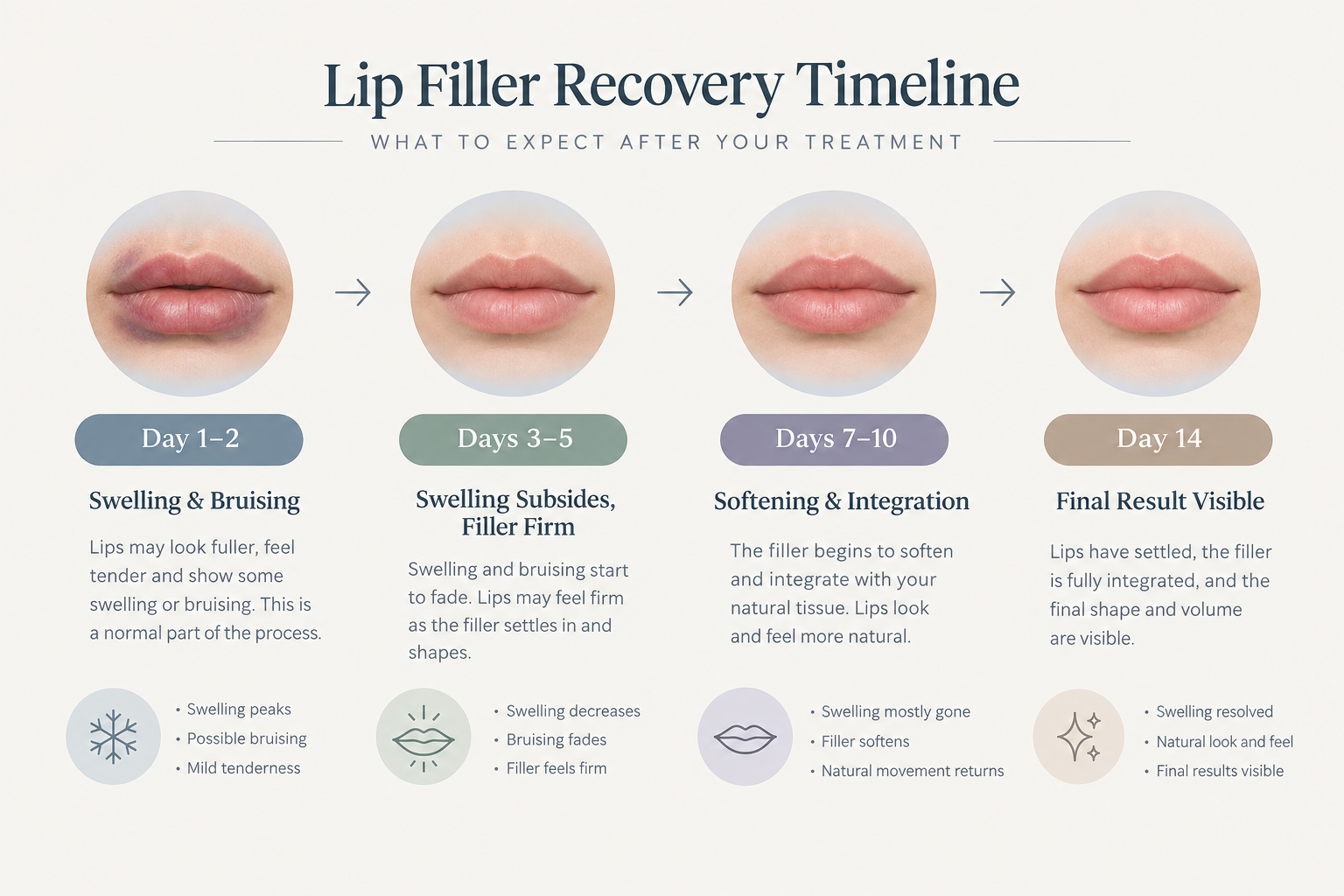
The two-week rule is a practical guideline: most practitioners advise waiting at least 14 days before assessing the final result or considering any touch-up. In the first few days, swelling can make the lips look overfilled; by days 3–5, some of that swelling subsides but the filler may still feel firm; by days 7–10, the product begins to integrate with the surrounding tissue and soften; and by day 14, the result is generally representative of what the filler will look like long-term. Judging the outcome before this point — or requesting additional product before swelling has fully resolved — is one of the most common reasons patients end up with more filler than they intended.
Standard aftercare advice includes avoiding strenuous exercise, alcohol, and significant heat exposure (such as saunas or steam rooms) for 24–48 hours after treatment. Patients are generally advised not to massage the lips unless specifically instructed to do so, as this can displace filler before it has integrated. Sleeping with the head slightly elevated on the first night may help reduce swelling.
How Long Do Results Last and What Does It Cost?
Hyaluronic acid lip filler is temporary. Most HA lip fillers last approximately 6–12 months, though this varies with the specific product, the amount used, the patient's metabolism, and lifestyle factors. Softer, lower-viscosity products such as Volbella or RHA 2 may last toward the longer end of this range in some patients. The lips are a dynamic area with significant movement, which tends to accelerate filler breakdown compared with less mobile facial areas.
Touch-up appointments every 6–9 months are typical for patients who want to maintain their results. A maintenance strategy matters: repeatedly adding full syringes of filler at each appointment without allowing previous product to fully degrade can lead to gradual accumulation, migration, and a loss of the natural definition that made the original result appealing. Some practitioners recommend a conservative top-up approach — adding a smaller amount at maintenance appointments rather than a full syringe — to avoid this pattern over time.
Lip filler cost per syringe in the UK typically ranges from approximately £250 to £600 depending on the product, the clinic, and the practitioner's experience level. In the United States, the range is broadly $500–$1,000 per syringe. Most lip augmentation treatments use between 0.5 ml and 1 ml of product, though this varies with the patient's goals and anatomy. Unusually low prices can be a warning sign of diluted product, unqualified practitioners, or counterfeit filler — factors that carry meaningful safety risks.
Reversibility and Safety Considerations
One of the most clinically significant advantages of hyaluronic acid lip filler is that it is reversible with hyaluronidase, an enzyme that breaks down hyaluronic acid. If a patient is unhappy with their result, experiences an adverse reaction, or develops a complication such as vascular occlusion, hyaluronidase can be injected to dissolve the filler. This reversibility is a meaningful safety feature that distinguishes HA fillers from permanent or semi-permanent alternatives.
Hyaluronidase treatment is not entirely without risk — allergic reactions are possible, and patients with a known allergy to bee venom may have a higher risk of reaction to hyaluronidase. Dissolution may also require more than one treatment session to fully resolve the filler, and the result after dissolving is not always identical to the pre-treatment appearance. These factors are worth discussing with a practitioner before treatment, particularly for patients who are uncertain about the outcome they want.
Vascular occlusion — where filler inadvertently enters or compresses a blood vessel — is a rare but serious complication that requires immediate treatment. Choosing a practitioner with appropriate training in recognising and managing this complication is an important safety consideration, not just an aesthetic one. Infection, prolonged swelling, nodule formation, and filler migration are less serious but more common adverse events that should be discussed during the pre-treatment consultation.
Alternatives to Lip Filler
| Option | Mechanism | Natural Look Suitability | Duration | Reversible? |
|---|---|---|---|---|
| HA Lip Filler | Volume addition via HA gel | High (with skilled injector) | 6–18 months | Yes (hyaluronidase) |
| Lip Flip (Botulinum Toxin) | Relaxes orbicularis oris to evert upper lip | High for subtle upper lip enhancement | 6–10 weeks | Yes (wears off) |
| Topical Plumping Serums | Temporary irritant-based swelling or hydration | Moderate (very subtle, temporary) | Hours | N/A |
| Fat Transfer | Autologous fat injected into lips | Variable — can look natural | Potentially long-term | No |
| Laser Lip Rejuvenation | Skin resurfacing around the mouth | High for perioral lines, not volume | Variable | N/A |
The lip flip is a useful option for patients who want subtle upper lip eversion without adding volume — it involves a small amount of botulinum toxin injected into the muscle around the upper lip, causing it to roll slightly outward. It does not add volume and is not a substitute for filler in patients with significant volume loss, but it can complement filler or serve as a lower-commitment starting point. Its effects last only 6–10 weeks, making it a short-term option.
How to Choose the Right Injector
The injector's skill, aesthetic judgement, and understanding of lip anatomy are the single most important factors in achieving a natural result. A technically competent practitioner using an appropriate product and conservative amounts is far more likely to produce a subtle, proportionate outcome than an inexperienced one using the same materials.
When reviewing a practitioner's portfolio, look for before and after photos that show a range of lip types and ages, not just one aesthetic template. Natural results should preserve the patient's individual lip shape while improving definition or volume — if every patient in the portfolio looks identical, that may indicate a formulaic approach rather than individualised treatment. Be cautious of portfolios that show only heavily filtered or heavily edited images, or that lack photos taken at rest and in motion.
Red flags worth noting include practitioners who suggest a full syringe or more for a first treatment without discussing a staged approach, those who cannot explain which product they plan to use and why, and those who do not conduct a thorough consultation before treatment. A practitioner who dismisses your preference for a conservative result or who pressures you toward more product than you requested is not demonstrating good clinical judgement.
Questions worth asking at your consultation include: How much product do you recommend for a first session? Which filler do you plan to use and why? What does your approach look like if I want to add more at a later date? What is your protocol if I experience a complication? What does your before and after portfolio show for patients with a similar starting point to mine?
Frequently Asked Questions
Can lip filler genuinely look natural?
Yes — when the right product is chosen, the amount is appropriate for the patient's anatomy, and the injector has the skill to place it accurately. Natural-looking lip filler results are achievable for most patients, but they depend heavily on the practitioner's technique and aesthetic judgement rather than the treatment category alone.
How much filler is needed for a subtle result?
Many practitioners recommend starting with 0.5 ml for a first treatment, particularly for patients with naturally fuller lips or those seeking only minor definition. A full 1 ml syringe may be appropriate for patients with thinner lips or more significant volume loss, but the right amount depends on individual anatomy and should be assessed in person. A staged approach — starting conservatively and reviewing the result after two weeks — is generally considered best practice.
Does lip filler affect natural lip movement?
A well-chosen, appropriately placed filler should not significantly restrict natural lip movement. Flexible products such as Restylane Kysse and RHA 2 are specifically designed to move with dynamic facial areas. Overfilling or using a product that is too dense for the lips can create stiffness, which is one reason product selection and conservative dosing matter.
Is lip filler painful?
Most patients describe the procedure as uncomfortable rather than significantly painful. Topical numbing cream applied before treatment reduces sensation, and most modern HA lip fillers contain lidocaine within the gel, which further reduces discomfort during injection. Individual pain tolerance varies, and the lips are a sensitive area, so some patients find the experience more uncomfortable than others.
What happens if I don't like the result?
Hyaluronic acid lip filler is reversible with hyaluronidase, an enzyme that dissolves HA. If you are unhappy with the result after swelling has fully resolved, a practitioner can inject hyaluronidase to reduce or remove the filler. This process may require more than one session and carries a small risk of allergic reaction, but it is a meaningful safety option that distinguishes HA fillers from permanent alternatives.
How soon can I see the final result?
Swelling after lip filler can be significant for the first 48–72 hours and may make the lips appear larger than the final result will be. Most practitioners advise waiting the full 14 days before assessing the outcome, as the filler continues to integrate and soften during this period. Requesting additional product before this point risks overfilling.
Are there people for whom lip filler is not suitable?
Lip filler is not appropriate during pregnancy or breastfeeding, in the presence of active infection or cold sores in the treatment area, or for patients with certain autoimmune conditions or clotting disorders. Patients taking blood-thinning medications may have a higher risk of bruising. A thorough medical history review at consultation is essential to identify any contraindications relevant to the individual patient.
Making an Informed Decision About Lip Filler
Natural-looking lip filler is not a matter of luck — it is the result of appropriate product selection, conservative dosing, skilled technique, and a practitioner who understands your individual anatomy and aesthetic goals. The treatment has a strong safety profile when performed by a qualified injector using FDA-approved or CE-marked hyaluronic acid products, and its reversibility with hyaluronidase provides a meaningful safety net that permanent alternatives cannot offer.
The most important steps before treatment are choosing a practitioner whose portfolio demonstrates consistently subtle, proportionate results, having an honest consultation about your goals and realistic expectations, and committing to a staged approach if you are new to lip augmentation. Swelling in the first two weeks can be misleading — patience before requesting additional product is one of the simplest ways to avoid an overdone result.
If you are considering subtle lip enhancement, a consultation with a qualified aesthetic practitioner — ideally a board-certified dermatologist, plastic surgeon, or trained aesthetic physician — is the appropriate starting point. They can assess your lip anatomy, discuss which product and technique may suit your goals, and help you understand what a realistic outcome looks like for your individual face.
