
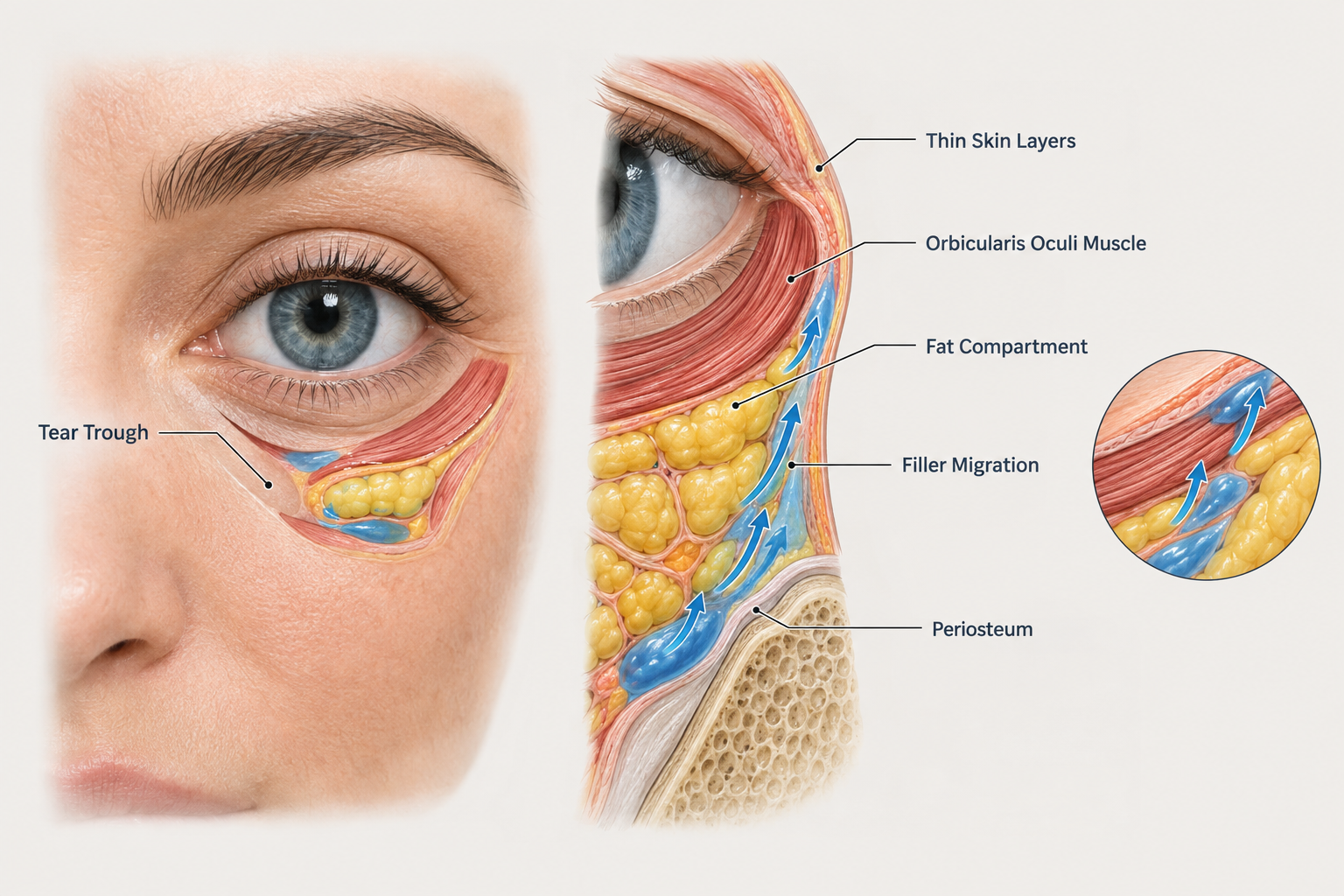

Tear trough filler migration is one of the most commonly discussed complications in under-eye filler treatment. When hyaluronic acid filler shifts from its intended placement, it can create visible lumps, persistent swelling, or a bluish discoloration beneath the eyes — sometimes months or even years after the original treatment. Understanding why this happens, how to recognise it, and what can be done about it is important for anyone considering or already having had filler in this delicate area.
Key Takeaways
- Tear trough filler migration occurs when hyaluronic acid filler moves away from its original injection site, most often into the surrounding soft tissue of the lower eyelid or cheek.
- The under-eye area is particularly prone to migration because of its thin skin, complex anatomy, and the constant movement of the orbicularis oculi muscle.
- Common signs include persistent puffiness, visible lumps or ridges, and a bluish tint known as the Tyndall effect.
- Migrated filler can often be dissolved with hyaluronidase, an enzyme that breaks down hyaluronic acid.
- Choosing an experienced, medically qualified injector and an appropriate filler product significantly reduces the risk of migration.
What Is Tear Trough Filler Migration?
The tear trough is the hollow groove that runs from the inner corner of the eye toward the cheek. Volume loss in this area can create a tired or sunken appearance, and hyaluronic acid filler is commonly used to soften this depression. Migration refers to the movement of that filler away from where it was originally placed. Rather than staying neatly within the tear trough groove, the filler spreads into adjacent tissue — most often the preseptal fat compartment of the lower eyelid, the superficial dermis, or the upper cheek.
Migration is distinct from simple swelling, which is a normal short-term response to injection. True migration involves the physical displacement of filler material and tends to persist or worsen over time rather than resolving within the first few weeks. It can occur shortly after treatment or develop gradually over months as the filler absorbs water and expands in volume.
Why the Under-Eye Area Is Especially Vulnerable
The periorbital region — the area surrounding the eye — has several anatomical features that make it more susceptible to filler migration than most other treatment areas. The skin beneath the eye is among the thinnest on the face, often measuring less than one millimetre in depth. This means there is very little tissue to contain an injected product, and any displacement becomes visible quickly.
Beneath this thin skin lies the orbicularis oculi muscle, which contracts repeatedly throughout the day with every blink, squint, and facial expression. This constant mechanical movement can gradually push filler away from its original position. The lower eyelid also contains fat compartments separated by thin fibrous septa, and filler can migrate between these compartments if it is placed too superficially or in excessive volume.
The lymphatic drainage in the periorbital area is relatively limited compared to other facial regions, which means that filler — particularly hydrophilic hyaluronic acid that attracts water — can accumulate and expand rather than dispersing evenly. This combination of thin skin, muscular movement, limited lymphatic drainage, and complex fat compartment anatomy makes the tear trough one of the most technically demanding areas to treat with filler.
Common Causes of Filler Migration Under the Eyes
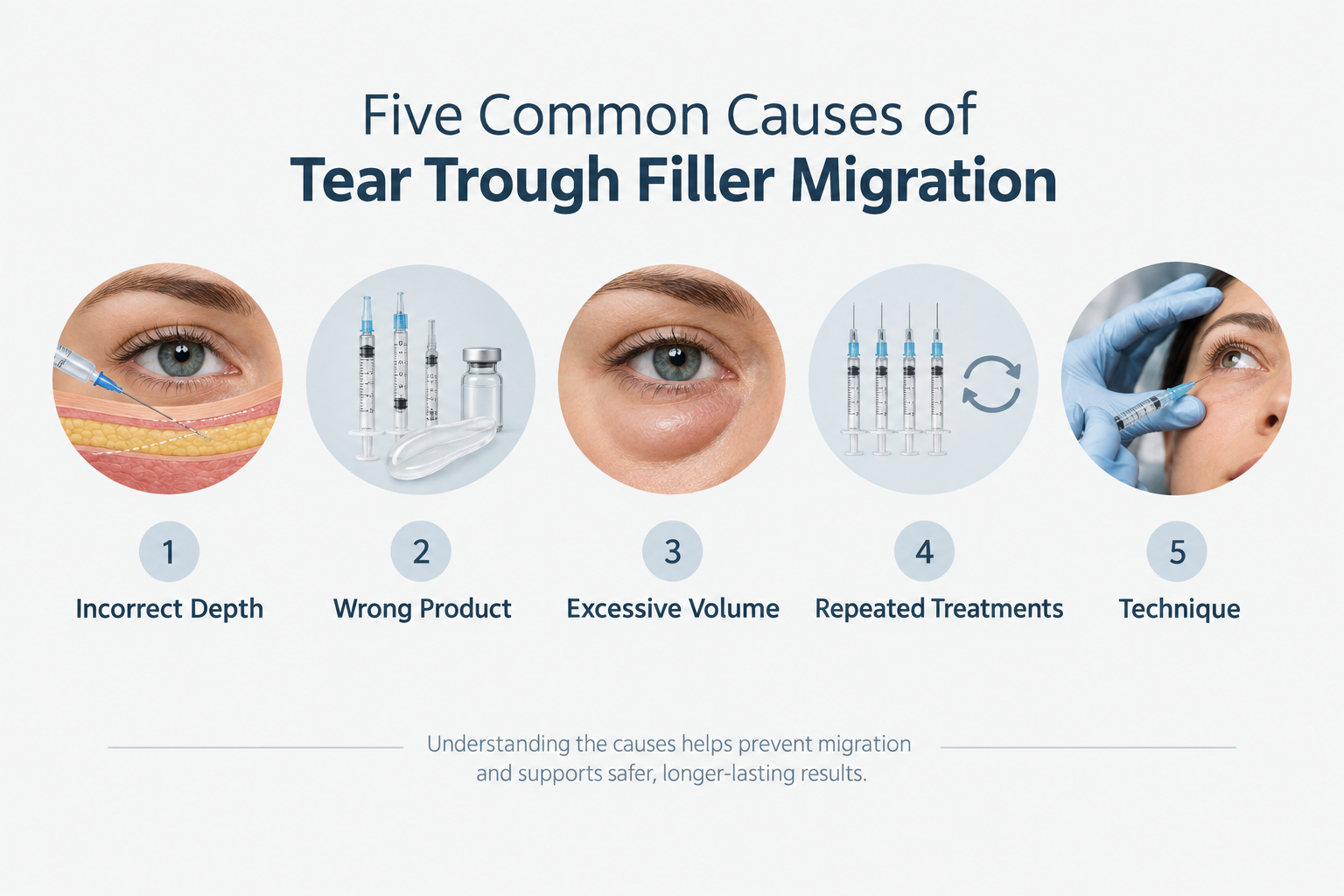
Several factors contribute to tear trough filler migration, and in most cases more than one is involved.
Incorrect Injection Depth
Tear trough filler is generally intended to be placed deep, on or just above the periosteum — the fibrous layer covering the bone — where it is better contained and less visible through the overlying skin. When filler is injected too superficially, into the dermis or just beneath it, it sits in a layer where it is more likely to spread laterally and become visible as a lump or ridge. Superficial placement also increases the risk of the Tyndall effect, a bluish discoloration caused by light scattering through filler that is too close to the skin surface.
Inappropriate Filler Product Selection
Not all hyaluronic acid fillers behave the same way. Fillers vary in their rheological properties — characteristics such as cohesivity, elasticity, and viscosity that determine how a product behaves once injected. Softer, more hydrophilic fillers with a high capacity to absorb water may be appropriate for some areas but can cause significant swelling and migration when used in the tear trough. Thicker, more cohesive fillers with lower water-absorption capacity are generally considered more suitable for this area, as they are less likely to spread or expand unpredictably. Using a product that is too soft or too hydrophilic for the periorbital region is a recognised contributor to migration and chronic puffiness under the eyes.
Excessive Filler Volume
The tear trough is a small anatomical space with limited capacity. Placing more filler than the tissue can comfortably accommodate increases the pressure within that space and encourages the product to spread into adjacent areas. Overfilling is a common cause of migration and is also associated with a worsening of under-eye puffiness over time, as the excess filler attracts additional fluid. Experienced practitioners typically use conservative volumes in this area and may prefer to build results gradually across more than one session rather than attempting significant correction in a single treatment.
Repeated Treatments Without Dissolving Previous Filler
Each time filler is added to an area that already contains residual product, the cumulative volume increases. Over successive treatments, this can lead to a gradual accumulation of filler that extends beyond the original treatment zone. Patients who have had multiple rounds of tear trough filler without dissolving previous product between sessions are at higher risk of developing migration-related changes over time. This is sometimes described as filler build-up and can result in a persistently puffy or heavy appearance beneath the eyes that does not resolve between treatments.
Practitioner Experience and Technique
The tear trough is widely regarded as one of the most technically challenging areas for filler injection. Precise knowledge of the local anatomy, appropriate product selection, careful depth control, and conservative volume management are all essential. Practitioners with limited experience in periorbital anatomy or those who do not regularly treat this area may be more likely to place filler incorrectly, increasing the risk of migration and other complications. The choice of needle versus cannula technique also influences outcomes, though both approaches carry their own considerations and neither eliminates the risk of migration entirely.
Recognising the Signs of Migrated Tear Trough Filler
Identifying migrated filler can sometimes be straightforward, but in other cases it requires clinical assessment by an experienced practitioner. The most common signs include persistent puffiness or swelling beneath the eye that does not fluctuate with hydration, sleep, or time of day in the way that normal under-eye fluid retention does. This puffiness may feel firm or gel-like to the touch rather than soft.
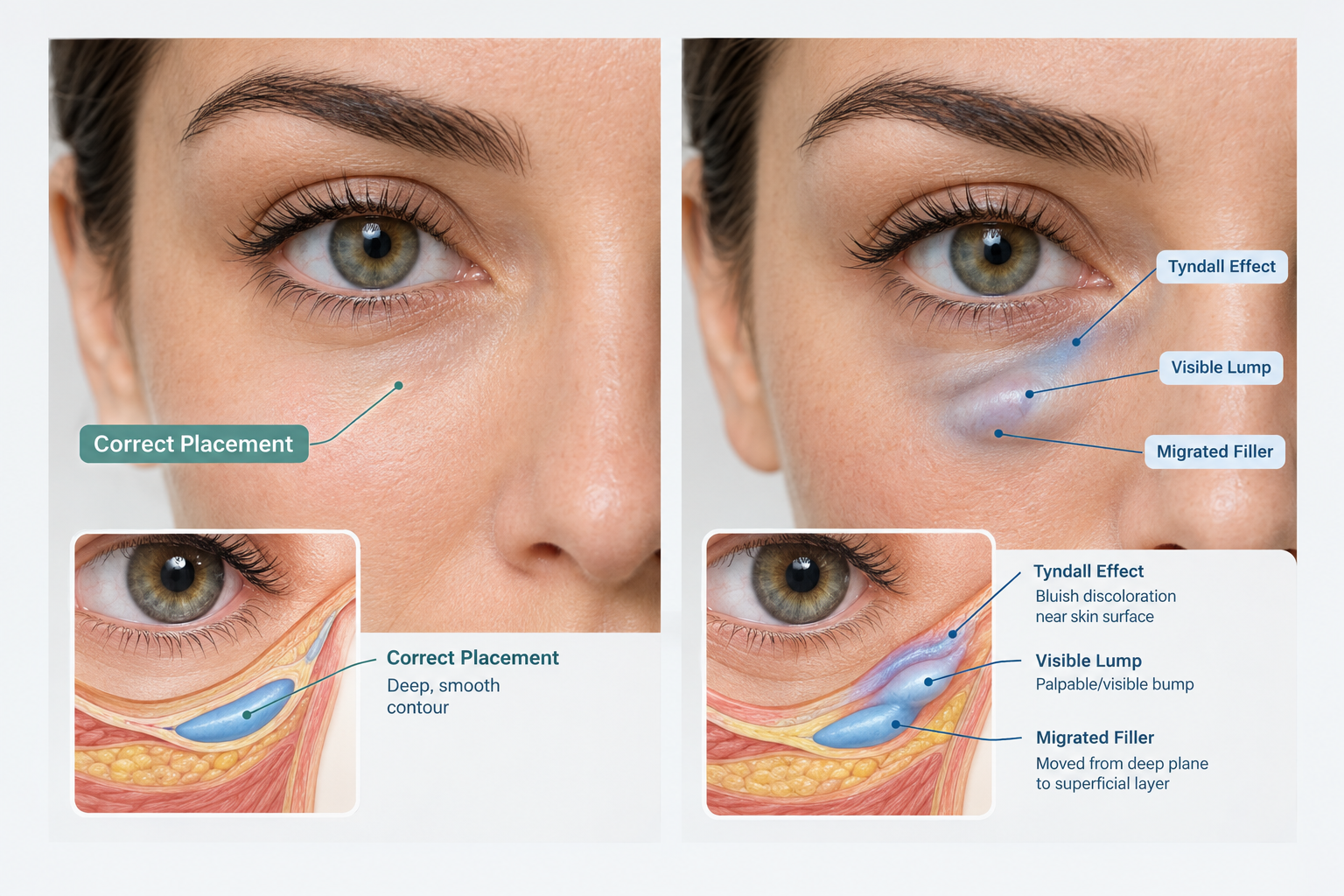
Visible lumps, ridges, or an uneven contour along the lower eyelid or upper cheek are also characteristic of migration. The Tyndall effect — a bluish or greyish discoloration visible through the skin — suggests that filler has moved into a superficial tissue plane where it interacts with light differently. This is distinct from the vascular dark circles caused by visible blood vessels, though the two can sometimes coexist and may be difficult to distinguish without clinical examination.
Some patients notice that their under-eye area looks worse than before treatment, or that an initial improvement has gradually reversed and been replaced by puffiness or heaviness. These changes may develop weeks, months, or occasionally years after the original injection, particularly if the filler has been absorbing water progressively over time.
How Migrated Filler Is Treated
The primary treatment for migrated hyaluronic acid tear trough filler is hyaluronidase, an enzyme that breaks down hyaluronic acid. When injected into or near the area of migrated filler, hyaluronidase dissolves the product relatively quickly — often within 24 to 48 hours, though the full result may take a week or two to assess. The procedure is generally straightforward but requires careful placement by a practitioner who understands the local anatomy, as hyaluronidase can also affect naturally occurring hyaluronic acid in the surrounding tissue.
Multiple hyaluronidase sessions may be needed if the filler is extensive, has been present for a long time, or has spread across a wide area. Some patients experience temporary swelling or bruising after dissolution treatment. In most cases, the under-eye area returns to its pre-filler baseline once the migrated product has been fully dissolved, though this can take several weeks to assess accurately.
After successful dissolution, patients who still wish to address the tear trough can consider retreatment with filler, ideally with a more appropriate product, conservative volume, and careful technique. Alternatively, they may wish to explore other approaches to under-eye concerns.
Alternatives to Tear Trough Filler
For patients who have experienced migration or who are concerned about the risks associated with tear trough filler, several alternative approaches may be worth discussing with a qualified practitioner.
Polynucleotides — also known as PDRN or PN injections — are a biostimulatory treatment derived from purified DNA fragments. When injected into the periorbital area, polynucleotides are thought to stimulate collagen production and improve skin quality rather than adding volume directly. Because they do not involve placing a volumising gel beneath the skin, the risk of migration is different from that associated with hyaluronic acid filler. Polynucleotide treatments for under-eye concerns are gaining interest, though the evidence base is still developing and results vary between individuals.
Skin booster injections, which use highly diluted hyaluronic acid to improve skin hydration and texture rather than add structural volume, may be appropriate for patients whose primary concern is skin quality rather than hollowness. These products behave differently from volumising fillers and carry a lower risk of the migration patterns described above.
For patients with significant volume loss or structural changes beneath the eye, a consultation with an oculoplastic surgeon or facial plastic surgeon may be appropriate. Surgical options such as lower blepharoplasty address the underlying anatomy more directly and may provide longer-lasting results in selected patients, though they carry their own risks and recovery considerations.
Addressing lifestyle factors such as sleep quality, hydration, and sun protection can also make a meaningful difference to the appearance of the under-eye area, particularly where dark circles are related to skin thinning, pigmentation, or vascular visibility rather than volume loss.
Reducing the Risk of Migration Before Treatment
Patients considering tear trough filler can take several practical steps to reduce the likelihood of migration. Choosing a medically qualified and experienced injector who regularly treats the periorbital area is the single most important factor. It is reasonable to ask about the practitioner’s training, their experience with tear trough treatments specifically, and which filler product they intend to use and why.
Requesting a conservative approach — starting with a small volume and assessing the result before adding more — is a sensible strategy in an area where overfilling is a recognised risk. Patients should also be aware that the tear trough may not always be the most appropriate treatment for their specific concern. Under-eye hollowness, dark circles, puffiness, and fine lines each have different underlying causes, and filler is not the optimal solution for every presentation. A thorough consultation that considers the individual anatomy and the nature of the concern is essential before proceeding.
Disclosing previous filler treatments in the area is important, as a practitioner who is unaware of existing product may inadvertently add to a cumulative volume that is already at or beyond the tissue’s capacity.
Frequently Asked Questions
How long after tear trough filler can migration occur?
Migration can occur at any point after treatment. Some displacement happens in the days immediately following injection, while other cases develop gradually over months as the filler absorbs water and expands. Patients who have had repeated treatments without dissolving previous product may notice cumulative changes over years.
Can migrated tear trough filler resolve on its own?
Hyaluronic acid filler does break down naturally over time, but this process is slow and unpredictable. Migrated filler is unlikely to resolve fully on its own within a clinically acceptable timeframe. Hyaluronidase treatment is the most reliable way to address migration and typically produces results within days to weeks.
Is the Tyndall effect the same as filler migration?
The Tyndall effect — a bluish discoloration beneath the skin — is often a consequence of filler being placed too superficially, which may or may not involve migration from a deeper plane. The two can occur together or independently. Both are assessed and managed by a qualified practitioner, and hyaluronidase is typically effective for both.
Will dissolving migrated filler leave me looking worse than before?
After hyaluronidase treatment, the under-eye area generally returns to its pre-filler baseline, which may include the original hollowness or dark circles that prompted treatment in the first place. Some temporary swelling or bruising may occur after dissolution. Most patients find that resolving migrated filler improves the appearance compared to the migrated state, even if the original concern returns.
Can I have tear trough filler again after migration?
Many patients choose to have the area retreated after successful dissolution of migrated filler. Retreatment should ideally involve a careful review of what contributed to the migration — product choice, volume, technique, or anatomy — so that the same issue does not recur. Some patients decide to explore alternative treatments instead.
Does the type of filler affect migration risk?
Yes. Filler rheology — the physical properties of the product — significantly influences migration risk. Softer, more hydrophilic fillers are generally considered less suitable for the tear trough than firmer, more cohesive products with lower water-absorption capacity. Product selection is an important part of reducing migration risk and should be discussed with the treating practitioner.
Is tear trough filler safe?
Tear trough filler can be performed safely, but it carries a higher risk profile than many other filler treatment areas due to the complex anatomy and proximity to the eye. Risks include migration, the Tyndall effect, prolonged swelling, bruising, vascular complications, and infection. The risk of serious complications, including vascular occlusion, is low but not negligible. Treatment should only be performed by a medically qualified practitioner with appropriate training and access to emergency management protocols.
What to Consider Before Deciding on Tear Trough Filler
Tear trough filler migration is a real and relatively common complication that patients and practitioners should understand before proceeding with under-eye filler treatment. The periorbital area presents unique anatomical challenges — thin skin, constant muscular movement, limited tissue capacity, and complex fat compartment anatomy — that make precise technique, appropriate product selection, and conservative volume management essential rather than optional.
For patients who have already experienced migration, hyaluronidase dissolution offers a reliable path to resolution in most cases. For those considering treatment for the first time, a thorough consultation with a medically qualified and experienced injector is the most important step. This should include an honest discussion of whether filler is the most appropriate approach for the specific concern, what product will be used and why, and what the realistic expectations and limitations of treatment are.
Alternatives such as polynucleotides, skin boosters, or surgical assessment may be worth exploring depending on the individual’s anatomy, concerns, and treatment history. The under-eye area responds well to careful, conservative treatment in suitable candidates — but it is also an area where the consequences of poor technique or inappropriate product choice are particularly visible and can be difficult to manage. Taking time to make an informed decision, and choosing a practitioner with genuine expertise in periorbital anatomy, remains the most effective way to reduce the risk of complications including migration.
