
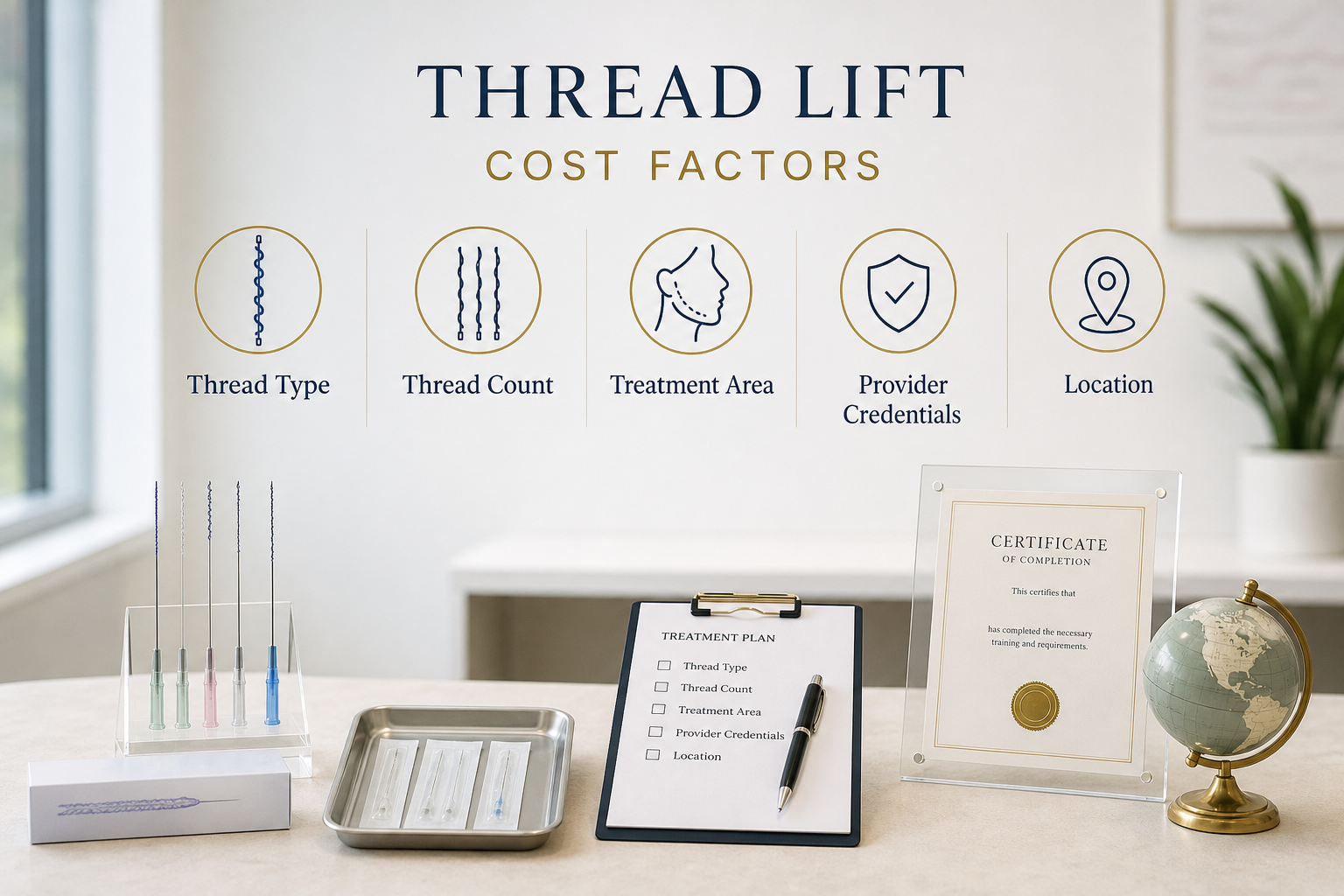

Thread lift pricing varies considerably — from under $1,000 for a single small area at a med spa to $4,500 or more for a full-face treatment performed by a board-certified plastic surgeon in a major city. That range can feel confusing when you’re trying to budget or compare quotes. Understanding the specific factors that drive thread lift cost helps you evaluate what you’re actually being offered, ask the right questions at your consultation, and avoid making a decision based on price alone.
Key Takeaways
- Thread lift cost in the United States typically ranges from approximately $1,000 to $4,500 depending on the treatment area, thread type, thread count, and provider credentials.
- The number of threads placed and the material used — polydioxanone (PDO), poly-L-lactic acid (PLLA), or polycaprolactone (PCL) — are among the most significant cost variables.
- Provider experience, geographic location, and what is included in the quoted price all affect what you pay and the value you receive.
- Thread lifts are elective cosmetic procedures and are not covered by health insurance; financing options are available at many clinics.
- Long-term cost depends on how often maintenance treatments are needed, which varies by thread material and individual response.
What Is a Thread Lift and Why Does Pricing Vary So Much?
A thread lift is a minimally invasive procedure in which absorbable sutures are inserted beneath the skin to mechanically lift sagging tissue and stimulate collagen production over time. Unlike a surgical facelift, it requires only local anesthesia, involves minimal downtime, and produces more subtle results. The procedure is sometimes described as a non-surgical facelift, though that comparison has important limitations — thread lifts work best for mild to moderate skin laxity and cannot replicate the degree of correction achievable with surgery.
Pricing varies so widely because thread lift is not a single standardized procedure. The number of threads placed, the type of thread material, the complexity of the treatment area, and the credentials of the provider all change from patient to patient and clinic to clinic. Two patients receiving a “thread lift” may have had entirely different procedures in terms of technique, material, and scope — which is why flat-rate comparisons between clinics can be misleading without understanding what each quote actually includes.
Thread Type: PDO, PLLA, and PCL Compared
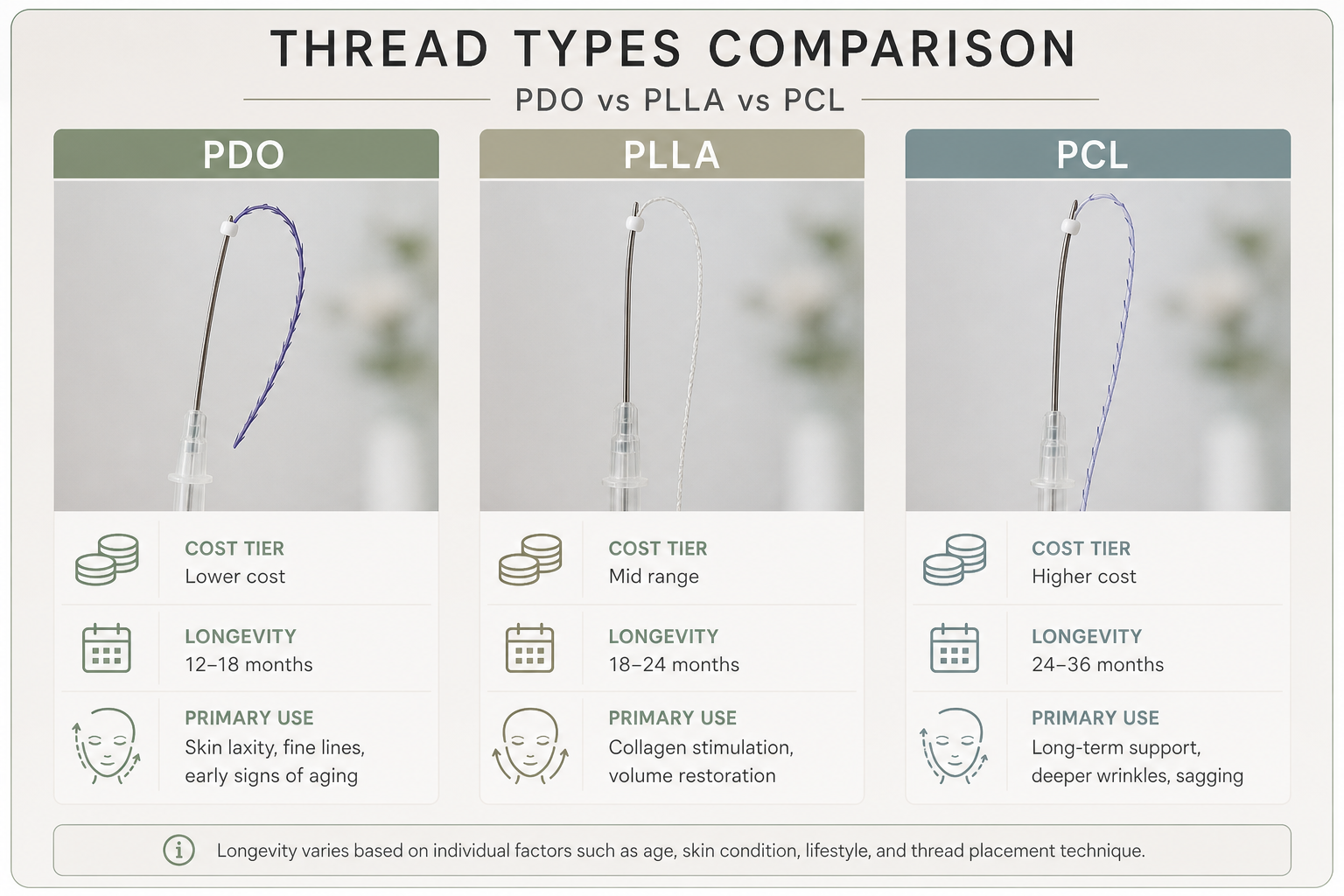
The material used for the threads is one of the most direct cost drivers. Three main types of biodegradable threads are used in aesthetic practice, each with different properties, longevity, and price points.
| Thread Material | Typical Cost Range (per session) | Longevity of Results | Primary Mechanism | Best Suited For |
|---|---|---|---|---|
| PDO (Polydioxanone) | $1,000 – $2,500 | 12–18 months | Mechanical lift + collagen stimulation | Mild to moderate laxity; most treatment areas |
| PLLA (Poly-L-Lactic Acid) | $1,500 – $3,500 | 18–24 months | Stronger collagen stimulation; gradual lift | Moderate laxity; patients prioritising longevity |
| PCL (Polycaprolactone) | $2,000 – $4,500 | 24–36 months | Sustained collagen remodelling; longest absorption | Patients seeking longer intervals between treatments |
Polydioxanone (PDO) threads are the most widely used and generally the most affordable option. They dissolve within six to twelve months but continue to support the skin through collagen stimulation for longer. Poly-L-lactic acid (PLLA) threads, including the Silhouette InstaLift system which has received FDA clearance, tend to cost more and offer a longer duration of effect. Polycaprolactone (PCL) threads are the most durable and typically the most expensive, with results that may persist for two to three years in suitable patients.
Within each material category, thread design also matters. Barbed threads — sometimes called cog threads — have small projections along their length that physically grip and reposition tissue, making them the primary tool for lifting. Smooth threads, or mono threads, lack these barbs and are used mainly to improve skin texture and stimulate collagen rather than to lift. A treatment plan using multiple barbed threads across the midface and jawline will cost considerably more than a session using smooth threads for skin quality improvement alone.
Thread Count: Why the Number of Threads Placed Matters
Thread count — the total number of threads inserted during a session — is one of the clearest determinants of cost, yet it is rarely explained transparently in clinic pricing. Many providers price thread lifts per thread rather than as a flat package, meaning the final cost depends directly on how many threads are required to achieve the desired result.
The number of threads needed depends on the size of the treatment area, the degree of skin laxity, and the provider’s technique. A brow lift may require as few as two to four threads per side, while a full-face treatment addressing the midface, jowls, and neck may involve fifteen to thirty or more threads. Patients with more advanced sagging generally require a higher thread count to achieve a meaningful result, which increases both the cost and the complexity of the procedure.
When comparing quotes from different clinics, it is worth asking for the thread count in writing, along with the thread brand and material. A lower headline price that includes fewer threads may deliver a less noticeable outcome than a higher-priced treatment with a more comprehensive thread plan. Understanding this helps you compare like with like rather than simply choosing the cheapest number.
Treatment Area and Complexity
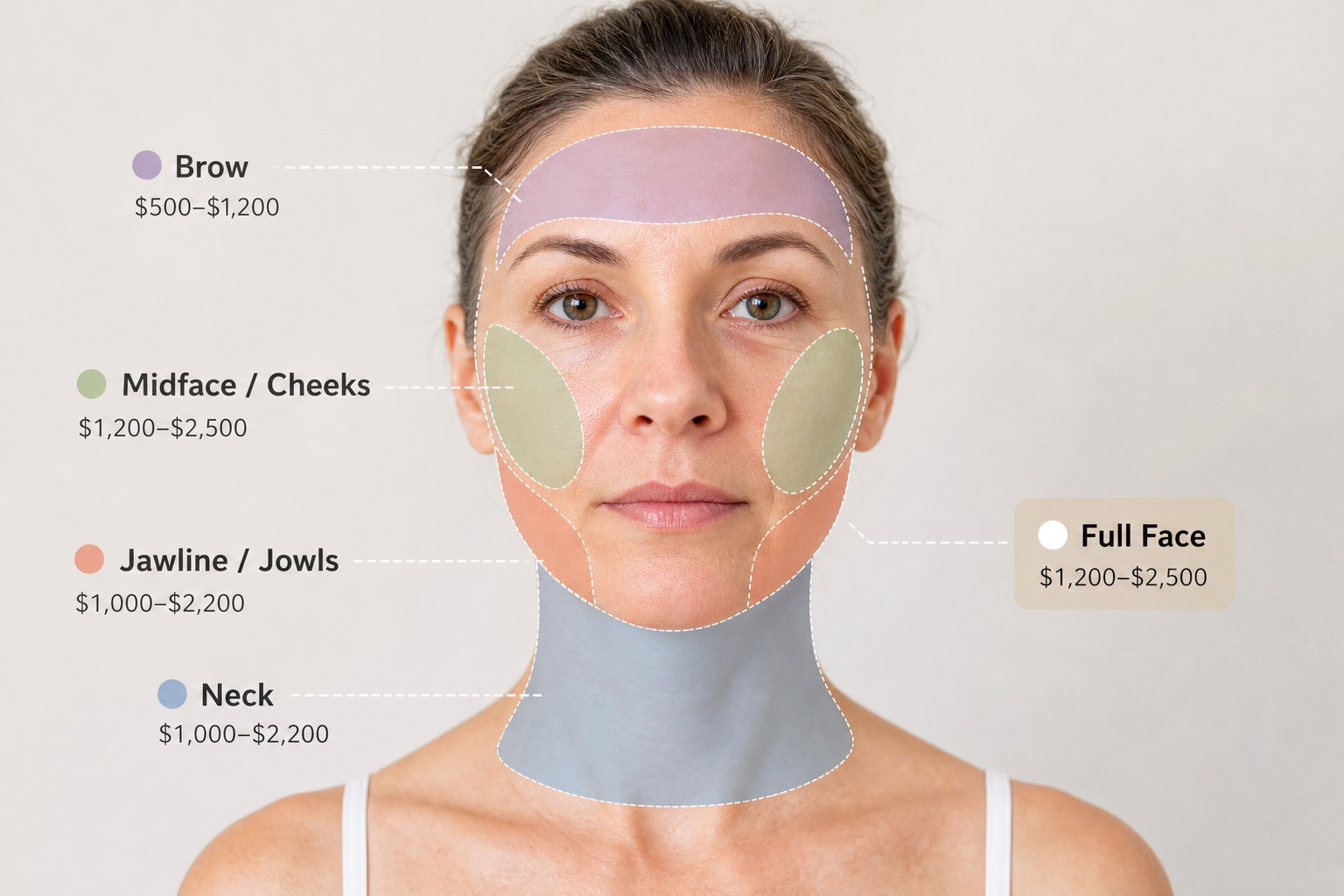
Thread lift cost also varies significantly by treatment area. Larger or more anatomically complex areas require more threads, more time, and greater technical skill, all of which are reflected in the price.
| Treatment Area | Approximate Cost Range (USD) | Typical Thread Count |
|---|---|---|
| Brow lift (per side) | $500 – $1,200 | 2–4 threads per side |
| Midface / cheeks | $1,200 – $2,500 | 4–8 threads |
| Jawline / jowls | $1,000 – $2,200 | 4–8 threads |
| Neck lift | $1,500 – $3,000 | 6–12 threads |
| Full face | $2,500 – $4,500+ | 12–30+ threads |
Treatment area complexity goes beyond size. The neck, for example, involves delicate anatomy and requires careful vector planning — the precise angle and direction in which threads are placed — to achieve a natural result without visible distortion. The midface involves lifting descended facial tissue over the cheekbone, which demands anatomical knowledge and experience. These technical demands justify higher fees for complex areas and are one reason why provider credentials matter so much in thread lift pricing.
Skin laxity is a related cost driver that is often overlooked. The degree of sagging a patient presents with directly affects how many threads are needed and how challenging the treatment will be. A patient with mild laxity in the lower face may achieve a satisfying result with six to eight threads, while a patient with more significant tissue descent in the same area may need twice as many to achieve a comparable lift. This means that two patients booking a “jawline thread lift” at the same clinic may receive very different quotes based on their individual anatomy.
Provider Credentials and Experience
The qualifications and experience of the person performing your thread lift have a direct and meaningful impact on cost. A board-certified plastic surgeon or facial plastic surgeon with extensive thread lift experience will typically charge more than a nurse injector or aesthetic nurse practitioner working in a med spa setting. This price difference reflects differences in training, anatomical knowledge, liability, and the level of clinical oversight available if a complication arises.
This does not mean that a med spa provider cannot perform thread lifts safely and effectively — many highly skilled aesthetic nurses deliver excellent outcomes. However, the risk profile of the procedure, which includes potential complications such as thread migration, visible puckering, asymmetry, infection, and nerve proximity, means that provider experience is a genuine safety consideration, not just a prestige factor. Choosing a provider based primarily on the lowest price can increase the risk of a suboptimal result or a complication that requires corrective treatment.
When evaluating providers, it is reasonable to ask about their specific training in thread lift techniques, how many procedures they perform per month, and what their protocol is if a complication occurs. A provider who is transparent about these details is generally a more reliable choice than one who deflects such questions.
Geographic Location and Clinic Overhead
Where you receive treatment affects what you pay. Clinics in major metropolitan areas such as New York, Los Angeles, Miami, and Boston operate with higher overhead costs — rent, staffing, and local market expectations — and their pricing reflects this. The same procedure performed by a provider with comparable credentials may cost thirty to fifty percent less in a smaller city or suburban market.
Clinic type also plays a role. A boutique plastic surgery practice with a dedicated surgical suite, a full support team, and premium aftercare products will have higher facility fees than a straightforward med spa. Neither model is inherently better, but understanding that the facility fee contributes to your total out-of-pocket expense helps you interpret price differences more accurately.
Some patients consider medical tourism — travelling to countries such as Thailand or Turkey where thread lift costs can be a fraction of US prices. While the savings can appear significant, this approach carries meaningful risks: follow-up care is difficult to arrange, complications that arise after returning home may be challenging to manage, and the quality of threads and provider training varies considerably across international markets. The apparent savings can erode quickly when travel costs, accommodation, and the potential cost of corrective treatment are factored in.
What Is Typically Included in the Quoted Price?
Thread lift quotes are not always structured the same way, and understanding what is and is not included helps you make accurate comparisons. Some clinics offer all-inclusive pricing that covers the consultation, the procedure itself, local anesthesia, and at least one follow-up visit. Others quote the procedure fee alone, with consultation fees, facility fees, and follow-up appointments billed separately.
A reasonable breakdown of costs to ask about includes:
- Consultation fee: Some clinics charge for the in-person consultation; others apply it toward the procedure cost if you proceed.
- Procedure fee: The core cost covering the provider’s time and skill.
- Thread material cost: Often embedded in the procedure fee but worth confirming, especially if per-thread pricing applies.
- Facility fee: The cost of using the treatment room, equipment, and support staff.
- Local anesthesia: Usually included, but confirm whether topical anesthesia alone is used or whether injectable local anesthesia is part of the plan.
- Follow-up visits: At least one post-procedure check is standard; confirm whether this is included or billed separately.
- Aftercare products: Some clinics include prescribed skincare; others do not.
Asking for a written itemized quote before committing allows you to compare clinics on equal terms and avoids unexpected charges after the procedure.
Combination Treatments and Their Effect on Total Cost
Thread lifts are frequently performed alongside other aesthetic treatments, and this combination approach can affect your total investment significantly. Many providers recommend pairing threads with dermal fillers to restore volume in areas such as the temples or tear troughs, or with botulinum toxin to relax dynamic lines that threads cannot address. Sculptra, a poly-L-lactic acid injectable filler, is sometimes used alongside threads to enhance collagen stimulation across a broader area.
Combining treatments in a single session can sometimes reduce the overall cost compared to booking each separately, as the consultation and facility components are shared. However, it also increases the total spend in one visit. If a provider recommends a combination approach, it is worth asking which elements are essential for your goals and which are optional, so you can make an informed decision about what to prioritise within your budget.
Thread Lift vs. Surgical Facelift: A Cost and Value Comparison
Thread lifts are often positioned as a more affordable alternative to surgical facelift, and in terms of upfront cost, they are. A surgical facelift in the United States typically costs between $8,000 and $20,000 or more when surgeon fees, anaesthesia, and facility costs are included. A thread lift at $1,500 to $4,500 appears significantly cheaper by comparison.
However, the long-term cost picture is more nuanced. Thread lift results are temporary — typically lasting twelve to eighteen months for PDO threads and up to two to three years for PCL threads. Patients who wish to maintain their results will need repeat maintenance treatments, each at a similar cost to the original procedure. Over a five-year period, the cumulative cost of two to four thread lift sessions may approach or exceed the one-time cost of a surgical facelift, particularly for patients who require a higher thread count.
The comparison is also limited by the fact that thread lifts and surgical facelifts address different degrees of laxity. Patients with significant facial tissue descent, deep jowling, or excess skin are unlikely to achieve a satisfying result from threads alone, regardless of cost. For these patients, a surgical facelift may represent better value despite the higher upfront investment. Thread lifts offer the most cost-efficient outcome for patients with mild to moderate sagging who are not yet candidates for surgery or who prefer to avoid it.
Does Insurance Cover Thread Lifts?
Thread lifts are elective cosmetic procedures and are not covered by health insurance in the United States or most other countries. The full cost is an out-of-pocket expense for the patient. There are no medical indications that would typically qualify a thread lift for insurance reimbursement.
A common patient question is whether Health Savings Accounts (HSA) or Flexible Spending Accounts (FSA) can be used to pay for thread lifts. In general, HSA and FSA funds are restricted to procedures that are medically necessary, and elective cosmetic treatments do not qualify. Patients should confirm this with their HSA or FSA administrator before assuming these funds are available, as rules can vary by plan.
Financing Options for Thread Lift Procedures
Many clinics offer financing arrangements to make thread lift costs more manageable. Third-party medical financing providers such as CareCredit, Cherry, and Prosper Healthcare Lending offer payment plans that allow patients to spread the cost over several months, sometimes with promotional interest-free periods. Some clinics also offer in-house payment plans.
If you are considering financing, review the interest rate and total repayment amount carefully, particularly if the promotional period expires before the balance is cleared. A procedure that costs $2,500 upfront can become significantly more expensive if financed at a high interest rate over an extended period. Financing is a practical option for many patients, but it is worth treating the total repayment cost as the true price of the procedure when making your decision.
Red Flags When Evaluating Thread Lift Pricing
Unusually low thread lift prices are worth scrutinising carefully. While competitive pricing exists in every market, prices that fall significantly below the regional average may reflect one or more of the following:
- A provider with limited experience or inadequate training in thread lift technique
- Lower-quality thread materials from unverified suppliers
- A reduced thread count that may not achieve a meaningful result
- No follow-up care included in the price
- A promotional introductory rate that does not reflect the provider’s standard of care
A thread lift performed with poor technique or substandard materials carries real risks, including thread migration, visible dimpling, asymmetry, and infection. Correcting a poorly performed thread lift can cost more than the original procedure. Evaluating a provider’s credentials, reviewing before-and-after photographs of their actual patients, and reading verified patient reviews are all reasonable steps before committing to a price-driven decision.
Long-Term Cost Considerations and Maintenance
Understanding the cost per year of thread lift maintenance is useful for long-term financial planning. PDO threads, which dissolve within six to twelve months, typically require a repeat session every twelve to eighteen months to maintain results. At an average cost of $2,000 per session, this represents approximately $1,300 to $2,000 per year as an ongoing out-of-pocket expense. PCL threads, with their longer duration, may reduce the annual cost to $700 to $1,500 per year depending on the treatment area and thread count required.

Some patients find that subsequent maintenance treatments require fewer threads than the initial session, as the collagen stimulation from earlier treatments provides a degree of ongoing structural support. This is not universal, and individual results vary considerably based on age, skin quality, lifestyle factors such as sun exposure and smoking, and the rate of natural tissue descent. Discussing realistic maintenance expectations with your provider at the in-person consultation gives you a more accurate picture of the long-term investment involved.
Frequently Asked Questions
What is the national average cost of a thread lift in the United States?
The national average for a thread lift in the US is broadly cited in the range of $1,500 to $3,000 for a single treatment area, with full-face treatments often reaching $3,500 to $4,500 or more. These figures vary by region, provider type, and thread material, so they are best used as a starting reference rather than a firm expectation.
Is per-thread pricing or flat-rate pricing better for patients?
Neither model is inherently better, but per-thread pricing is more transparent because it allows you to understand exactly what you are receiving. Flat-rate packages can offer good value if they include a sufficient thread count for your needs, but they can also obscure whether the treatment is appropriately tailored to your anatomy. Always ask for the thread count regardless of the pricing model used.
Can I use an HSA or FSA to pay for a thread lift?
In most cases, no. Thread lifts are elective cosmetic procedures and generally do not qualify for HSA or FSA reimbursement, which is typically restricted to medically necessary treatments. Confirm with your plan administrator before assuming these funds are available.
How do I know if I am a good candidate for a thread lift?
Thread lifts tend to deliver the best value for patients with mild to moderate skin laxity — typically those in their late thirties to mid-fifties who are experiencing early facial tissue descent but do not yet have significant excess skin. Patients with more advanced sagging may find that threads provide insufficient correction relative to the cost. A clinical assessment at an in-person consultation is the only reliable way to determine suitability.
Are there hidden costs I should be aware of?
Potential additional costs include the consultation fee if not waived, follow-up appointments if billed separately, aftercare products, and the cost of any combination treatments recommended alongside the thread lift. If a complication occurs, corrective treatment may also represent an unplanned expense. Asking for a fully itemized written quote before proceeding helps minimise surprises.
Does a higher price guarantee a better result?
Not automatically, but provider experience and thread quality are genuine factors in outcome quality, and these tend to correlate with price to some degree. A significantly lower price than the regional average warrants careful investigation. The goal is to find a provider whose credentials, technique, and materials justify their fee — not simply to pay the most or the least.
Making an Informed Decision About Thread Lift Investment
Thread lift cost is not a single number — it is the product of several interacting variables including thread material, thread count, treatment area complexity, skin laxity, provider credentials, geographic location, and what is bundled into the quoted price. Patients who understand these factors are better positioned to evaluate quotes accurately, ask meaningful questions at their consultation, and make a decision that reflects both their aesthetic goals and their financial situation.
The most cost-efficient thread lift outcome tends to go to patients with mild to moderate laxity who are well-suited to the procedure, treated by an experienced provider using appropriate thread materials for their anatomy. Patients with more advanced sagging may find that threads offer limited value relative to the cost, and a conversation about surgical alternatives may be worthwhile. If you are considering a thread lift, an in-person consultation with a qualified and experienced aesthetic provider is the essential first step — both to confirm your suitability and to receive a realistic, itemized cost estimate based on your individual needs.
