


Returning to physical activity after rhinoplasty is one of the most common concerns patients raise during recovery. The short answer is that most people can resume light walking within days, but strenuous exercise, weightlifting, and contact sports require a significantly longer wait — often measured in weeks or months rather than days. Understanding why these restrictions exist, and following a structured week-by-week timeline, is the most reliable way to protect your surgical results and avoid complications during the healing process.
Key Takeaways
- Exercise after rhinoplasty must be reintroduced gradually; even moderate activity too soon can raise blood pressure enough to increase swelling, trigger postoperative bleeding, or disrupt healing nasal structures.
- Most patients can begin light cardio around weeks three to four, return to the gym for lower-body resistance work around weeks four to six, and resume full training — including weightlifting — only after receiving explicit surgeon’s clearance, typically around the six-week mark or later.
- Contact sports carry the highest risk and are generally restricted for a minimum of three months, sometimes longer after revision rhinoplasty or procedures involving osteotomies.
- Warning signs such as nose throbbing, nosebleed, sudden swelling, or dizziness during or after exercise are signals to stop immediately and contact your surgical team.
- Individual factors — including whether osteotomies were performed, skin thickness, and whether the procedure was a primary or revision rhinoplasty — affect how quickly each patient can safely progress.
Why Exercise Must Be Restricted After Rhinoplasty
The nasal structures altered during rhinoplasty — including reshaped bone, repositioned cartilage, and sutured soft tissue — are in an active and fragile healing state for weeks after surgery. Physical exertion raises both heart rate and blood pressure, which causes vasodilation: the widening of blood vessels throughout the body, including those supplying the nose. In the early postoperative period, this increased blood flow can reactivate nasal swelling, place mechanical stress on healing tissue, and raise the risk of postoperative bleeding from vessels that have not yet fully stabilised.
A specific mechanism worth understanding is the Valsalva maneuver — the involuntary breath-holding and straining that occurs naturally during heavy lifting, intense resistance training, or maximal effort. This action sharply increases intra-abdominal and intrathoracic pressure, which in turn elevates pressure within the blood vessels of the head and face. For a nose that has recently undergone osteotomy (surgical repositioning of the nasal bones) or cartilage grafting, this pressure spike can be enough to cause bleeding, worsen nasal swelling, or shift structures that have not yet healed into their new position. This is why weightlifting after rhinoplasty carries a different risk profile from, say, a gentle walk.
Nasal swelling after rhinoplasty is also highly sensitive to dependent positioning and heat. Bending forward, lying flat during intense exercise, or exposing the body to elevated temperatures — as in hot yoga, saunas, or steam rooms — all promote fluid accumulation in the nasal tissues and can prolong the overall recovery timeline. Keeping the head elevated and avoiding heat sources is therefore relevant not just at rest but during any physical activity attempted in the early weeks.
Week-by-Week Exercise Timeline After Rhinoplasty
The following timeline reflects general guidance based on typical rhinoplasty recovery. Individual progression should always be confirmed with your surgeon, as factors such as the complexity of the procedure, whether osteotomies were performed, and your personal healing response will influence the appropriate pace.
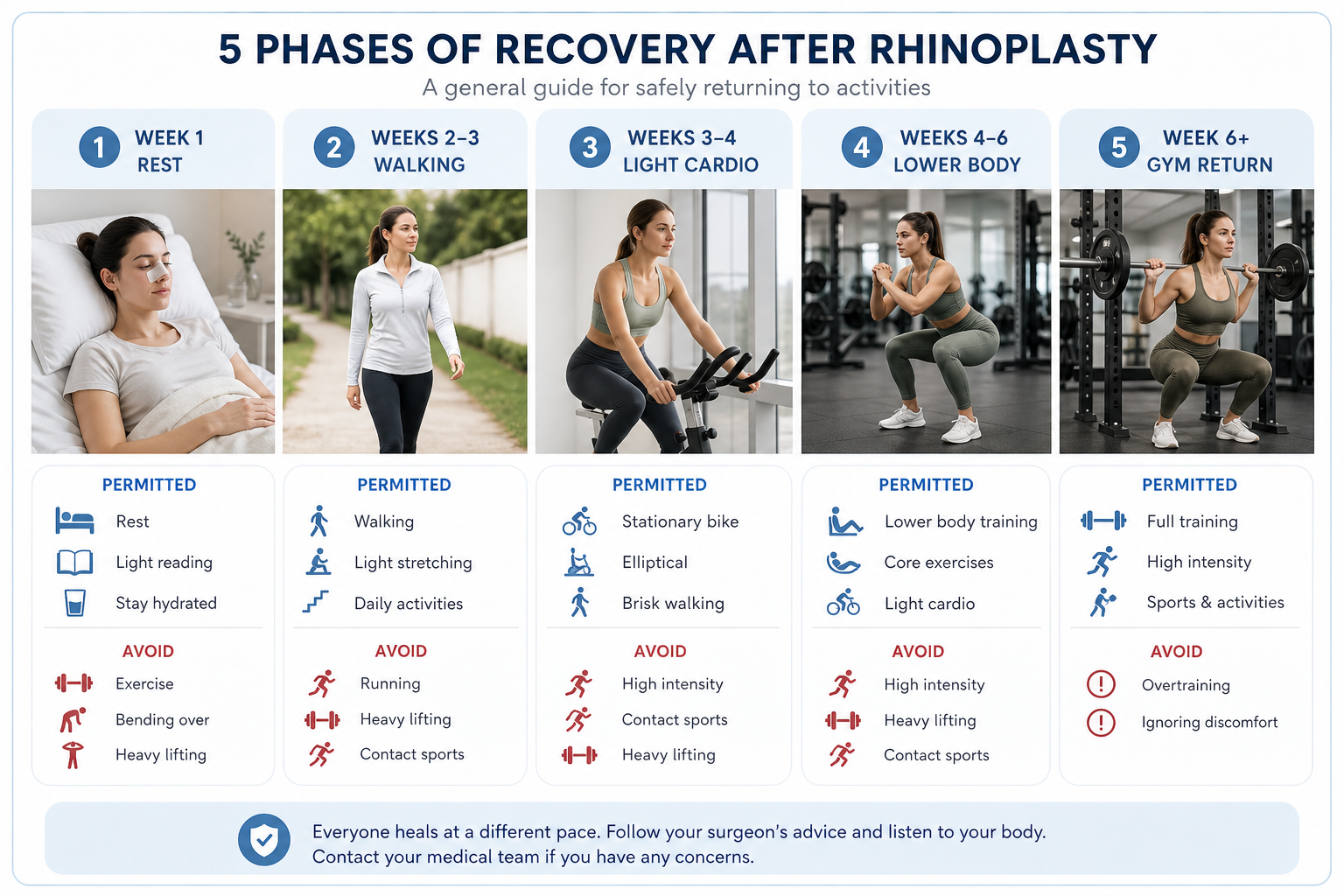
| Recovery Phase | What Is Generally Permitted | What to Avoid |
|---|---|---|
| Week 1 | Rest; short, slow indoor walks to aid circulation | All exercise; bending over; any activity that raises heart rate |
| Weeks 2–3 | Gentle flat-surface walking; light household activity | Brisk walking, jogging, cycling, any resistance training |
| Weeks 3–4 | Brisk walking; stationary bike at low resistance; light stretching (no inversions) | Running, swimming, weightlifting, yoga inversions, HIIT |
| Weeks 4–6 | Low-impact cardio (elliptical, stationary bike); lower-body resistance at light loads | Upper-body lifting, heavy squats, running, swimming, contact sports |
| Week 6+ (with clearance) | Gradual return to the gym; light weights; jogging; upright yoga | Heavy lifting, breath-holding during lifts, contact sports, hot yoga |
| 3 months+ (with clearance) | Full training including running and weightlifting; most sports | Contact sports and combat sports may require additional clearance |
This week-by-week timeline is a framework, not a guarantee. Patients who had more extensive procedures — including those involving multiple osteotomies, significant cartilage grafting, or revision rhinoplasty — should expect the more conservative end of each range. Patients who experienced any postoperative complications should follow their surgeon’s specific guidance rather than a general timeline.
Activity-by-Activity Guidance
Walking
Short, slow walks are generally safe from the first week and are actively encouraged to support circulation and reduce the risk of blood clots. The key distinction is pace and duration: a gentle stroll around the house or neighbourhood is appropriate; brisk walking that noticeably elevates heart rate should wait until weeks two to three. Avoid walking in hot weather or direct sun during the first few weeks, as heat promotes nasal swelling.
Running and Jogging
Running after rhinoplasty is typically not recommended before the six-week mark, and only then with surgeon’s clearance and a gradual return. The impact and cardiovascular demand of running raises heart rate substantially, and the repetitive jarring motion — even without direct nasal contact — can increase swelling and discomfort. Begin with light jogging on flat surfaces and monitor the nose carefully after each session for throbbing, increased swelling, or any bleeding.
Cycling and the Stationary Bike
A stationary bike at low resistance is one of the earliest forms of low-impact cardio that can be reintroduced, generally around weeks three to four. It allows cardiovascular conditioning without impact or the risk of a fall. Road cycling should wait longer, as the risk of an accident — and the associated face-first impact — makes it unsuitable until healing is well advanced. Avoid leaning heavily over the handlebars, as this forward-flexed position increases pressure in the nasal region.
Swimming
Swimming after rhinoplasty is typically restricted for at least four to six weeks, and often longer. Submerging the face exposes healing incisions and nasal passages to bacteria and chemicals (chlorine in pools, salt and microorganisms in open water), raising infection risk. The physical exertion of swimming also elevates heart rate significantly. Patients with open rhinoplasty incisions at the columella should be particularly cautious about water exposure until wounds are fully healed and the surgeon has confirmed it is safe.
Weightlifting After Rhinoplasty
Weightlifting after rhinoplasty carries a specific risk beyond simple cardiovascular elevation. As noted above, the Valsalva maneuver — the natural breath-holding that accompanies heavy compound lifts such as deadlifts, squats, and bench press — creates a sharp spike in head and facial pressure. This is distinct from the more gradual pressure increase seen with cardio. For this reason, returning to resistance training should be staged carefully: begin with lower-body exercises at light loads around weeks four to six, avoid upper-body pressing and pulling movements until at least six weeks, and never hold your breath during any lift. Heavy compound movements are generally best deferred until three months post-surgery.
Yoga After Rhinoplasty
Gentle, upright yoga postures — such as seated breathing exercises, gentle stretching, and standing poses — may be appropriate from around weeks three to four. However, yoga after rhinoplasty requires specific caution around inversions: poses such as downward dog, headstands, shoulder stands, and forward folds place the head below the heart, which increases blood pressure in the nasal vessels and can worsen swelling. Hot yoga presents an additional concern, as the elevated room temperature promotes vasodilation and fluid retention in healing tissue. Inversions and hot yoga classes should generally be avoided for at least six to eight weeks, and ideally until the surgeon confirms the nasal structures are sufficiently healed.
Contact Sports
Contact sports after rhinoplasty — including football, basketball, rugby, boxing, martial arts, and MMA — carry the highest risk of all activities due to the possibility of direct nasal trauma. A blow to the nose during the healing period can fracture repositioned bones, displace cartilage grafts, or cause significant bleeding. Most surgeons recommend avoiding all contact sports for a minimum of three months, and some advise six months or longer for patients who have had complex procedures or revision rhinoplasty. When returning to contact sports, wearing a protective face guard is strongly advisable and should be discussed with your surgeon.
Factors That Affect Your Individual Timeline
Not every rhinoplasty patient heals at the same rate, and the general timeline above may need to be adjusted based on several individual variables.
- Open vs. closed rhinoplasty: Open rhinoplasty involves an external incision at the columella and typically involves more extensive tissue dissection, which can mean a slightly longer initial recovery period compared with closed rhinoplasty, where all incisions are internal.
- Osteotomy: When nasal bones are surgically fractured and repositioned (osteotomy), the bone healing process adds an additional layer of fragility. Patients who have had osteotomies should be more conservative about returning to any activity that raises blood pressure or risks nasal impact.
- Skin thickness: Patients with thicker, more sebaceous skin tend to retain swelling for longer than those with thinner skin. This does not necessarily change when exercise can resume, but it does mean that swelling may persist as a visible sign of ongoing healing for a longer period.
- Revision rhinoplasty: Revision procedures are generally more complex than primary rhinoplasty, often involving scar tissue, cartilage grafts from the ear or rib, and more extensive structural work. Recovery timelines for revision rhinoplasty are typically longer, and the exercise restrictions should be treated as more conservative across all phases.
- Age and general health: Younger patients with good baseline health and no relevant medical conditions tend to heal more efficiently. Patients with conditions affecting circulation, immune function, or wound healing may need additional time before resuming physical activity.
Warning Signs to Stop Exercising Immediately
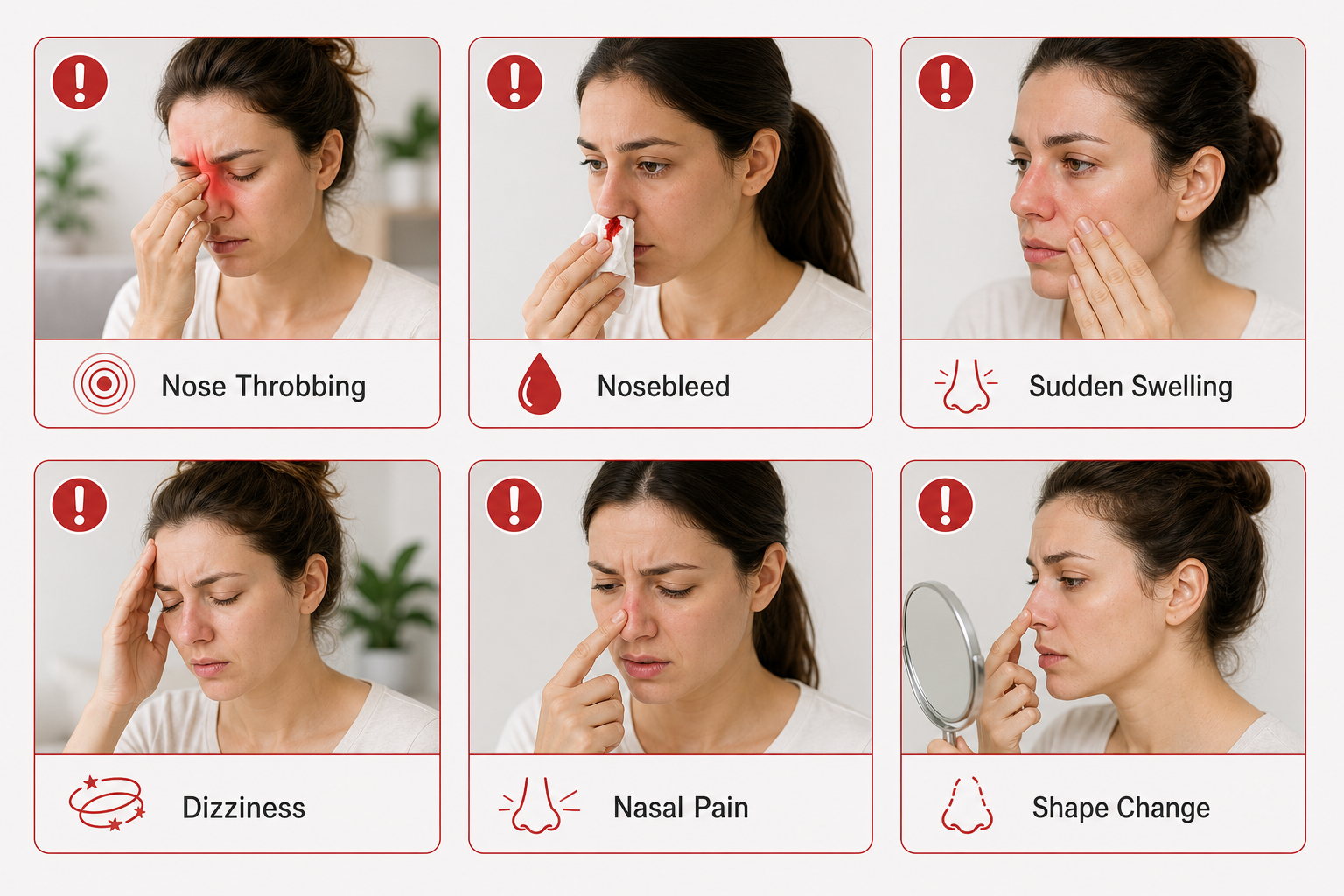
Knowing when to stop is as important as knowing when to start. The following warning signs during or after rhinoplasty recovery exercise indicate that the activity was too intense or too early, and that you should stop, rest, and contact your surgical team if symptoms persist or worsen.
- Nose throbbing or pulsing: A sensation of throbbing or pulsing in the nose during or after exercise suggests that blood pressure elevation is placing stress on healing nasal vessels. This is a clear signal to reduce intensity or stop entirely.
- Nosebleed (epistaxis): Any postoperative bleeding from the nose during or after physical activity requires immediate rest and elevation of the head. If bleeding does not resolve within a few minutes, seek medical attention.
- Sudden increase in nasal swelling: A noticeable increase in swelling that does not resolve with rest and elevation within a few hours suggests the activity was premature.
- Lightheadedness or dizziness: These symptoms may indicate that cardiovascular demand exceeded what the body can safely manage during recovery.
- Pain or tenderness over the nose: Discomfort localised to the nasal bridge or tip during exercise is a sign that healing structures are under stress.
- Visible changes in nasal shape: Any perceived change in the shape or symmetry of the nose following exercise warrants prompt assessment by your surgeon.
“I Exercised Too Early — Have I Ruined My Results?”
This is one of the most anxiety-provoking questions patients ask after rhinoplasty, and it deserves a direct answer. In most cases, a single episode of moderate activity — such as a brisk walk or a light jog — that was slightly premature will not permanently damage surgical results. The most likely consequence is a temporary increase in nasal swelling, which may take additional days or weeks to subside. Swelling is not the same as structural damage.
However, repeated early exercise, high-intensity activity, or any incident involving direct nasal impact during the healing period carries a genuinely higher risk of affecting outcomes. If you exercised earlier than advised and noticed significant swelling, bleeding, or any change in nasal shape, contact your surgeon promptly rather than waiting for your next scheduled appointment. In most cases, the surgeon will be able to assess whether the healing process has been affected and advise accordingly. Honest communication with your surgical team is always the right approach — there is no benefit in concealing early activity if you are concerned about the outcome.
Practical Tips for a Safe Return to Exercise
A structured approach to resuming physical activity reduces the risk of complications and helps protect your surgical results throughout the recovery period.
- Always obtain surgeon’s clearance before progressing to a new phase of activity. A general timeline is a guide; your surgeon’s assessment of your specific healing is the authoritative source.
- Start at lower intensity than you think you need. If you were running 5km before surgery, begin with a 15-minute jog at a conversational pace and assess how the nose responds before increasing duration or speed.
- Monitor your nose after every session in the early weeks. Check for throbbing, swelling, or any bleeding within the hour following exercise. If any of these occur, reduce intensity at the next session.
- Avoid breath-holding during resistance training. Use controlled breathing throughout every repetition to minimise the Valsalva effect. This is good practice in general but is particularly important during rhinoplasty recovery.
- Avoid bending forward during exercise, as this increases pressure in the nasal region. Exercises that require a forward-flexed head position — such as certain rowing movements or yoga forward folds — should be deferred.
- Stay away from heat. Saunas, steam rooms, hot yoga studios, and exercising in hot outdoor conditions all promote vasodilation and can worsen nasal swelling during recovery.
- Stay well hydrated. Adequate hydration supports tissue healing and helps regulate cardiovascular response during exercise. Dehydration can exaggerate heart rate elevation during activity.
- Consider a readiness checklist before resuming workouts: no active bleeding or discharge; no throbbing at rest; nasal splint removed and surgeon has confirmed healing is on track; no current infection or fever; surgeon has given explicit clearance for the planned activity level.
Guidance for Serious Athletes and Regular Gym-Goers
For patients who train regularly — whether competitive athletes, recreational runners, or dedicated gym members — the enforced rest period after rhinoplasty presents a genuine challenge, both physically and psychologically. Being sidelined from a routine that forms part of daily identity and mental wellbeing is a real consideration that deserves acknowledgment, not just a list of restrictions.
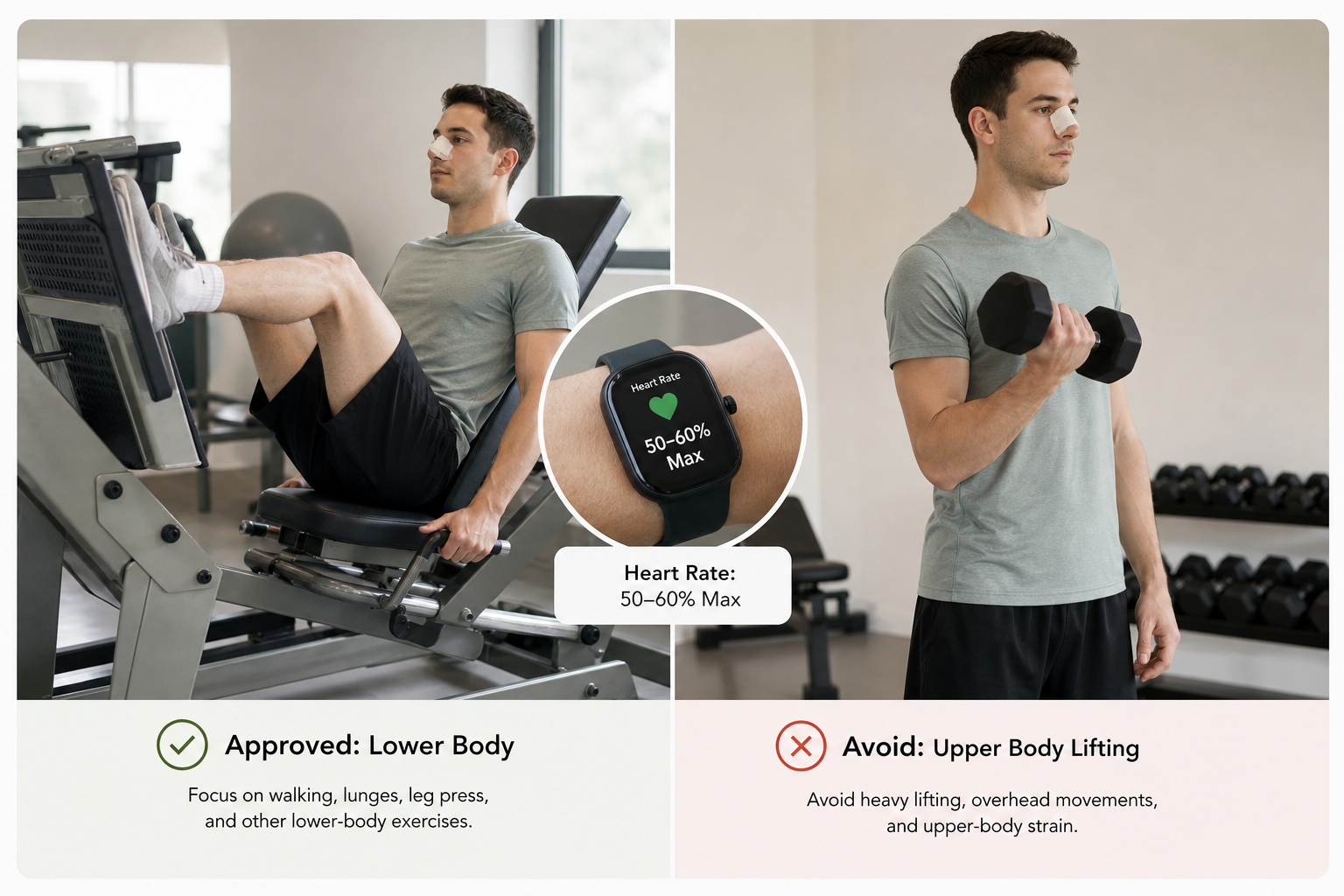
Practically, the recovery period can be used strategically. During the first four weeks, approved lower-body work — such as light leg press, bodyweight squats, and walking lunges at low intensity — can maintain some muscular conditioning without the upper-body pressure or Valsalva risk associated with pressing and pulling movements. Keeping heart rate within a moderate zone (roughly 50–60% of maximum heart rate) during approved cardio in weeks three to four allows some cardiovascular maintenance while staying within safe physiological limits. Athletes who train with a coach or personal trainer should inform them of the rhinoplasty and the specific restrictions so that programming can be adapted accordingly.
The psychological challenge of reduced training is also worth planning for. Setting small, progressive goals within the permitted activity levels — such as increasing walking duration by five minutes each day — can provide a sense of forward momentum during a period when full training is not possible. Most patients find that a structured, gradual return to the gym after rhinoplasty, beginning around the six-week mark with surgeon’s clearance, allows them to rebuild their routine without compromising the surgical outcome they invested in.
Frequently Asked Questions
When can I go back to the gym after rhinoplasty?
Most patients can begin a gradual return to the gym around six weeks after rhinoplasty, provided their surgeon has given clearance. This typically means starting with light lower-body exercises and low-impact cardio, then progressively reintroducing upper-body work and heavier loads over the following weeks. Full gym training is generally appropriate from around three months post-surgery.
Can I do squats after rhinoplasty?
Bodyweight squats and light lower-body resistance work are generally among the earlier exercises that can be reintroduced, typically from around weeks four to six. Heavy barbell squats should be deferred until at least six weeks, as the loading and associated breath-holding create significant pressure in the head and face. Always confirm with your surgeon before adding load.
When can I swim after rhinoplasty?
Swimming is typically restricted for at least four to six weeks after rhinoplasty, and often longer. The combination of infection risk from water exposure to healing incisions, the cardiovascular demand of swimming, and the face-down position in many strokes makes it one of the later activities to be reintroduced. Your surgeon will advise when your specific incisions and nasal passages are sufficiently healed.
Is sweating after rhinoplasty a problem?
Sweating itself is not directly harmful to rhinoplasty results, but the conditions that cause heavy sweating — elevated body temperature, high-intensity exercise, saunas, and steam rooms — are problematic during recovery. Heat promotes vasodilation and nasal swelling, and high-intensity activity raises blood pressure. Avoiding these conditions during the early recovery period is advisable regardless of whether sweating itself is the concern.
Can I do yoga after rhinoplasty?
Gentle upright yoga postures may be appropriate from around weeks three to four. Inversions — including downward dog, headstands, and forward folds — should be avoided for at least six to eight weeks, as they increase blood pressure in the nasal vessels. Hot yoga should be avoided for a similar period due to the vasodilatory effects of heat on healing tissue.
Does open rhinoplasty require a longer exercise restriction than closed rhinoplasty?
Open rhinoplasty generally involves more extensive tissue dissection and an external incision, which can mean a slightly longer initial recovery. However, the exercise restrictions are broadly similar for both approaches. The more significant variable is whether osteotomies were performed and the overall complexity of the procedure, rather than the open or closed technique alone.
When can I return to contact sports after rhinoplasty?
Contact sports after rhinoplasty are typically restricted for a minimum of three months, and often longer for revision cases or procedures involving osteotomies. The risk of direct nasal trauma during this period is significant enough to warrant a conservative approach. Discuss the specific timeline and the use of a protective face guard with your surgeon before returning to any contact or combat sport.
Planning Your Return to Exercise After Rhinoplasty
Rhinoplasty is a significant surgical investment, and the recovery period — including the restrictions on physical activity — is an integral part of achieving the result you planned for. The exercise restrictions are not arbitrary; they reflect the genuine physiological demands of bone and cartilage healing, the sensitivity of nasal vasculature to pressure changes, and the real risk that premature strenuous activity poses to surgical outcomes.
For most patients, the period of full restriction is relatively short. Gentle movement begins within days, light cardio is typically possible within a month, and a gradual return to the gym is achievable by six weeks with surgeon’s clearance. The activities that require the longest wait — heavy weightlifting and contact sports — are also the ones that carry the highest risk of undoing careful surgical work, which makes the patience required genuinely worthwhile.
If you are planning rhinoplasty and are an active person, discuss your training routine with your surgeon during the consultation. A clear, personalised week-by-week plan agreed in advance will make the recovery period easier to navigate and reduce the anxiety of not knowing when each activity is safe to resume. Your surgical team is the most reliable source of guidance for your specific procedure and healing progress.
