
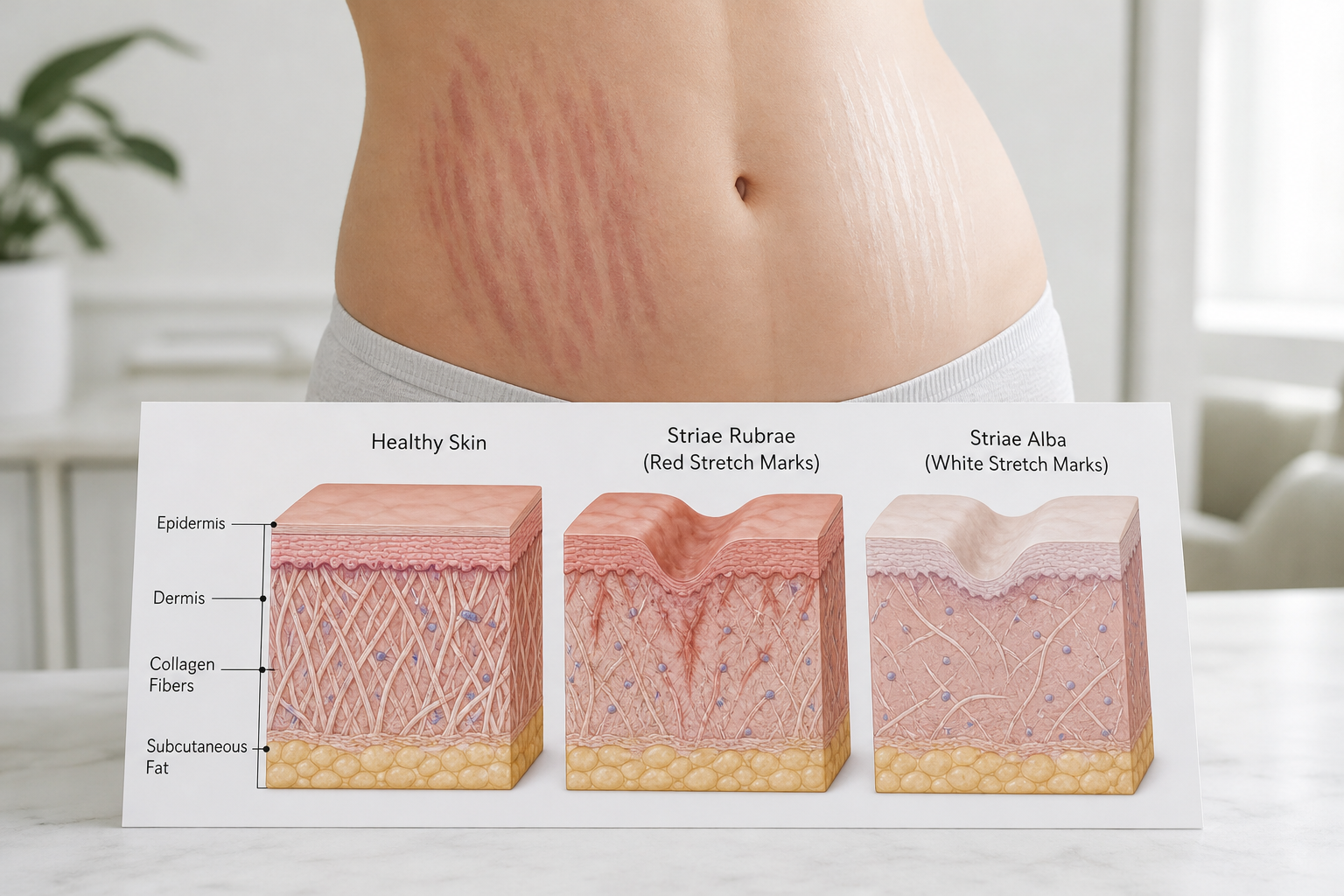

Stretch marks are among the most common skin concerns brought to dermatology and aesthetic clinics, affecting an estimated 50–90% of pregnant women and large numbers of adolescents, bodybuilders, and anyone who has experienced rapid weight change. While stretch marks cannot be completely removed, a range of topical and professional treatments can significantly reduce their appearance — particularly when treatment begins early. This guide explains what stretch marks are, why some respond better to treatment than others, and which options are supported by clinical evidence.
Key Takeaways
- Stretch marks (striae distensae) are a form of dermal scarring; they can be significantly faded but cannot be completely removed by any currently available treatment.
- Early treatment is most effective — red, newer marks (striae rubrae) respond considerably better than mature white marks (striae alba).
- Professional treatments such as fractional CO2 laser, RF microneedling, and microneedling with PRP produce the most meaningful improvements, especially when used as part of a combination treatment approach.
- Topical options including tretinoin (retinoid) and hyaluronic acid can help with early-stage marks but have limited effect on established white stretch marks.
- Skin tone matters: people with darker Fitzpatrick skin types face a higher risk of post-inflammatory hyperpigmentation from certain laser treatments and require careful practitioner assessment.
What Are Stretch Marks?
Stretch marks, medically termed striae distensae, form when the skin is stretched faster than its collagen and elastin fibers can accommodate. This rapid stretching causes micro-tears within the dermis — the deeper structural layer of the skin — resulting in linear, atrophic marks that differ in texture and color from the surrounding skin. Stretch marks are not simply a surface blemish; they represent a structural change in the dermis, which is why purely surface-level treatments have limited effect on established marks.
The marks progress through recognizable stages. Striae rubrae are the early, active phase: they appear red, pink, or purple, may feel slightly raised or itchy, and reflect active inflammation and increased blood vessel activity in the dermis. This inflammatory phase is the window during which treatment tends to be most effective. Over months to years, striae rubrae mature into striae alba — flat, pale, silver-white marks with a slightly wrinkled texture. At this stage, the inflammatory activity has resolved, the dermis has thinned, and the marks are considerably harder to treat. Less commonly, stretch marks may appear dark brown or blue-grey in people with deeper skin tones, classified as striae nigra or striae caerulea.
What Causes Stretch Marks?
The underlying mechanism is rapid skin stretching combined with hormonal changes that temporarily reduce the skin’s structural resilience. Common triggers include pregnancy (striae gravidarum), puberty-related growth spurts, rapid weight gain or loss, and significant muscle growth from bodybuilding. Corticosteroid use — whether topical, inhaled, or systemic — can also weaken collagen fibers and increase susceptibility. Certain medical conditions, including Cushing’s syndrome, Marfan syndrome, and Ehlers-Danlos syndrome, are associated with a higher likelihood of developing stretch marks due to their effects on connective tissue.
Genetics play a meaningful role: if a parent developed stretch marks during pregnancy or adolescence, the likelihood of developing them is higher. Skin tone and baseline skin elasticity also influence both the likelihood of developing marks and how they respond to treatment. Stretch marks in men are more common than often acknowledged — bodybuilding and rapid muscle gain during adolescence are frequent causes, and the marks typically appear on the shoulders, upper arms, and thighs as well as the abdomen.
Red vs. White Stretch Marks: Why the Difference Matters for Treatment
Understanding whether stretch marks are in the striae rubrae or striae alba stage is one of the most important factors in choosing an appropriate treatment. The distinction affects which treatments are likely to help, how many sessions may be needed, and what level of improvement is realistic.
| Feature | Striae Rubrae (Red/New) | Striae Alba (White/Mature) |
|---|---|---|
| Appearance | Red, pink, or purple; may be slightly raised | Pale, silver-white, flat or slightly depressed |
| Stage | Early / active inflammatory phase | Mature / post-inflammatory |
| Dermis activity | Active collagen remodeling occurring | Collagen remodeling largely complete |
| Response to topicals | Moderate — tretinoin and hyaluronic acid may help | Limited — topicals alone rarely produce visible change |
| Response to laser | Good — vascular lasers target redness effectively | Moderate — fractional CO2 laser can improve texture |
| Response to microneedling | Good — stimulates collagen production | Moderate to good — RF microneedling most effective |
| Realistic outcome | Significant fading and texture improvement possible | Meaningful improvement possible; complete removal unlikely |
Topical Treatments: What the Evidence Shows
Topical treatments are the most accessible starting point and are most useful during the striae rubrae phase. They work by supporting collagen production, improving skin hydration, and encouraging cell turnover — but their ability to penetrate the dermis is limited, which constrains how much improvement they can achieve on their own.
Tretinoin (Retinoid Cream)
Tretinoin at concentrations around 0.1% is among the best-studied topical options for early stretch marks. As a retinoid, tretinoin accelerates skin cell turnover and stimulates collagen synthesis in the dermis, which can help reduce the appearance of striae rubrae when applied consistently over several months. Clinical studies have shown measurable improvements in mark length, width, and color with regular use. However, tretinoin is not suitable during pregnancy or breastfeeding due to potential risks to the developing fetus, and it can cause initial skin irritation, dryness, and photosensitivity. Over-the-counter retinol products contain a weaker form of the active ingredient and may offer milder benefits with less irritation.
Hyaluronic Acid
Hyaluronic acid applied topically helps maintain skin hydration and may support skin elasticity during periods of rapid stretching. Some evidence suggests that regular application during pregnancy may modestly reduce the severity of stretch marks that develop, though it does not prevent them entirely. Hyaluronic acid is considered safe during pregnancy, making it one of the few evidence-supported topical options for this group.
Glycolic Acid and Centella Asiatica
Glycolic acid, an alpha-hydroxy acid, promotes surface cell turnover and may improve the texture of early stretch marks when used consistently. Centella asiatica (also known as gotu kola) is an herbal extract with some evidence supporting its role in stimulating collagen production and improving skin elasticity. Products combining centella asiatica with other active ingredients have shown modest benefits in small studies, particularly for prevention during pregnancy. Aloe vera gel is widely used for its soothing properties, though clinical evidence for its specific effect on stretch marks remains limited.
What Topicals Cannot Do
Topical treatments — including cocoa butter, bio-oil, and vitamin E — are frequently marketed for stretch marks, but evidence for many of these products is weak or absent. Cocoa butter in particular has been studied in pregnancy and has not been shown to prevent or significantly reduce stretch marks. For mature striae alba, topical-only approaches are largely ineffective because the structural changes in the dermis require deeper intervention to produce meaningful collagen remodeling.
Professional Treatments for Stretch Marks
Professional cosmetic procedures offer the most significant improvements for stretch marks, particularly for mature white marks or cases where topical treatments have not produced satisfactory results. A combination treatment approach — using two or more complementary modalities — consistently produces better outcomes than any single treatment alone, according to systematic reviews of the clinical literature.
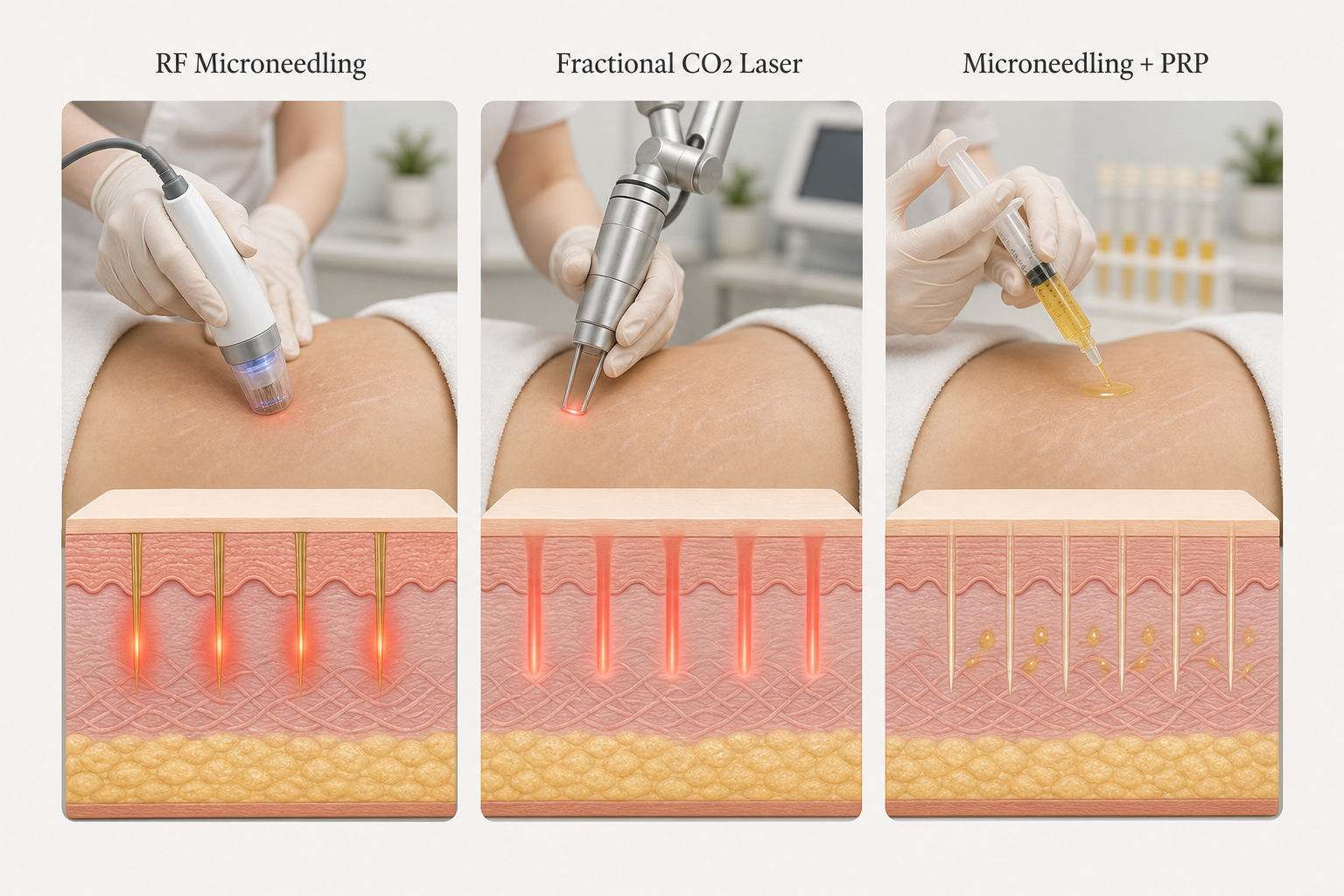
Fractional CO2 Laser
Fractional CO2 laser is one of the most widely studied and effective treatments for striae distensae. The laser delivers microscopic columns of thermal energy into the dermis, triggering a controlled wound-healing response that stimulates collagen remodeling and new collagen production. This skin resurfacing process can improve both the texture and color of stretch marks. Fractional photothermolysis is particularly useful for striae alba, where it can restore some dermal thickness and reduce the visual contrast between the mark and surrounding skin. Multiple sessions are typically required — often three to six — and results develop gradually over several months as new collagen matures. Downtime of several days to a week is common, with temporary redness, swelling, and peeling. People with darker skin tones should be assessed carefully, as fractional CO2 laser carries a higher risk of post-inflammatory hyperpigmentation in Fitzpatrick skin types IV–VI; lower-energy settings or alternative devices may be more appropriate.
RF Microneedling
RF microneedling combines the collagen-stimulating effect of microneedling with radiofrequency (RF) energy delivered directly into the dermis through fine needles. Devices such as Morpheus8 and Exion Body use this approach to heat the deeper layers of the skin, promoting collagen remodeling and improving skin elasticity without significantly damaging the surface. RF microneedling is considered suitable for a broader range of skin tones than ablative laser treatments, as the energy is delivered below the epidermis, reducing the risk of pigmentation changes. It is particularly useful for stretch marks on the abdomen, thighs, and buttocks, and is often used as part of a combination protocol alongside topical treatments or PRP. A course of three to four sessions spaced four to six weeks apart is typical, with results continuing to improve for several months after the final session.
Microneedling and PRP
Standard microneedling uses fine needles to create controlled micro-injuries in the skin, stimulating the body’s natural collagen production response. When combined with platelet-rich plasma (PRP) — a concentration of growth factors derived from the patient’s own blood — the treatment may enhance collagen remodeling and accelerate tissue repair. PRP injected into or applied over stretch marks during microneedling has shown promising results in clinical studies, particularly for striae rubrae. The combination treatment approach of microneedling with PRP is increasingly used as a less aggressive alternative to laser for patients who prefer shorter downtime or have skin tones that make laser treatment higher risk.
Vascular Laser Treatments
For red stretch marks (striae rubrae), vascular lasers — including pulsed dye laser and devices such as the Excel V — target the blood vessels responsible for the red or purple color. By reducing the vascular component of early stretch marks, these lasers can significantly fade the redness and help marks transition to a less visible state more quickly. Vascular laser treatment is most effective during the active inflammatory phase and has limited effect on mature white marks.
Microdermabrasion and Chemical Peels
Microdermabrasion uses fine crystals or a diamond-tipped wand to exfoliate the outermost skin layer, which can modestly improve the surface texture of stretch marks. Chemical peels using glycolic acid or trichloroacetic acid (TCA) work similarly by removing the upper skin layers and stimulating mild collagen production. Both treatments are generally less effective than laser or RF microneedling for stretch marks, but they may be useful as adjuncts in a combination protocol or for patients seeking a lower-cost, lower-downtime option for mild marks.
Surgical Option: Abdominoplasty
A tummy tuck (abdominoplasty) physically removes the lower abdominal skin, which can eliminate stretch marks located in that area. It is a surgical procedure with significant recovery time, cost, and surgical risks, and is generally considered only when there is also excess skin laxity that the patient wishes to address. It does not treat stretch marks on other body areas and is not a cosmetic procedure chosen solely for stretch mark removal.
Stretch Marks During Pregnancy: Safe Treatment Options
Pregnancy is one of the most common causes of stretch marks, and many women want to know what they can safely use during this time. Tretinoin and other retinoids are contraindicated during pregnancy and breastfeeding due to potential teratogenic effects and should be avoided entirely. Laser treatments and RF microneedling are also generally deferred until after pregnancy and breastfeeding have concluded.
Pregnancy-safe options with some supporting evidence include topical hyaluronic acid, centella asiatica-based creams, and regular moisturizing with gentle formulations. Keeping the skin well-hydrated and maintaining gradual, healthy weight gain within recommended guidelines may help reduce the severity of marks that develop, though they cannot guarantee prevention. After pregnancy and breastfeeding, professional treatments can be considered if marks remain a concern.
Skin Tone and Fitzpatrick Scale Considerations
Skin tone is a clinically important factor that is frequently overlooked in general consumer information about stretch mark treatment. People with medium to deep skin tones (Fitzpatrick types III–VI) have a higher concentration of melanin in the epidermis, which means certain laser treatments — particularly ablative and fractional CO2 lasers — carry a greater risk of triggering post-inflammatory hyperpigmentation (PIH), where the treated area becomes darker than the surrounding skin. This is not a reason to avoid professional treatment, but it does mean that practitioner selection and device settings are critically important. RF microneedling, which delivers energy below the epidermis, is generally considered safer across a wider range of skin tones. A thorough consultation with a practitioner experienced in treating diverse skin tones is essential before proceeding with any laser-based treatment.
Treatment Timeline: What to Realistically Expect
One of the most common sources of disappointment with stretch mark treatment is unrealistic expectations about how quickly results appear and how complete they will be. Collagen remodeling is a slow biological process; visible improvements from professional treatments typically develop over three to six months after a session, not days or weeks. Most professional treatment courses involve multiple sessions — often three to six for laser or RF microneedling — spaced several weeks apart to allow the skin to recover and respond between appointments.
Topical treatments require consistent daily application over at least two to three months before meaningful changes become visible. Stopping early is one of the most common reasons topical treatments appear ineffective. For mature striae alba, realistic expectations involve meaningful improvement in texture and a reduction in the visual contrast between the marks and surrounding skin — not complete elimination. Early-stage striae rubrae treated promptly with appropriate professional treatments can achieve significantly more visible fading, sometimes to the point where marks become difficult to notice in normal lighting.
Can Stretch Marks Be Prevented?
Prevention is not guaranteed, but certain measures may reduce the severity of stretch marks that develop. Maintaining gradual, steady weight gain rather than rapid fluctuations reduces the mechanical stress on the dermis. Keeping the skin well-moisturized supports its elasticity during periods of stretching. A balanced diet adequate in vitamins C and E, zinc, and protein supports healthy collagen production. Avoiding prolonged use of topical corticosteroids on areas prone to stretch marks is also advisable where clinically appropriate. Sun protection matters too: UV exposure degrades collagen fibers and can make existing stretch marks more visible by tanning the surrounding skin while the marks themselves do not tan.
Common Myths About Stretch Mark Treatment
Several widely promoted remedies have little or no clinical evidence behind them. Coconut oil, despite its popularity, has not been shown in controlled studies to prevent or significantly reduce stretch marks. Bio-oil is frequently marketed for this purpose, but the evidence for its effectiveness beyond general moisturization is limited. Tanning — whether from sun exposure or self-tanner — does not fade stretch marks; in fact, UV tanning makes marks more visible by darkening the surrounding skin while the marks themselves, lacking functional melanocytes, remain pale. Dry brushing and massage alone are unlikely to produce meaningful structural changes in the dermis, though massage may support circulation and general skin health.
Cost Overview: What to Budget
| Treatment | Approximate Cost Range | Sessions Typically Needed | Best For |
|---|---|---|---|
| Topical tretinoin / retinoid | £20–£80 per tube (prescription) | Ongoing daily use | Early striae rubrae |
| OTC creams / serums | £15–£60 per product | Ongoing daily use | Prevention, mild early marks |
| Microdermabrasion / chemical peel | £80–£200 per session | 4–6 | Mild marks, surface texture |
| Microneedling | £150–£350 per session | 3–6 | Striae rubrae and alba |
| RF microneedling | £300–£700 per session | 3–4 | All stages, broader skin tones |
| Fractional CO2 laser | £400–£900 per session | 3–6 | Striae alba, texture improvement |
| Vascular laser (e.g., Excel V) | £300–£600 per session | 2–4 | Striae rubrae (redness) |
| Microneedling with PRP | £400–£800 per session | 3–4 | Striae rubrae, combination protocol |
| Abdominoplasty (tummy tuck) | £4,000–£9,000 (surgical) | One procedure | Lower abdominal marks with skin laxity |
Stretch mark treatments are considered cosmetic procedures and are not typically covered by health insurance or the NHS. Costs vary significantly by clinic, practitioner experience, geographic location, and the size of the treatment area. Always obtain a detailed written quote before committing to a course of treatment.
Frequently Asked Questions
Do stretch marks go away on their own?
Stretch marks do not disappear on their own, but they do naturally fade over time. Striae rubrae gradually transition to striae alba — becoming paler and less noticeable — over months to years without any treatment. However, they remain visible as textural changes in the skin. Treatment can accelerate and significantly improve this fading process.
Is it too late to treat old white stretch marks?
It is not too late, but mature striae alba are more challenging to treat than early red marks. Fractional CO2 laser and RF microneedling can still produce meaningful improvements in texture and color contrast for white stretch marks, though complete removal is not achievable. A realistic goal is a noticeable reduction in visibility rather than elimination.
Does exercise reduce stretch marks?
Exercise does not directly reduce stretch marks. Maintaining a healthy body composition through regular exercise may help prevent new marks from forming due to rapid weight fluctuations, and improved muscle tone can change how the skin looks overall. However, exercise alone does not alter the structural changes in the dermis that cause existing stretch marks.
Are stretch marks covered by insurance?
In most cases, stretch mark treatments are classified as cosmetic procedures and are not covered by private health insurance or public healthcare systems. Exceptions may exist in rare cases where stretch marks are associated with a specific medical condition, but this is uncommon. It is advisable to confirm coverage directly with your insurer before beginning treatment.
What is the most effective treatment for stretch marks?
No single treatment is universally most effective. Clinical evidence consistently shows that a combination treatment approach — for example, fractional CO2 laser combined with RF microneedling, or microneedling with PRP — produces better outcomes than any single modality alone. The most appropriate combination depends on the stage of the marks, skin tone, treatment area, and individual goals, and should be determined through a consultation with a qualified dermatologist or aesthetic practitioner.
Can teenagers have stretch mark treatment?
Puberty-related stretch marks are very common in teenagers and can have a meaningful psychological impact. Many professional treatments are suitable for adolescents, though parental consent is required for minors and some treatments may be deferred until growth has stabilized. A dermatologist-recommended starting point for teenagers is consistent topical treatment during the striae rubrae phase, with professional options considered if marks persist. The emotional dimension of stretch marks in young people deserves acknowledgment alongside practical treatment options.
Deciding on Stretch Mark Treatment: A Practical Starting Point
Stretch marks are a normal and extremely common skin change — not a medical problem requiring treatment. For those who do wish to reduce their appearance, the most important factors are the stage of the marks, skin tone, realistic expectations, and access to a qualified practitioner who can assess suitability for specific treatments. Early treatment is most effective, and the combination treatment approach consistently outperforms single-modality options in clinical evidence.
If stretch marks are new and red, starting with a dermatologist-recommended topical such as tretinoin (if not pregnant or breastfeeding) alongside a professional consultation is a reasonable first step. For mature white marks, professional treatments — particularly RF microneedling or fractional CO2 laser, chosen with skin tone in mind — offer the most meaningful improvement. A consultation with a qualified dermatologist or aesthetic practitioner will allow for a personalized assessment of which options are most appropriate for your specific marks, skin type, and goals, and will help you set realistic expectations before committing to a course of treatment.
