


Key Takeaways
- Natural-looking lip filler results depend on injector skill, conservative dosing, appropriate product selection, and respect for your facial proportions — not the treatment itself.
- Hyaluronic acid fillers are the clinical standard for subtle lip enhancement because they integrate naturally with tissue and are reversible with hyaluronidase if needed.
- The microdosing technique and a less-is-more approach — often starting with 0.5 mL — help build volume gradually while preserving natural lip movement and shape.
- Overfilled or unnatural-looking lips typically result from excessive volume, poor technique, or ignoring individual facial anatomy — not from lip augmentation itself.
- Swelling after treatment is temporary; final results settle at around two weeks, so judging the outcome immediately after treatment is not accurate.
What Does “Natural-Looking Lip Filler” Actually Mean?
Natural-looking lip filler refers to lip augmentation results where the lips appear enhanced but not artificially inflated — fuller, better defined, or more hydrated, while still looking like your lips. The goal is not to disguise the fact that someone has had treatment, but rather to ensure that the outcome complements their face rather than dominating it. Lips that move naturally during speech, retain their structural landmarks, and remain proportionate to surrounding features are the hallmarks of a well-executed result.
The perception that lip fillers always look fake or overdone is largely outdated. It reflects a specific era of technique and product, not the current standard of care. Modern hyaluronic acid fillers, refined injection methods, and a greater clinical emphasis on facial harmony have made subtle lip enhancement far more achievable and consistent than it was a decade ago.
Why Hyaluronic Acid Filler Is the Clinical Standard
Hyaluronic acid (HA) filler is the most widely used product for lip augmentation, and for good reason. Hyaluronic acid occurs naturally in the body, particularly in connective tissue and skin, where it plays a key role in retaining moisture. When formulated as an injectable gel, it integrates with surrounding lip tissue in a way that supports both structure and softness.
The properties that make HA filler particularly well suited to natural results include its filler viscosity — how thick or fluid the gel is — which can be matched to the specific area being treated. Thinner, more fluid formulations are appropriate for delicate areas like the vermilion border (the defined edge of the lip) and the Cupid’s bow, while slightly thicker gels provide volume in the body of the lip. Brands such as Juvederm Volbella, Juvederm Ultra XC, and Restylane Kysse are commonly used in this context, each with different cross-linking technology that affects how the product behaves in tissue and how long it lasts.
Critically, HA fillers are reversible with hyaluronidase, an enzyme that dissolves hyaluronic acid. This reversibility is a genuine clinical safety advantage: if a result is asymmetrical, excessive, or simply not what the patient wanted, a qualified practitioner can dissolve the filler and return the lips to their natural state. This makes the less-is-more approach easier to commit to, because any treatment can be built upon gradually rather than committed to in a single session.
Filler Product Comparison
Different hyaluronic acid formulations suit different treatment goals. The table below outlines commonly used options and their general characteristics. Individual suitability should always be assessed at consultation.
| Product | Viscosity | Best Use | Typical Longevity |
|---|---|---|---|
| Juvederm Volbella | Low (soft, flexible filler) | Subtle hydration, fine lip lines, delicate border definition | Up to 12 months |
| Juvederm Ultra XC | Medium | Volume addition, fuller lips, overall augmentation | 6–12 months |
| Restylane Kysse | Medium-low (flexible) | Natural movement, lip volume, definition with flexibility | 6–12 months |
Product choice is one variable among many. A soft, flexible filler applied with poor technique in the wrong anatomical location will not produce a natural result, while a skilled injector can achieve excellent outcomes with any of these formulations by selecting the product that best matches the patient’s goal and lip structure.
Understanding Lip Anatomy and Proportions
A thorough understanding of lip anatomy is the foundation of natural results. The lips are not simply two surfaces to fill — they are a complex structure with distinct regions, each contributing to overall appearance and expression.
Key anatomical landmarks include the Cupid’s bow, the double-curved upper lip border that defines the peak of the lip; the vermilion border, the transition line between lip tissue and surrounding skin; the philtral columns, the two vertical ridges running from the nose to the centre of the upper lip; and the lip body, which provides fullness and volume. Preserving and respecting these structures during treatment is what separates natural results from an overdone appearance.
Facial proportions also matter significantly. A commonly referenced aesthetic framework — sometimes called the golden ratio — suggests that the lower lip ideally appears slightly fuller than the upper lip, with an approximate ratio of 1:1.6. This is not a rigid rule, but it provides useful guidance for maintaining lip symmetry and balance within the context of the rest of the face. A good injector will assess how the lips relate to the nose, chin, and overall facial proportions before placing a single injection, rather than applying a standardised volume to every patient.
Injection Techniques That Support Natural Results
Technique is at least as important as product selection when it comes to achieving a natural-looking outcome. Several approaches are particularly relevant.

Microdosing
The microdosing technique involves injecting very small amounts of filler at multiple precise points rather than depositing a larger volume in fewer locations. This approach allows the injector to sculpt the lip gradually, building shape and volume in a controlled way. It minimises the risk of localised lumps or areas of excessive fullness, and it is particularly effective for patients who want a subtle enhancement or who are new to lip augmentation. Peer-reviewed literature has described structured multi-injection frameworks using this principle to achieve consistent, natural outcomes in lip augmentation.
Conservative Dosing and Staged Treatment
Many experienced practitioners recommend starting with half a syringe (0.5 mL) rather than a full syringe, particularly for first-time patients. Conservative dosing allows the patient to assess the result once swelling has settled, then decide at a touch-up appointment whether they would like additional volume. This staged approach — to build volume gradually across more than one session — is widely considered the safest route to natural results and helps avoid the over-correction that leads to a puffy or unnatural appearance.
Cannula vs. Needle
Injectors may use either a fine needle or a blunt-tipped cannula (a flexible tube) to deliver filler. Needles allow greater precision at specific injection points and are commonly used for border definition and Cupid’s bow enhancement. Cannulas, which pass through a single entry point, are associated with reduced bruising and may be preferred for adding volume to the body of the lip in certain patients. The choice between cannula and needle technique depends on the area being treated, the injector’s training, and the individual patient’s anatomy.
Layering
A layering approach places filler at different depths within the lip tissue to create a result that looks and feels three-dimensional rather than simply inflated. This technique respects the natural architecture of the lip and helps the filler integrate smoothly with surrounding tissue.
The Importance of Choosing a Skilled Injector
No filler product, regardless of brand or formulation, can compensate for inadequate injector skill. The practitioner’s understanding of facial anatomy, their aesthetic judgement, and their technical precision are the single most important factors in determining whether a lip augmentation result looks natural or overdone.
When choosing a provider, it is worth looking for a board-certified dermatologist, plastic surgeon, or appropriately trained medical professional with documented experience in lip augmentation specifically. A practitioner’s portfolio of before-and-after photographs is a useful starting point — but rather than focusing purely on size, look at how the treated lips relate to the patient’s overall face. Do they retain natural structure? Are the philtral columns preserved? Does the Cupid’s bow remain defined? These details reveal whether the injector understands anatomy or is simply adding volume.
At consultation, a skilled injector will assess your natural lip shape, discuss your goals, explain realistic outcomes, and recommend a treatment plan tailored to your facial structure. Be cautious of any provider who offers a standard volume without examining your lips and face, or who does not ask about your medical history and current medications.
Age-Specific Considerations
What constitutes a natural-looking result varies considerably depending on age. Younger patients seeking lip augmentation are often looking for subtle volume enhancement or improved definition of the Cupid’s bow. For these patients, a small amount of strategically placed filler — perhaps 0.5 mL — may be all that is needed to achieve a noticeable but refined result.
For older patients, the goals are often different. As the lips age, they lose collagen, HA, and structural support, leading to thinning, flattening of the Cupid’s bow, and the development of fine lines around the mouth (perioral lines). In these cases, the priority may be restoring definition and hydration rather than adding appreciable volume. A soft, flexible filler placed along the vermilion border and into the lip body can refresh the appearance without adding bulk, making the lips look younger and more hydrated rather than simply larger. This distinction — between augmentation and restoration — is clinically important and is often not discussed with patients beforehand.

What Causes Overfilled or Unnatural-Looking Lips?
Understanding what leads to an overdone result helps patients make better decisions about their treatment. Overfilled lips — sometimes described as the “duck lip” look — are not an inherent consequence of lip augmentation. They typically result from one or more of the following:
- Excessive volume: Adding more filler than the lips can accommodate naturally, often because multiple full syringes have been placed over successive appointments without adequate reassessment.
- Poor product placement: Injecting volume into areas that do not naturally hold fullness, or disrupting the vermilion border in a way that makes the lip appear to roll outward.
- Ignoring proportions: Focusing on making the lips larger without considering how they relate to the nose, chin, and overall facial structure.
- Cumulative overfilling: Each individual session may appear conservative, but if touch-up appointments are scheduled before existing filler has metabolised, volume can accumulate over time to an unnatural degree.
- Inadequate injector training: A practitioner who lacks detailed knowledge of lip anatomy or injection technique is more likely to produce an asymmetrical or exaggerated outcome.
Patients who are concerned about an existing result should consult a qualified practitioner about the possibility of dissolving the filler with hyaluronidase before proceeding with any additional treatment.
Lip Shape Style Guide
Not every patient wants the same aesthetic outcome. Different goals require different approaches in terms of placement and volume:
- Subtle hydration and definition: A small amount of soft filler placed along the vermilion border and into the lip body restores moisture and clarity without visible size increase. Suitable for patients who want refreshed lips, not augmentation.
- Cupid’s bow enhancement: Precise placement along the peaks of the upper lip and into the philtral column base creates greater definition without adding general volume. Results in a more sculpted appearance.
- Overall volume increase: Filler distributed throughout the lip body using a layering approach. Most effective when applied conservatively across more than one session.
- Korean cherry lips aesthetic: Concentrates volume in the central area of both lips, leaving the corners relatively untouched. Creates a rounded, youthful appearance with a defined centre.
- Glass lips aesthetic: Focuses on surface hydration and light reflection using a very soft filler, creating a plump, glossy appearance without structural augmentation.
What to Expect: The Procedure and Recovery
A lip filler appointment typically begins with a detailed consultation, during which the practitioner assesses your lips, discusses your goals, and agrees on a treatment plan. Before the injections, a topical numbing cream is applied to minimise discomfort. The injections themselves usually take between 15 and 30 minutes depending on the technique and volume being used. Most patients describe the sensation as mild pressure or a brief sting rather than significant pain.
Immediately after treatment, the lips will appear noticeably swollen — often more so than the intended final result. This is a normal response to the injections and not a reliable indicator of the long-term outcome. Bruising may also occur, particularly around the vermilion border where the skin is delicate. Both swelling and bruising typically resolve within one to two weeks. The final shape and volume of the result becomes fully visible at around the two-week mark, which is also the appropriate time to schedule a touch-up appointment if additional refinement is needed.
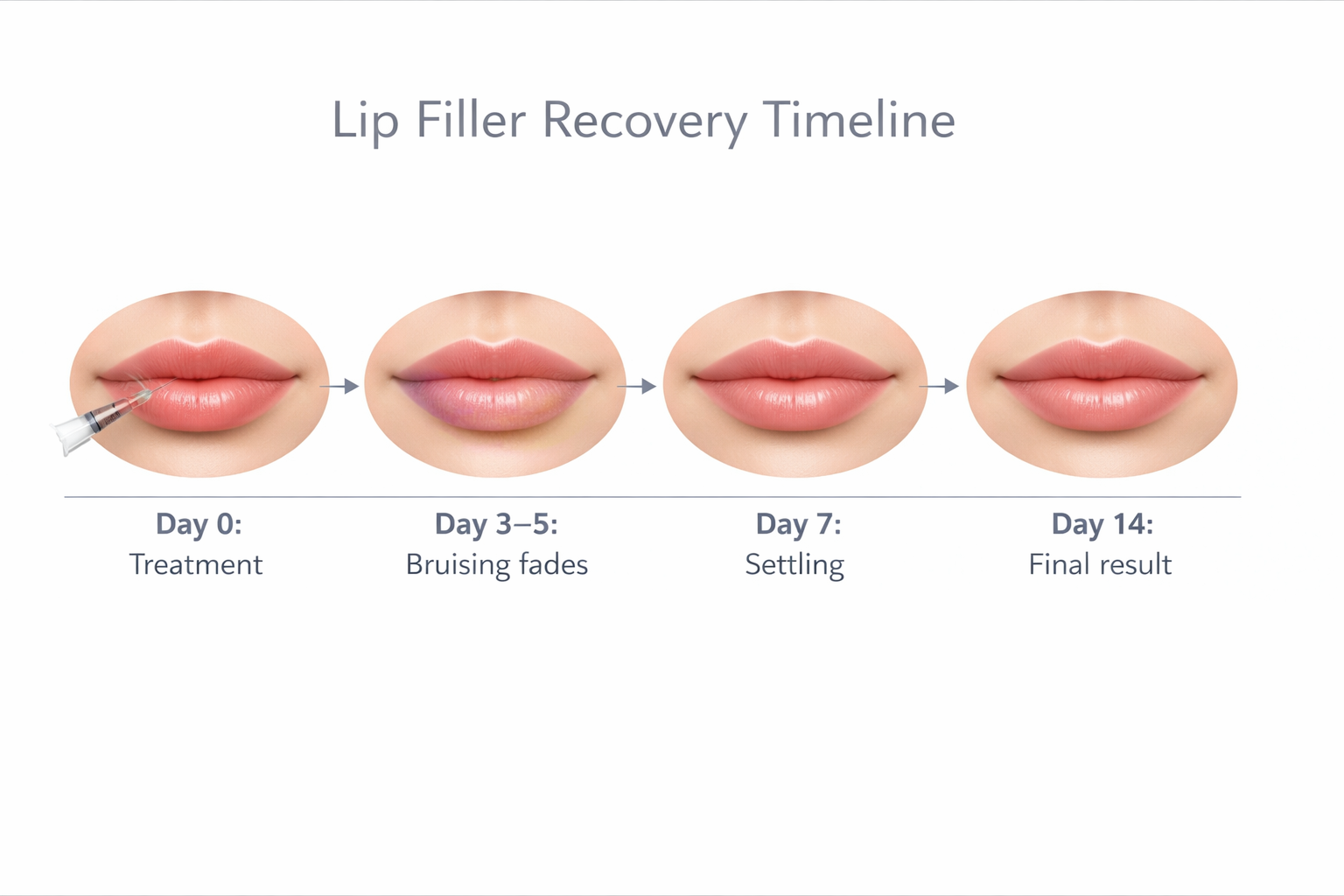
Downtime is generally minimal, though most practitioners advise avoiding strenuous exercise, alcohol, and excessive heat (such as saunas or hot baths) for 24 to 48 hours after treatment to reduce swelling and bruising risk.
How Long Do Results Last?
Lip filler results typically last between six and twelve months, though this varies between individuals. Factors that influence longevity include the specific product used, how quickly the individual metabolises hyaluronic acid, their lifestyle (higher levels of physical activity may accelerate breakdown), and the volume placed. Lips have a relatively high degree of movement compared to other facial areas, which means filler in this location may be metabolised slightly faster than filler placed elsewhere.
Most patients find that a maintenance schedule of one touch-up appointment every nine to twelve months is sufficient to preserve their preferred result. Patients who build volume gradually across multiple sessions, then maintain with smaller top-ups, often achieve the most natural and consistent long-term outcomes.
Frequently Asked Questions
Will lip filler make my lips look fake?
Not necessarily. When performed by a skilled injector using an appropriate volume and product for your facial proportions, lip augmentation can look entirely natural. The risk of an overdone appearance increases significantly with excessive volume, repeated overfilling, or poor injector technique. Starting conservatively with 0.5 mL and assessing the result before adding more is a well-supported strategy for avoiding this outcome.
Can lip filler be reversed if I don’t like the result?
Yes. Hyaluronic acid filler is reversible with hyaluronidase, an enzyme that breaks down HA gel. A qualified practitioner can administer hyaluronidase to dissolve filler partially or completely. Results from dissolving are typically visible within 24 to 48 hours. This reversibility is one of the key safety advantages of HA fillers over permanent or semi-permanent alternatives.
How much filler do I actually need?
There is no universal answer. The appropriate volume depends on your starting lip shape, your aesthetic goals, and your facial proportions. Many patients achieve satisfying natural results with 0.5 mL to 1 mL. A good practitioner will recommend the minimum effective volume rather than a standard amount, and may suggest building gradually across more than one session.
Does it hurt?
Most patients find the procedure manageable with topical numbing cream applied beforehand. The lips are a sensitive area, so some discomfort is normal, but significant pain is not expected. Many lip fillers also contain lidocaine (a local anaesthetic) in the formulation itself, which further reduces discomfort during injection.
How do I know if a before-and-after photo shows a natural result?
When evaluating a practitioner’s portfolio, focus on lip shape and how the treated lips complement the overall face rather than simply comparing size. Look for preserved anatomical landmarks — a defined Cupid’s bow, an intact vermilion border, natural-looking philtral columns — and check whether the lips appear proportionate to the nose, chin, and surrounding features. Natural results maintain individual character rather than looking identical across patients.
Is there anything that makes me unsuitable for lip filler?
Lip filler may not be appropriate during pregnancy or breastfeeding, in the presence of active infection or cold sores in the treatment area, or for individuals with certain autoimmune conditions or bleeding disorders. A thorough medical consultation is essential before treatment. Always disclose your full medical history and current medications, including blood thinners and supplements, to your practitioner.
Is Lip Filler the Right Choice for Your Goals?
Lip filler is a well-established, minimally invasive option for patients who want fuller, more defined, or better-hydrated lips while maintaining a natural appearance. When approached conservatively — with a qualified practitioner, an appropriate HA product, a technique suited to your anatomy, and realistic expectations — the treatment can produce results that genuinely complement your face without drawing unwanted attention.
The most important factors in achieving a natural outcome are not the product alone, but the combination of injector expertise, conservative dosing, respect for facial proportions, and a willingness to build results gradually over time. Patients who rush toward maximum volume in a single session, or who choose a provider based on cost alone, are more likely to be disappointed with the outcome.
If you are considering lip augmentation, a thorough consultation with a board-certified or appropriately qualified practitioner is the essential first step. Use that appointment to discuss your goals clearly, ask to see their portfolio, and understand the realistic outcome for your specific lip anatomy before any treatment begins.
