
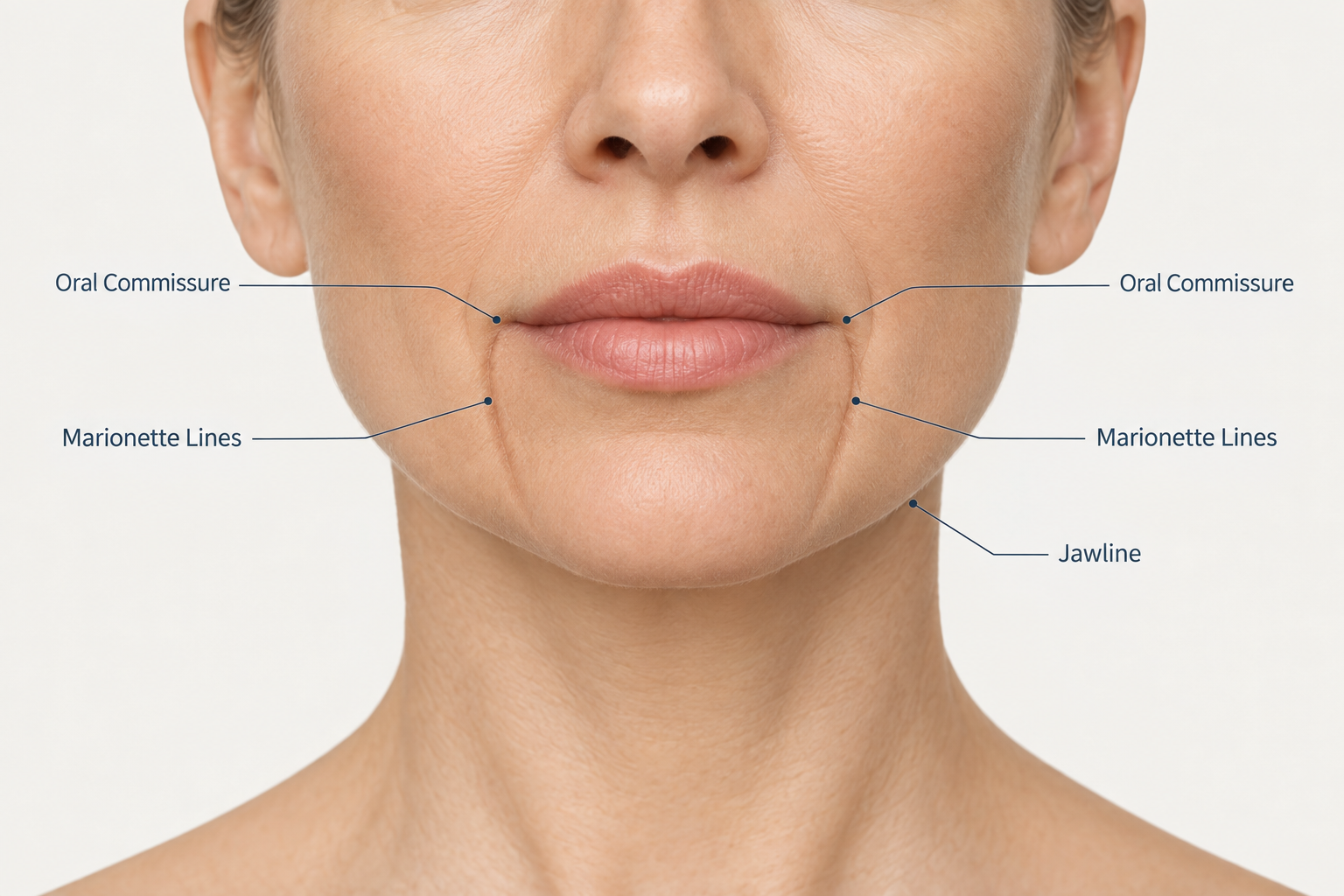

Marionette lines are the vertical creases that run downward from the corners of the mouth toward the chin, giving the lower face a downturned or aged appearance. Understanding what causes them — and why some people develop them earlier or more deeply than others — is the first step toward making informed decisions about prevention and treatment options.
Key Takeaways
- Marionette lines form primarily due to the natural loss of collagen, elastin, and facial fat that occurs with age, combined with the repeated action of facial muscles around the mouth and jaw.
- Genetics, sun exposure, smoking, and significant weight fluctuations can all accelerate or worsen their development.
- The depth and prominence of marionette lines varies considerably between individuals, depending on skin type, bone structure, and lifestyle factors.
- These lines are a normal part of facial ageing, though their appearance can be addressed through a range of non-surgical and surgical options when they cause concern.
- A qualified aesthetic practitioner can assess the specific contributing factors in your case and recommend appropriate approaches.
What Are Marionette Lines?
Marionette lines take their name from the hinged wooden puppets whose mouths open and close along a vertical groove at each corner of the jaw. On the human face, these lines appear as folds or creases running from the oral commissures — the corners of the mouth — downward toward the chin and sometimes continuing toward the jawline. They are distinct from nasolabial folds, which run from the sides of the nose to the corners of the mouth, though both types of fold often develop together as part of the broader ageing process of the lower face.
In their early stages, marionette lines may only be visible during certain facial expressions such as smiling or speaking. Over time, as the underlying structural changes become more pronounced, they can become visible at rest and may deepen into more significant grooves. The skin between the corner of the mouth and the chin can also begin to sag, creating a jowl-like appearance that further emphasises the lines.
It is worth noting that marionette lines are not a medical condition. They are a natural anatomical feature of the ageing face, though the age at which they appear and the degree to which they develop varies considerably from person to person.
The Primary Cause: Age-Related Structural Changes in the Face
The most significant cause of marionette lines is the cumulative loss of structural support in the face that occurs with age. This involves several interconnected processes happening simultaneously in the skin, soft tissue, and underlying bone.
Collagen and Elastin Decline
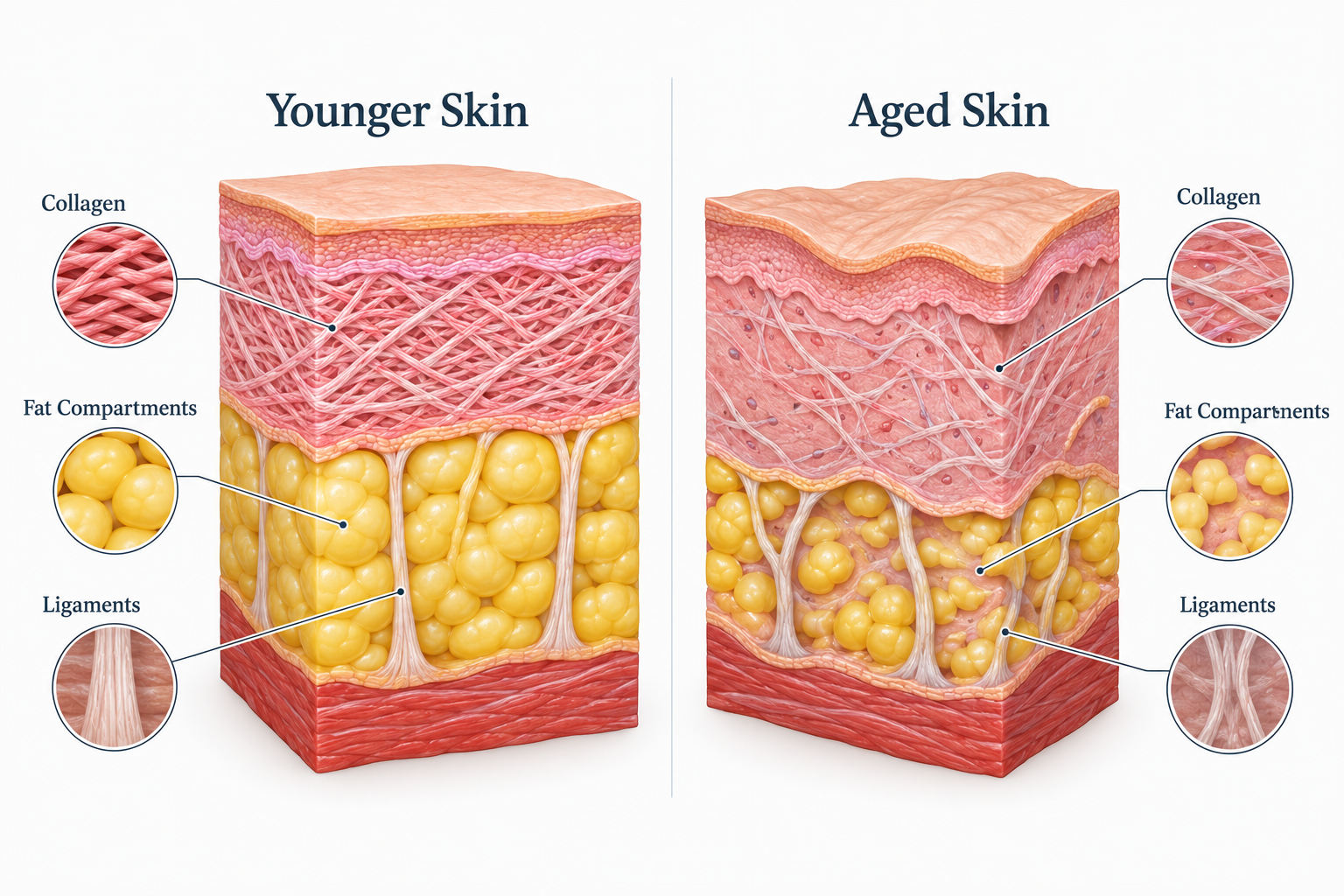
Collagen is the main structural protein in the skin, responsible for its firmness and resistance to deformation. Elastin is the protein that allows skin to spring back after being stretched or compressed. From the mid-twenties onward, the body's production of both proteins begins to slow, and the quality of existing collagen fibres gradually deteriorates. By the time most people reach their forties and fifties, this decline becomes visually apparent as the skin loses its ability to maintain a smooth, taut surface. In the lower face, where the skin is subject to constant movement from eating, speaking, and expressing emotion, this loss of structural integrity contributes directly to the formation of marionette lines.
Loss of Facial Fat and Volume
The face contains multiple compartments of subcutaneous fat that provide volume and support to the overlying skin. With age, these fat compartments undergo significant changes: some areas lose volume, while others may shift downward due to the effects of gravity and the weakening of the ligaments that hold them in place. The fat pads around the cheeks and midface are particularly relevant to marionette line formation. As cheek volume diminishes and descends, the support that once held the lower face in a lifted position is reduced, allowing the skin around the mouth and chin to fold and crease more easily.
Bone Resorption
The facial skeleton itself changes with age. Research has shown that the bones of the face, including the jaw and the area around the eye sockets, gradually lose density and volume over time. This skeletal resorption reduces the foundation upon which the soft tissues of the face rest. In the lower face, changes to the mandible (jawbone) can reduce the projection and support of the chin and jaw area, contributing to the sagging and folding that characterises marionette lines and jowling.
Ligament Laxity
The skin and soft tissues of the face are anchored to the underlying bone and muscle by a network of fibrous ligaments. With age, these ligaments stretch and weaken, reducing their ability to hold facial tissues in their youthful position. The mandibular ligament, which runs along the jawline, is particularly relevant to the development of marionette lines and jowls. As this ligament loses its tension, the soft tissue above it can descend, creating the characteristic downward fold at the corner of the mouth.
The Role of Facial Muscles
The depressor anguli oris (DAO) is a triangular muscle that originates along the lower jaw and inserts at the corner of the mouth. Its primary function is to pull the corners of the mouth downward — an action involved in expressions of sadness, displeasure, or concentration. Over a lifetime of repeated contraction, the DAO contributes to the formation of the groove that defines the marionette line. In younger skin with adequate collagen and volume, this repeated movement does not leave a permanent mark. As the skin ages and loses its resilience, however, the repeated downward pull of the DAO progressively etches the marionette line more deeply into the skin.
The interaction between muscle activity and skin quality is important to understand because it explains why marionette lines are not simply a surface skin problem. They reflect a combination of dynamic muscle forces acting on skin that has lost its structural capacity to recover fully between expressions.
Genetic Factors
Genetics play a meaningful role in determining when marionette lines appear and how prominent they become. Individuals whose parents or grandparents developed deep lower facial folds at a relatively young age are more likely to follow a similar pattern. Genetic factors influence the rate of collagen degradation, the distribution and volume of facial fat compartments, bone structure, and skin thickness — all of which affect susceptibility to marionette line formation. People with naturally thinner skin or less facial fat volume may notice these lines earlier than those with fuller facial features, even when other lifestyle factors are comparable.
Skin tone also has a genetic basis and is relevant here. Melanin provides some degree of protection against ultraviolet-induced collagen breakdown, which is one reason that individuals with deeper skin tones may experience certain signs of facial ageing at a later stage. However, this does not eliminate the development of marionette lines, which are driven by structural changes that affect all skin types.
Sun Exposure and Photoageing
Ultraviolet radiation from the sun is one of the most well-established external causes of accelerated skin ageing, a process known as photoageing. UV exposure — particularly UVA radiation, which penetrates deeply into the dermis — damages collagen fibres and impairs the skin's ability to produce new collagen. It also degrades elastin, leading to a loss of skin elasticity that makes the lower face more susceptible to folding and creasing. Cumulative sun exposure over decades significantly accelerates the structural changes that lead to marionette lines, often causing them to appear earlier and become more pronounced than they would through intrinsic ageing alone.
Consistent use of broad-spectrum sunscreen with an adequate SPF is widely recommended by dermatologists as one of the most effective preventive measures against photoageing. While sunscreen cannot reverse existing marionette lines, it may help slow the rate at which they deepen over time.
Smoking and Its Effect on Skin Structure
Smoking accelerates facial ageing through several mechanisms. Nicotine causes vasoconstriction — the narrowing of blood vessels — which reduces blood flow to the skin and limits the delivery of oxygen and nutrients needed for collagen synthesis and skin repair. The thousands of chemicals in cigarette smoke also generate free radicals that directly damage collagen and elastin fibres. Additionally, the repeated pursing of the lips involved in smoking contributes to the activation of muscles around the mouth, which over time can worsen the creasing of the lower face. Research consistently shows that smokers tend to develop more pronounced facial lines at an earlier age than non-smokers, and marionette lines are among the features affected.
Weight Fluctuations and Body Composition Changes
Significant changes in body weight can influence the development of marionette lines in two distinct ways. Excess weight can stretch the skin and the ligaments of the face over time, reducing their elasticity. When weight is subsequently lost, the skin may not fully retract, leaving it looser and more prone to folding. Conversely, very low body weight or significant weight loss in later life can reduce facial fat volume rapidly, removing the soft tissue support that helps keep the lower face smooth. Repeated cycles of weight gain and loss — sometimes called yo-yo dieting — may be particularly damaging to the structural integrity of facial skin and soft tissue over time.
Sleep Position
Sleeping consistently on one side of the face can contribute to the development of facial lines over time, including in the lower face. When the face is pressed against a pillow for several hours each night, the skin is repeatedly compressed and folded in the same direction. Over years and decades, this mechanical compression can contribute to the formation or deepening of creases. While sleep position is unlikely to be a primary cause of marionette lines on its own, it may be a contributing factor, particularly in individuals who already have reduced skin elasticity due to age or other factors. Sleeping on the back or using a supportive pillow designed to reduce facial compression is sometimes suggested as a preventive measure, though evidence for this specific intervention remains limited.
Facial Structure and Anatomy
Individual differences in facial anatomy significantly influence the likelihood and timing of marionette line development. People with a naturally narrow or recessed chin, a less prominent jawline, or a relatively flat midface may develop marionette lines earlier because their facial structure provides less inherent support to the overlying soft tissue. Conversely, individuals with strong bony projections, fuller cheeks, and a well-defined jaw may retain a smoother lower face for longer, even as the same age-related processes occur beneath the surface.
The depth of the nasolabial fold and the prominence of the jowl area are also anatomically related to marionette line severity. These features tend to develop together as part of the overall descent of the midface and lower face, and their relative prominence is partly determined by the individual's underlying skeletal and soft tissue anatomy.
How Marionette Lines Differ from Nasolabial Folds
Marionette lines and nasolabial folds are often discussed together because they share similar causes and frequently develop in parallel. However, they are anatomically distinct. Nasolabial folds run from the sides of the nose diagonally downward to the corners of the mouth, while marionette lines continue below the corners of the mouth toward the chin. Nasolabial folds are present to some degree in most people from a relatively young age and become more prominent with age and midface volume loss. Marionette lines tend to appear somewhat later and are more directly associated with the descent of the lower face and the activity of the depressor anguli oris muscle. Understanding this distinction is relevant when considering treatment options, as the two types of fold may respond differently to the same approach.
When Do Marionette Lines Typically Appear?
Most people begin to notice early marionette lines in their late thirties to mid-forties, though this varies considerably. In individuals with significant sun damage, a history of smoking, or a genetic predisposition to early facial ageing, lines may become visible in the early thirties. In others, particularly those with fuller facial features, good skin quality, and limited sun exposure, they may not become a noticeable concern until the fifties or sixties. The lines typically begin as subtle dynamic creases visible only during expression and gradually become static lines visible at rest as the underlying structural changes progress.
Can Marionette Lines Be Prevented?
Complete prevention of marionette lines is not realistic, as they are a natural consequence of the ageing process that affects everyone to some degree. However, certain lifestyle and skincare practices may help slow their development or reduce their eventual severity. These include consistent use of broad-spectrum sunscreen, avoiding smoking, maintaining a stable and healthy body weight, following a skincare routine that supports skin barrier function and hydration, and using topical retinoids where appropriate — retinoids have reasonable evidence supporting their role in stimulating collagen production and improving skin texture over time.
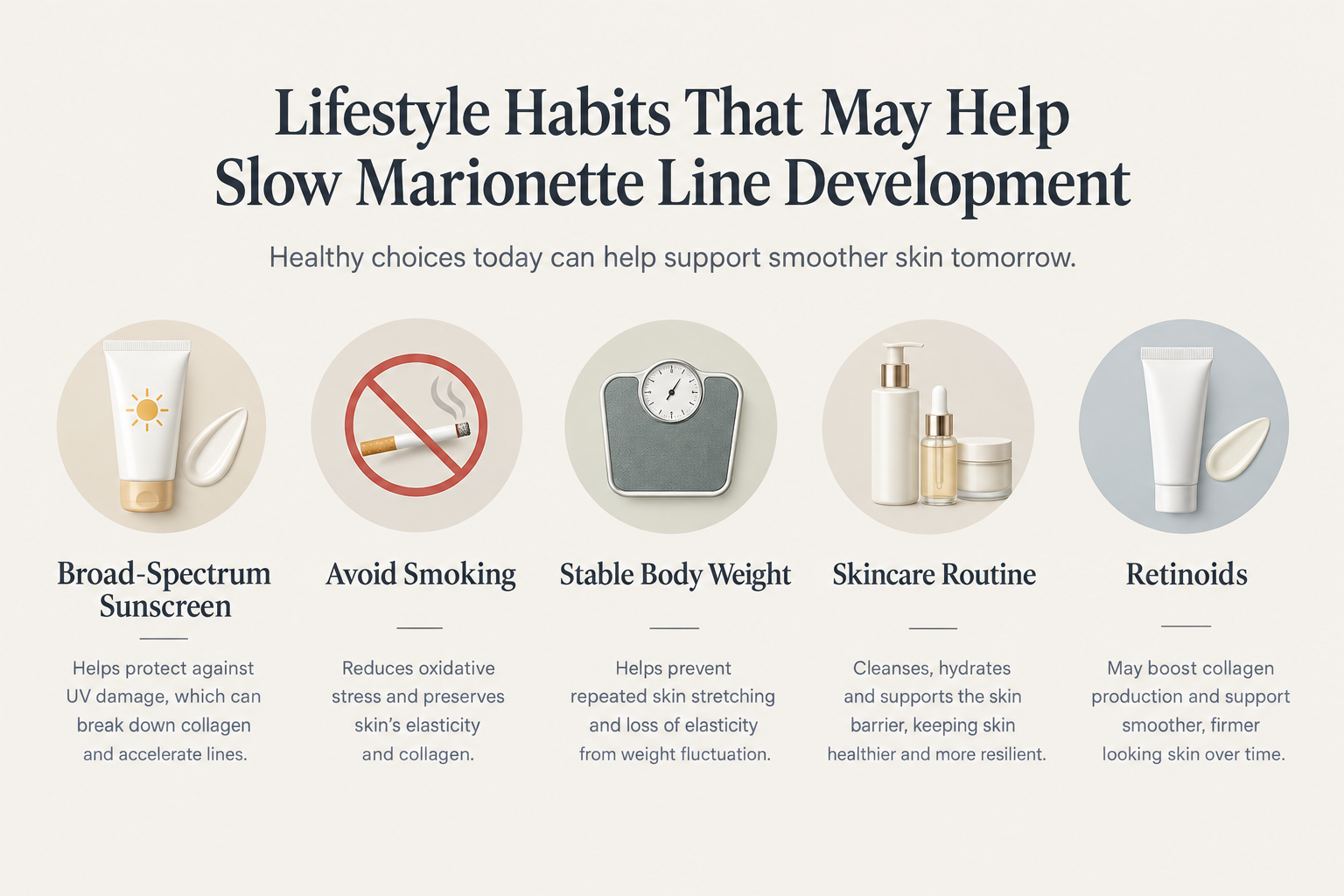
Protecting the skin from environmental stressors such as pollution and excessive alcohol consumption, which can generate oxidative stress and impair collagen synthesis, may also be beneficial. These measures are most effective when started early, before significant structural changes have occurred, but they remain relevant at any age as a way of supporting overall skin health.
Treatment Options for Marionette Lines
When marionette lines become a source of concern, several non-surgical and surgical approaches may be considered. The most appropriate option depends on the depth of the lines, the degree of volume loss and skin laxity present, the individual's anatomy, and their goals and preferences. A thorough assessment by a qualified aesthetic practitioner is essential before any treatment decision is made.
Dermal fillers — typically hyaluronic acid-based products — are commonly used to restore volume in the lower face and soften the appearance of marionette lines by supporting the overlying skin. Botulinum toxin injections targeting the depressor anguli oris muscle may help reduce the downward pull at the corners of the mouth, which can complement volume restoration. Skin-tightening treatments such as radiofrequency, ultrasound-based devices, or collagen-stimulating injectables may be considered for individuals where skin laxity is a significant contributing factor. Surgical options such as a lower face lift address the underlying ligament laxity and tissue descent more directly and may be appropriate for more advanced cases. Each approach carries its own benefits, limitations, risks, and recovery considerations, which should be discussed in detail with a practitioner.
Frequently Asked Questions
Are marionette lines the same as jowls?
Marionette lines and jowls are related but distinct features. Marionette lines are the vertical creases running from the corners of the mouth toward the chin. Jowls refer to the sagging of soft tissue below the jawline on either side of the chin. Both develop as a result of similar underlying changes — ligament laxity, fat descent, and bone resorption — and they often appear together, but they are not the same thing.
Do marionette lines make people look sad or angry?
Because marionette lines pull the corners of the mouth downward, they can give the lower face a downturned appearance that some people associate with sadness or displeasure, even when the person is at rest and not expressing any particular emotion. This is one of the reasons many people seek treatment — not because the lines are medically significant, but because they feel the lines misrepresent their resting expression.
Can facial exercises prevent or reduce marionette lines?
The evidence for facial exercises as a means of preventing or reducing marionette lines is limited and mixed. Some research suggests that targeted facial exercises may help maintain muscle tone and potentially provide modest improvements in facial appearance, but the effect on established marionette lines specifically is not well established. Overworking certain muscles around the mouth could theoretically worsen dynamic creasing in some cases. This is an area where individual assessment is advisable before committing to a specific exercise programme.
At what age should I consider treatment for marionette lines?
There is no universally correct age to consider treatment. The decision depends on when the lines become a personal concern, their depth and impact on appearance, and the individual's overall facial anatomy and skin condition. Some people choose to address early lines in their thirties or forties with preventive or maintenance approaches, while others prefer to wait until the lines are more established. A consultation with a qualified practitioner can help clarify what options may be appropriate at any given stage.
Will losing weight make my marionette lines worse?
Significant weight loss, particularly in later life when skin elasticity is already reduced, can sometimes make marionette lines and other lower facial folds more noticeable. This is because the reduction in facial fat volume removes some of the soft tissue support that helps keep the lower face smooth. The effect varies depending on the amount of weight lost, the individual's age, and their skin quality. Gradual weight loss is generally considered less likely to cause dramatic changes in facial appearance than rapid loss.
Is there a non-invasive way to treat marionette lines effectively?
Several non-surgical options may improve the appearance of marionette lines, including dermal fillers, botulinum toxin, radiofrequency skin tightening, and collagen-stimulating treatments. The effectiveness of these approaches depends on the severity of the lines and the underlying causes. Mild to moderate marionette lines often respond well to non-surgical treatment, while deeper lines with significant skin laxity may require more than one approach or may ultimately be better addressed surgically. Results from non-surgical treatments are temporary and require maintenance.
Understanding Marionette Lines and Deciding on Next Steps
Marionette lines develop as a result of multiple overlapping processes — the gradual loss of collagen and elastin, the redistribution and reduction of facial fat, changes to the underlying bone, ligament laxity, and the cumulative effect of muscle movement on ageing skin. External factors including sun exposure, smoking, and weight fluctuations can accelerate these changes, while genetics and individual anatomy determine much of the baseline susceptibility. Recognising these causes helps set realistic expectations: marionette lines are not a flaw or a failure of skincare, but a predictable consequence of how the face ages over time.
For those who find marionette lines a source of concern, a range of treatment options exists, from non-surgical approaches that can soften their appearance to surgical procedures that address the underlying structural changes more directly. The right approach depends on the individual's specific anatomy, the severity of the lines, and their personal goals. If you are considering treatment, a consultation with a qualified and experienced aesthetic practitioner is the appropriate starting point — they can assess the contributing factors in your case and discuss which options may be realistic and suitable for you.
