
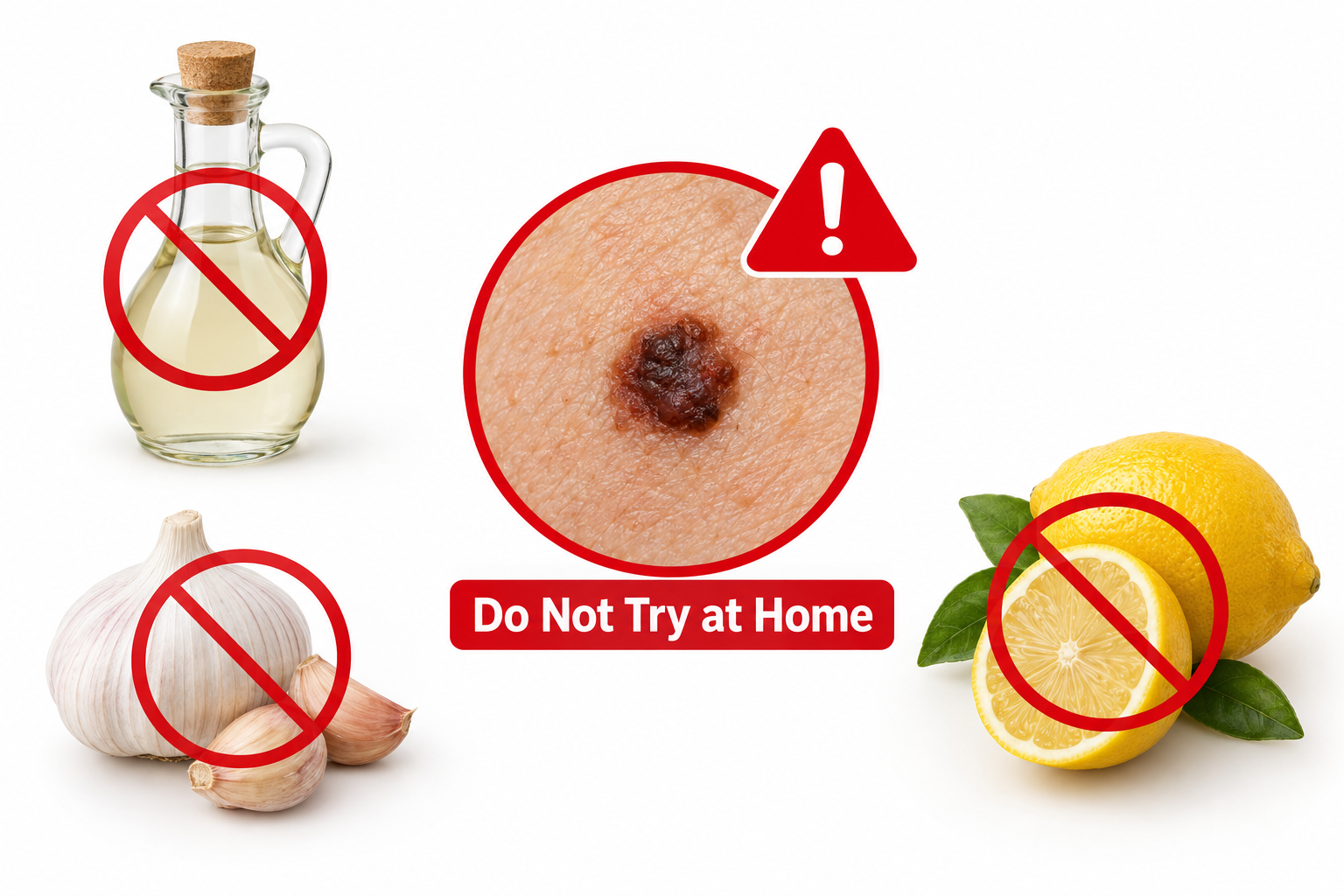

Searches for how to remove moles naturally in a day reflect a genuine desire for a quick, painless, and affordable solution. The reality, however, is that no home remedy, plant extract, or over-the-counter product can safely and effectively remove a mole in a day — or at all. More importantly, attempting to remove a mole at home carries real medical risks, including infection, scarring, and the possibility of missing a skin lesion that requires professional evaluation. This article explains why natural mole removal methods do not work, what the evidence actually shows, and what clinically appropriate options exist for people who want a mole assessed or removed.
Key Takeaways
- No home remedy has been clinically shown to safely or effectively remove a mole. Claims about apple cider vinegar, garlic, castor oil, and similar substances are not supported by dermatological evidence.
- Moles should always be assessed by a qualified clinician before any removal is considered, because some lesions that resemble ordinary moles may require medical investigation.
- Attempting to remove a mole at home can cause infection, permanent scarring, and may destroy tissue that a dermatologist would need to examine.
- Safe, clinically established mole removal methods exist and are performed by trained practitioners using appropriate techniques and, where indicated, histological analysis of the removed tissue.
- Any mole that changes in size, shape, colour, or texture, or that bleeds or itches without explanation, should be reviewed by a doctor promptly rather than treated at home.
What Is a Mole and Why Does It Matter?
A mole, known medically as a melanocytic naevus, is a benign growth formed by clusters of pigment-producing cells called melanocytes. Most people have between 10 and 40 moles, and the majority are entirely harmless. Moles can be flat or raised, smooth or slightly textured, and range in colour from pale tan to dark brown. They may appear anywhere on the body and can develop from childhood through to early adulthood, with some changing gradually over time.
The reason professional assessment matters before any removal attempt is that not every dark or raised skin lesion is a straightforward benign mole. Dysplastic naevi — moles with irregular features — and early melanoma can visually resemble ordinary moles to an untrained eye. A qualified clinician uses dermoscopy, a technique involving a magnifying instrument with polarised light, to examine the internal structure of a lesion before deciding whether removal or monitoring is appropriate. This step cannot be replicated at home, and skipping it in favour of a DIY removal method removes the opportunity to catch a potentially significant lesion at an early, treatable stage.
Common Natural Mole Removal Claims and What the Evidence Shows
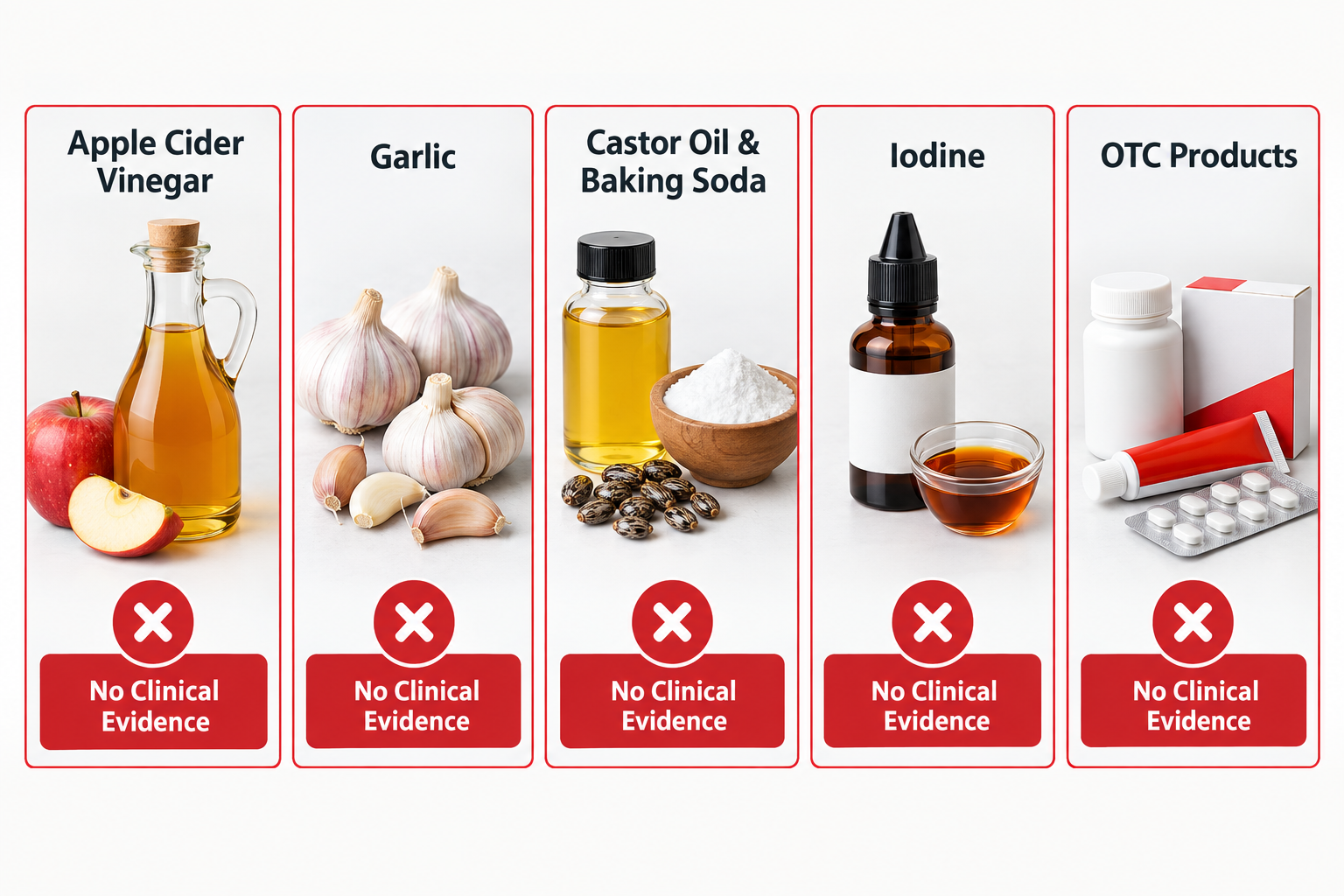
A wide range of substances are promoted online as natural mole removers. These include apple cider vinegar, garlic paste, castor oil mixed with baking soda, iodine, hydrogen peroxide, banana peel, tea tree oil, and various herbal preparations. None of these have been evaluated in rigorous clinical trials for mole removal, and dermatological and medical organisations do not endorse any of them for this purpose.
Apple Cider Vinegar
Apple cider vinegar is one of the most frequently cited home remedies for mole removal. The claim is that its acidity gradually breaks down mole tissue. In practice, applying an acidic substance repeatedly to skin causes chemical irritation and superficial tissue damage to the surrounding skin, not selective removal of melanocytic cells. The result is more likely to be a chemical burn, post-inflammatory hyperpigmentation, or scarring than any meaningful reduction in the mole itself. There is no peer-reviewed evidence supporting apple cider vinegar as a safe or effective mole removal method.
Garlic
Garlic contains allicin, a compound with some antimicrobial properties, and is sometimes suggested as a topical mole treatment. Applying raw garlic to skin is known to cause contact dermatitis and chemical burns even in short exposure periods. Prolonged application to a mole is likely to damage the surrounding healthy skin without selectively affecting the mole tissue. Garlic has no established mechanism for removing melanocytic naevi and no clinical evidence supporting its use for this purpose.
Castor Oil and Baking Soda
This combination is widely described in online forums as a gentle, gradual mole remover. Castor oil is an emollient with no known capacity to alter melanocyte clusters. Baking soda is a mild abrasive and alkaline substance. Neither ingredient has a plausible biochemical mechanism for removing a mole, and no clinical evidence supports this combination for mole removal. Repeated application may cause mild skin irritation without producing any meaningful change to the lesion.
Iodine
Iodine is an antiseptic used in clinical settings for wound care and skin preparation. Some sources suggest applying iodine solution directly to a mole over several weeks. While iodine can cause localised tissue irritation, it does not selectively target melanocytic cells and is not an appropriate or evidence-based method for mole removal. Repeated iodine application to intact skin can cause irritation, staining, and in some cases allergic reactions.
Over-the-Counter Mole Removal Products
Various creams, serums, and pen-style devices are sold commercially with claims of removing moles at home. Regulatory bodies in many countries, including the UK’s Medicines and Healthcare products Regulatory Agency (MHRA) and the US Food and Drug Administration (FDA), have not approved any over-the-counter product for mole removal. Products that use strong acids or caustic agents may cause chemical burns and scarring. Products that use electrical current or heat without clinical calibration carry risks of uncontrolled tissue damage. None of these products allow for the histological examination of removed tissue, which is an important safety step in clinical mole removal.
Why Attempting Home Mole Removal Is Medically Risky
The risks associated with attempting to remove a mole at home go beyond the immediate discomfort of applying an irritating substance. Understanding these risks helps explain why dermatologists and aesthetic practitioners consistently advise against DIY mole removal.
Infection
Breaking or irritating the skin surface — whether through repeated acid application, cutting, or abrasion — creates an entry point for bacteria. Skin infections following amateur mole removal attempts can range from localised cellulitis to more serious complications requiring antibiotic treatment. The face, neck, and areas prone to friction are particularly vulnerable.
Scarring
Uncontrolled tissue damage from caustic substances or physical interference with a mole frequently results in permanent scarring. Clinical mole removal techniques are designed to minimise scarring through precise tissue removal and appropriate wound management. Home methods offer no such precision, and the resulting scar may be more noticeable than the original mole.
Incomplete Removal and Recurrence
Even if a home remedy appears to flatten or darken a mole temporarily, it is unlikely to remove the underlying melanocyte cluster. Partial disruption of a mole can cause it to regrow in an altered form, which may then be more difficult to assess clinically. A mole that has been partially treated at home may also be harder to evaluate with dermoscopy, potentially obscuring features that a clinician would otherwise use to determine whether further investigation is needed.
Delayed Diagnosis of a Significant Lesion
This is arguably the most serious risk. A lesion that appears to be a straightforward mole may, on clinical examination, show features that warrant a biopsy or referral. Attempting to remove such a lesion at home destroys the tissue before it can be properly examined. Early-stage melanoma, for example, is highly treatable when identified and excised promptly. Delayed diagnosis because a lesion was partially destroyed by a home remedy can have serious consequences.
The ABCDE Rule: When to Seek Professional Assessment
Dermatologists use the ABCDE criteria as a practical framework for identifying moles that require professional evaluation. Any mole displaying one or more of these features should be assessed by a qualified clinician rather than treated at home.
- Asymmetry: One half of the mole does not mirror the other.
- Border: The edges are irregular, ragged, notched, or blurred rather than smooth and well-defined.
- Colour: The mole contains multiple shades of brown, black, red, white, or blue rather than a uniform colour.
- Diameter: The lesion is larger than approximately 6 millimetres, roughly the size of a pencil eraser, though smaller lesions can also be significant.
- Evolution: The mole has changed in size, shape, colour, or texture, or has begun to bleed, itch, or crust without an obvious cause.
These criteria are a guide rather than a diagnostic tool, and a clinician’s assessment using dermoscopy provides considerably more information than a visual check alone. If there is any doubt about a lesion, professional evaluation is always the appropriate first step.
Clinically Established Mole Removal Methods
For people who want a mole removed for cosmetic reasons, or for those whose clinician has determined that removal is appropriate, several well-established clinical techniques are available. The choice of method depends on the size, depth, and location of the mole, as well as whether histological examination of the removed tissue is required.
Surgical Excision
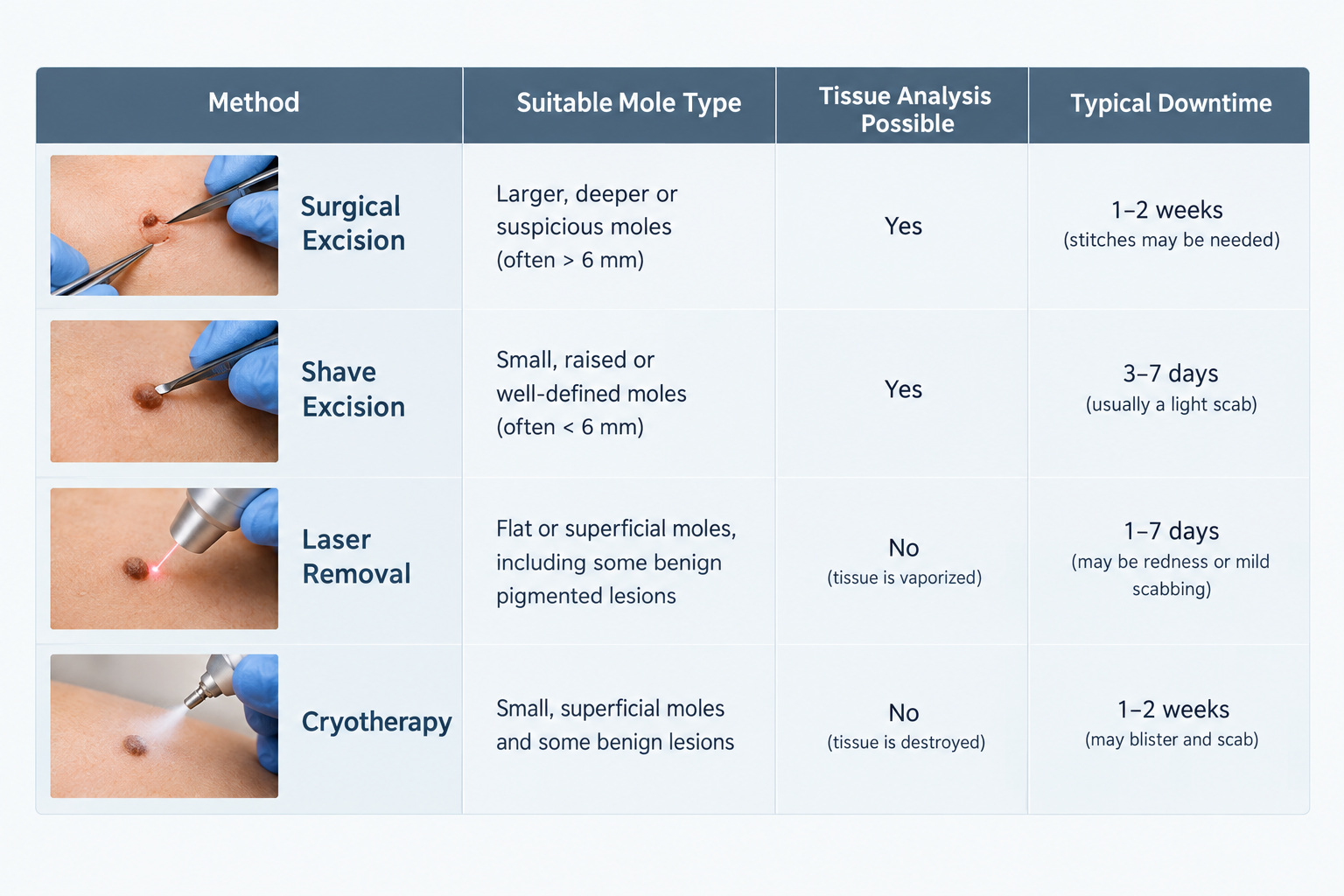
Surgical excision involves removing the mole and a small margin of surrounding tissue using a scalpel, followed by suturing the wound. This method is suitable for moles of most sizes and allows the removed tissue to be sent for histological analysis — examination under a microscope by a pathologist. Histological analysis is an important safety step because it confirms whether the lesion was entirely benign or whether any further treatment is needed. Surgical excision typically leaves a fine linear scar, the appearance of which depends on the location, the size of the mole, and individual healing characteristics.
Shave Excision
Shave excision uses a surgical blade to remove a raised mole flush with or just below the skin surface without the need for sutures. This technique is commonly used for benign raised moles and tends to leave a smaller, less noticeable mark than full excision. The removed tissue can still be sent for histological analysis. Shave excision is generally not appropriate for flat moles or for lesions where deeper removal is clinically indicated.
Laser Removal
Laser mole removal uses targeted light energy to break down pigmented cells within the mole. It is typically suitable for small, flat, benign moles and is not generally recommended for raised moles or for any lesion that has not been thoroughly assessed clinically. A significant limitation of laser removal is that it destroys the tissue, meaning histological analysis is not possible. For this reason, laser removal is only appropriate when a clinician has already confirmed that the lesion is benign and does not require further investigation. Results can vary depending on mole depth and skin type.
Cryotherapy
Cryotherapy uses liquid nitrogen to freeze and destroy mole tissue. It is more commonly used for other benign skin lesions such as warts and seborrhoeic keratoses than for melanocytic naevi. Like laser removal, cryotherapy does not allow for tissue analysis, and its use for mole removal is generally limited to specific clinical contexts where a benign diagnosis has already been established.
Radiofrequency and Electrosurgery
Radiofrequency ablation and electrosurgery use controlled electrical energy to remove raised benign skin lesions. These techniques are used in some aesthetic and dermatology clinics for cosmetic mole removal and can produce good cosmetic outcomes for appropriate lesions. As with laser and cryotherapy, tissue is not preserved for histological analysis, so prior clinical assessment is essential.
What to Expect from a Clinical Mole Assessment and Removal
A clinical mole assessment typically begins with a consultation in which the practitioner takes a brief medical history and examines the mole, usually with a dermatoscope. The clinician will assess whether the mole appears benign, whether it has any features that warrant further investigation or referral, and whether removal is appropriate and by which method.
If removal proceeds, the area is cleaned and a local anaesthetic is injected to numb the skin. The removal itself is usually brief and should not be painful, though some pressure or mild discomfort may be felt. Depending on the technique used, the wound may be left to heal naturally, dressed, or sutured. Most people can return to normal activities the same day, though the treated area should be kept clean and protected from sun exposure during healing. Healing time varies from a few days to a few weeks depending on the method and the size of the mole removed.
If the removed tissue is sent for histological analysis, results are typically available within one to two weeks. The clinician will contact the patient if any further action is needed based on the pathology report.
Frequently Asked Questions
Can apple cider vinegar really remove a mole?
No. Apple cider vinegar is an acidic liquid that can irritate and chemically burn the skin surface, but it has no clinically demonstrated ability to remove melanocytic naevi. Applying it to a mole is more likely to cause a chemical burn, scarring, or skin discolouration than to remove the mole. There is no peer-reviewed clinical evidence supporting its use for this purpose.
Is it safe to cut off a mole at home?
No. Cutting or shaving a mole at home carries serious risks including significant bleeding, infection, and permanent scarring. It also destroys tissue that a clinician might need to examine. Clinical shave excision is a controlled procedure performed under local anaesthesia with sterile instruments by a trained practitioner — it is not something that can be safely replicated at home.
How quickly can a mole be removed at a clinic?
The removal procedure itself is often completed within a single appointment, which may last between 15 and 45 minutes depending on the technique and the number of moles being treated. However, a clinical assessment should always precede removal, and this may take place at the same appointment or a separate one depending on the clinic’s protocol.
Will mole removal leave a scar?
All mole removal methods carry some risk of scarring, though the extent varies considerably depending on the technique, the size and depth of the mole, its location on the body, and individual healing characteristics. Surgical excision typically leaves a fine linear scar. Shave excision and laser removal generally leave smaller marks. A clinician can discuss realistic expectations for scarring before treatment.
Do I need a GP referral to have a mole removed at a private clinic?
In many countries, a GP referral is not required to attend a private dermatology or aesthetic clinic for mole assessment and removal. However, if a clinician at a private clinic identifies any features of concern during assessment, they should refer the patient to an appropriate specialist or NHS dermatology service. It is always reasonable to ask a GP to assess a mole first, particularly if it has changed or is causing concern.
Can all moles be removed with laser?
No. Laser mole removal is generally suitable only for small, flat, superficial, and confirmed benign moles. It is not appropriate for raised moles, deeply pigmented moles, or any lesion that has not been thoroughly assessed. Because laser destroys tissue, it does not allow for histological analysis, which is an important safety consideration for any lesion that has not been definitively confirmed as benign.
What should I do if a mole changes suddenly?
Any mole that changes in size, shape, colour, or texture, or that begins to bleed, itch, or crust without an obvious cause, should be assessed by a qualified clinician promptly. Do not attempt to treat or remove a changing mole at home. Rapid change in a mole is one of the features that warrants professional evaluation to rule out a lesion requiring medical attention.
What to Do Instead of Trying Natural Mole Removal
If a mole is bothering you cosmetically, or if you have noticed any change in a mole’s appearance, the appropriate first step is a professional assessment rather than a home remedy. A qualified clinician — whether a GP, dermatologist, or trained aesthetic practitioner with appropriate mole assessment credentials — can examine the lesion properly, advise whether removal is suitable, and explain which method is most appropriate for your specific mole and skin type.
Cosmetic mole removal at a reputable clinic is generally straightforward for confirmed benign lesions, and the procedures available today can achieve good cosmetic outcomes with minimal downtime. The key difference between clinical removal and any home method is not just safety — it is also the assurance that the lesion has been properly evaluated before treatment, and that the tissue can be examined afterwards if needed. No home remedy offers either of these safeguards, regardless of how it is described online.
If cost is a concern, it is worth noting that some moles may be removed on the NHS if a GP considers them clinically significant. For cosmetic removal, prices at private clinics vary depending on the method and the number of moles treated, and many clinics offer an initial assessment appointment to discuss options before any commitment to treatment.
