
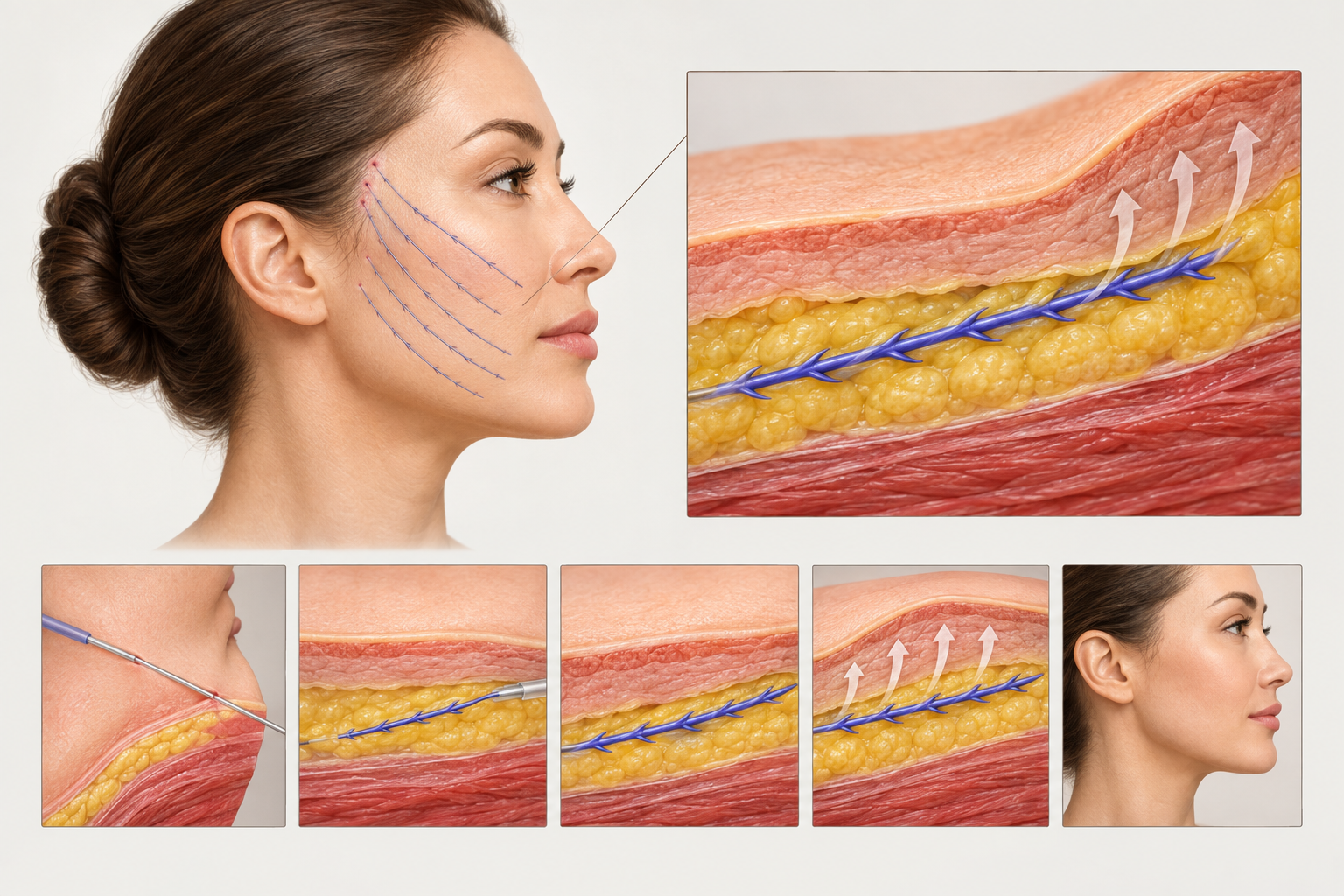

A threading face lift is a minimally invasive procedure that uses dissolvable sutures inserted beneath the skin to lift and reposition sagging facial tissue. Interest in thread lift treatments has grown considerably as patients look for alternatives to surgical face lifting that involve less downtime and lower procedural risk. Understanding what thread lifts can and cannot achieve is essential before deciding whether this approach is worth discussing with a qualified practitioner.
Key Takeaways
- A threading face lift uses temporary dissolvable sutures to mechanically lift sagging skin and stimulate collagen production, producing results that typically last between one and two years.
- Thread lifts are generally best suited to patients with mild to moderate facial laxity, not those with significant skin sagging who may achieve more durable correction through surgical face lifting.
- Results are visible relatively quickly but are more subtle than surgical outcomes; realistic expectations are important before proceeding.
- Risks exist and include thread migration, puckering, infection, and asymmetry; choosing an experienced, medically qualified practitioner significantly influences safety and outcome.
- Thread lift treatment is not a permanent solution and maintenance or repeat procedures may be needed to sustain the effect.
What Is a Threading Face Lift?
A threading face lift, also referred to as a thread lift or PDO thread lift, involves inserting fine sutures made from biocompatible materials into the deeper layers of facial tissue through small entry points in the skin. The threads are then gently tensioned to reposition descended tissue, creating a lifting effect in areas such as the midface, jowls, brows, and neck. Unlike a surgical face lift, no skin is excised and no general anaesthesia is required, making it a procedure typically performed in a clinic setting under local anaesthesia.
The most widely used thread material in aesthetic practice is polydioxanone, commonly abbreviated as PDO. PDO is a synthetic absorbable polymer that has been used in surgical sutures for decades. Other thread materials used in aesthetic thread lifting include polylactic acid (PLLA) and polycaprolactone (PCL), which differ in their absorption timelines and the duration of their collagen-stimulating effects. The choice of thread type, thread design, and insertion technique varies between practitioners and is tailored to the individual patient’s anatomy and treatment goals.
How Does a Thread Lift Work?
Thread lift effectiveness relies on two distinct mechanisms working together. The first is a mechanical lifting effect: barbed or coned threads grip the subcutaneous tissue and, when tensioned, physically reposition it to a higher position on the face. This provides an immediate visible improvement in contour that is apparent shortly after the procedure.
The second mechanism is biological. As the body recognises the inserted threads as a foreign material, it initiates a controlled healing response. This response stimulates fibroblast activity and the production of new collagen around the threads. Over the weeks and months following treatment, this neocollagenesis contributes to improved skin firmness and texture in the treated area. Because the threads themselves gradually dissolve, the longevity of the result depends substantially on how much collagen the body has produced during this period. This is why results may continue to develop for several months after the initial procedure and why individual outcomes vary considerably depending on age, skin quality, and the body’s healing capacity.
What Areas Can a Threading Face Lift Treat?
Thread lift procedures can be applied to several areas of the face and neck, though the degree of improvement achievable varies by location and the extent of tissue laxity present.
- Midface and cheeks: Lifting descended cheek tissue to restore a more youthful midface contour is one of the most common applications. Thread lifting in this area may reduce the appearance of nasolabial folds by repositioning the overlying soft tissue.
- Jowls and lower face: Threads placed along the jawline can improve early jowling and help define the mandibular border, though significant jowl laxity may not respond adequately to thread lifting alone.
- Brow and forehead: Brow thread lifting can elevate a descended lateral or medial brow, which may also improve the appearance of upper eyelid heaviness in some patients.
- Neck: Threads can be used to address mild neck laxity and early platysmal banding, though the neck is technically more challenging and results may be more limited than in the midface.
- Skin quality: Smooth, non-barbed PDO threads are sometimes used in a mesh pattern to improve skin texture, fine lines, and overall skin quality rather than to achieve a lifting effect. This application is distinct from a structural thread lift.
How Effective Is a Threading Face Lift?
The effectiveness of a threading face lift depends on several factors, including the patient’s baseline skin laxity, the thread type and technique used, and the practitioner’s experience. Clinical studies and published case series generally report that thread lifts produce a meaningful but modest improvement in facial contour, particularly in patients with mild to moderate tissue descent. The procedure is not equivalent to a surgical face lift in terms of the degree of correction achievable or the durability of results.
Published evidence on thread lift outcomes is growing but remains heterogeneous. Studies vary in the thread materials evaluated, the outcome measures used, and the follow-up periods reported. A number of clinical assessments have documented measurable improvements in facial contour, patient satisfaction, and photographic grading at three to six months post-procedure. However, systematic reviews have noted that the overall quality of evidence is still developing, with many studies being small, uncontrolled, or of short follow-up duration. Patients should be aware that the evidence base, while encouraging, does not yet match the volume and rigour of evidence available for surgical face lifting.
In practical terms, a threading face lift tends to work best when the goal is a subtle, natural-looking improvement rather than a dramatic transformation. Patients who are not ready for or do not wish to undergo surgery, and who have realistic expectations about the degree of change achievable, are generally the most satisfied with thread lift outcomes. Those seeking correction of significant skin excess or deep structural changes are unlikely to achieve their goals through thread lifting alone.
How Long Do Thread Lift Results Last?
Thread lift results are temporary. The mechanical lifting effect begins to diminish as the threads dissolve, and the collagen stimulated during the healing process gradually remodels over time. Most practitioners and published literature suggest that results from a PDO thread lift typically last between one and two years, though this range varies depending on the thread material used, the number of threads placed, the treatment area, and individual patient factors such as age, skin quality, and lifestyle.
Polycaprolactone threads, which absorb more slowly than PDO, may offer a somewhat longer duration of effect, with some practitioners reporting results lasting up to two years or beyond. Polylactic acid threads stimulate a prolonged collagen response and may also extend the visible benefit. However, these differences in longevity are not universally established in high-quality comparative studies, and individual variation remains significant.
Maintenance treatments are generally required to sustain the effect. Some patients choose to repeat thread lift procedures at intervals, while others transition to surgical options if their degree of laxity progresses beyond what thread lifting can adequately address. Combining thread lifting with complementary non-surgical treatments such as injectable skin boosters, dermal fillers, or energy-based skin tightening devices may help prolong the overall aesthetic result, though this should be discussed with a qualified practitioner on an individual basis.
What Happens During a Thread Lift Appointment?
A thread lift procedure typically begins with a thorough consultation to assess facial anatomy, skin laxity, and suitability. The practitioner will discuss the patient’s goals, explain the procedure, and outline realistic expectations before any treatment is agreed upon.
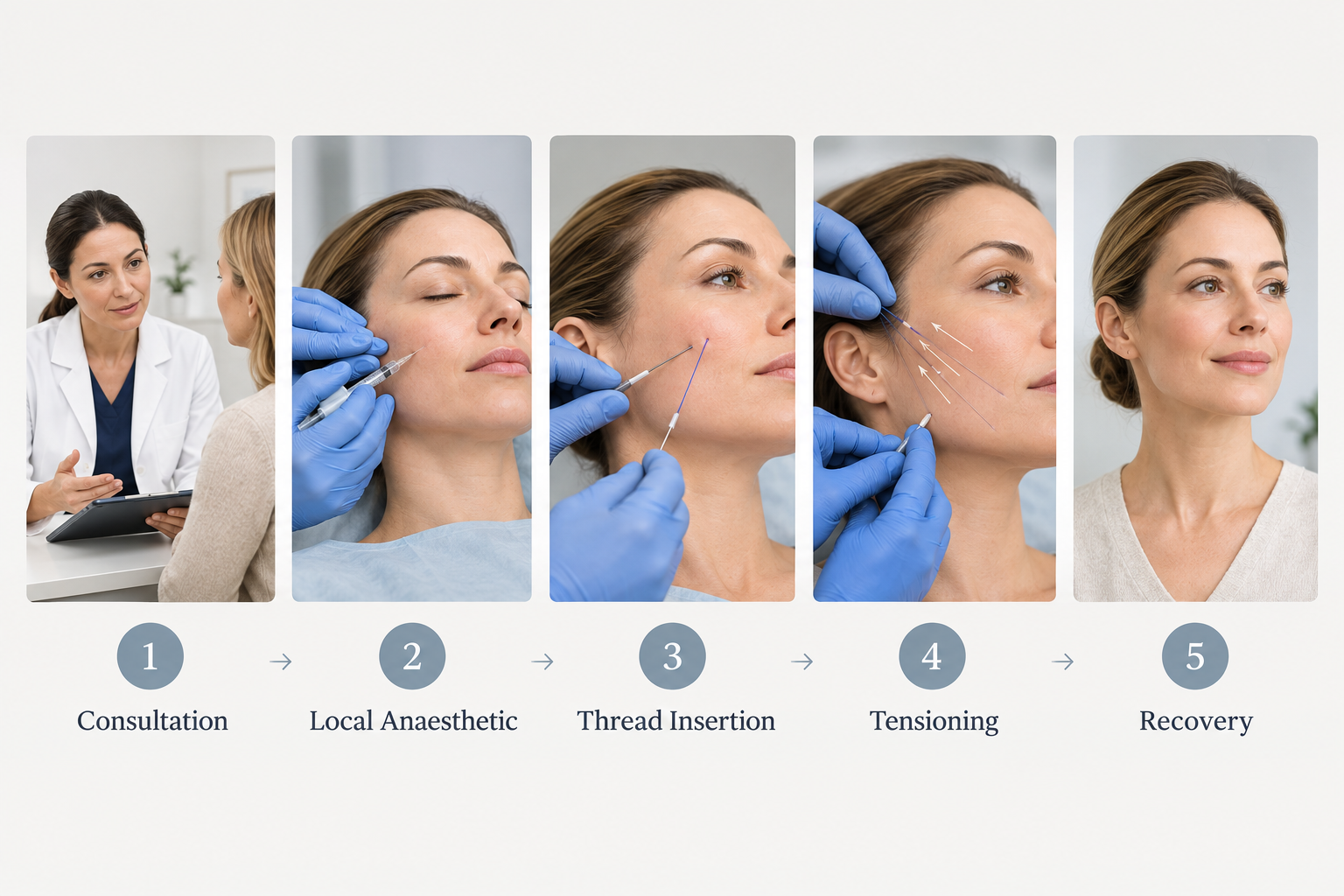
On the day of treatment, the skin is cleansed and local anaesthetic is applied to the entry points and along the planned thread pathways to minimise discomfort. The practitioner uses a fine needle or cannula to insert the threads beneath the skin at the appropriate depth. Once positioned, the threads are tensioned to achieve the desired lift and any excess is trimmed. The entry points are small and generally do not require sutures themselves.
The procedure typically takes between 45 minutes and 90 minutes depending on the number of areas treated and the complexity of the technique. Most patients can return home the same day. Some immediate swelling, bruising, and mild discomfort are expected and are a normal part of the early recovery period.
Recovery and Downtime After a Threading Face Lift
One of the frequently cited advantages of a threading face lift over surgical face lifting is the comparatively shorter recovery period. Most patients experience swelling, bruising, and tenderness in the treated areas for approximately one to two weeks following the procedure. Some patients notice a slight puckering or dimpling of the skin at the thread entry points or along the thread pathway in the early post-treatment period; this usually resolves as the tissue settles around the threads.
Practitioners typically advise patients to avoid strenuous exercise, sleeping on the treated side, and significant facial movements such as wide mouth opening for a period of one to two weeks after treatment. Dental appointments and facial massage are usually deferred for a similar period. These precautions help reduce the risk of thread displacement during the early healing phase.
While downtime is less than that associated with surgical face lifting, it is not negligible. Patients should plan for some social downtime, particularly if bruising is visible, and should follow their practitioner’s specific aftercare instructions carefully to support optimal healing and reduce complication risk.
Risks and Side Effects of Thread Lifting
Thread lift procedures carry a range of potential risks and side effects that patients should understand before proceeding. While serious complications are not common when the procedure is performed by an experienced, medically qualified practitioner, they can occur and some may require intervention.
- Bruising and swelling: These are the most common side effects and are expected in the early recovery period. They typically resolve within one to two weeks.
- Skin puckering or dimpling: Temporary surface irregularities along the thread pathway are relatively common and usually resolve as the tissue adapts. Persistent puckering may occasionally require intervention.
- Thread migration or extrusion: In some cases, threads may shift from their intended position or, less commonly, become visible or palpable beneath the skin. This may require removal or repositioning.
- Infection: As with any procedure that breaches the skin, infection is a risk. Signs of infection including increasing redness, warmth, swelling, or discharge should be reported to the treating practitioner promptly.
- Asymmetry: Uneven lifting or asymmetric results can occur and may be difficult to fully correct without removing or adjusting threads.
- Nerve or vessel injury: Although uncommon, injury to superficial nerves or blood vessels is possible and underscores the importance of practitioner expertise and thorough anatomical knowledge.
- Granuloma formation: A localised inflammatory reaction around the thread material can occasionally occur, presenting as a firm nodule beneath the skin.
The risk profile of thread lifting is generally considered lower than that of surgical face lifting, but it is not risk-free. Patients should receive a thorough pre-treatment assessment and should disclose their full medical history, including any blood-thinning medications, autoimmune conditions, active skin infections, or previous facial procedures, to allow the practitioner to assess suitability and minimise risk.
Who May Be a Suitable Candidate for a Thread Lift?
Thread lift treatment tends to produce the most satisfying outcomes in patients who fall within a specific range of facial ageing. Ideal candidates are generally adults, often in their late thirties to mid-fifties, who have begun to notice mild to moderate facial sagging but retain reasonable skin elasticity and adequate soft tissue volume. Patients in this group are likely to see a meaningful improvement in facial contour without requiring the more extensive correction that surgical face lifting provides.
Patients who may be less suitable for thread lifting include those with significant skin laxity or excess, very thin or fragile skin, active skin infections or inflammatory conditions in the treatment area, a history of keloid scarring, or certain autoimmune conditions. Patients who are pregnant or breastfeeding are generally advised to defer elective aesthetic procedures. Those taking anticoagulant medications may face an elevated risk of bruising and bleeding and should discuss this with their practitioner before proceeding.
A thorough in-person consultation with a qualified medical practitioner is essential to determine individual suitability. Photographs, facial assessment, and a detailed discussion of goals and expectations form the basis of an appropriate treatment plan.
Thread Lift vs Surgical Face Lift: Key Differences
Understanding the distinction between a threading face lift and a surgical face lift helps patients make an informed decision about which approach may be appropriate for their degree of facial ageing and their personal priorities.
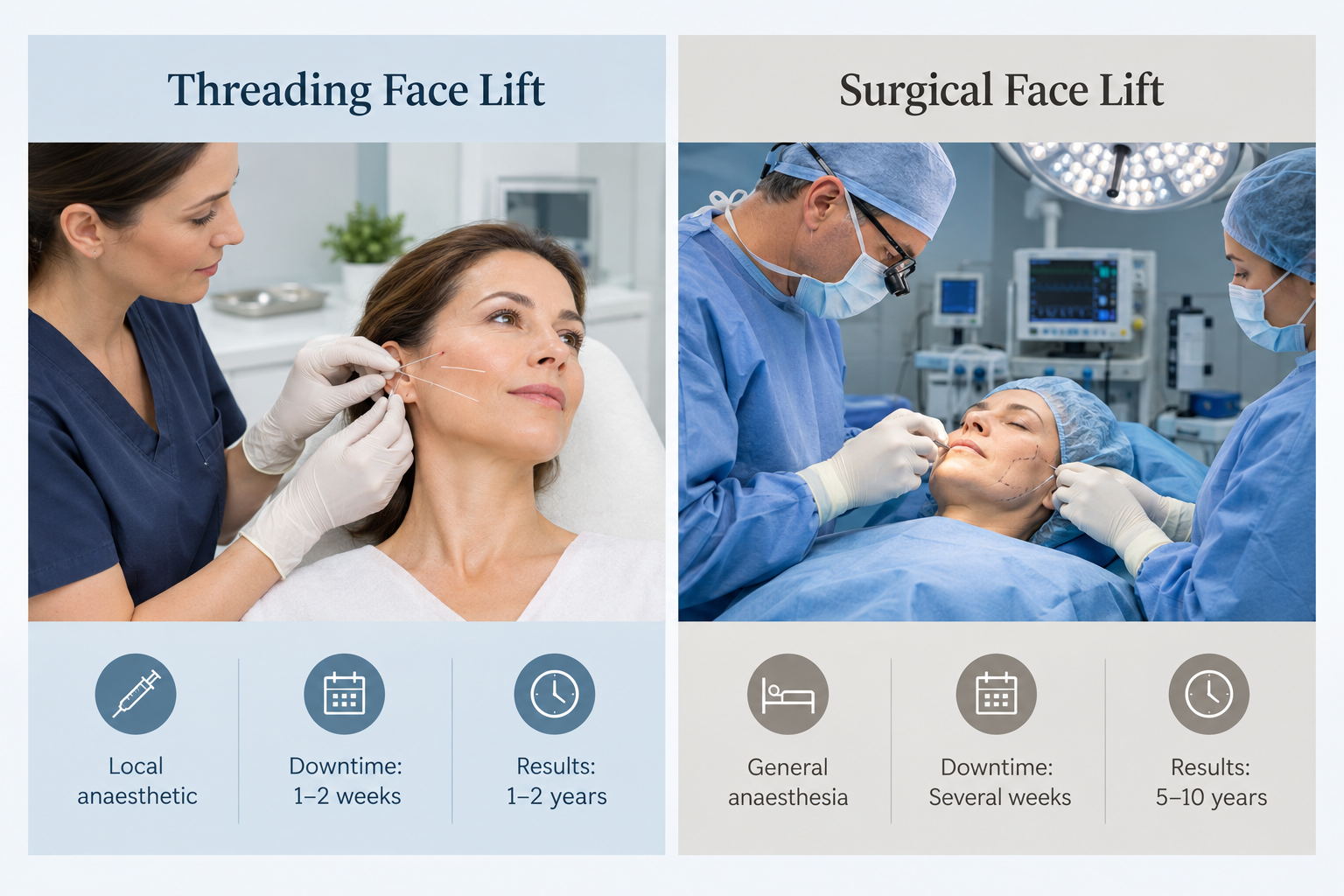
| Characteristic | Threading Face Lift | Surgical Face Lift |
|---|---|---|
| Procedure type | Minimally invasive, in-clinic | Surgical, operating theatre |
| Anaesthesia | Local anaesthetic | General or sedation anaesthesia |
| Degree of correction | Mild to moderate laxity | Moderate to significant laxity |
| Downtime | Approximately 1–2 weeks | Several weeks to months |
| Results onset | Immediate, improving over months | Visible after swelling resolves |
| Longevity | Approximately 1–2 years | 5–10 years or longer |
| Risk profile | Lower than surgery, not risk-free | Higher procedural risk |
| Reversibility | Threads dissolve; limited reversibility | Permanent structural changes |
| Maintenance | Repeat procedures likely needed | Less frequent revision required |
A surgical face lift remains the most effective intervention for significant facial sagging and provides the most durable structural correction. A threading face lift offers a less invasive option with a shorter recovery period and lower procedural risk, but with more modest and temporary results. Neither approach is universally superior; the appropriate choice depends on the individual patient’s anatomy, degree of laxity, health status, lifestyle, and goals.
Non-Surgical Alternatives to Thread Lifting
Patients exploring facial rejuvenation without surgery have several non-surgical options that may be considered alongside or instead of thread lifting, depending on their specific concerns.
High-intensity focused ultrasound (HIFU) uses focused ultrasound energy to heat tissue at precise depths, stimulating collagen production and producing a gradual tightening effect. HIFU targets the superficial musculoaponeurotic system (SMAS), the same tissue layer addressed in surgical face lifting, and may be suitable for patients with mild to moderate laxity who prefer a non-invasive approach with no needles and no downtime.
Radiofrequency (RF) skin tightening delivers controlled thermal energy to the dermis and deeper tissue to stimulate collagen remodelling. RF treatments are available in various forms, including monopolar, bipolar, and microneedling radiofrequency devices. Results develop gradually and multiple sessions are typically required.
Dermal fillers can restore lost facial volume and improve contour in areas such as the cheeks, temples, and jawline. While fillers do not lift tissue in the same mechanical way as threads, strategic volumisation can create a rejuvenated appearance and may complement thread lifting in a combined treatment plan.
Botulinum toxin injections can address dynamic lines and, in specific applications such as the brow or lower face, may produce a subtle lifting effect by relaxing muscles that contribute to tissue descent.
The most appropriate non-surgical approach depends on the patient’s primary concern, skin quality, degree of laxity, and treatment goals. A qualified practitioner can help determine which option or combination of options is most likely to achieve a meaningful result.
Frequently Asked Questions
How soon will I see results after a threading face lift?
An immediate improvement in facial contour is usually visible after the procedure, though initial swelling may temporarily obscure the final result. As swelling resolves over the first one to two weeks, the lifting effect becomes clearer. The collagen-stimulating response continues to develop over the following two to three months, meaning the full result may not be apparent until several months after treatment.
Is a thread lift painful?
Local anaesthetic is used to minimise discomfort during the procedure. Most patients describe the experience as tolerable, with some pressure or mild discomfort during thread insertion. Post-procedure soreness, tenderness, and tightness in the treated areas are common for several days and are managed with over-the-counter pain relief in most cases.
Can thread lifts be combined with other treatments?
Thread lifting is frequently combined with complementary treatments such as dermal fillers, botulinum toxin, skin boosters, or energy-based devices to address multiple aspects of facial ageing simultaneously. Combining treatments should be planned carefully by an experienced practitioner to avoid overtreatment and to sequence procedures appropriately for safety and optimal results.
What happens when the threads dissolve?
As the threads gradually dissolve, the mechanical lifting effect diminishes. However, the collagen produced during the healing response remains in the tissue and continues to provide some degree of skin firmness and support. The overall result fades gradually rather than disappearing suddenly, and many patients choose to repeat the procedure to maintain their result.
Are thread lifts suitable for all skin types?
Thread lifts can be performed across a range of skin types, but suitability depends more on skin quality, degree of laxity, and individual anatomy than on skin tone alone. Very thin or fragile skin may be more prone to thread visibility or puckering. A thorough assessment by a qualified practitioner is necessary to determine whether thread lifting is appropriate for an individual patient.
How do I choose a practitioner for a thread lift?
Thread lift procedures should be performed by a medically qualified practitioner with specific training and demonstrable experience in thread lifting techniques. Relevant qualifications, a portfolio of outcomes, a thorough consultation process, and clear communication about risks and realistic expectations are all important factors when selecting a provider. Avoid choosing a practitioner based on price alone, as technique and experience significantly influence both safety and outcome.
Is a Threading Face Lift Worth Considering for You?
A threading face lift can be an effective option for patients with mild to moderate facial laxity who are seeking a meaningful but subtle improvement in facial contour without undergoing surgery. The procedure offers a shorter recovery period and a lower procedural risk than surgical face lifting, and the dual mechanism of mechanical lifting and collagen stimulation means that results can continue to develop for several months after treatment.
The limitations are equally important to understand. Thread lift results are temporary, typically lasting one to two years, and the degree of correction achievable is modest compared to surgical alternatives. Patients with significant skin sagging, poor skin elasticity, or expectations of a dramatic transformation are unlikely to be well served by thread lifting alone. The evidence base, while growing, is still developing in terms of long-term outcome data and comparative effectiveness.
For patients who fall within the appropriate candidate profile and who approach the procedure with realistic expectations, a threading face lift may offer a worthwhile non-surgical option for facial rejuvenation. A detailed consultation with a qualified and experienced medical practitioner is the essential first step to determine whether thread lifting is appropriate for your individual anatomy, concerns, and goals.
